

Koech K Mathew
4.2K posts

Koech K Mathew
@KoechKM
Nephrologist. Activist. On the front-line fighting against kidney disease, HIV and injustice.
Eldoret, Kenya Katılım Mart 2009
2.7K Takip Edilen6.1K Takipçiler

Since 1972, only two players have ever won three consecutive DP World Tour events: Sir Nick Faldo and the late, great Seve Ballesteros.
Casey Jarvis has a chance to join the duo with victory this week.
#JoburgOpen
English
Koech K Mathew retweetledi


Koech K Mathew retweetledi
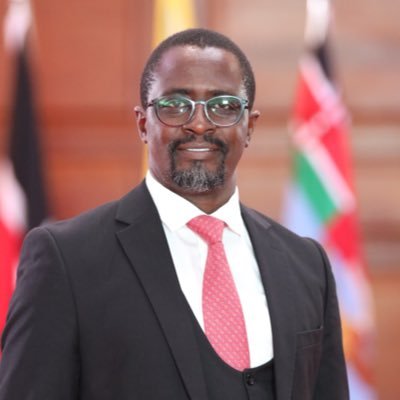
At exactly 6am on 20th August 2019, four people entered a brand new studio and started a journey along an uncharted path.
When I switched on the four microphones that morning I was excited at launching yet another station, but I also had butterflies in my stomach; would this work? Would the audience embrace four hours of non-stop talk during their busy morning commute?
The four of us with CT Muga, Ndu Okoh and Njeri Thorne took on the new assignment with dedication and a true belief that we could do it. Outside of that studio was our producer Brian Evusa, the Programmes Controller Brian Obara and, although he wasn’t in the studio, the Radio General Manager Tom Japanni was present.
It has been a great journey building The Situation Room to what it has become and we have very many people to thank, not least the team of producers, marketing, commercial, technical and other colleagues.
The Situation Room has become the home of Kenya’s Biggest Conversations and it continues to host many thought leaders, community influencers, different professionals and duty bearers.
The biggest part of this show has been the audience who tune in on radio, Tv or digital platforms. It’s humbling whenever people reach out on calls, text or approach us with compliments, comments and suggestions for the show.
On this 6th day of January 2025, my heart is heavy as I bid kwaheri to the brilliant team of colleagues at Spice FM and the Standard Group. I am grateful for the opportunity to once again be a part of Kenya’s oldest private media house and I am proud of the teams that I leave behind in radio, TV and print.
I love the thrill of creating and starting new things and I have been blessed to do just that. I was privileged to be there at the launch of Kenya’s first 24hr religious media house - Family FM and Family TV, the first 24hrs vernacular radio station - Kameme FM and the first 24hr news and information TV station - K24.
Is there room for something new? Of course, always, and I sure hope to be a part of it soon. Wish me luck, I will keep you posted.
English
Congratulations @JustinThomas34 for the T2 at the Zoho Championship. I know it could have been better but this is a step in the right direction.
All the best going forward.
English
#PresidentsCup The Internationals came to play today! Go go go!
English
Koech K Mathew retweetledi

President @WilliamsRuto, thanks for making time this afternoon to answer difficult questions and to engage. This is progress. Now we wait and hope you will act decisively on the issues raised.
English
Koech K Mathew retweetledi

I see you all digging into my past posts where I supported the current President when he was Deputy. Yes, that was me then, and I'm still the same person today. I just lost trust and faith in him. He's the opposite of what I thought, and he proves it daily with his actions.
English
Koech K Mathew retweetledi

Been attending the #ISNWCN including most recently in-person at Melbourne Australia 🇦🇺 and Bangkok Thailand 🇹🇭 Unfortunately this time round I won’t be traveling to Buenos Aires Argentina for WCN’24 due to logistical and scheduling reasons coming off my 3-year sabbatical, but nonetheless I have my abstract for presentation as e-poster which is also published in the current issue of Kidney International Reports. Will also be participating virtually in the ISN Africa Regional Board meeting where I represent renal pathology. Wishing all my colleagues at @ISNWCN an enjoyable educative and networking meeting.


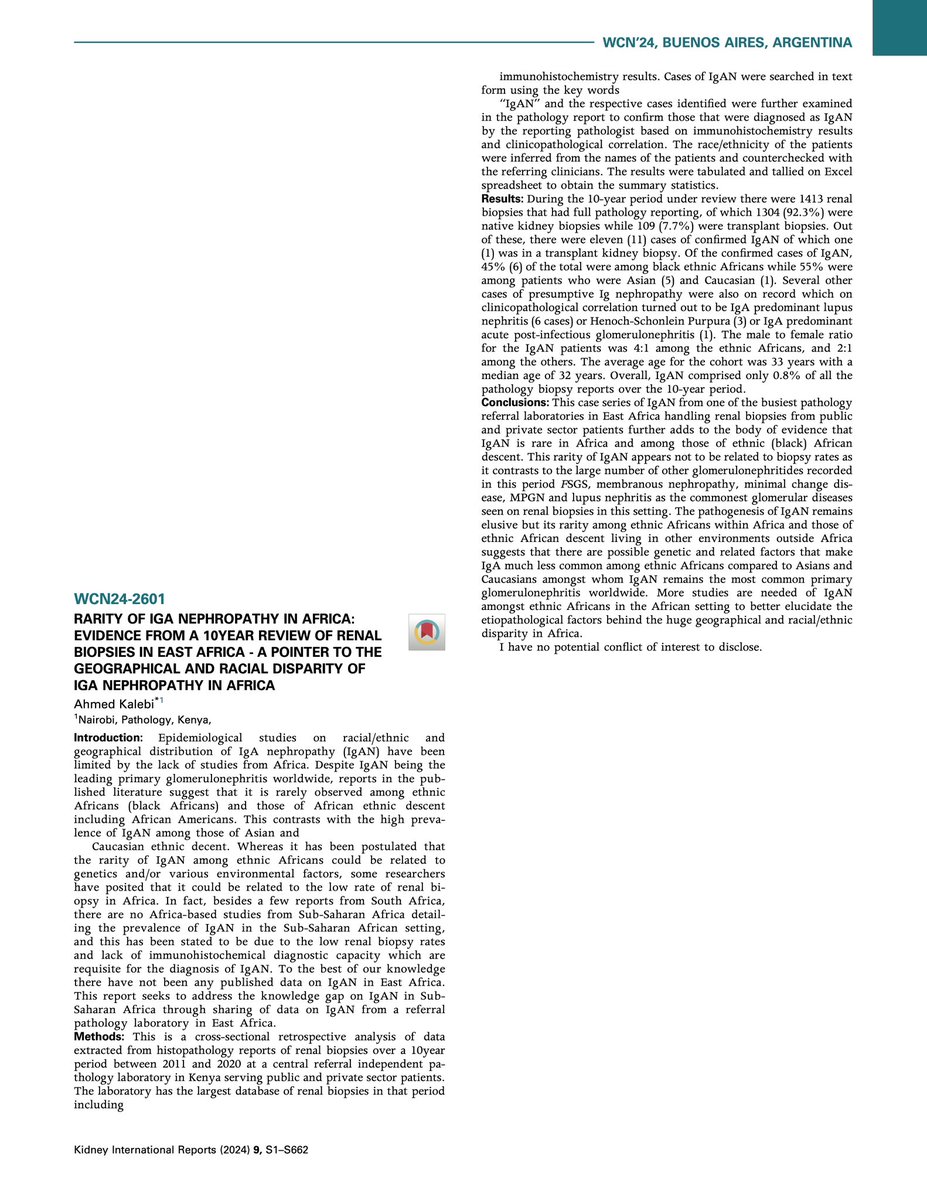
Nairobi, Kenya 🇰🇪 English
We recently reviewed the policy on organ donation and transplantation set in motion by the Government of Kenya. It has set us on a path to progress. There are some things that need to be done to get things even better. Read it here: journals.lww.com/transplantjour…
English
Koech K Mathew retweetledi

Three things I will not be party to, defend or take collective responsibility for.
1. Lies, and taking the public for fools
2. Corruption
3. Vomiting on the peoples shoes
English
@BIOVentures @GlenMcGugan Thank you very much for this. Unfortunately, I missed yesterday’s session. I have since registered for subsequent sessions. Is it possible to get yesterday’s recording?
English

Monday (November 13) is the launch of our free Introduction to Grant Writing Digital Course! This week: Finding Suitable Funding Opportunities and Writing your CV taught by Dr. Glen McGugan. @GlenMcGugan
Register here: us06web.zoom.us/webinar/regist…

English
Koech K Mathew retweetledi

Kenya’s looming problem that is bigger than our debt and corruption.
Three major drivers of an economy are capital allocation, energy availability and consumption and population age demographics. Sadly, in Kenya there is not much discussion on population demographics as a major factor in government development planning.
Let me break down our demographics below and explain why this is the bigger elephant in the room for national development, political stability, and our future economy.
As at the end of 2022, Kenya is estimated to have had a population of 54,027,487, split between 49.95% males (26,743,606) and 50.05% females (27,283,881).
A few key points to note on the age structure are as follows.
· Only 4.4% (2,377,209) of our population is above 60 years of age. Only 1.6% (864,139) of our population is above 70 years of age, if your grand parents are alive above this age, you are lucky.
· 49.3% (26,625,551) of our population is below 20 years of age.
· 58.9% (31,822,189) of our population is below 25 years of age.
· 67.1% (36,252,443) of our population is below 30 years of age.
· 74.4% (40,196,450) of our population is below 35 years of age.
· 21.2% (11,453,827) of our population is between 35 and 60 years of age.
Other data points to look at that will be relevant to my discussion are;
· Urbanization is around 29% as of 2022. I.e. around 15,667,971 of the population lives in urban areas.
· Poverty headcount ratio is 38.6% in 2021. Poverty headcount is defined as “Households whose overall consumption expenditure fell below Ksh 3,947 in rural and Ksh 7,193 in urban areas per person per month were considered to be absolute poor.”
Why is the age demographics a big challenge?
I turned 35 years old earlier this year and to think that 74.4% (40,196,450) of our population is below my age. Is something to think about. Pause and let that sink in; out of our population of approx. 54m, 40m are below the age of 35.
This is what I want to base my discussion on.
Our population age structure is very youthful. Economists call this a demographic dividend. Implying that a youthful age provides an abundant supply of future labour and innovation. Kenya is seen to be at its demographic window of opportunity.
This optimism comes with a caveat that if the governance and capital structure of the country do not recognize this early enough and set policies that are supportive of investment, then this optimistic outlook turns into total gloom. A youthful population is also associated with increased poverty, radicalization, violent conflict, and political change.
With 58.9% (31,822,189) of our population below 25 years of age, over the next 25 years we expect to see on average 1.27 million young people leave their homes on an annual basis seeking jobs and other opportunities to engage in the economy. Most of these young people will prefer to live in urban areas and this will put a strain on already existing amenities. This transition of youth from dependence on their parents to seeking independence in an already struggling economy, is likely to significantly increase the poverty headcount ratio.
Governance and Capital Allocation
These two issues will continue to be the make-or-break factors in either allowing us to take advantage of this demographic opportunity or deteriorate into socio economic challenges. The Arab spring that ran from December 2010 to 2012, is an example of what could happen in terms of socioeconomic and political changes in a society that has a youthful and under engaged population.
In Kenya, we continue to see a governance structure that is not supportive of economic progress. The dissociation between politics and business in the country is caused by three primary factors. A ballooning government structure (that needs to be funded via taxation and borrowing), ballooning debt, and corruption / political opportunism and parasitism on the economy. Let me tackle each of these issues separately.
Ballooning Government Structure
A ballooning government structure requires more finances to fund it which in turn requires more taxation on businesses and more borrowing. Our new government structure as per the 2010 constitution was a transition that was needed at that time to bring equity in national development. However, this change did not consider the economy and how its taxation was going to be the basis of funding the new government structure. The result was an increasing demand on the government to collect taxes from an infant economy, in order to fund its operations. The government as a result diverted its efforts from building an economy to taxing the economy. This slowed down the progress in economic growth. With a big government embroiled in debt, the pressure to collect taxes is even more today. In some cases, to the detriment of the businesses, more so as we see companies shutting down their operations. This vicious cycle ignores the age demographics and the need to build an economy that will allow us as a country to take advantage of the youthful population.
Government Debt
Secondly, we need to look at the current government debt separately as a factor that has negative impact on the economy. Our debt structure in Kenya is mainly through direct borrowing from Eurobond markets and other governments / multilateral institutions and internal borrowing through bond issues. I will focus on bond issues (internal borrowing) and how this affects our economic growth and our ability to position our economy in a growth phase.
Traditionally, government issued bonds are bought by a central bank as a monetary policy tool to increase monetary supply in the economy (quantitative easing). In Kenya, our central bank issues the bonds on behalf of the treasury for the public and private institutions to purchase (they themselves do not buy the bonds). This different approach in monetary policy means that when the government issues bonds, the effect is that money is withdrawn from the economy through the purchase. When this happens, there is less capital in the economy for reinvestment. Over the years this has led to economic stagnation. Again, with the need to fund its objectives, the government continues to borrow directly from the economy (capital allocators, pension funds and banks) rather than the funds being reinvested back in the economy. This again requires the government to turn a blind eye on developments on age demographics and the need to build a future economy that would provide opportunities for a youthful population.
Corruption / Political Opportunism
Thirdly, another factor that has hindered economic progress in Kenya has been corruption / political opportunism and parasitism on the economy. In Kenya, we continue to see a cartel centered broker led parasite that sucks the economy. From individuals importing sugar to the extent of killing an entire industry, to government supported brokers import of maize at the expense of farmers, to wheat importation, to the capturing of tea / coffee produce by brokers at the points of export resulting in meagre earnings for the farmers. One common observable factor surrounding this behavior in Kenya is that it is perpetrated by politically connected individuals. This behavior has been largely at the expense of building the economy. In the absence of this short sighted and short-term profit seeking behavior, Kenya would have by now experienced agricultural transformation. This would have been our first big step towards building a more robust economy and transitioning from agriculture into a manufacturing economy. This transition from an agricultural economy into a manufacturing and service economy post agricultural transformation is what we should be experiencing now as the economy prepares to utilize the youthful population.
Looking at our age demographics (40 million people under the age of 35) and the need to have seen an economy that should have adapted to provide opportunities, these three factors above have significantly hindered the ability of our economy to grow and provide opportunities. And without opportunity, an increasing number of dis engaged youth will prove to be a national security issue in the near future.
Looking at the current state of affairs, the one question is what the government can do to salvage the narrow window of opportunity that we have to start building the economy and adapting it to engage the youth.
In my view the government can engage through three intervention mechanisms.
· A Builders fund.
· A technology fund.
· A talent fund.
Builders Fund
The Kenyan government launched the hustlers fund earlier on this year, a good political initiative. It now needs to consider a builder’s fund, an economic initiative. This fund should focus on providing grants / capital to mid-sized businesses that are established and need capital for growth / expansion or for investment in technology. This fund can focus on areas of our economy that our government sees as a priority to expand. The funded businesses could be required to demonstrate their ability to grow and provide employment in the future.
Our government in 2023 is projected to collect over Kes 2.1 trillion in tax revenue. The government can reserve on an annual basis 10 billion shillings (0.5% of its revenue) towards this fund and target to fund up to 30 mid-sized businesses annually, located in different counties. This government fund can be managed through a bank and with business technical support from a tier one or tier two audit firm. Together they can provide business analysis and guidance on technology, business growth and financial management to the funds recipients.
This type of fund can allow us to take a longer-term horizon in fast tracking the building of our economy, with the guiding hand of the government deliberately defining priority areas and charting the course of our future economy. Through smaller, specialized cottage industries, we can be a manufacturing front for Africa and take advantage of the Africa Continental Free Trade Area (ACTFA) by offering consumer products and services in demand continent wide. Over time, the benefits can be immense, more so in job creation and stabilizing Forex through increasing export volume.
Technology Fund
In addition to a builder’s fund, the government needs an equivalent allocated fund focused on technology (tech fund). Technology is becoming a core component of our economy, from Safaricom Mpesa, to uber and other ride hailing apps, to Airbnb, to motorbike delivery apps, to online shops like jumia, to mobile money financing to creators on social media platforms. Over the last 20 years, technology has been one of the largest employers in Kenya.
Ten years ago, in 2013, if you mentioned to anyone in Kenya that today, we will be having over 30,000 people riding taxi’s in Nairobi and making over 120,000 trips in a day, supported by technology, they would not believe it. In the 90’s, if you explained to the tourism sector that with time, tourists would come to Kenya and board on rooms in people’s houses, they would laugh at you; today we have Airbnb. And so on and so forth.
Kenya as an economy is ahead of most counties in Sub Saharan Africa in terms of technology adoption. With a younger population, this trend will only grow. The question is whether as a country we will continue to only consume technology or whether we will provide solutions directly for the marketplace.
The technology fund can be channeled to funding technology startups and funding technology research at the university level. The government can reserve on an annual basis 5 billion shillings (0.25% of its revenue). Again, the government can select priority areas like, AI, medical technology, improving government services using technology, consumer behavior focused technology, etc.
Technology and technology startups are the domains of young people. Facebook was started by Mark Zuckerberg at 28 years, Airbnb by Brian Chesky at 27 years, Uber by Travis Kalanick at 33 years, bytedance (tiktok) by Zhang Miying at 35 etc. This fund will allow us as a country to use the creativity and capability of our youth to provide solutions for the future. They are the best people to interpret what the future could possibly look like.
The internet has leveled the playing field in terms of skill acquisition and development. Today, you can learn from you tube / free code camp / coursera / udemy, the same skills that someone is learning in a top tier university in the world. This is a phenomenon that we should take advantage of by introducing learners to technology and its capabilities early. The only market gap that continues to be a hinderance in the technology field is startup funding. The government can use the tech fund to fast track local products that offer solutions for industries and allow us as a country to breed the next technology platforms.
Talent Fund
Historically, the Kenyan society has not appreciated talent and development of talent. We have been an education (rote learning, minimal critical thinking, non-innovative) focused country. As a society we need to understand that talent has in build dividends that are naturally leveraged. This is something that we have chosen to ignore.
From the dad who reprimands their boy or girl child for playing sports in school (seen as a distraction from learning). To a government that fails to make travel arrangements in time for athletes traveling for international competitions. To an underfunded sports ministry, to lack of early talent identification structures. These characteristics in our society reflect how we view talent.
But let’s think this through.
The best basketballer in the world might be a 13 year old boy in Rusinga island, the best 100m female sprint runner might be a young girl in Makueni country. The best javelin sportsman in the world might be a 12-year-old boy in Mathare slum. What we know globally about talent is that its presence is geographically nonselective in nature (talent is everywhere). We have had some of the best footballers come from a slum in Rio de Janeiro. The best marathon runners from our country. The best music from Nigeria.
Talent is everywhere. What makes some countries succeed in leveraging talent, is early identification of talent and structures to develop / perfect this. The gold medalists for the 2024 Olympics in Paris have been training over the last 10 years. China has camps dedicated to training talent for their future participation in Olympics. This is the same for Russia, Japan, the US, the UK, Europe, talent is identified early and developed over time.
An Eliud Kipchoge, a Drogba, a Mane, a Wizkid, a Davido, a Diamond, a Sauti Soul provides substantial leverage for their immediate community. Whereas there can only be a few hundred of these people in any creative / talent field. Countries can structure their education system to identify talent early, and have specific education institutions that are dedicated towards developing talent alongside normal education.
We should see a situation where our government in intentionally directly collaborating with talent in the economy. We can see GOK funding Ogopa Deejays or Calif Records to be the biggest and best music production company in Africa. Or the government funding sports academies or funding hubs where talented creative people can access spaces and technology needed to collaborate and thrive.
Summary
In summary, our government needs to take a longer-term view and a wider scope on the economy today and engage the youth in developing the economy of the future, through taping into their creativity and preferences. Government taxes should stretch beyond building roads (infrastructure), paying civil servants and funding health. A direct investment by the government into tomorrow’s economy (the youth) should be seen as critical for the survival of the country and its stability in the longer term. Failure to make a provision for this will result in dis engaged, dis enchanted youth and this will result in political instability.
40 million Kenyans under the age of 35 out of a possible 54 million persons is not something that we should take for granted. Careful planning and out of the norm thinking and strategies led by the government is required to avoid societal disintegration characterized by increased poverty, radicalization, violent conflict, and political change.

English
The US Captain must think 4-0, nothing else #RyderCupUSA #RyderCup
English
Koech K Mathew retweetledi
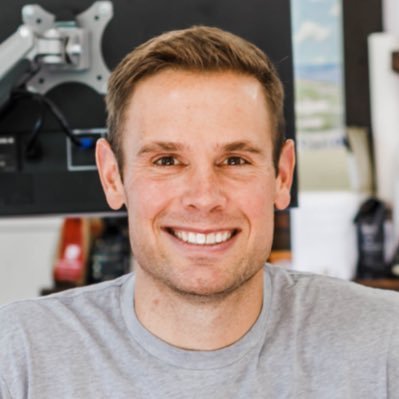
Hovland's back nine.
• 6/7 fairways
• 9/9 greens
• 3.5 SG approach lol
• 6.5 SG total
• Six birdie looks inside 9 feet
• Eight 3s
• 11 putts
• 28 total shots

English
Koech K Mathew retweetledi

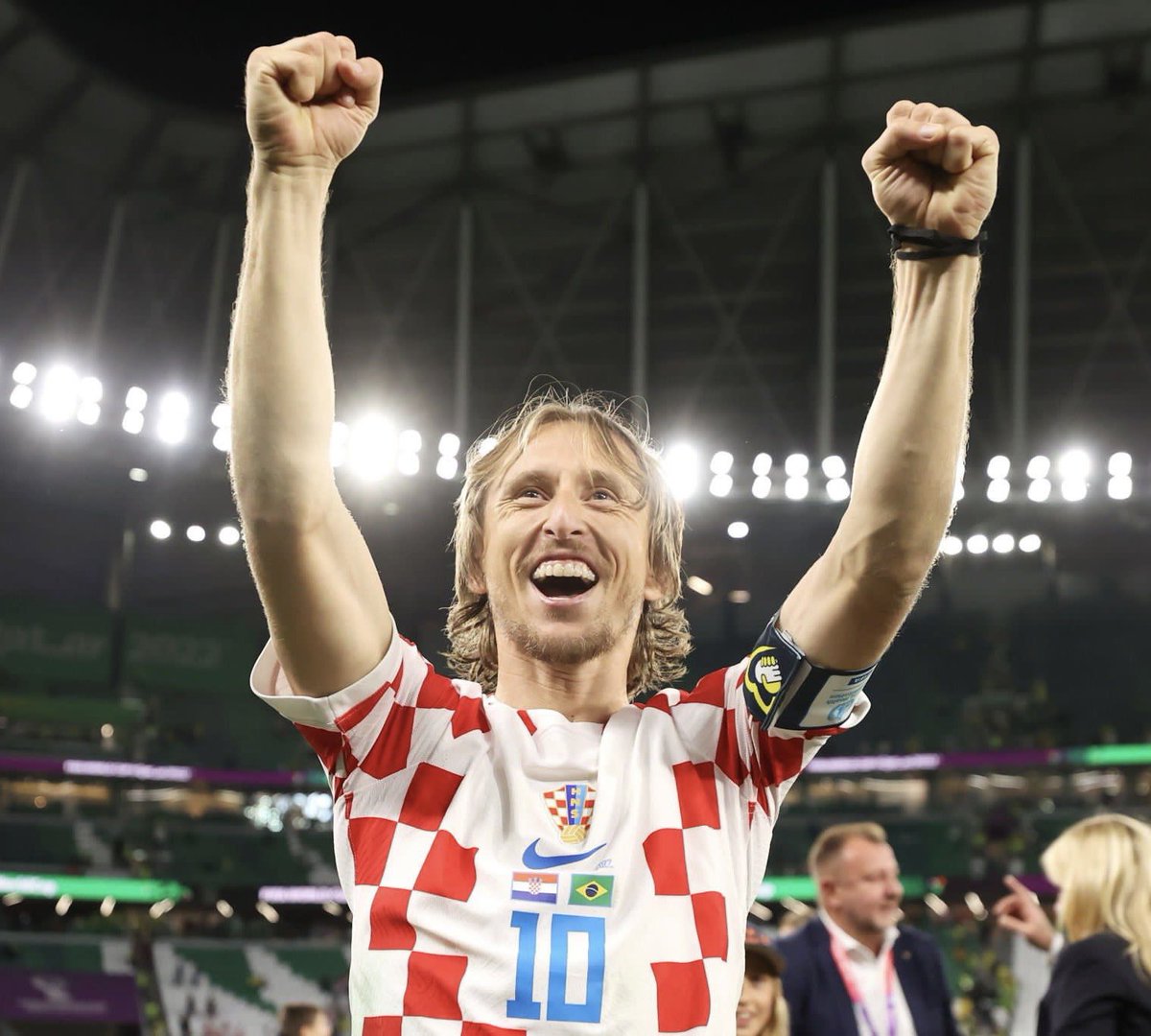
Koech K Mathew retweetledi

Koech K Mathew retweetledi
