K'Onyango Martin

1.4K posts

K'Onyango Martin

K'Onyango Martin

@Konyango_Martin

Strategic Impact Litigator, Reproductive Rights Defender,Advocate, Notary Public, Commissioner for oaths.

kenya Katılım Ekim 2012
1.6K Takip Edilen1K Takipçiler
K'Onyango Martin
K'Onyango Martin@Konyango_Martin·
Now that'the law is clear 'Advocates have cooled down,Let's now discuss Enforcement of the Bill of Rights:Appropriate reliefs :Limitation of rights and finally rights that may not be limited in the context of the High Court decision on Gachagua's impeachment. Reduce the noise.
English
0
0
0
31
K'Onyango Martin retweetledi
Center for Reproductive Rights Africa
Earlier today on @ntvkenya Martin Onyango, Associate Director for Legal Strategies at the Center for Reproductive Rights, unpacked the landmark judgment and what it means for adolescent rights, dignity, and access to justice in Kenya.
English
0
6
16
537
K'Onyango Martin retweetledi
KTN News
KTN News@KTNNewsKE·
The High Court of Kenya has delivered what rights advocates are describing as a transformative ruling for adolescent rights, declaring that criminalising consensual and non-coercive relationships between adolescents violates constitutional protections. standardmedia.co.ke/national/artic…
English
1
2
4
570
K'Onyango Martin retweetledi
Raise Your Voice CBO
Raise Your Voice CBO@RaiseYourV_oice·
The High Court ruling recognizes the need for fairness and proportionality when handling cases involving consenting teenagers. 1/2 #RaiseYourVoice
Raise Your Voice CBO tweet media
English
1
3
7
101
K'Onyango Martin retweetledi
Paul MUKIIBI
Paul MUKIIBI@pmpaulmukiibi·
A hospital cannot detain a discharged patient for non-payment of medical bills. Detention on account of an outstanding hospital bill amounts to unlawful self-help, violates the patient’s constitutional rights to liberty, dignity and freedom of movement, and cannot be justified as a debt-recovery mechanism. A hospital policy that permits detention after discharge, or refusal to discharge until the accrued bill is settled, is not constitutionally sound. In Gicheru v Nairobi Hospital & another (Constitutional Petition E258 of 2026) [2026] KEHC 5341 (KLR), a ruling delivered on 28 April 2026, R.E. Aburili J considered two interlocutory applications by Stephen Ndwaru Gicheru, who sought an interim mandatory order for his release from Nairobi Hospital. He had been discharged after open-heart surgery but remained at the hospital because of non-payment of the balance of his medical bill, after the insurance company declined to settle it. The petitioner argued that his continued detention was unconstitutional and violated his rights under Articles 28, 29, 39 and 47 of the Constitution. His family had shown good faith by paying KShs 1,000,000 and had undertaken to settle the outstanding lawful bill, but the hospital declined to release him. The Court held that the right to personal liberty is one of the most fundamental human rights and that any detention not authorised by law, where used to procure payment of a contractual debt, violates the right to liberty and affronts human dignity. Relying on earlier authorities, including Ndegwa v Republic, Sonia Kwamboka Rasugu v Sandalwood Hotel & Resort Ltd, Maina v Registered Trustees of the Sisters of Mercy (Kenya) t/a Mater Misericordiae Hospital, and international human rights instruments including the ICCPR, the Court reiterated that liberty cannot be curtailed merely because a person is unable to fulfil a contractual obligation. The Court emphasised that hospitals are entitled to recover lawful medical bills, but they must do so through lawful debt-recovery mechanisms, not by detaining discharged patients. It stated that it cannot be a hospital policy to detain patients after discharge, or to refuse discharge until the accrued bill is settled, because such a policy is not constitutionally sound. Since the petitioner had already been discharged, part of the bill had been paid, and his family had undertaken to settle the outstanding lawful bill, the Court found that this was an exceptional case justifying an interim mandatory order. The Court therefore ordered Nairobi Hospital and its Chief Executive Officer to immediately release Stephen Ndwaru Gicheru, together with all his medical records, to his next of kin for post-operative follow-up care, upon the next of kin signing an undertaking to settle any outstanding lawful medical bill incurred at the hospital. Read full ruling here: drive.google.com/file/d/1y2_zrM…
Paul MUKIIBI tweet media
English
3
88
114
7.5K
K'Onyango Martin
K'Onyango Martin@Konyango_Martin·
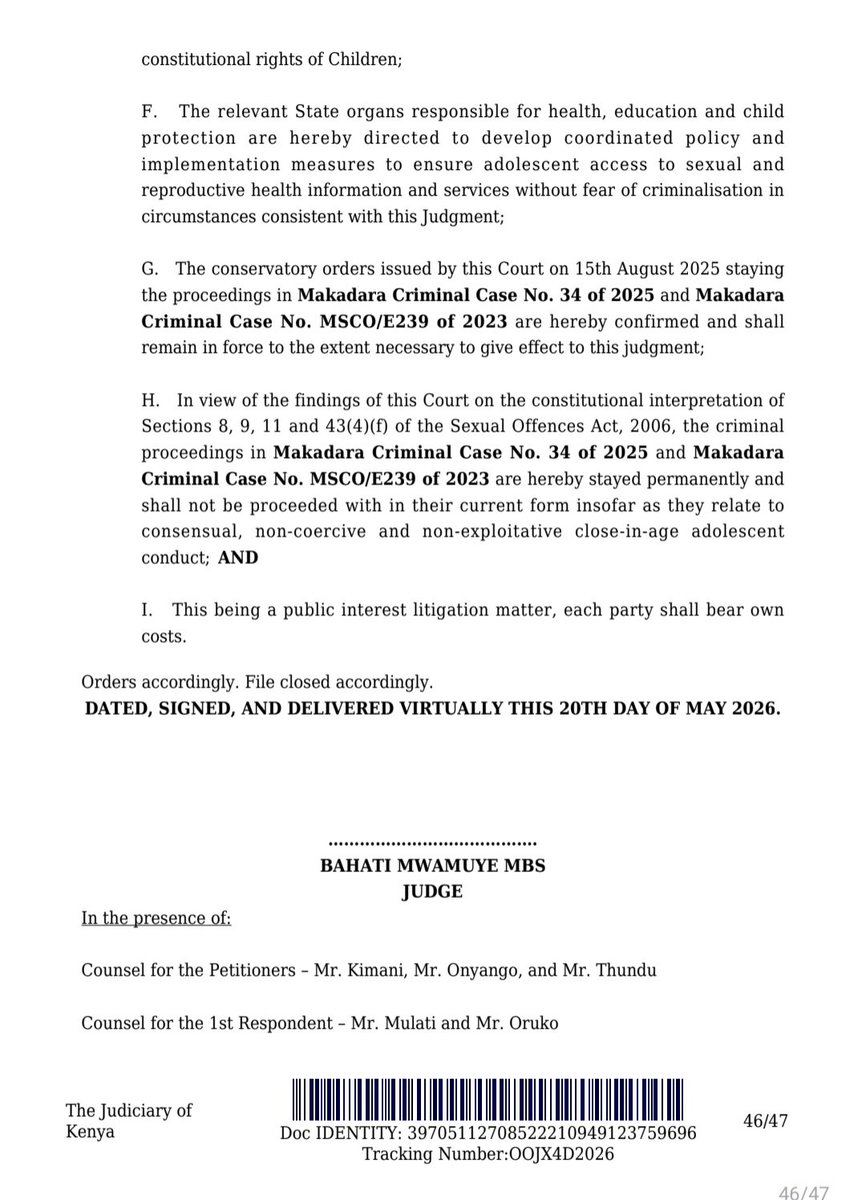
Our contribution in fixing the Nation.
K'Onyango Martin tweet media
English
0
0
1
33
Adv. Kirwa
Adv. Kirwa@kirwakiptoo2·
Can we all appreciate the research and the submissions made by and on behalf of the Petitioners in this landmark decision of the High Court by Hon. Justicrle Bahati Mwamuye in HCCHRPET/E490/2025:HSO, AMO, TA &ANOTHER VERSUS THE AG AND 3 OTHERS. Pure intelectualism.
English
5
32
159
9K
K'Onyango Martin
K'Onyango Martin@Konyango_Martin·
@FaithOdhiambo8 I represented the petitioners, can we read the judgement fully and have a constitutional discourse.All Kenyans deserve equal protection in law.
English
0
0
3
204
Faith Odhiambo
Faith Odhiambo@FaithOdhiambo8·
Yesterday, the High Court delivered a significant judgment in Petition E490/2025 (HSO & 3 Others v. ODPP & 4 Others) that will reshape Kenya's approach to adolescent sexuality and criminal law. The Court ruled that the misapplication of the Sexual Offences Act to prosecute adolescents engaged in consensual, non-coercive peer relationships violates their constitutional rights to equality, dignity, privacy, health, education and the best interest of the child. This judgment addresses a documented tension in our legal framework. While the Sexual Offences Act was enacted to shield children from sexual abuse and exploitation, it has been applied broadly against adolescents in consensual peer relationships while ignoring their evolving capacities and driving them where they cannot access sexual and reproductive health services out of fear of prosecution. The Court's directives are clear. The ODPP must publish prosecutorial guidelines distinguishing consensual peer relationships from exploitative conduct, the National Police Service must review arrest protocols and State organs must develop coordinated policies ensuring adolescents can access SRH information without fear. But we must ask the difficult questions. Against the backdrop of Kenya's escalating GBV and femicide crisis will this judgment inadvertently create loopholes that perpetrators exploit? The ODPP has previously employed diversion mechanisms in cases involving teenagers yet concerns persist about weaponization of these alternatives. The criminal justice system has failed women and girls through inadequate investigations, delayed prosecutions and impunity for perpetrators. Distinguishing consensual peer relationships from exploitation becomes so subjective that predatory conduct escapes accountability under the guise of consent. Without precise legislative safeguards, we risk creating interpretive gaps that undermine hard-won protections for children particularly girls who bear the burden of sexual violence. Who determines genuine consent among adolescents of varying maturity levels? How do we prevent this progressive protection from eroding gains in combating child sexual abuse in a country grappling with what many have called a national GBV and femicide crisis? Reform of the Sexual Offences Act remains urgent but it must be survivor-centered and grounded in the realities of GBV in Kenya. We need legislative amendments that protect juveniles from sexual violation without victimizing them for age-appropriate peer relationships while tightening enforcement against exploitation and abuse. The judgment's legacy will depend entirely on its implementation and future interpretation by courts and prosecutors. Only time will tell whether the promised guidelines will include safeguards that prevent manipulation by those who seek to exploit power imbalances. As we monitor this decision closely, one principle must remain non-negotiable, justice must protect the vulnerable not create new vulnerabilities.
Faith Odhiambo tweet mediaFaith Odhiambo tweet mediaFaith Odhiambo tweet mediaFaith Odhiambo tweet media
English
15
120
274
21.1K
K'Onyango Martin
K'Onyango Martin@Konyango_Martin·
@Thuranira_1 Kindly read Justice Mwamuye's decision on the application of sections 8,9,11 and 43 of the SOA..
English
0
0
1
807
Thuranira
Thuranira@Thuranira_1·
Sex between minors is a thorny issue in the judiciary. What makes it more challenging is that under the Sexual Offences Act, a child cannot consent. This means that any act of penetration involving a minor automatically amounts to defilement. Justice Chitembwe was widely criticised after acquitting a 24 year old man who had been sentenced to 20 years for having sex with a 13 year old girl,on the basis that she behaved like an adult. When it comes to minors engaging in sexual activity, the question becomes, how do we determine that both minors agreed, when the law is clear that a minor cannot consent? In many cases, male minors, especially those from poor backgrounds are the ones most affected. Judicial officers should exercise great care and sobriety when dealing with cases where one minor is alleged to have defiled another.
Thuranira tweet media
English
18
34
119
19.1K
K'Onyango Martin retweetledi
Center for Reproductive Rights Africa
The 47th Session of the African Committee of Experts on the Rights and Welfare of the Child @acerwc was officially opened and the Center for Reproductive Rights and it's partners from Uganda, Zambia, Malawi and Kenya were in the room. Alongside member states, civil society organizations and children's representatives from across the continent, we are here to advance children's rights and push for meaningful progress on the issues that matter most — from harmful traditional practices and gender inequality, to systemic barriers to education, healthcare, and reproductive health services for adolescent girls. The work of the Committee is critical in making legal decisions, reviewing state compliance and setting the normative standards that shape laws and policies across Africa . We continue to push to ensure that adolescent sexual and reproductive health and rights are central to that agenda. #AfricaFit4Children #Agenda2040 #AdolescentSRHR #ReproductiveRights
Center for Reproductive Rights Africa tweet media
English
1
14
25
488
K'Onyango Martin retweetledi
Reproductive Health Network Kenya
Too many girls walk miles for care… only to leave unseen, unheard, unsupported. Healthcare should not be a journey of barriers. It should be a place of safety, trust and dignity. Change is coming — built with her realities in mind. The count down is still on! 3 DAYS TO GO. 📆 25th February 2026 Stay with us. #SystemsThatWorkForHer #HerHealthMatters #3DaysToGo
Reproductive Health Network Kenya tweet media
English
1
24
41
471
K'Onyango Martin retweetledi
Willis Evans Otieno
Willis Evans Otieno@otienowill·
I am officially endorsing Mr. Mwaura Kabata for the Law Society of Kenya presidency. The campaign period has unfortunately been dominated by personality attacks instead of substantive agendas on what each candidate intends to deliver while in office. Kabata has demonstrated the leadership, vision, and commitment needed to take care of the welfare of Advocates and to restore dignity and focus within the Society. My support is grounded on issues, delivery, and the future of the legal fraternity. Strong, steady, and issue-driven ; that is the leadership that defines Mwaura Kabata.
English
9
42
154
11.3K