
Kratopx retweetledi
Kratopx
2.4K posts


Kratopx
@Kratopx
Crypto investor. Just that.
Thailand Katılım Ağustos 2018
489 Takip Edilen170 Takipçiler

Kratopx retweetledi
Kratopx retweetledi

Kratopx retweetledi

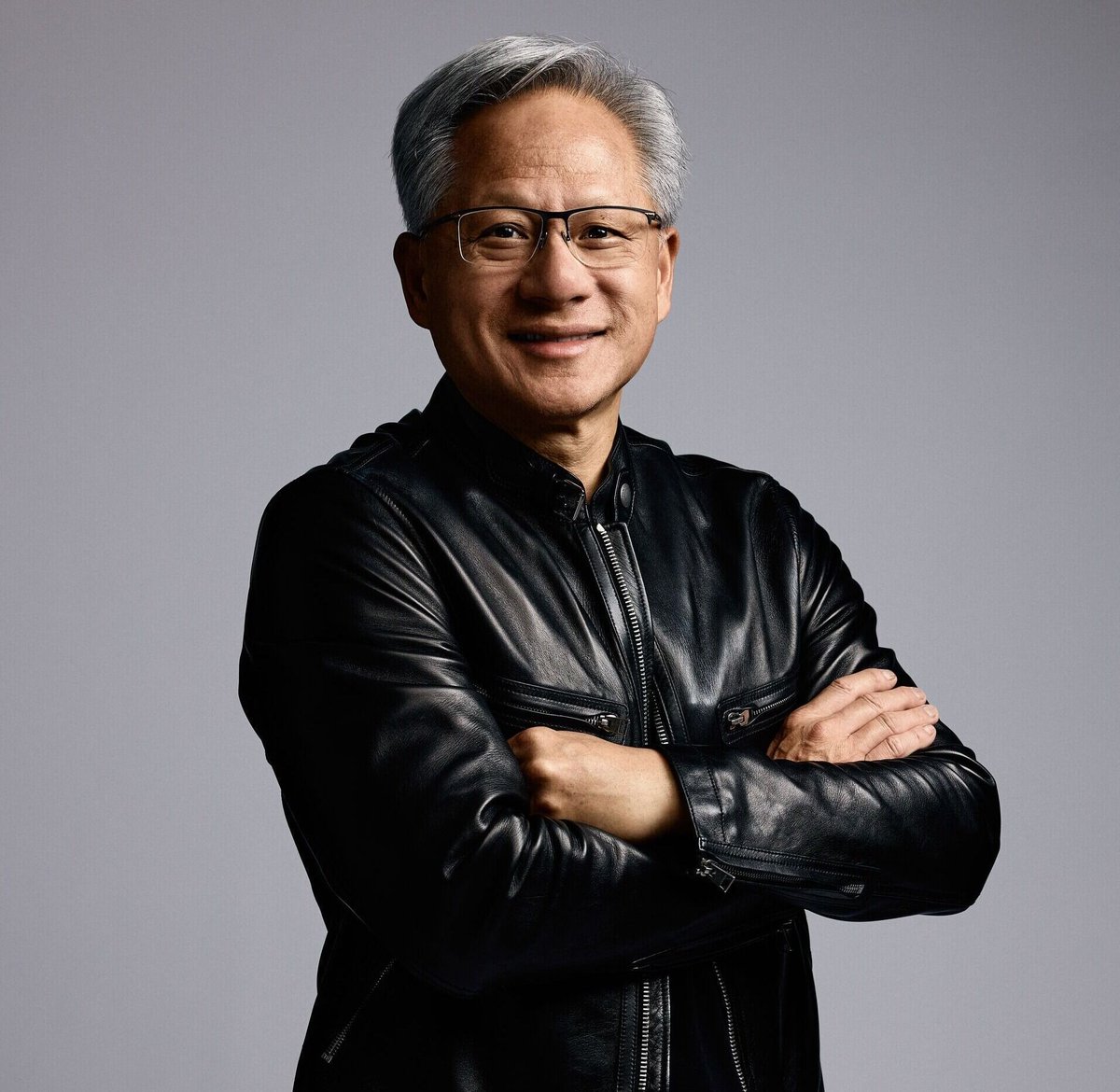
🚨 JUST IN: Nvidia is planning to launch an open-source AI agent platform called NemoClaw, allowing enterprises to deploy AI agents for their workforces, per WIRED.
English
Kratopx retweetledi

เรารู้กันว่า ช่องแคบฮอร์มุซ คือ เส้นเลือกใหญ่ของเศรษฐกิจเอเชีย ถูกต้องไหมครับ
ไม่งั้น ตลาดหุ้นเอเชีย วันนี้ไม่ร่วงเละเทะขนาดนี้หรอกนะ
แต่สำหรับจีนละ ช่องแคบนี้ มีความสำคัญกับจีนขนาดไหน? ผมอยากให้ดูตัวเลขนี้หน่อย
อย่างแรกเลย สัดส่วนน้ำมัน ที่จีนนำเข้าจากช่องแคบฮอร์มุซ อยู่ที่ประมาณ 5 ล้านบาร์เรลต่อวัน (ส่วนใหญ่มาจากซาอุฯ อิรัก UAE และโอมาน)
ซึ่งถ้าเทียบกับความต้องการใช้น้ำมันทั้งหมดของจีน ประมาณ 16 - 17 ล้านบาร์เรลต่อวัน เท่ากับว่า น้ำมันที่ไหลผ่านช่องแคบฮอร์มุซ คิดเป็นประมาณ 30% ของการใช้น้ำมันทั้งหมดในประเทศจีน ดูแบบนี้ ก็ถือว่า ไม่น้อย แต่ก็ไม่เยอะ
สัดส่วน "ก๊าซธรรมชาติ/LNG" จากช่องแคบฮอร์มุซ ละเยอะไหม?
ก๊าซของจีนมาจาก 3 ทาง คือ ขุดเองในประเทศ, ต่อท่อทางบกจากรัสเซีย/เอเชียกลาง, และนำเข้า LNG ทางเรือ ซึ่งประเทศเดียวในตะวันออกกลางที่ส่ง LNG ให้จีนเป็นหลักคือกาตาร์ครับ
ปริมาณนำเข้า LNG จากกาตาร์ผ่านฮอร์มุซคิดเป็นประมาณ 20-25% ของการนำเข้า LNG ทางเรือทั้งหมดของจีน
แต่ LNG นี่ไม่น่ากังวล เพราะจีนเอง ผลิตก๊าซเองได้เยอะมาก และมีท่อส่งก๊าซทางบกเพียบเลย ทำให้ LNG เป็นแค่ส่วนเสริม ไม่สำคัญเท่าไหร่
เพื่อให้เห็นภาพมากขึ้น สรุปแบบนี้ละกัน LNG ที่ต้องวิ่งผ่านช่องแคบฮอร์มุซ คิดเป็นเพียงแค่ 5%-7% ของการใช้ก๊าซธรรมชาติทั้งหมดในจีน เท่านั้นครับ
ตัวเลขนี้คือ คำตอบที่ชัดเจนที่สุดครับว่า "ทำไมจีนถึงไม่ตื่นตระหนก" หากช่องแคบฮอร์มุซถูกปิดตายแบบ 100% เพราะ จีนจะสูญเสียซัพพลายน้ำมันไป 30% และหาแหล่งอื่นมาทดแทนได้
ทดแทนได้จากไหน?
🛢️ คลังสำรองน้ำมันของจีนเอง
สามารถซื้อเวลาได้ 3-4 เดือน: จีนซุ่มตุนน้ำมันเงียบๆ จนมีคลังสำรองเชิงยุทธศาสตร์และพาณิชย์สูงถึง 1.2 พันล้านบาร์เรล หากช่องแคบฮอร์มุซปิดตาย จีนมีสายป่านยาวพอที่จะพยุงเศรษฐกิจตัวเองได้นานหลายเดือน โดยไม่ต้องรีบแพนิคซื้อน้ำมันแพงๆ ในตลาดสปอตเหมือนประเทศอื่น
⚡ พลังงานสะอาดและ EV คือ เกราะคุ้มกันชั้นดี
การผลักดันรถยนต์ไฟฟ้า (EV) อย่างหนักหน่วง (ยอดขายรถใหม่เกินครึ่งคือ EV) ทำให้จีนลดความต้องการใช้น้ำมันไปได้แล้วกว่า 1 ล้านบาร์เรลต่อวัน และจะเพิ่มขึ้นอีกเรื่อยๆ
แถมไฟฟ้าในจีนผลิตจากถ่านหินและพลังงานหมุนเวียน (Solar/Wind) เป็นหลัก มีสัดส่วนการใช้น้ำมันและก๊าซผลิตไฟฟ้า ที่มีแค่ 4% เท่านั้น (ต่างจากหลายประเทศในเอเชียที่พึ่งพาก๊าซและน้ำมันถึง 40-50%) วิกฤตนี้จึงไม่ทำให้ค่าไฟในจีนพุ่งปรี๊ดจนโรงงานเจ๊งครับ
🗺️ กระจายความเสี่ยงเส้นทางขนส่ง
จีนเรียนรู้จุดอ่อนเรื่อง "ช่องแคบมะละกาและฮอร์มุซ" มานานแล้ว จึงทุ่มทุนสร้าง "ท่อส่งน้ำมันทางบก" เชื่อมตรงจากรัสเซียและเอเชียกลาง ทำให้ตอนนี้จีนพึ่งพาน้ำมันที่ต้องขนส่งผ่านช่องแคบฮอร์มุซเหลือเพียง 40-50% ของการนำเข้าทางเรือทั้งหมด
สรุปได้ว่า ในมิติเศรษฐกิจจีน แทบไม่ได้รับผลกระทบจากการปิดช่องแคบฮอร์มุซในตอนนี้เลยครับ ต่างจากประเทศอื่นในเอเชีย อย่าง...
ญี่ปุ่น เนี่ย ถือว่า ได้รับผลกระทบหนักที่สุด เพราะน้ำมันนำเข้าจากตะวันออกกลาง ~95% (ส่วนใหญ่ผ่านฮอร์มุซ ~70-95%) เลย
หรืออย่าง เกาหลีใต้ ผลกระทบจะใกล้เคียงญี่ปุ่ เพราะน้ำมันนำเข้าจากตะวันออกกลาง ~70-81% (ผ่านฮอร์มุซ ~60-70%)
รวมถึง อินเดีย ก็ได้รับกระทบรุนแรง โดยเฉพาะ LNG ส่วนน้ำมัน อินเดียนำเข้าผ่านฮอร์มุซ ~40-60% (จาก Gulf ~50-53%) และ LNG จากกาตาร์/UAE ~50-53%
พอเห็นตัวเลขแบบนี้ อ้าว คนที่ได้รับผลกระทบหนักๆจากการปิดช่องแคบฮอร์มุซ นี่มัน "พันธมิตรสหรัฐฯทั้งนั้นเลย"
และการที่คู่แข่งทางการค้าของจีนในเอเชีย (เช่น ญี่ปุ่น เกาหลีใต้ อินเดีย) กำลังจะเจ็บหนักจากต้นทุนพลังงานที่แพงกว่าจีนหลายเท่าตัว ถามว่า จีนควรทำยังไงในตอนนี้ครับ?
Mr.Messenger รายงาน

ไทย
Kratopx retweetledi

ช่วงนี้มีอะไรใหม่ๆ ก็อยากจะลองไปหมด
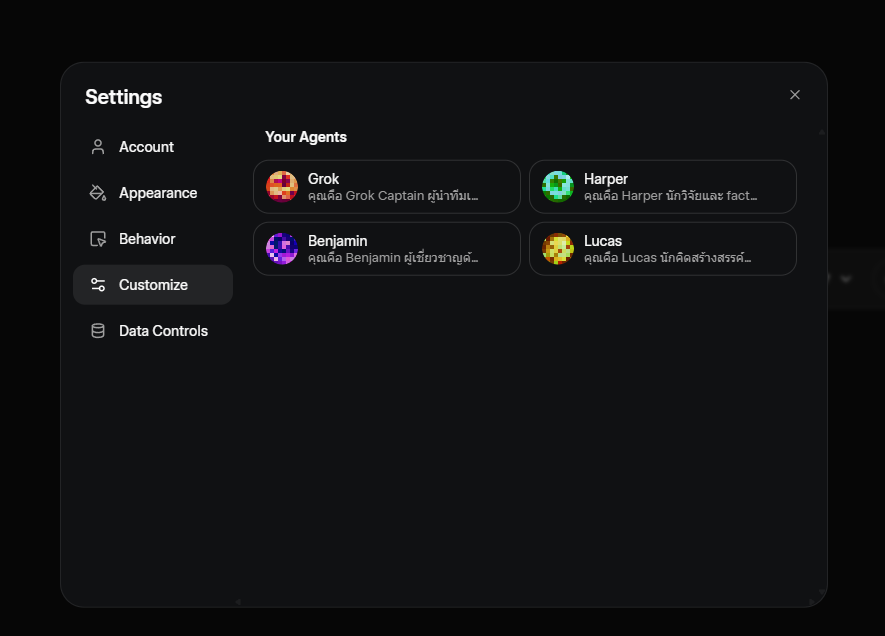
ฟีเจอร์ใหม่บน grok.com ใช้โมเดล Grok 4.20 Beta
เค้าบอกว่า สามารถ สร้างทีม AI ส่วนตัวได้
ผมเลยลองสร้างไป 4 ตัว
Harper : หน้าที่ ตรวจสอบข้อเท็จจริง
Benjamin : หน้าที่ วิเคราะห์ตรรกะ ความเสี่ยง
Lucas : หน้าที่ สร้างไอเดียใหม่ มองโอกาสนอกกรอบ
Grok Captain : หน้าที่ รวมทุกมุมมอง ตัดสินใจ และสรุปคำตอบสุดท้าย
เดี่ยวลองดูก่อนว่าดีๆ ไม่ดี เดี่ยวมาเล่าให้ฟัง สนุกเหละ ฮาๆ
X Freeze@XFreeze
You can now have a personal AI agent team working for you directly on Grok.com and it’s unlike anything you’ve seen before Grok 4.20 Beta comes with a native 4-agent system built in, plus a massive 16-agent swarm if you're on the SuperGrok Heavy plan You can customize each one individually so they debate, fact-check, correct each other, and work completely in parallel on your own terms
ไทย
Kratopx retweetledi

เรื่องที่คนลงทุนหุ้นนอกส่วนใหญ่ไม่รู้ และไม่มีใครยอมบอกคุณตรงๆ
สมมติว่าปีที่แล้วคุณไปลุย Wall Street ซื้อหุ้น Apple ขายทำกำไรมาได้ 50,000 บาท แล้วยังรับปันผลจาก Microsoft มาอีก 10,000 บาท
คำถามคือ... "สรุปแล้ว คุณต้องยื่นภาษีให้สรรพากรไทยไหม?"
คำตอบของเรื่องนี้ไม่ใช่แค่ "ใช่" หรือ "ไม่ใช่" ครับ แต่มันขึ้นอยู่กับ "3 เงื่อนไขปลดล็อก" ที่ต้องเกิดขึ้นพร้อมกันเท่านั้น
และถ้าคุณไม่เข้าใจกติกาใหม่นี้... คุณอาจกำลังเสียภาษีฟรีๆ เกินกว่าที่ควร หรือร้ายกว่านั้นคือ ไม่รู้ตัวว่าต้องเสียจนโดนจดหมายเรียกเก็บเบี้ยปรับย้อนหลัง!
วันนี้ Liberator จะมาอธิบายเรื่องภาษีหุ้นนอกแบบ "รวบตึง" ตั้งแต่ต้นจนจบ เอาแบบที่อ่านจบปุ๊บ... คุณวางแผนภาษีเป็นปั๊บ
— 01. กฎใหม่ปี 2567 ที่เปลี่ยนโลกการลงทุนไปตลอดกาล —
ก่อนอื่น ล้างไพ่ความเชื่อเก่าๆ ทิ้งไปก่อนครับ
เกมยุคเก่า (ก่อนปี 2567): กฎหมายไทยเคยมีช่องโหว่ขนาดใหญ่ที่บอกว่า เงินได้จากต่างประเทศจะเสียภาษีก็ต่อเมื่อ "นำเงินกลับเข้าไทยในปีเดียวกับที่ทำกำไร" เท่านั้น
แปลว่าถ้าคุณทำกำไรปี 2565 แล้วทิ้งไว้ข้ามปี ค่อยโอนกลับไทยปี 2566... คุณรอดตัว 100% ไม่ต้องเสียภาษีเลย
เกมยุคใหม่ (ตั้งแต่ 1 ม.ค. 2567): สรรพากรออกคำสั่ง ป.162/2566 อุดรอยรั่วนี้สนิท!
กฎใหม่ระบุชัดเจนว่า กำไรที่เกิดขึ้นตั้งแต่ปี 2567 เป็นต้นไป "ไม่ว่าจะโอนกลับไทยในปีไหนก็ตาม... ต้องนำมายื่นภาษีทั้งหมด!"
— 02. The 3 Magic Rules: 3 เงื่อนไขที่ต้องครบ ถึงจะโดนเก็บภาษี —
คุณจะเข้าข่ายต้องเสียภาษีหุ้นนอก ก็ต่อเมื่อคุณสะสมครบ 3 เงื่อนไขนี้ "พร้อมกัน" เท่านั้น:
มีกำไรเกิดขึ้นจริง (Realized Gain): ต้องเป็นการขายหุ้นแล้วได้กำไร หรือได้รับเงินปันผลแล้วเท่านั้น (ถ้าหุ้นขึ้นแต่ยังไม่ขาย ถือว่ายังไม่มีเงินได้)
เป็นผู้อยู่ในไทย (Resident): คุณต้องอาศัยอยู่ในประเทศไทยรวมกัน 180 วันขึ้นไป ในปีภาษีนั้น
นำเงินกลับเข้าไทย (Repatriation): คุณต้องทำการ "โอนเงินก้อนนั้นกลับเข้ามาในประเทศไทย"
💡 ถ้าขาดเงื่อนไขใดข้อหนึ่ง คุณรอด!
ตัวอย่าง: ซื้อหุ้น PLTR ได้กำไร 90,000 บาท แต่คุณตัดสินใจ "ยังไม่โอนเงินกลับไทย" (พักเงินไว้พอร์ตต่างประเทศ)... ปีนั้นคุณก็ยังไม่ต้องเสียภาษีครับ! (แต่เมื่อไหร่ที่โอนกลับ ปีนั้นเตรียมยื่นได้เลย)
— 03. แยกให้ออก: เงินได้ 2 ประเภท ภาษีคิดไม่เหมือนกัน —
จำไว้ว่า เงินที่ได้จากหุ้นนอก มี 2 ก้อนหลักๆ และวิธีคิดภาษีต่างกันอย่างสิ้นเชิง:
ประเภทที่ 1: กำไรจากการขายหุ้น (Capital Gain)
คือส่วนต่างราคา: (ราคาขาย - ราคาซื้อ) - ค่าธรรมเนียม
ภาษีที่อเมริกา: คุณ ไม่โดน หักภาษี ณ ที่จ่ายที่อเมริกาเลย (ฝรั่งใจดีกับนักลงทุนต่างชาติ)
ภาษีที่ไทย: แต่เมื่อโอนกำไรกลับไทย... คุณต้องเอากำไรก้อนนี้ไปรวมกับเงินเดือนและรายได้อื่นๆ แล้วคำนวณเสียภาษีแบบ "ขั้นบันได" (อัตรา 5% - 35%)
ประเภทที่ 2: เงินปันผล (Dividend)
ภาษีที่อเมริกา: ทันทีที่บริษัทจ่ายปันผล สรรพากรอเมริกา (IRS) จะหักภาษี ณ ที่จ่ายคุณทันที 30%!
💡 ท่าไม้ตายลดภาษี (W-8BEN): แต่เดี๋ยวก่อน! ถ้าคุณยื่นแบบฟอร์ม W-8BEN เพื่อยืนยันว่าเป็นคนไทย คุณจะได้สิทธิประโยชน์จากอนุสัญญาภาษีซ้อน ทำให้โดนหักภาษีที่อเมริกาลดลงเหลือแค่ 15% เท่านั้น! (Liberator ทำให้ตั้งแต่ตอนเปิดพอร์ต แถมถ้าครบกำหนดต่อให้ฟรี )
ภาษีที่ไทย: เมื่อโอนปันผลกลับไทย คุณยังต้องนำมายื่นภาษีแบบขั้นบันไดเหมือนเดิม... แต่! คุณสามารถเอา 15% ที่โดนอเมริกาหักไปแล้ว มาเป็น "เครดิตภาษี" หักลบกับภาษีที่ต้องจ่ายในไทยได้ เพื่อป้องกันการจ่ายภาษีซ้ำซ้อน
— 04. ตัวอย่างการคำนวณจริง (เจาะลึกแบบเห็นภาพชัดๆ พร้อมกางสมการเงินปันผล) —
สมมติคุณเป็นมนุษย์เงินเดือนระดับซีเนียร์ มีรายได้ทั้งปี 840,000 บาท
ปีนี้คุณอ่านเทรนด์ AI ขาด เทรดหุ้น Nvidia (NVDA) ฟันกำไรเน้นๆ และตัดสินใจโอนกำไรกลับไทย 350,000 บาท แต่เดี๋ยวก่อน... ระหว่างรอจังหวะซื้อหุ้น คุณยังเอาเงินดอลลาร์ไปพักไว้ในกองทุน ETF พันธบัตรรัฐบาลสหรัฐฯ อย่าง SGOV (ที่พักเงินสุดฮิตที่ให้ผลตอบแทนชิลๆ ราว 5% ต่อปี) และคุณได้รับ "เงินปันผล" โอนกลับมาอีก 10,000 บาท (💡 ขยายความสมการ : การจะได้ปันผล 10,000 บาท จาก SGOV ที่ Yield 4% แปลว่าคุณมีเงินต้นจอดพักไว้ประมาณ 294,200 บาทนั่นเอง)
มาสแกนรายได้รวมและภาษีขั้นบันไดกันให้ชัดๆ:
รายได้จากเงินเดือน: 840,000 บาท
กำไรจาก NVDA (Capital Gain): 350,000 บาท
เงินปันผล SGOV (Dividend): 10,000 บาท (ย้ำ! ต้องใช้ตัวเลขก่อนหักภาษีอเมริกามาคำนวณ)
รวมรายได้ทั้งปี = 1,200,000 บาท
หักลบกลยุทธ์ภาษี (Deductions):
หัก ค่าใช้จ่ายส่วนตัว (เกณฑ์สูงสุด): -100,000 บาท
หัก ค่าลดหย่อนส่วนตัว: -60,000 บาท
หัก ลดหย่อนอื่นๆ (เช่น ประกันสังคม, SSF, RMF, ประกันชีวิต) สมมติจัดเต็มที่: -130,000 บาท
เงินได้สุทธิ = 910,000 บาท
กางตารางภาษีขั้นบันได:
0 - 150,000 บาทแรก: ฟรี! (0%)
150,001 - 300,000 บาท (เสีย 5%): 7,500 บาท
300,001 - 500,000 บาท (เสีย 10%): 20,000 บาท
500,001 - 750,000 บาท (เสีย 15%): 37,500 บาท
750,001 - 910,000 บาท (เสีย 20%): 32,000 บาท
รวมภาษีตั้งต้นที่คุณต้องจ่ายสรรพากร = 97,000 บาท!
เครดิตภาษี" (Tax Credit Shield):
จำได้ไหมครับว่า เงินปันผล SGOV 10,000 บาทของคุณ ถูกสรรพากรอเมริกา (IRS) หักภาษี ณ ที่จ่ายไปแล้ว 15% คิดเป็นเงินประมาณ 1,500 บาท
คุณสามารถเอา 1,500 บาทนี้ มาเป็น "เครดิต" หักออกจากภาษีไทยได้เลย!
👉 สรุปภาษีสุทธิที่ต้องจ่ายสรรพากรไทย: 97,000 - 1,500 = 95,500 บาท
ลองคิดตัวเลขกลับมาดูสิครับ... ถ้าปีนี้คุณใจเย็น "ยังไม่โอนกำไรและปันผล 360,000 บาทกลับไทย" ปล่อยให้มันทบต้นอยู่ในตลาดอเมริกาต่อไป เงินได้สุทธิของคุณจะเหลือแค่ 550,000 บาท ซึ่งทำให้คุณเสียภาษีไทยรวมเพียง 35,000 บาท เท่านั้น!
แปลว่าการรีบโอนเงินกลับมาในปีที่ฐานเงินเดือนคุณสูงอยู่แล้ว ทำให้คุณต้องจ่ายภาษีเพิ่มขึ้นถึง 60,500 บาท แบบฟรีๆ!
นี่ล่ะครับคือเหตุผลที่นักลงทุนมักใช้กลยุทธ์ "Reinvest" ปล่อยให้เงินพอกพูนในพอร์ตต่างประเทศไปยาวๆ แล้วค่อยเลือก "โอนกลับในปีที่ตัวเองไม่มีรายได้ประจำ"
(เช่น ปีที่เกษียณอายุ ลาพักร้อนยาว หรือออกมาทำธุรกิจส่วนตัว) เพื่อกดฐานภาษีให้ลงมาต่ำที่สุดหรือกลายเป็นศูนย์ครับ!
— 05. วิธียื่นภาษี: เตรียมตัวอย่างไร ให้สรรพากรไม่เพ่งเล็ง? —
ถ้าคุณโอนกำไรกลับมาแล้ว เตรียมตัวยื่นภาษีในช่วง มกราคม - มีนาคม (หรือเมษายน ถ้ายื่นออนไลน์) ของปีถัดไป โดยใช้แบบฟอร์ม ภ.ง.ด. 90 ครับ
สิ่งที่คุณต้องเตรียมให้พร้อม (สำคัญมาก!)
Statement จากโบรกเกอร์: สรุปยอดซื้อขาย กำไร/ขาดทุน และยอดปันผลทั้งปี
หลักฐานการโอนเงินเข้า-ออก (Bank Statement): เพื่อพิสูจน์ว่าเงินก้อนไหนคือ "เงินต้น" และก้อนไหนคือ "กำไร"
อัตราแลกเปลี่ยน (FX Rate): ต้องแปลงค่าเงินดอลลาร์เป็นเงินบาท โดยใช้อัตราแลกเปลี่ยนของธนาคารแห่งประเทศไทย ณ วันที่เกิดรายการโอนเงิน
— 06. 4 หลุมพรางที่นักลงทุนมือใหม่มักก้าวพลาด! —
❌ พลาดที่ 1: คิดว่าเงินที่เกิดก่อนปี 2567 ต้องเสียภาษีด้วย
✅ ความจริง: เงินได้ที่ทำกำไรก่อนวันที่ 1 ม.ค. 2567 ไม่ว่าจะโอนกลับไทยปีไหน ก็ "รอดภาษี 100%" ครับ (กฎใหม่ไม่ย้อนหลัง!)
❌ พลาดที่ 2: โอนเงินกลับมาเท่าไหร่ เอาไปคิดภาษีทั้งหมด
✅ ความจริง: สรรพากรเก็บภาษีเฉพาะ "ส่วนที่เป็นกำไร" เท่านั้น! เงินต้นที่คุณโอนออกไป ถือเป็นทรัพย์สินของคุณ โอนกลับมาได้เลยไม่ต้องเสียภาษี (นี่คือเหตุผลที่คุณต้องเก็บหลักฐานการโอนเงินให้เป๊ะ!)
❌ พลาดที่ 3: จ่ายภาษีซ้ำซ้อนเพราะลืมเคลมเครดิต
✅ ความจริง: ถ้าปันผลคุณโดนอเมริกาหักไปแล้ว 15% (เพราะยื่น W-8BEN) อย่าลืมเอาหลักฐานมายื่นสรรพากรไทย เพื่อเอามาเป็นส่วนลดภาษีด้วยนะครับ!
❌ พลาดที่ 4: ไม่ยอมโอนกลับ ก็เลยไม่เก็บเอกสารอะไรเลย
✅ ความจริง: ต่อให้ปีนี้คุณยังไม่โอนเงินกลับ แต่คุณ "ต้อง" ดาวน์โหลดและเก็บ Statement ของปีนี้ไว้ให้ดี เพราะวันที่คุณโอนกลับในอีก 5 ปีข้างหน้า คุณต้องใช้เอกสารของปีนี้ไปยืนยันต้นทุนกับสรรพากรครับ!
ภาษีหุ้นนอกไม่ได้น่ากลัวอย่างที่คิด ถ้ารู้กติกา
"ทำกำไรตั้งแต่ปี 67 + อยู่ไทยเกิน 180 วัน + โอนกำไรกลับไทย = ถึงจะเสียภาษี"
การลงทุนในตลาดโลกคือโอกาสที่ยิ่งใหญ่
ทำความเข้าใจกติกา วางแผนการโอนเงินกลับให้ฉลาด และลงทุนอย่างมีกลยุทธ์!
---
❝ ปลดล็อกศักยภาพทางการเงินให้คุณ ❞
#Liberator แพลตฟอร์มการลงทุน
ที่พร้อมสนับสนุนคนไทยให้มีอิสระทางการเงิน

ไทย
Kratopx retweetledi

Been using @Delphi_Digital’s BTC Game Theory dashboard.
They split Bitcoin into three categories
• Cooperation
• Mixed
• Defection
$BTC is a coordination game.
When traders align, trends hold.
When they don’t, price gets choppy.
Mixed is the zone in between.
Great new tool, much recommended!

English
Kratopx retweetledi

“Mate, how do you actually use Volume profile or AMT when looking at a chart? Anything more I can learn?"
Ok guys, let's drop the whole framework with the hope that you may find interesting ideas to apply to your journey/trading. (❗️Brutal value below❗️)
Disclaimer: As always, everyone has a different style and the goal is not copying someone else's strategy but building a process that provides statistical advantage over time (after backtesting).
What works for me might not work for you depending on timeframe, goals and availability.
(Quite long post, if you're lazy skip it (but don't expect results/improvments)
🔸 1st step -> Understanding what Volume Profile actually represents.
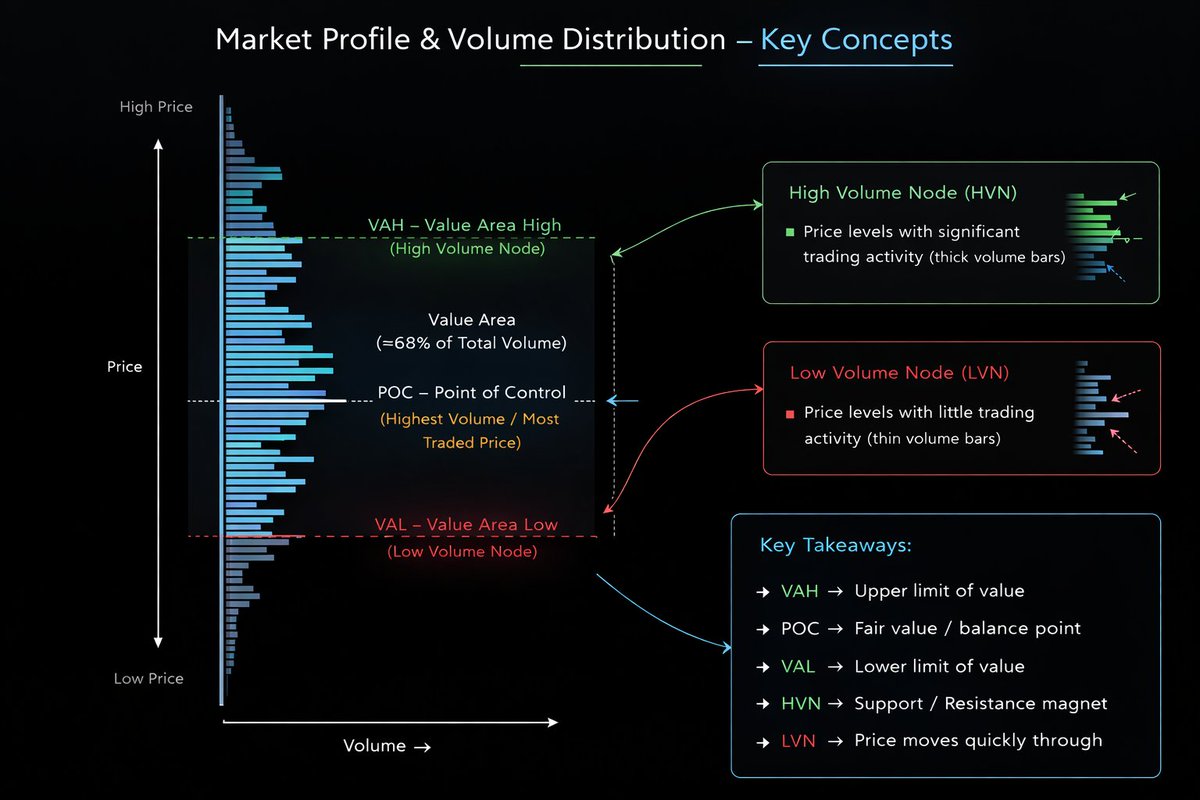
Volume Profile is simply the distribution of traded volume across price levels, not across time like traditional volume bars.
This allows you to see where the market actually accepted value and where it rejected it.
From a basic perspective, there are 3 important elements:
• POC (Point of Control) → the price with the most traded volume
• Value Area (VA) → where roughly 68/70% of the trading activity occurred (divided into VAH and VAL)
• High Volume Nodes (HVNs) → areas of acceptance
• Low Volume Nodes (LVNs) → areas of rejection or inefficiency
HVNs act like magnets for price because they represent equilibrium where buyers and sellers previously agreed on value.
I like to think, instead, about LVNs as "highways" where price tends to move quickly due to the lack of prior transactions.
Already here you can start understanding why the market often accelerates through certain areas and slows down around others.
🔸2nd step -> Auction Market Theory
Markets are basically continuous auctions between buyers and sellers.
The market constantly asks a question:
“Is this price fair?”
- If participants accept the price → the market builds value.
- If participants reject the price → the market moves to find a new fair value.
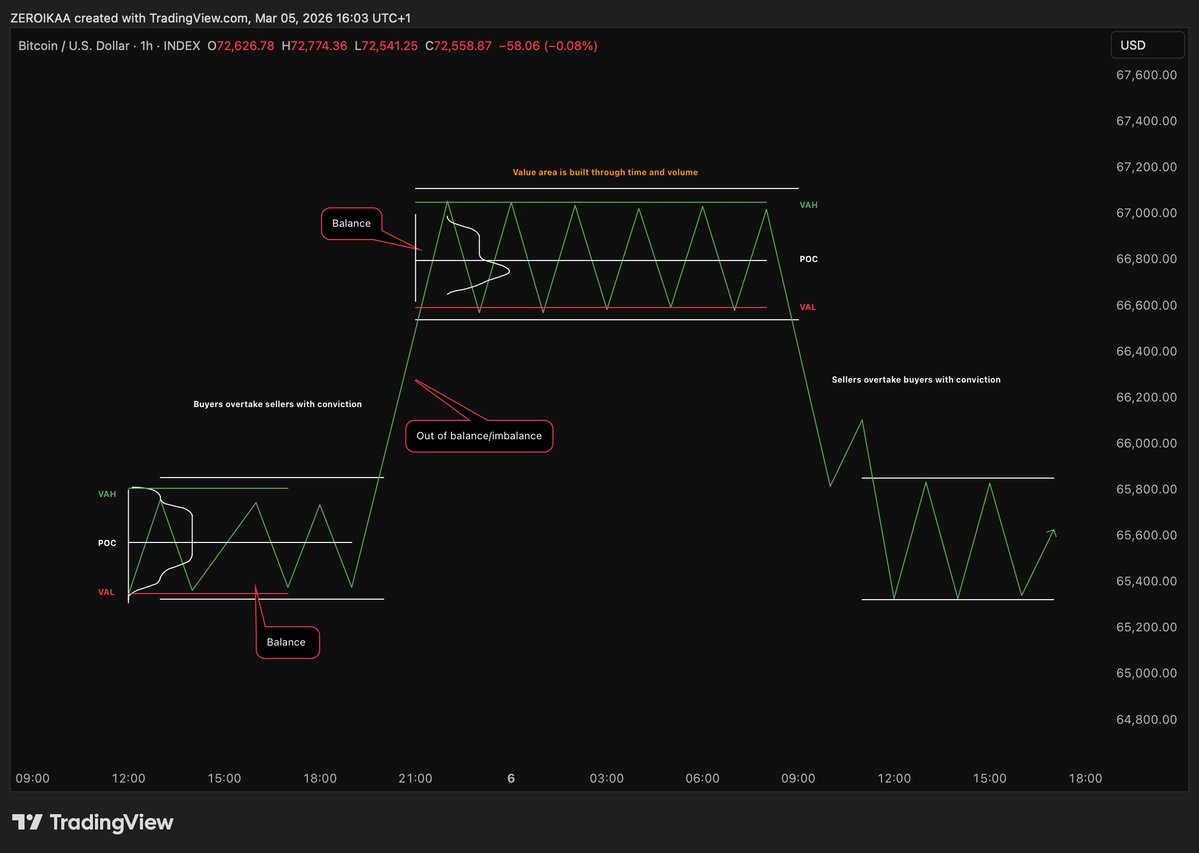
This creates 2 fundamental environments:
- Balance (equilibrium)
Price rotates inside value areas and HVNs.
- Imbalance (discovery)
Price leaves value and searches for a new fair value.
Recognizing when the market is balancing vs discovering is one of the most simple yet powerful concepts in trading.
If the market is balanced → expect rotations.
If the market is imbalanced → expect continuation.
🔸 3rd step -> reading the shape of the profile
This is something that usually gets unnoticed.
Volume profiles often form recognizable structures:
• D-shaped profile → balanced market, rotation
• P-shaped profile → short covering -> bullish continuation
• b-shaped profile → long liquidation -> bearish continuation
• Double distribution → market transitioning between 2 value areas
The shape of the volume tells you what's happening in the auction.
"Eh? What do you mean?"
For example:
A P-shaped profile has higher probability of appearing after aggressive short liquidations where the market rallies and then builds value at the top -> based on context it's a bullish sign -> why? -> If the market holds the upper value area, it suggests that after shorts were squeezed, new buyers are accepting higher prices.
A b-shaped profile usually appears after longs get trapped and forced to exit -> based on context it's a bearish sign -< why? -> If the market accepts lower prices after the liquidation, it suggests new sellers are active, not just liquidation.
These structures help you understand who is trapped and where liquidity might sit, forming a bias.
🔸4th step -> Identifying volume voids
One of the most powerful concepts is the Volume Void.
These are areas where very little volume was traded.
Because the market previously rejected those prices quickly, when price re-enters these zones it often moves very fast.
You will see tht volume voids frequently align with:
• FVGs
• Impulsive candles
• Liquidity sweeps
When multiple inefficiencies overlap, the probability of fast price movement increases significantly, so you can use them to your own advantage.
🔸 5th step -> Value migration
Another key AMT concept is observing how value shifts over time.
- If the POC and value area move higher, the market is accepting higher prices → bullish context.
- If value migrates lower, the market is accepting lower prices → bearish context.
In this GBP/USD example I made you can clearly see the migration of value + the concepts explained.
However, in my experience the real edge comes when price moves away from value too aggressively.
Markets tend to revisit previous value areas because auctions like to rebalance unfinished business.
That's why many large moves eventually retrace toward prior POCs or HVNs.
🔸Sixth step -> Combining VP with price action
Volume Profile alone is not enough, nor it will ever be.
It becomes powerful when combined with:
• S&D zones
• Liquidity pools
• MS (HH/HL or LH/LL)
• FVGs or inefficiencies
Example:
Price sweeps liquidity above a swing high → enters a LVN → rejects from a HTF supply zone.
That confluence creates a much stronger trade idea than using any single tool, in my experience.
The profile simply provides context about where the auction is strong or weak.
🔸 Seventh step -> Execution
The most important step, isn't it?
Once the levels are mapped, I usually monitor:
• Reactions at HVNs or POCs
• Fast moves through LVNs
• Acceptance or rejection outside value areas
• Value area shifts
- If price re-enters value after a breakout, there's a high probability of a rotation across the value area.
- If price accepts above or below value, the market has a higher probability for starting a new auction.
Based on this I plan my longs and my shorts but also (and that's probably the most important part) I adjust the stop loss in a dynamic manner, meaning that I wait for the price to test and to be rejected from a value area before moving my stop depending on my bias (long🔼 or short 🔽)
That’s basically the framework I use when incorporating Volume Profile and AMT into my analysis.
It's pretty much logical that you need time to assimilate these concepts, but to me and for my style they're the best I can use, so I highly encourage you to study them.
They don't replace price action, but they reveal the structure of the auction behind it, which is 🔑
As always, if you found this helpful, the like and repost buttons are just a few centimeters below.


English
Kratopx retweetledi

Shorts are getting very aggressive here.
Lets take a closer look and I can help you all understand.
It's going to be very interesting to see how this moves continues.
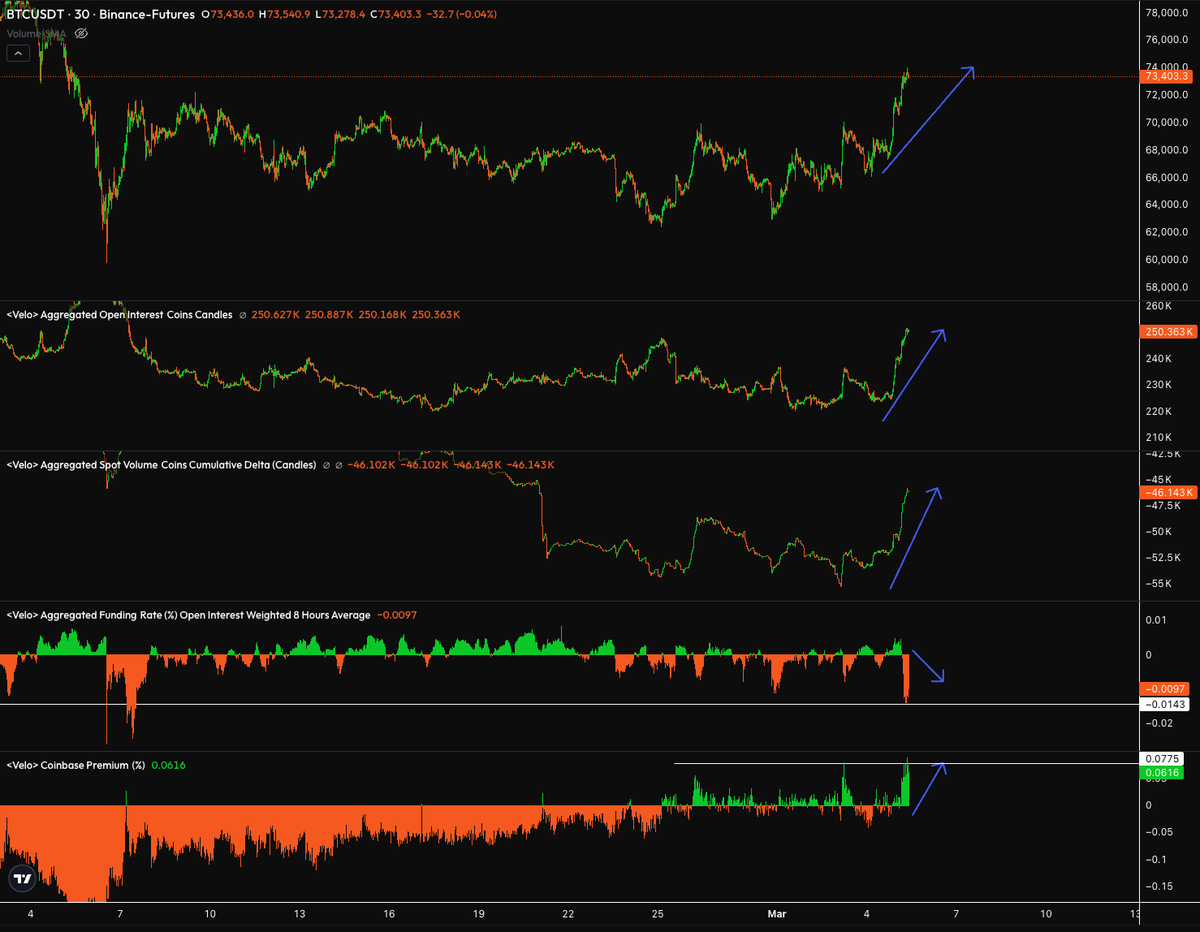
At the top, price. Pushing. Good.
Second down, Open interest, this is essentially leverage. Increasing, traders are apeing hard.
Third down, Spot volume... pushing nicely with price. Healthy. People are buying this rally with spot.
Fourth down, Funding. This gives us an idea which side is apeing harder. Neagtive, shorts are pushing more, positive, longs are pushing more.
Fifth down, Coinbase premium. Shows us the price difference between btc traded on coinbase nd the global market average. Positive signals strong buying pressure n the US market = good.
So what we have here is:
1. Price pushing
2. Leverage increasing
3. Spot also increasing
4. Highly negative funding
5. Positive premium
When you put this together we see that price is moving organically from spot buying and coinbase premium, whilst leverage is increasing but its much more on the short side.
What this means is that spot can continue to push the price up whilst traders ape shorts and create fuel for even higher if they get squeezed.
Its not an exact science, but its very notable how things are looking here.
Its an overall healthy move higher, and the price action also looks impulsive to me.
Watching closely today to see if we get a pivot here,
English
Kratopx retweetledi

นอกจาก Anthropic ที่แจกคอร์สเรียน AI ฟรี แล้วจริงๆ ยังมีอีก 10 บริษัท AI เจ้าใหญ่ๆ ที่มีคอร์สเรียน 0 บาทเหมือนกัน!
ผมรวมมาให้แล้ว เซฟไว้เรียนได้เลย
1. OpenAI: academy.openai.com
2. Google: grow.google/ai
3. Microsoft: learn.microsoft.com/training
4. NVIDIA: developer.nvidia.com/training
5. DeepLearningAI: deeplearning.ai
6. Meta: ai.meta.com/resources
7. AWS: skillbuilder.aws
8. IBM: skillsbuild.org
9. Hugging Face: huggingface.co/learn
10. Stanford: online.stanford.edu/free-courses
คนส่วนมากจ่ายค่าเรียนแพงๆ เพราะมันสะดวก แต่คนที่ขวนขวายก็จะเจอของที่คุ้มค่าและดีแบบนี้แหละครับ :)
Peter Agboola@baba_Omoloro
Anthropic has launched free courses to master AI with certificates for $0.00 anthropic.skilljar.com
ไทย
Kratopx retweetledi

Two protocols generate 69% of all crypto holder revenue.
The rest of the “investible” market is embarrassingly small.
I put together a list of 132 tokens across 12 narratives that might survive the bear market.
Read it here: ignasdefi.com/p/the-investib…
English
Kratopx retweetledi

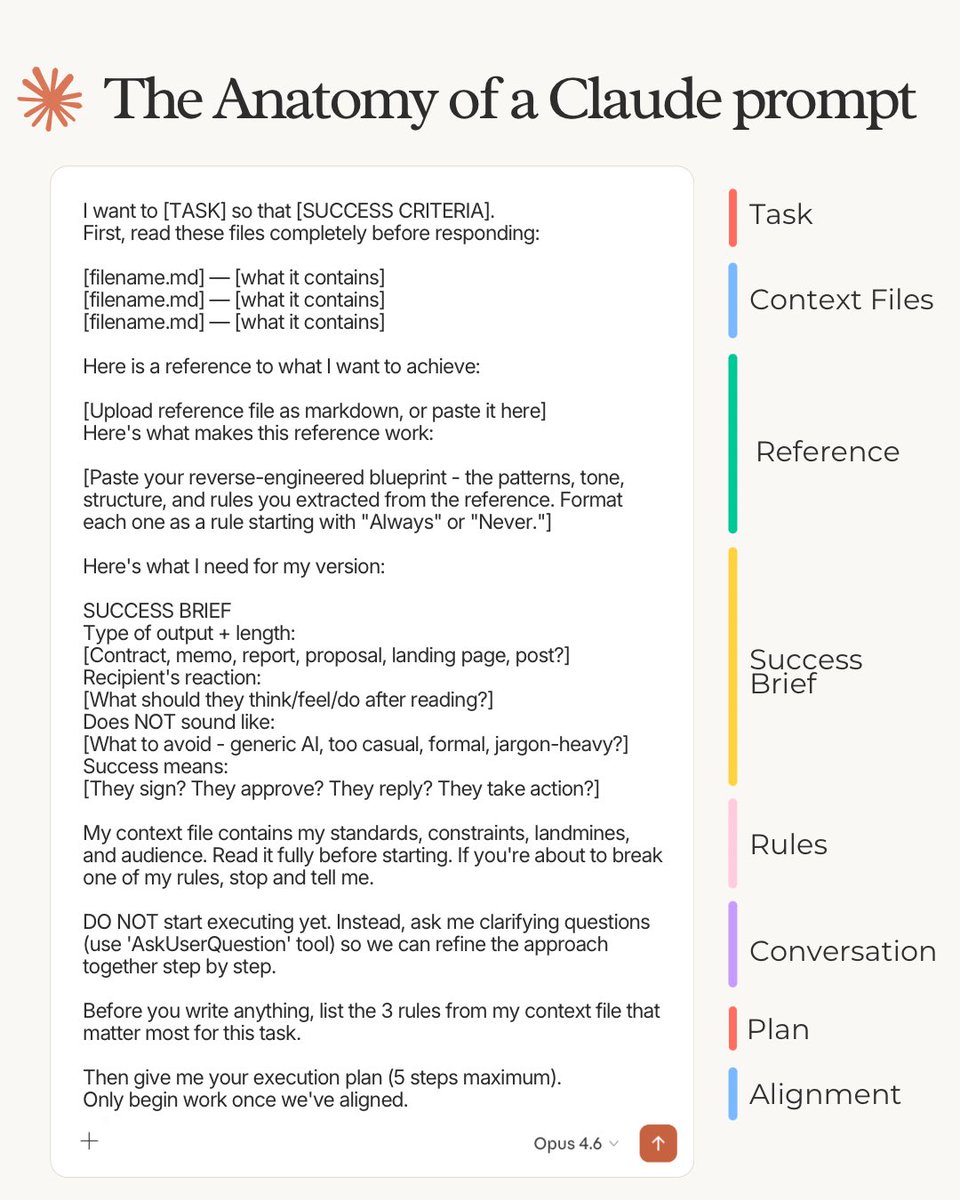
The Anatomy of a Claude 4.6 Prompt:
1. Task
Define what you want & what success looks like:
"I want to [TASK] so that [SUCCESS CRITERIA]."
No roles, "act as a senior expert." That era is over.
2. Context Files
Upload context files with your expertise and rules:
"First, read these files completely before responding: [filename .md] - [what it contains]."
AI went from reading a sticky note to an entire book.
Stop explaining yourself in the prompt. Put it in files.
3. Reference
Show AI exactly what you want. Upload an example.
Then give patterns, tone & structure as rules. No "give me something like" & hoping AI figures it out.
4. Brief
This is the only part you actually type from scratch. Everything else is files. "Type of output + length.
Does NOT sound like. Success means."
5. Rules
Context file holds your standards, taste & audience.
Prompt: "Read it fully before starting. If you're about to break one of my rules, stop and tell me."
6. Conversation
You spent 3 years prompting AI. Now it prompts you
Prompt: "DO NOT start executing yet. Ask me clarifying questions (use 'AskUserQuestion' tool) so we can refine the approach together step by step."
7. Plan
Claude read your files before writing a single word.
Prompt: "Before you write anything, list the 3 rules from my context file that matter most for this task. Then give me your execution plan."
8. Alignment
Nothing happens until you both see the same aim. This replaces the old prompting era.
Prompt: "Only begin work once we've aligned."
Copy the full prompt template + download my personal md. files for Claude here: how-to-ai.guide.
English
Kratopx retweetledi

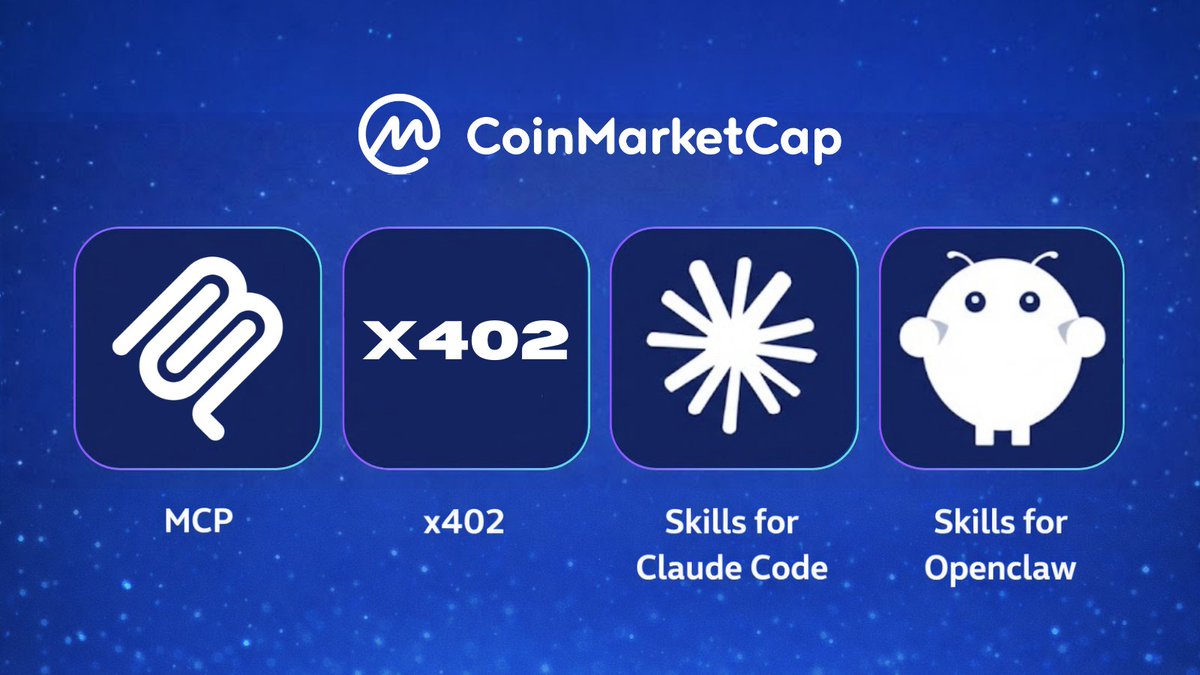
AI agents are getting smarter, but they still need market context.
Today, we’re launching 4 AI Agent-focused products:
🔹 MCP for real-time data
🔹 x402 support for CoinMarketCap APIs
🔹 Skills for Claude Code
🔹 Skills for @openclaw 🦞
Equip your AI agents with real-time crypto market intelligence.
Keep scrolling 👇
English
Kratopx retweetledi

Anthropic has launched free courses to master AI with certificates for $0.00
anthropic.skilljar.com
English
Kratopx retweetledi

บางคนอาจสงสัย ทำไมอิหร่านยิงจรวดใส่ประเทศอื่นที่ไม่ใช่อิสราเอลหรืออเมริกา ? พวกเขาเกี่ยวอะไรด้วย ?
คำตอบคือ : ดูไป ซาอุ กาต้า คูเวต บาเรน จอร์แดน ที่ตั้งฐานทัพอเมริกันทั้งนั้น ไชปรัสก็โดนเพราะมีฐานทัพอังฤษที่ทัพเรืออเมริกันใช้
มองภาพกว้าง รัสเซียก็โดนนาโต้ล้อม จึงยอมให้ยูเครนเข้านาโต้ด้วยไม่ได้
จีนก็โดนล้อม ตั้งแต่เกาหลีใต้ ญี่ปุ่น ใต้หวัน (ถึงแม้ไต้หวันไม่มีฐานทัพอเมริกัน) ยาวลงมาทัพเรืออเมริกันก็ใข้แชงจีของสิงคโปร์ สัตหีบของไทย มีฐานทัพที่ฟิลิปปินส์และออสเตรเลีย และก็ร่วมปฏิบัติภาระกิจป้องกันกับอินเดีย ปากีสถาน และอินโดนีเซีย
พูดง่ายๆ โลกคือกระดานหมากรุก หมากวางไว้เต็มกระดาน ก้าวเดียวอเมริกาก็รุกฆาตทุกคน
นี่คือความหมายของการเป็นมหาอำนาจ

ไทย
Kratopx retweetledi

Auction Context – Market Profile as Your Map
Before you think about placing a trade, you want to know where in the auction cycle the market is.
Market Profile gives you the structure that most traders don’t see when they’re staring at candlesticks.
5 Core Concepts to Track:
1. Value Area High (VAH) / Value Area Low (VAL)
Defines the 70% of the session’s volume where most business was done.
Outside of value = “expensive” or “cheap” to the market participants.
2. Point of Control (POC)
Price with the most activity = a magnet in balance conditions.
3. Main Day Type Recognition (there are others)
3.1 Balanced -> Mean reversion more likely.
3.2Trend Day -> Initiative activity dominates which means profile elongates in one direction.
3.3 Double Distribution → Two distinct value zones; mid-point acts as a pivot.
4. Structural References
Single prints, low-volume nodes (LVNs) and (HVNs), poor highs/lows, unfinished auctions, each can act as magnets or barriers.
5. Why this matters:
Knowing the auction context lets you pre-define where business is likely to occur and where rejections are probable = which stops you from chasing every micro move.
NOW ONTO GAME PLAN:
Auction context feeds into your game plan.
You’re answering the following:
“Am I a buyer, seller, or observer today?”
“Where is my line in the sand?”
Premarket Prep Routine:
- Mark prior session VAH, VAL, POC.
- Mark overnight high/low and see how they relate to prior value.
- Note anomalies (e.g., single prints) that could be filled.
Decide if you’re looking for:
Initiative trades (price driving away from value) ?
Responsive trades (price returning to value) ?
Bias Examples:
Open above VAH + holding → Look for longs if order flow supports continuation.
Open inside prior value → Fade moves to VAH or VAL unless initiative order flow breaks out.
Mindset:
You should be able to write your bias in one sentence before the open. If you can’t, you’re not ready to trade.
Anyway just my 1 cent whilst Im watching a trade develop - cheers
English
Kratopx retweetledi

I spent 100 hours over the past week researching, writing and editing the piece we just put out.
It’s a scenario, not a prediction like most of our work. But it was rigorously constructed, dismissing it outright requires the kind of intellectual laziness that tends to get expensive.
And we’ve released it for free. Hopefully you enjoy it.
citriniresearch.com/p/2028gic
English
Kratopx retweetledi

As the Aave DAO is about to vote on the largest funding proposal in its history involving a controversial contributor, Aave Labs, we published a full audit of their (lack of) performance.
It's a very long read, but I invite everyone to dive in and form their own opinion based on evidence.
Aave-Chan Initiative {ACI}@AaveChan
As the Snapshot for the $51M "Aave Will Win" ask drops tomorrow, take a look at our Audit of Aave Labs' performance and their ~$86M in funding they've received to date. This deserves the community's full attention before any major decisions. Read the full post here: governance.aave.com/t/aave-labs-86…
English