Nikolaus Kriegeskorte

4.8K posts

Nikolaus Kriegeskorte banner
Nikolaus Kriegeskorte

Nikolaus Kriegeskorte

@KriegeskorteLab

Vision, neural networks, and open brain science. RT means "This may deserve more attention". Like means "I have read this (e.g. paper) and think it's solid."

Katılım Haziran 2014
3K Takip Edilen10K Takipçiler
Nikolaus Kriegeskorte retweetledi
Lance Ying
Lance Ying@LanceYing42·
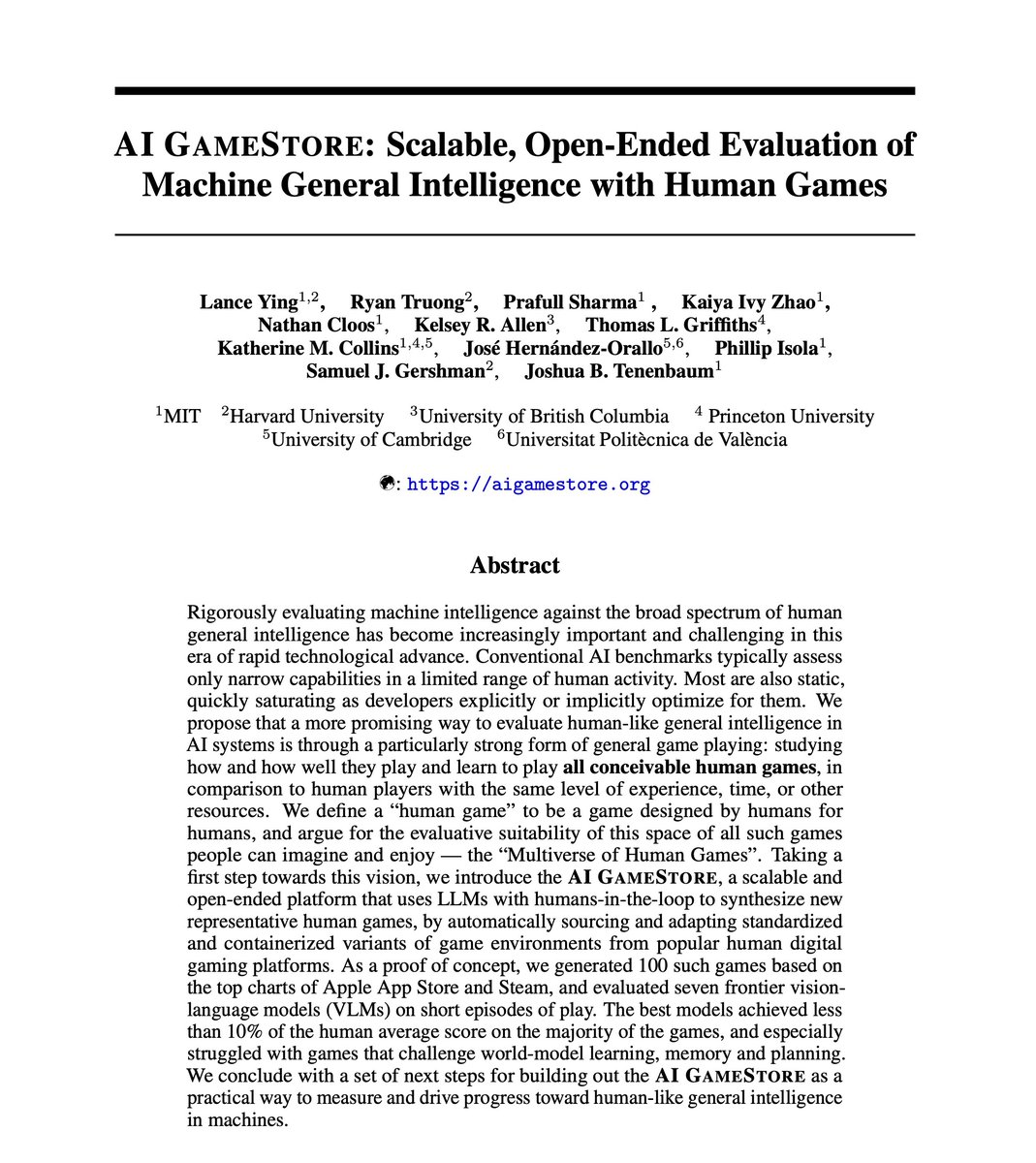
Today we present a new framework for measuring human-like general intelligence in machines (what some people call AGI). Conventional AI benchmarks today assess only narrow capabilities in a limited range of human activities. We propose that a more promising way to evaluate human-like general intelligence in AI systems is through a particularly strong form of general game playing: studying how and how well they play and learn to play all conceivable human games — what we call the ``Multiverse of Human Games''. Taking a first step towards this vision, we introduce the AI GameStore, a scalable and open-ended platform that uses LLMs with humans-in-the-loop to automatically construct standardized and containerized variants of popular human games on digital gaming platforms. As a proof of concept, we generated 100 such games based on the top charts of Apple App Store and Steam, and evaluated seven frontier vision-language models (VLMs) on short episodes of play. The best models achieved less than 10% of the human average score on the majority of the games. Check out our website to play the games, see how agents play, and build agents to solve them!
Lance Ying tweet media
English
4
28
111
18.4K
Nikolaus Kriegeskorte retweetledi
Kazuki Irie
Kazuki Irie@kzkirie·
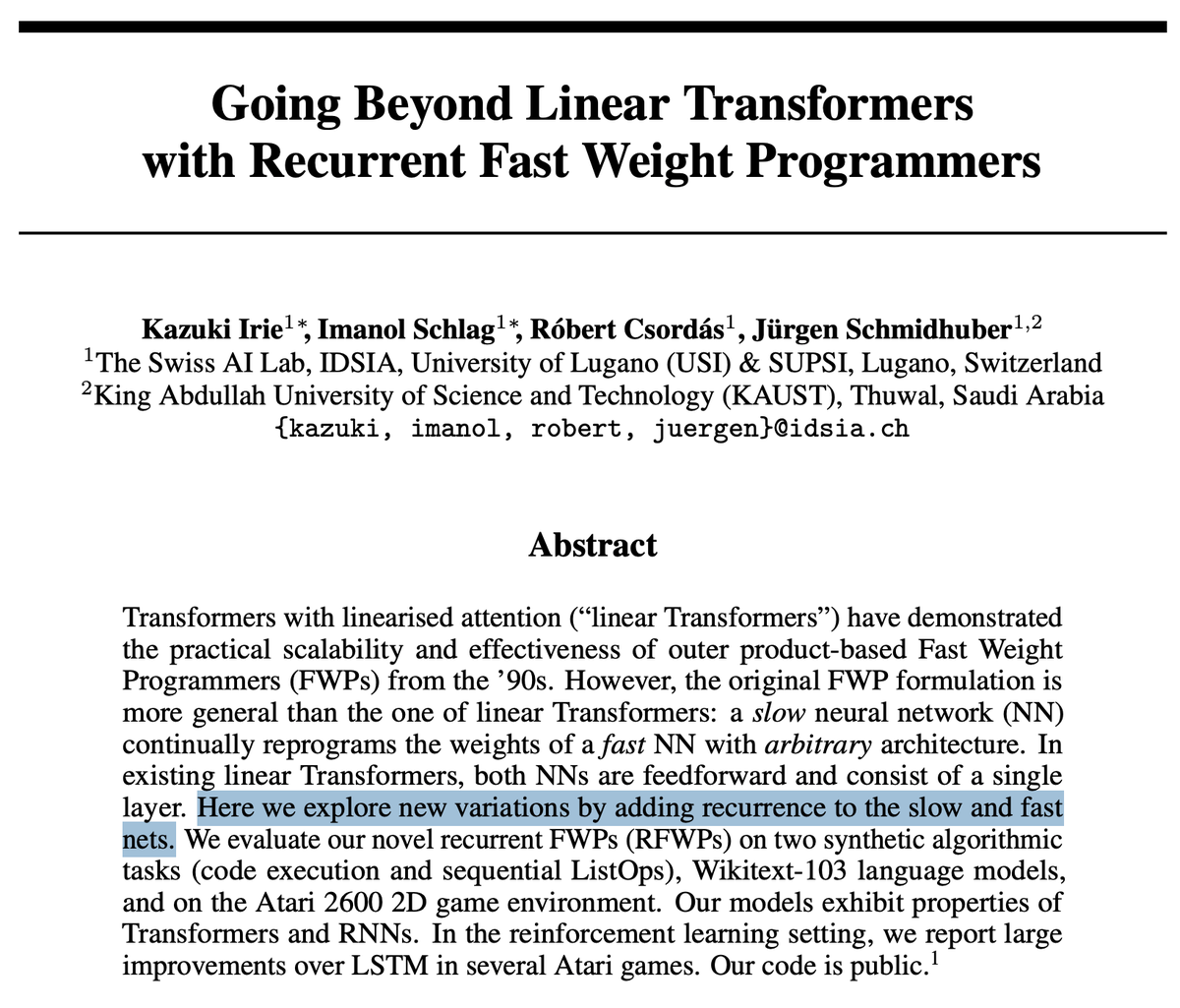
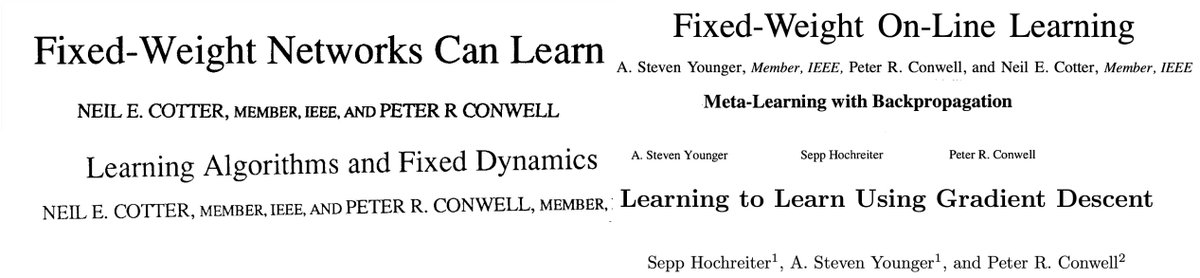
Am I the only one ​w​ho thinks Cotter & Conwell's "Fixed-weight networks can learn" (1990) is so underappreciated in light of in-context learning (and beyond)? with follow-ups including @HochreiterSepp's masterpiece (2001). Cited 62 times (​of which 10% are me). Seems too few.
Kazuki Irie tweet media
English
4
8
34
3K
Nikolaus Kriegeskorte retweetledi
McGovern Institute
McGovern Institute@mcgovernmit·
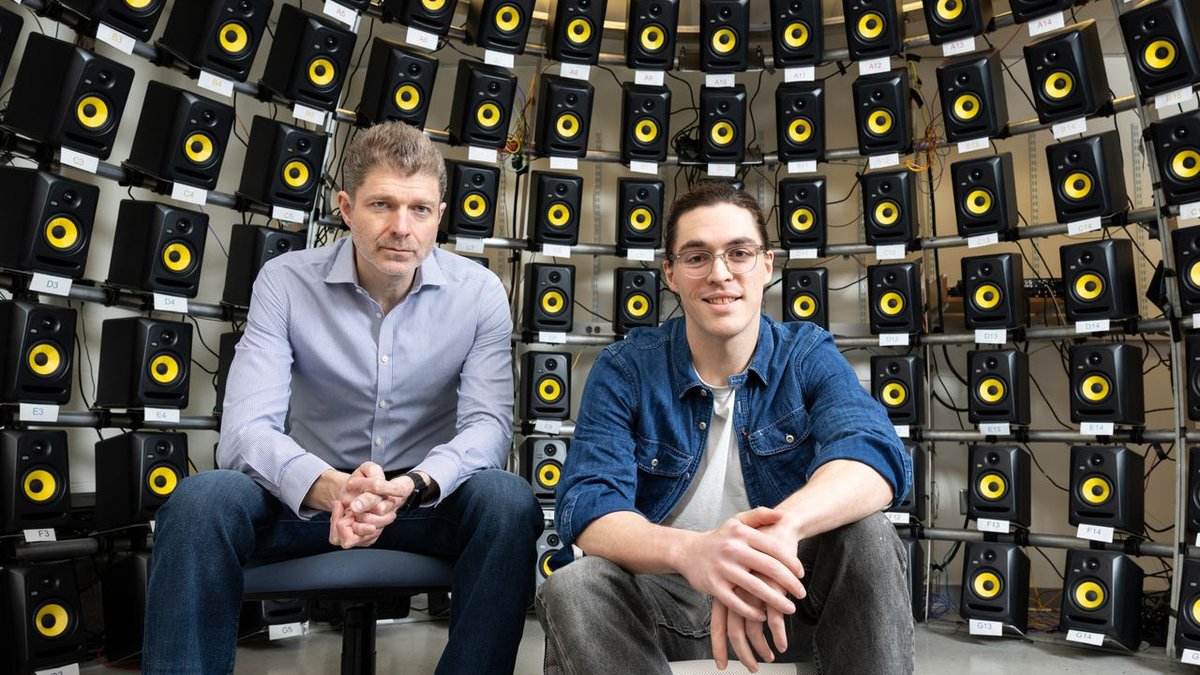
How does your brain follow one voice in a noisy room? MIT scientists found that the brain may focus on a speaker by boosting neural signals tuned to features of that voice—like its pitch. This insight could help improve cochlear implants. 🦻 mcgovern.mit.edu/2026/03/13/how…
McGovern Institute tweet media
English
1
8
31
2.6K
Nikolaus Kriegeskorte retweetledi
Greg Lukianoff
Greg Lukianoff@glukianoff·
American elites took public trust for granted. That was a catastrophic mistake. If people see even one academic punished or canceled for holding a view most Americans share, they stop trusting experts. And it didn’t happen once: FIRE found 14% of faculty — about 1 in 7 — say they’ve been disciplined or threatened with discipline for speech.
Gurwinder@G_S_Bhogal

It doesn't take much censorship to create a culture of self-censorship. And self-censorship is the most dangerous form of censorship because it looks exactly like freedom.

English
17
253
1.1K
50.5K
Nikolaus Kriegeskorte retweetledi
Ilya Sutskever
Ilya Sutskever@ilyasut·
It’s extremely good that Anthropic has not backed down, and it’s siginficant that OpenAI has taken a similar stance. In the future, there will be much more challenging situations of this nature, and it will be critical for the relevant leaders to rise up to the occasion, for fierce competitors to put their differences aside. Good to see that happen today.
English
1.4K
2.5K
25.6K
3M
Nikolaus Kriegeskorte retweetledi
Stéphane Deny
Stéphane Deny@StphTphsn1·
Today, I'd like to tell you about an article by Yohtaro Takano, entitled "Perception of Rotated Forms: A Theory of Information Types" (1989). 🧵
Stéphane Deny tweet mediaStéphane Deny tweet media
English
4
50
258
15K
Nikolaus Kriegeskorte retweetledi
Doris Tsao
Doris Tsao@doristsao·
I’m truly excited about today’s announcement that @dileeplearning is joining @AsteraInstitute to lead the AGI research program. I feel incredibly lucky that I’ll get to work alongside him and his team on the shared quest to understand intelligence and consciousness, with AGI and neuroscience advancing side by side. As he writes in his blog post, there is no shortcut. Only through deep, humble engagement with core structures of intelligence, including object binding, knowledge schemas, learning, memory, columnar architecture, will we understand the brain’s solution and move closer to human level AGI. I encourage everyone to read the post. If these ideas resonate with you, experimentally or computationally, please reach out.
Dileep George@dileeplearning

x.com/i/article/2026…

English
5
28
206
16K
Nikolaus Kriegeskorte retweetledi
Paul Linton
Paul Linton@LintonVision·
Absolute honor to be awarded the David Marr Medal by the Applied Vision Association, and to present my talk "Experience Before Inference" as a Keynote at their Christmas Meeting. Video and preprint to follow soon!
Paul Linton tweet media
English
4
4
41
2.7K
Nikolaus Kriegeskorte retweetledi
Steven Pinker
Steven Pinker@sapinker·
Bombshell: Oliver Sacks (a humane man & a fine essayist) made up many of the details in his famous case studies, deluding neuroscientists, psychologists, & general readers for decades. The man who mistook his wife for a hat? The autistic twins who generated multi-digit prime numbers? The institutionalized, paralyzed man who tapped out allusions to Rilke? Made up to embellish the stories. Probably also: the aphasic patients who detected lies better than neurologically intact people, including Ronald Reagan's insincerity. newyorker.com/magazine/2025/…
English
3
2.7K
12.4K
6.6M
Nikolaus Kriegeskorte retweetledi
Kamila Maria Jozwik
Kamila Maria Jozwik@KamilaJozwik·
4-year PhD position in visual cognitive computational neuroscience at the University of Cambridge in my lab kamilajozwik.com/docs/PhD_posit… (soon advertising a postdoc position too; feel free to contact me)
English
8
71
344
38K
Nikolaus Kriegeskorte retweetledi
Eivinas Butkus
Eivinas Butkus@eivinasbutkus·
1/ Can causal models and causal inference engines emerge through next-token prediction? @yudapearl and others (@matej_zecevic) have argued no. We present behavioral and mechanistic evidence that this is possible. #neurips2025 #NeurIPS
English
9
23
67
23K
Nikolaus Kriegeskorte retweetledi
Ethan Hwang
Ethan Hwang@ethanhwang_·
Encoding models predict visual responses to novel images in cortical areas. But can these models offer new insights about categorical representations? If so, we should be able to generate new hypotheses from them to be tested in future experiments. @NeurIPSConf #NeurIPS2025 1/15
Ethan Hwang tweet media
English
1
8
25
3K
Nikolaus Kriegeskorte retweetledi
Tomoyasu Horikawa
Tomoyasu Horikawa@HKT52·
Our "mind captioning" paper is now published in @ScienceAdvances. The method generates descriptive text of what we perceive and recall from brain activity — a linguistic interpretation of nonverbal mental content rather than language decoding. doi.org/10.1126/sciadv…
Tomoyasu Horikawa@HKT52

Our new paper is on bioRxiv. We present a novel generative decoding method, called Mind Captioning, and demonstrate the generation of descriptive text of viewed and imagined content from human brain activity. The video shows text generated for viewed content during optimization.

English
3
25
80
10.7K
Nikolaus Kriegeskorte retweetledi
Hjalmar Wijk
Hjalmar Wijk@HjalmarWijk·
What are examples of compelling/moving/interesting art that uses generative AI in novel ways, rather than recreating existing art styles? I'm surprised I haven't seen more of this (but maybe I haven't been looking in the right places), some examples in thread
English
10
5
14
2.2K
Nikolaus Kriegeskorte retweetledi
Ilia Sucholutsky
Ilia Sucholutsky@sucholutsky·
🧵🎉 Our mega-paper is finally published in TMLR! We're "Getting Aligned on Representational Alignment" - the degree to which internal representations of different (biological & artificial) information processing systems agree. 🧠🤖🔬🔍 #CognitiveScience #Neuroscience #AI
Ilia Sucholutsky tweet media
English
5
37
149
33.9K