

3ZY
222 posts

In the Shafi'i madhab it is permitted to delay making up a salaat you have missed due to sleeping over.
Namely if you missed fajr due to sleeping till after its time and wake up after, you can go back to sleep and pray it later on.
English
3ZY retweetledi
" مَّا كَانَ مُحَمَّدٌ أَبَا أَحَدٍ مِّن رِّجَالِكُمْ وَلَٰكِن رَّسُولَ اللَّهِ وَخَاتَمَ النَّبِيِّينَ .. "
اللهم صل وسلم على نبينا محمد
•• || بصوت #احمد_بن_طالب حميد
العربية
3ZY retweetledi

@ibmsulaymani the name and handle should be enough to know that it's a militant shia so the exuce of him not going on his profile and not seeing this post wouldnt work
English

Daniel Haqiqatjou is now retweeting open Rawāfiḍ who insult the Ṣaḥābah, particularly the likes of Abū Bakr, ʿUmar, ʿUthmān and ʿĀʾishah (رَضِيَ اللهُ عَنْهُم).


Română


@abdul_now How do the mutakalimin try to make sense of creation coming to being without any change or act before it? Is it true that al-Ghazali just said that it exceedes the human mind and language - the christian mystery cope-out?
English

The Cosmological Argument Without the Kalami Baggage
The reason I know Hijab hasn't carefully read Ibn Taymiyya on these questions is that he says something like this without seeming to notice what it actually does to the route he's taking. If he really sat with those discussions, the point he's making in this clip would not look like support for his strategy at all.
He says he does not know anyone who accepts an infinite regress of causes, and that's true. But once that much is already out the way, this whole shift to an Avicennan framework with all the baggage it comes with should already start looking a lot less appealing. Let me explain why.
If an infinite regress of causes is impossible, then all you need in order to reach the conclusion Hijab wants to reach is just one thing that came into being after not existing at all. All you need is one instance of temporal origination. Your own coming into existence and the things happening right in front of you give you exactly that. And unless you're now going to retreat from even this to satisfy the skeptic, you already have all you need. Not just from what's all around you, but from within your very self. You have, in your very own existence, something that came into being after not existing, and therefore requires a cause that brought it into being, a self-sufficient cause whose existence is not itself from something else.
And regardless of whether the sequence of temporally originated things extends infinitely into the past or not, it still follows that the whole series cannot sufficiently explain the temporally originated thing in question, because if an infinite regress of causes is impossible, then the series cannot just hang there without terminating in a self-sufficient cause. So once he's already granted that much, the conclusion he's after is already right there in substance. But if that's the case, why abandon this clearly more straightforward route in favor of Ibn Sina's? Why leave behind the immediate and obvious reality of temporal origination and retreat into a highly abstract metaphysical framework with all the theological baggage it comes with?
Part of the answer is that there's a significant amount of kalami pressure still doing work in the background, whether he sees it clearly or not. He's still being pulled by a picture in which that one temporally originated thing right in front of him somehow does not yet feel enough, and in which there's still a need to rule out a beginningless past of any kind at all before the argument is secure. And since fighting through this kalami route comes with its own heavy costs, Ibn Sina's more abstract starting point becomes appealing precisely because it seems to float above that whole battlefield entirely.
That whole picture doesn't just come from nowhere. It belongs to a framework shaped by Mu'tazili-Ash'ari atomist commitments and by the Avicennan alternative that presents itself as the way out. But that's precisely the false dichotomy that Ibn Taymiyya's engagement with these schools exposes. And that's why I said at the start that Hijab clearly has not absorbed those discussions.
I say this because nobody exposes how this whole dilemma gets manufactured in the first place more clearly than Ibn Taymiyya. Once you follow both of these approaches through to where they actually lead, the picture roughly looks like this: On the kalami side, the world is temporally originated, but there's no temporal cause and no temporally specifying reason for why it began when it did rather than before or after. On the Avicennan side, the idea of a temporally originated world without a temporally specifying reason for why it began at one moment rather than another is rejected, and what that drives them to is an eternal world flowing necessarily from a timeless source.
The first side is left saying that the world did not exist and then suddenly came into being, when absolutely nothing changed in the first "non-existence" state to bring the "existence" state about. No new act, no new cause, no new specification of any kind. Just non-existence, and then existence, with nothing in between that accounts for the difference. And this isn't just the ordinary sense of "why this moment rather than another" as if time was already flowing in the background and there was succession of some sort. The issue is that there's no succession there at all, and yet somehow a first occurrence appears without anything new accounting for it.
The second side, on the other hand, tries to avoid that mess by denying the beginning altogether. But then it runs into a worse problem, because if the world flows necessarily from an eternally sufficient cause, then by right, there shouldn't be temporally originated things happening right in front of us at all. If the sufficient cause is eternally what it is and its effect follows necessarily, then nothing genuinely new should ever come to be. And yet things do come to be and events do occur right before our eyes. So that picture ends up in something far worse than the kalami one, because it leaves the very occurrences we're constantly witnessing impossible to account for in the first place.
This choice between denying any kind of beginningless past on one side, or accepting an eternal emanation of the world from a timeless source on the other, only starts looking meaningful once certain premises about God have already been quietly accepted in the background. Brother Hijab is either knowingly or unknowingly operating within a system that traps you between these two options. Part of what Ibn Taymiyya's critiques are meant to show is that this whole "menu" is already the product of framework-level concessions that didn't need to be made in the first place.
The whole force of Ibn Sina's move depends on those prior concessions. If you deny real volitional attributes and deny that God's willing and acting are themselves genuinely real and successive (as opposed to being reduced to mere effects within creation), then of course you're going to be left staring at the world's coming into existence and finding nothing in God that accounts for it. And that's exactly the pressure Ibn Sina exploits. He isn't exposing some universal difficulty that falls equally on every conception of God. He's taking advantage of a problem that only becomes a problem once those earlier denials are already in place.
From our side, that whole pressure is manufactured by a prior departure from what revelation teaches plainly and what a sound fitrah and uncorrupted reason recognize naturally about God. He acts when He wills. He does what He wills. One thing genuinely follows another by His act and decisive will. He truly answers when called upon. He creates, commands, speaks, loves, is pleased, is angered, and does what He wills when He wills. This is not some later philosophical patchwork brought in to rescue a weak position. It's the direct meaning of what was revealed to the prophets (peace be upon them) and the most natural and intelligible understanding of the Creator in the first place. The whole metaphysical mess we've been walking through only begins after that is set aside and people start trying to reconstruct coherence in its absence. The dilemma that pushes Hijab toward Ibn Sina simply does not arise for those who never made that initial concession.
But even if all of that is set aside and Ibn Sina is taken on his own terms, his approach doesn't solve this manufactured problem anyway. It makes it worse. If the world proceeds from an eternally complete cause that necessarily produces its effect without interval or delay, the very occurrence of events within the world becomes unintelligible. If the sufficient cause is eternally what it is and its effect follows necessarily from it, then why are new things happening at all? Why is anything coming to be? Why is there succession? Either everything that proceeds from that cause should always have been exactly as it is, in which case the occurrence of new events becomes impossible to make sense of, or events are somehow happening without anything genuinely bringing them into being, which is even worse.
Hijab's own position sits uncomfortably between both of these frameworks without actually being grounded in either of them. On the kalami side, the denial of real volitional attributes is driven by the famous dalil al-a'rad that Ash'aris inherited from the Mu'tazila. A flawed argument whose anti-past-infinitude burden Hijab himself seems uneasy about defending, and one that even scholars within the kalami tradition have never fully settled among themselves. On the Avicennan side, the denial of volitional attributes is tied to the composition argument, which is even more obviously flawed than the first, and which Hijab himself effectively rejects the moment he wants to affirm real attributes of God elsewhere. So he's neither willing to fully own the kalami grounds nor willing to accept the Avicennan ones, and yet he remains caught between both frameworks in a way that has him selectively borrowing loaded conclusions from each while rejecting the very premises that would at least give either position a fighting chance at internal coherence. As for the position that actually makes sense, the one that does not require any of this maneuvering and doesn't come loaded with any of these burdens, that's the one he keeps stepping around.
He already has temporal origination staring him right in the face, not just in the world around him but in his very own existence. And once he grants the impossibility of an infinite regress of causes, that's already all he needs to arrive at the conclusion he's after. And yet instead of taking the direct route that's right there in front of him, he moves into inherited frameworks with all the speculative premises and theological costs that come with them, and then has to spend his time patching around the problems those frameworks generate. That's what happens when you reach for the most sophisticated-looking formulation without a sufficiently clear view of what drove people into those frameworks to begin with, and without a clear understanding of what they had to give up along the way to stay in them.
English
3ZY retweetledi

Don't ask how the rock got there
Jamie Bambrick@j_bambrick
“So the rain fell on the rocks for millions and millions of years and then this thing just spontaneously appeared.”
English
@SolarBeam2Lunar @IslamicSH_ it's not sheikh, it comes from the persian word "shah" which means king and it's still pronaunced exactly like that in some countries
English

@IslamicSH_ Relevant Potential: Sheikh matt.
means the king is dead!
European slang: Check mate.
English
An Andalusian Muslim and a Christian playing Chess, an engraving from 1283.

English
3ZY retweetledi

أفأمنتم أن يخسف بكم جانب البر..| ترتيل عذب وبديع! للشيخ #أحمد_بن_طالب من سورة الإسراء ♥️..
العربية
The great advantage of "there is no doubt that there is existence" over the cogito, we are told, is that it gives the opponent even less wiggle room to work with. Which tells you something about what this whole project is actually organized around.
When sophistry gets to set the terms of the discussion, what follows is a project organized around finding the most insulated and opponent-proof formulation possible. That approach already pulls the discussion away from the immediate and obvious realities that should be doing the actual work. And once that happens, the arguments start being shaped by strategic concerns rather than by what's actually evident and clear.
This is also the deeper problem with that "strong" sense of philosophical rationalism as a methodological approach to these debates. It has the tendency to treat what is more abstract and more analytically "tidy" in the mind as more rationally secure than what is plainly known through the reality right in front of us. So instead of starting from originated and dependent things as they're actually encountered, the ambition becomes to retreat to a more minimal formal premise and build upward from there, as if certainty becomes stronger the more you distance it from the concrete realities that actually ground the discussion in the first place.
That's why the comparison to Descartes matters, because the whole impulse here is the same sort of move: start from the most intellectually "controllable" point you can possibly formulate in the mind, then try to build the rest of reality upward from there. It's also why Hijab is drawn to Ibn Sina's route. What attracts him is not just one argument among others, but the promise of a "cleaner" construction.
Ibn Sina's approach lets Hijab get past the debates around time and infinite regress, and that's clearly a large part of the appeal for him. But that doesn't mean he's somehow left the deeper methodological problem behind. It means he's stepped into a framework with its own pressure points and its own consequences, whether he wants to acknowledge them or not. What exactly does he think happens once you adopt such a framework? That philosophers just stop arguing?
People have been contesting Ibn Sina's framework itself and the whole set of problems it comes with for centuries. If you want to play by the sophists' rules, there's no clean way out. That's the whole point. Once you make this whole "abstract construction" game the thing everything hangs on, there will always be counter-construction, resistance, and sophistry pushed back at you from the other side.
The problem with Hijab's use of Ibn Sina is that he wants to borrow the framework while denying or evading what it naturally carries with it. Contingency in Ibn Sina's sense is not just ordinary dependence in the direct and familiar sense people usually have in mind. It gets extended in a far more abstract direction to the extent that it includes even what is eternal so long as its existence is not taken to be "self-sufficient" in a very specific, loaded sense of the term. What it actually comes down to is something closer to analytic necessity: that the very abstract concept, taken just as a concept, is treated as enough to secure existence without anything beyond it. What counts as truly "necessary" then ends up being "absolute existence" considered in the abstract, not the real, willing Creator affirmed in revelation. It's a perfect example of confusing what exists only as an abstraction in the mind with what exists concretely in reality.
The same twists and turns happen with the concept of causation too (in order to leave room for eternal/simultaneous causation). In the lecture, Hijab brings up the "finger-and-ring" example to make simultaneous causation seem intuitive, as if the causal relation on this "eternal universe" picture can be understood without any real temporal origination coming after an act of creation. But as Ibn Taymiyya and others discuss, what that example actually shows is just a chain of dependence in which neither item is the source of its own movement. The ring moves because the finger moves, but the finger's movement is only a condition for the ring's movement, just as the palm's movement is a condition for the finger's movement. So the relation of the finger to the ring is no different in kind from the relation of the palm to the finger: in both cases, you aren't looking at a sufficient causal source, but at one dependent thing being moved through another dependent thing, where the efficient cause (the actual source of the movement) is nowhere to be found in the chain itself. The finger's movement is not a sufficient cause of the ring's movement, and both sit inside a larger chain whose members are all receiving motion from beyond themselves.
In any case, it's this kind of verbal juggling that somehow gets you a world that's always existed and yet is still supposedly dependent on God as the causal source of its existence. And the "necessary existent" the argument arrives at ends up stripped of any real attributes, because the framework's own logic makes any determinate characterization of it look like a threat to its necessity. That's what this approach leads to when followed through. Hijab openly promoting this framework is a serious problem, and the fact that he dodges some of its entailments does not make that problem go away. It just turns the whole thing into exactly what we would call سمك لبن تمر هندي in Egypt.
The truth that dependent things require what is genuinely self-sufficient is obvious and can just be stated plainly. But once it is reformulated in Avicennian terms, it's no longer the same obvious point. It now comes packaged with a whole set of commitments about what contingency and necessity entail, about the idea of createdness itself being obscured and emptied of meaning in the process, about divine action being reframed as eternal emanation instead of volitional origination, and about what can coherently be affirmed of God once that framework is in place.
Sapience Institute@SapienceOrg
"There is no doubt that there is existence." What does this sound close to? Watch Mohammed Hijab's new series: youtu.be/p8jNEplGItQ?si
English
3ZY retweetledi

How to Earn One Thousand Good Deeds in a Day: A Simple Prophetic Dhikr—Magnificent in Reward, Yet So Easily Attained!
Shaykh Ali bin Zayd Al-Madkhali حفظه الله
English
@abuibrahim_mm because it doesn't come up with anything, it recycles horrible facebook names from 2012
English

there's one simple thing AI is still pretty bad at: coming up with a good name.
English
3ZY retweetledi

3ZY retweetledi
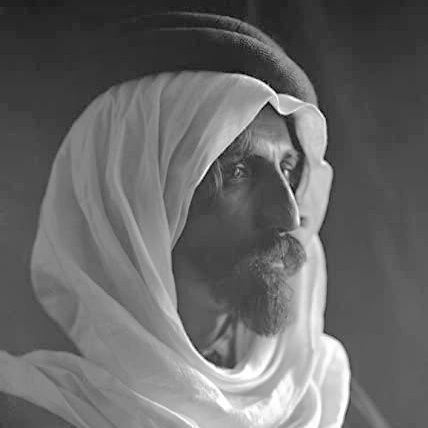
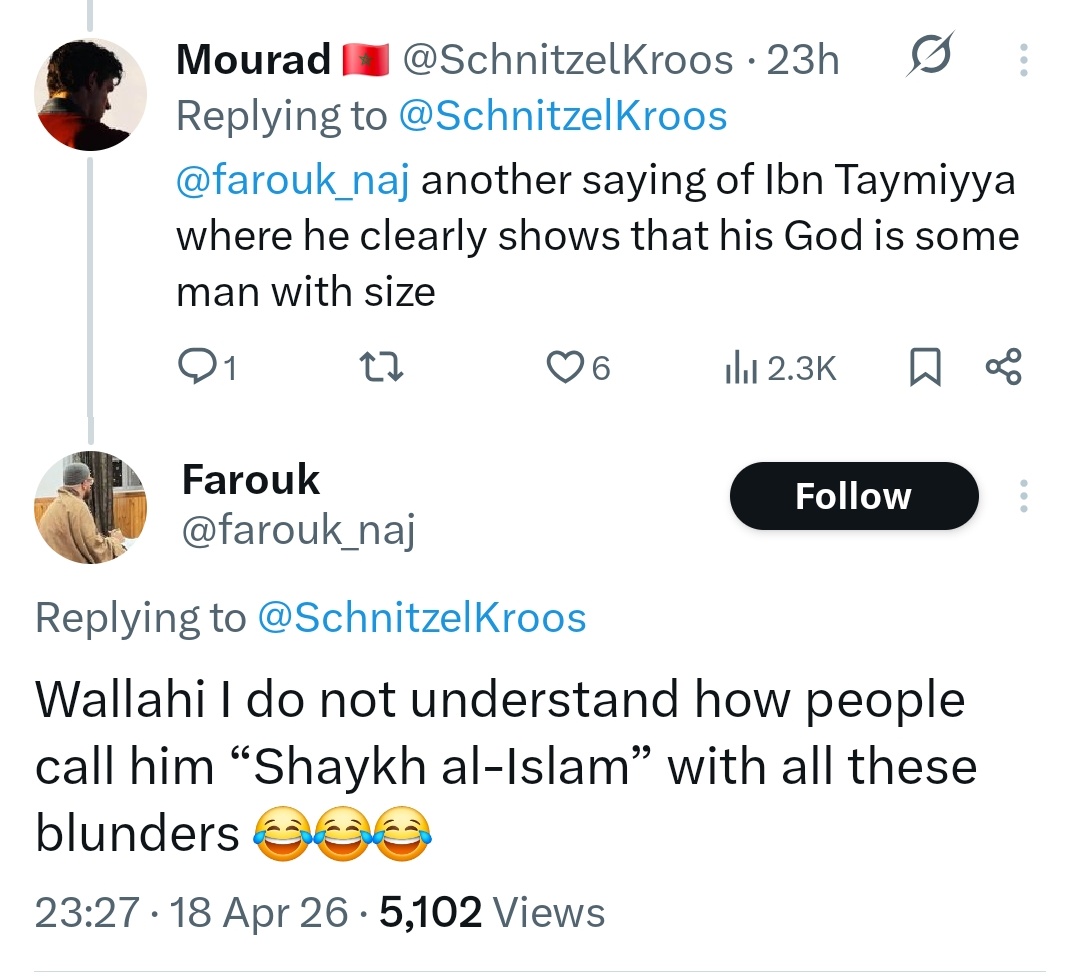
“As a dog returns to its vomit, so fools repeat their folly.” (Proverbs 26.11)
English
3ZY retweetledi
@skibidibap2 @ojora the hadith mentiones cedar tree (شجرة أرز) some of them look very simmilar to the pine trees
English



there really is a whole other world out there
ִֶָ@tatemclisa
i’m almost done paying off my tate mcrae ticket
English
3ZY retweetledi
