

Luke Hutchison
1.1K posts
Luke Hutchison
@LH
Everything-ist: computer scientist, biologist, chemist, physicist, cosmologist. PhD, MIT / Harvard Medical School. Former Google AI research scientist.
Planet Earth Katılım Mayıs 2009
1.8K Takip Edilen3K Takipçiler


Corporate AI psychosis is not just real but rampant, in particular agent psychosis. I have observed this firsthand. It's CORBA all over again. Five years from now, companies will be ripping out agents to return to sane, safe, deterministic, monolithic architectures.
Mitchell Hashimoto@mitchellh
I strongly believe there are entire companies right now under heavy AI psychosis and its impossible to have rational conversations about it with them. I can't name any specific people because they include personal friends I deeply respect, but I worry about how this plays out. I lived through the great MTBF vs MTTR (mean-time-between-failure vs. mean-time-to-recovery) reckoning of infrastructure during the transition to cloud and cloud automation. All those arguments are rearing their ugly heads again but now its... the whole software development industry (maybe the whole world, really). It's frightening, because the psychosis folks operate under an almost absolute "MTTR is all you need" mentality: "its fine to ship bugs because the agents will fix them so quickly and at a scale humans can't do!" We learned in infrastructure that MTTR is great but you can't yeet resilient systems entirely. The main issue is I don't even know how to bring this up to people I know personally, because bringing this topic up leads to immediately dismissals like "no no, it has full test coverage" or "bug reports are going down" or something, which just don't paint the whole picture. We already learned this lesson once in infrastructure: you can automate yourself into a very resilient catastrophe machine. Systems can appear healthy by local metrics while globally becoming incomprehensible. Bug reports can go down while latent risk explodes. Test coverage can rise while semantic understanding falls. Changes happens so fast that nobody notices the underlying architecture decaying. I worry.
English
@Riazi_Cafe_en I have been using the Dvorak layout for 30 years... It has proved to be a very good decision to switch.
English


Luke Hutchison retweetledi

China has really planned out the propaganda during Trump's visit. They even gave them different-sized chairs so that Xi would appear bigger than Trump.
English
Luke Hutchison retweetledi

I'm traveling the world for a bit, starting with China but then hopping around the globe, anywhere. Open to any adventure. No plans, only a backpack. Hoping to meet & get to know humans from all walks of life. The pic is from a long hike on the Great Wall. For me, as a fan of history, this was an epic experience.
In China, first I'm visiting a few big cities & talking to engineers at the heart of China's AI revolution. After that, if feeling crazy enough, I'm hitchhiking (first time) across rural China for a few weeks. Hitchhiking because I think it's the best way to meet rural folks who I would otherwise never get the chance to meet. I hope to do the same in US and other places.
I have a request, if you have a travel recommendation, fill out the form(s) below if you feel like it. Or share with folks who might have advice about such travel.
Form 1 - travel recommendation:
If you can, recommend to me an interesting place I should visit anywhere in the world. For this, fill out form 1. Not touristy stuff, but something off the beaten path, that tourists may not know about, but is legendary. It could be as remote as meeting a herder in the mountains who is a local legend. Asia, Middle East, Europe, India, South/North America, Africa, Australia, anywhere. In China, I'm hoping to visit maybe Heibei, Shanxi, Shaanxi, Gansu, Sichuan, Yunnan, etc, so recommendations for spots to visit are helpful.
Form 2 - coffee:
If you want to grab a coffee with me anywhere in the world, fill out form 2 (please don't use form 1 for that).
Anyway, I hectically tossed stuff in backpack. Realizing I don't have a clear plan of any kind, which is probably the only way to do it. LFG.
Love you all ❤️

English
I can't handle the deluge of tweets full of AI tells. 🤮
My commitment: I will never use AI to write my tweets.
English

The absolute non-takeoff of VR and AR is probably one of the big upsets in consumer electronics history
Pretty much everyone thought this would be huge and it sort of just isn't
English
Luke Hutchison retweetledi
There will be no AI jobpocalypse.
The story that AI will lead to massive unemployment is stoking unnecessary fear. AI — like any other technology — does affect jobs, but telling overblown stories of large-scale unemployment is irresponsible and damaging. Let’s put a stop to it.
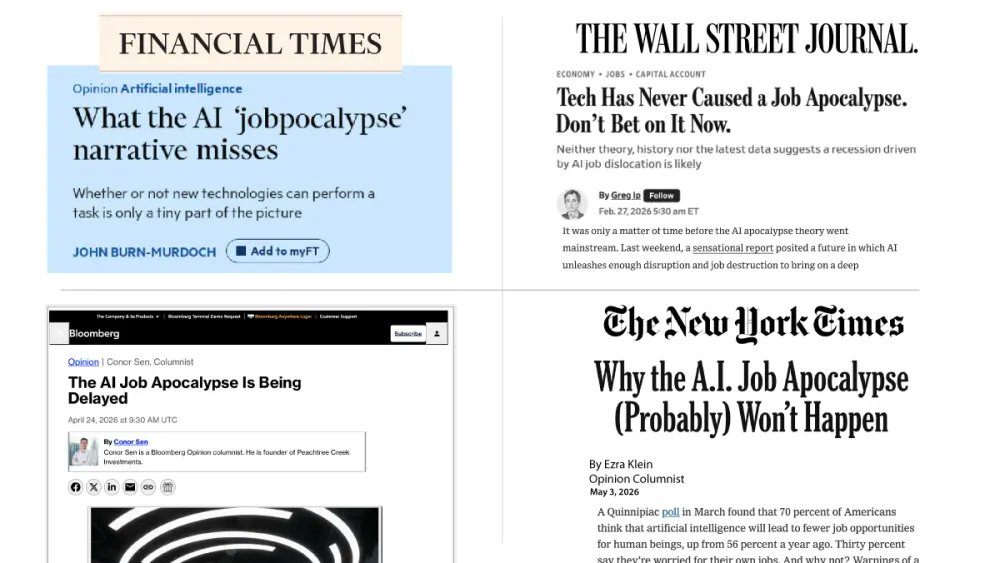
I’ve expressed skepticism about the jobpocalypse in previous posts. I’m glad to see that the popular press is now pushing back on this narrative. The image below features some recent headlines.
Software engineering is the sector most affected by AI tools, as coding agents race ahead. Yet hiring of software engineers remains strong! So while there are examples of AI taking away jobs, the trends strongly suggest the net job creation is vastly greater than the job destruction — just like earlier waves of technology. Further, despite all the exciting progress in AI, the U.S. unemployment rate remains a healthy 4.3%.
Why is the AI jobpocalypse narrative so popular? For one thing, frontier AI labs have a strong incentive to tell stories that make AI technology sound more powerful. At their most extreme, they promote science-fiction scenarios of AI “taking over” and causing human extinction. If a technology can replace many employees, surely that technology must be very valuable!
Also, a lot of SaaS software companies charge around $100-$1000 per user/year. But if an AI company can replace an employee who makes $100,000 — or make them 50% more productive — then charging even $10,000 starts to look reasonable. By anchoring not to typical SaaS prices but to salaries of employees, AI companies can charge a lot more.
Additionally, businesses have a strong incentive to talk about layoffs as if they were caused by AI. After all, talking about how they’re using AI to be far more productive with fewer staff makes them look smart. This is a better message than admitting they overhired during the pandemic when capital was abundant due to low interest rates and a massive government financial stimulus.
To be clear, I recognize that AI is causing a lot of people’s work to change. This is hard. This is stressful. (And to some, it can be fun.) I empathize with everyone affected. At the same time, this is very different from predicting a collapse of the job market.
Societies are capable of telling themselves stories for years that have little basis in reality and lead to poor society-wide decision making. For example, fears over nuclear plant safety led to under-investment in nuclear power. Fears of the “population bomb” in the 1960s led countries to implement harsh policies to reduce their populations. And worries about dietary fat led governments to promote unhealthy high-sugar diets for decades.
Now that mainstream media is openly skeptical about the jobpocalypse, I hope these stories will start to lose their teeth (much like fears of AI-driven human extinction have).
Contrary to the predictions of an AI jobpocalypse, I predict the opposite: There will be an AI jobapalooza! AI will lead to a lot more good AI engineering jobs, and I’m also optimistic about the future of the overall job market. What AI engineers do will be different from traditional software engineering, and many of these jobs will be in businesses other than traditional large employers of developers. In non-AI roles, too, the skills needed will change because of AI. That makes this a good time to encourage more people to become proficient in AI, and make sure they’re ready for the different but plentiful jobs of the future!
[Original text in The Batch newsletter.]
English
Luke Hutchison retweetledi

On May 11, 1916, the world lost Karl Schwarzschild at only 42; yet in those final weeks, while serving on the Russian front in World War I, he achieved immortality.
Lying in a muddy tent, he solved Einstein’s newly published field equations for a spherical mass in record time and mailed the solution to Einstein himself. The Schwarzschild metric was born: the first exact solution to general relativity and the mathematical cradle of black holes.
His radius; the distance at which light itself cannot escape; still defines the event horizon that bends spacetime and captures our imagination a century later. A brilliant astronomer and mathematician who had already mapped stellar dynamics, Schwarzschild turned war’s darkness into cosmic insight. His life proved that the human mind can conquer gravity even when the body cannot.
Today we remember a hero who showed the universe its own shadow and taught us that genius can bloom anywhere; even on the edge of oblivion.

English
Take five minutes to understand how a company has already successfully extracted usable electrical energy from the vacuum of empty space.
Deep Tech Week@deeptechweek
Casimir Energy is a startup that has engineered a nanoscale structure to harvest energy from the quantum vacuum. Here are the highlights of the phyiscs and economics from @DrSonnyWhite talk at NYC @deeptechweek 2026, presented by @M31Capital
English
Luke Hutchison retweetledi
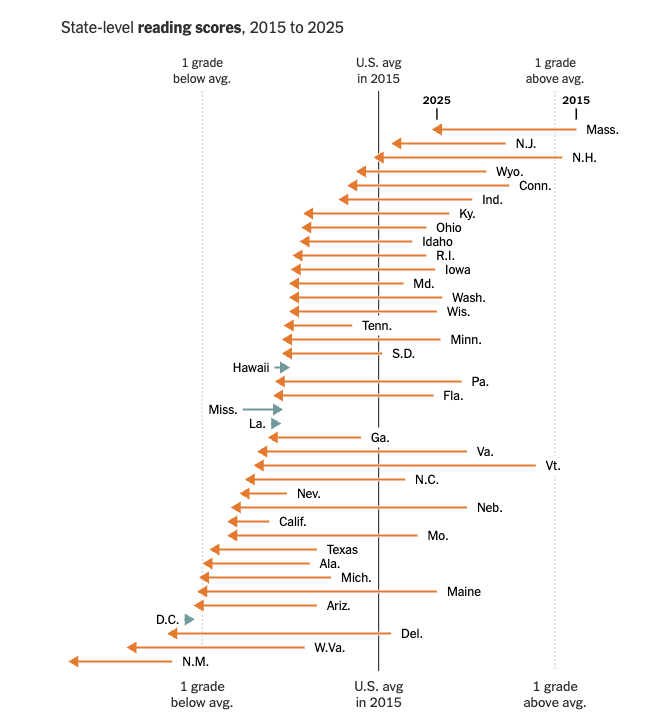
Reading scores, 3rd graders to 8th graders, 2015 to 2025. This is a national tragedy.
English
@pmddomingos Almost all of the best open weight models are Chinese. But of course those models refuse to discuss Taiwan, Tibet, or Xinjiang, or at least they spout CCP rhetoric.
English

Kiss your freedom goodbye if China wins the AI race.
English
Luke Hutchison retweetledi

Hantavirus isn't the next big one
Which is lucky
Because the US under RFK Jr's quackery, is not remotely ready for the next pandemic.
English
Luke Hutchison retweetledi
I'm a microbiologist and just see cruise ships as giant Petri dishes

English
Luke Hutchison retweetledi

New @washingtonpost story details the secret instructions AI companies give to chatbots to steer them towards certain behaviors: wapo.st/4ffQ96k
One example from OpenAI: "Never talk about goblins, gremlins, raccoons, trolls, ogres, pigeons, or other animals or creatures unless it is absolutely & unambiguously relevant to the user’s query."

English

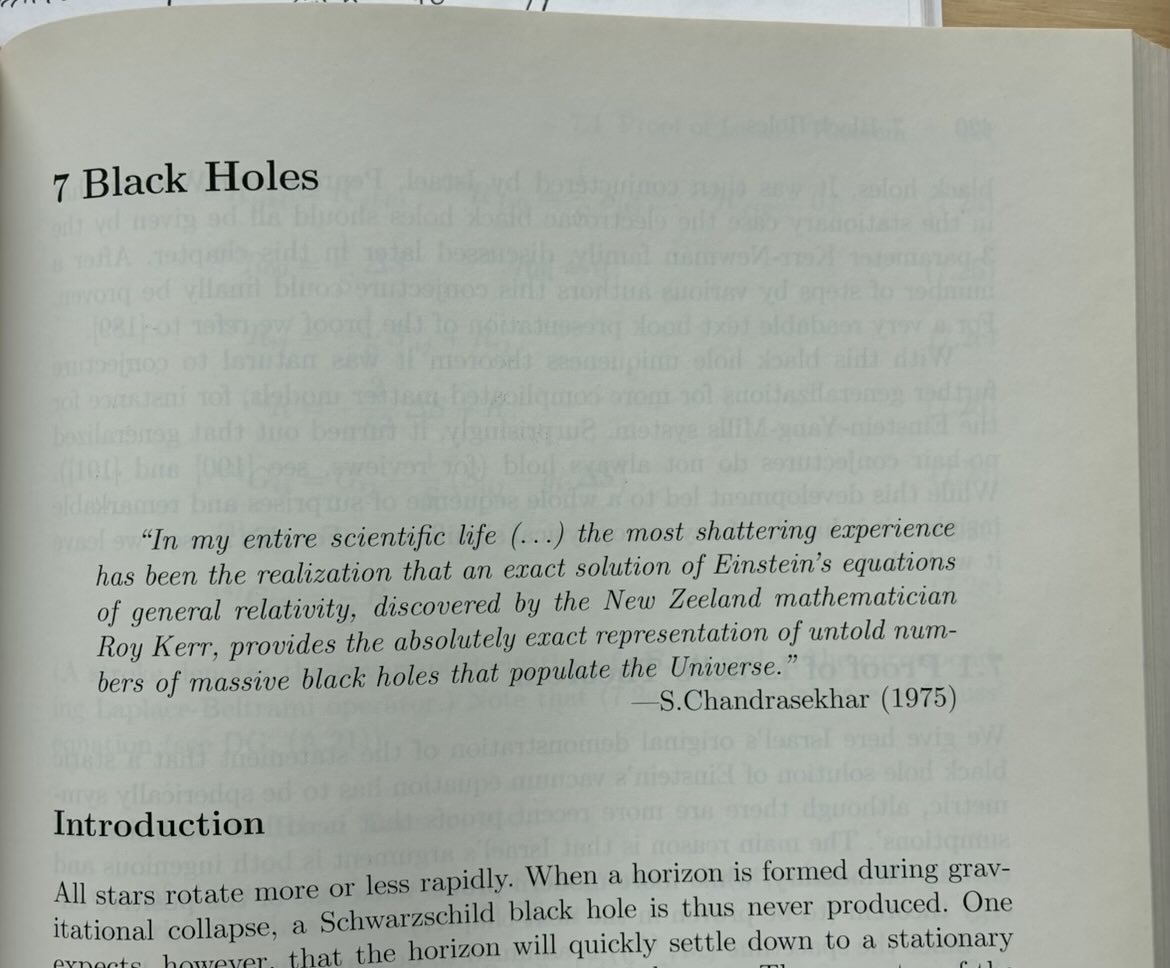
If this doesn’t give you goosebumps you’re not a physicist
English
English

Very excited to share a new milestone in AI for Math: Aletheia, powered by Gemini Deep Think, was just used to autonomously solve a Kirby problem! “Kirby’s list” is a “compendium of the most important unsolved problems in topology, the study of deformable shapes” (Quanta magazine). 🧵

English
@bryan_johnson @davemcclure Also get your regular screenings (colonoscopy if over 45, mammogram as a woman, check PSA as a man, etc.)
English
Luke Hutchison retweetledi

This is it.
Everything learned spending millions on longevity.
From: Your Immortal Unc and Auntie.
To: Our Immortal nieces and nephews.
0. Sleep is the world's most powerful drug.
1. Be in your bed for 8 hours
2. Same bedtime every night, any time before midnight
3. Don’t eat right before bed
4. Calm foods for dinner
5. No screens 1 hour before bed
6. Avoid added sugar (be aware it’s in everything)
7. Avoid all things in an American convenience store
8. Avoid fried foods
9. Shoes off at the door
10. Eat whole foods, particularly veggies fruits nuts legumes berries
11. Walk a little after meals or air squats
12. Get your heart rate high routinely
13. Lift heavy things
14. Stretch daily
15. Water pik, floss, brush, tongue scrape, morning and night
16. Make an effort to drink water
17. Get sunlight when you wake up (UV is low)
18. Protect skin in midday sun
19. Stand up straight
20. See at least one friend once a week
21. Avoid plastic where you can (in all things)
22. Circulate air in rooms
23. When stressed, breathe, learn to calm your body
24. Go to the dentist
25. Avoid sitting for long times
26. Protect your hearing, the world is too loud
27. Alcohol is bad for you
28. Finish coffee before noon
29. Avoid bright lights after sunset
30. If obese, look into a GLP
31. Sleep in a cold room
32. Texting while driving is dangerous
33. Turn off all notifications
34. Limit social media use
35. Don’t smoke anything
36. If you struggle to sleep, read a physical book before bed
37. 1 hour before bed have a calm wind down routine: bath, read, light walk, listen to music
38. The body is a clock and loves routine. Have a daily morning and evening schedule.
39. Avoid long distance travel where you can
40. Baby steps first: incorporate new things slowly
41. Do less… most things don’t work.
Bonus points if you get your blood checked.
Start here, it will change your life.
English
Luke Hutchison retweetledi

One of the biggest problems with using LLMs as a google replacement for programming, is that getting zero relevant results on google used to be a signal that you had the wrong idea about the root cause. Whereas LLMs will happily indulge any terrible idea you suggest.
English