Adriana Labardini

14.8K posts

Adriana Labardini banner
Adriana Labardini

Adriana Labardini

@LabardiniA

Abogada de interés público en tecnología y desarrollo. Policy Coordinator LAC @rhizomatica consejera@The_IIC, Presidenta @conectadas_mx. Hablo por mí

Mexico Katılım Nisan 2009
2.7K Takip Edilen7.2K Takipçiler
Adriana Labardini retweetledi

Chief Nerd
Chief Nerd@TheChiefNerd·
🚨 SAM ALTMAN: “We see a future where intelligence is a utility, like electricity or water, and people buy it from us on a meter.”
English
5.5K
2.7K
12.6K
26.3M
Pizu, Emilio Saldaña
Consejo Coordinador de Inteligencia Artificial de la UNAM: • Buscará salvaguardar integridad académica y propiedad intelectual ante desafíos del entorno digital • Impulsará innovación en procesos de enseñanza-aprendizaje • Se apoyará en un Comité Académico Interdisciplinario
UNAM@UNAM_MX

#BoletínUNAM La UNAM a la vanguardia: crea su Consejo Coordinador de Inteligencia Artificial > acortar.link/fbVWRw

Español
5
27
125
13.3K
Adriana Labardini
Adriana Labardini@LabardiniA·
La Seguridad Nacional vista solamente desde los hombres en un país en que las mujeres víctimas de la inseguridad y expertas en la materia pareciera que no existen. Les sugiero expandir su lente. Expertas como Lisa Sánchez @lismarybaby hubieran enriquecido mucho su libro y evento
Adriana Labardini tweet media
Español
0
0
0
91
Adriana Labardini
Adriana Labardini@LabardiniA·
@MCoeckelbergh Oh my God intelligence as a utility? No, those are heavily regulated. What Altman bets is AI as a commodity externalizing costs to all and monopolizing profits.
English
0
0
2
72
Adriana Labardini retweetledi
José Mario
José Mario@JoseMarioMX·
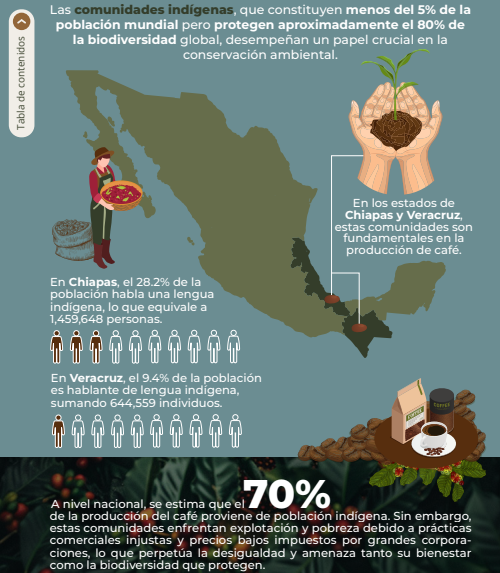
La reforma judicial se vendió como un acto de “democratización”. Pero el informe preliminar de la @OEA_oficial cuenta otra historia. Una historia incómoda: elecciones con apenas 13% de participación, reglas improvisadas, candidaturas sin evaluación jurídica rigurosa y señales preocupantes de inducción del voto. El resultado es una pregunta brutal que atraviesa todo el documento: ¿esto fortaleció la justicia… o la dejó más vulnerable frente al poder? Porque la justicia no funciona como una campaña. Un juez no está para gustarle a la mayoría ni para seguir tendencias políticas. Está para aplicar la ley incluso cuando incomoda al gobierno o a la opinión pública. Cuando el sistema empuja a los jueces hacia la lógica electoral —popularidad, apoyos, “acordeones”, cálculo político— lo que se erosiona no es un procedimiento: es la independencia misma del poder que debe frenar los abusos. Por eso la frase final de la OEA pesa tanto: no recomienda replicar este modelo en ningún otro país. Es una advertencia seria. Muy seria. México quiso inaugurar una nueva forma de elegir jueces, pero el mundo hoy la mira más como un experimento riesgoso que como un avance democrático.
José Mario tweet media
Español
25
643
864
14.7K
Adriana Labardini
Adriana Labardini@LabardiniA·
Just analyze the terrible case of Cancun Airport: this mafia charges 200USD or more to Akumal for a ride when 1 full day car rental at @Hertz may cost 25 USD . Why do the State of @GobQuintanaRoo protects them? You will have to dig deeper.
Antonio Ocaranza@aocaranza

The airport taxi system in México is an example of how artificial monopolies work. Consumers pay the price through worse service, higher prices, less transparency, and less freedom to choose. When a better alternative appears the state uses its power to block the new entrant.
English
3
4
3
337
Adriana Labardini retweetledi
Ricardo Pascoe Pierce
Ricardo Pascoe Pierce@rpascoep·
El precio del barril del petróleo alcanzó más de US$114 a la apertura de los mercados asiáticos este lunes. El domingo en la noche el tipo de cambio MX/US brincó de $17 a más de $18. Pone en riesgo todos los criterios económicos de Banxico tomados para calcular el PEP2026, sobre inflación, tipo de cambio, precio del petróleo y el PIB. La estabilidad financiera depende del crecimiento de la economía. Sin certezas en el entorno económico, la inversión no va a fluir. Al no haber inversión en las cantidades requeridas, se asoma la amenaza de la recesión y el retroceso en los ingresos fiscales de la federación. Así va a impactar la guerra de Estados Unidos e Israel con Irán a México. Y debilita políticamente a México en vísperas de la apertura de negociaciones del T-MEC, porque una economía con amenaza recesiva, poca inversión productiva y caída en sus ingresos fiscales debilita políticamente al país que padece la situación.
Español
27
389
1.2K
56.9K
Clara Luz Alvarez
Clara Luz Alvarez@claraluzalvarez·
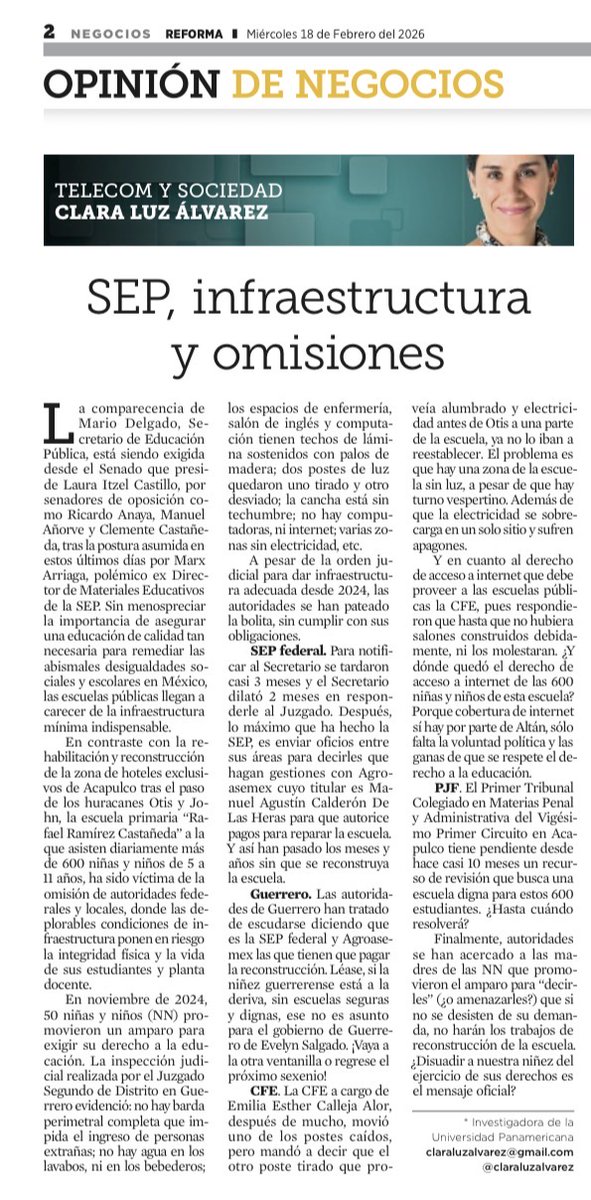
En Acapulco se reconstruyen hoteles. Pero 600 niñas y niños estudian sin agua, sin luz adecuada, sin internet y sin aulas seguras. Lxs niñxs presentaron amparo desde 2024 q acompañamos desde @TomaTuRemo @PertenecesAC. Hay orden judicial. Nadie cumple. #Educación #SEP #Guerrero
Clara Luz Alvarez tweet media
Español
1
68
34
3.6K
Adriana Labardini retweetledi
Luiza Jarovsky, PhD
Luiza Jarovsky, PhD@LuizaJarovsky·
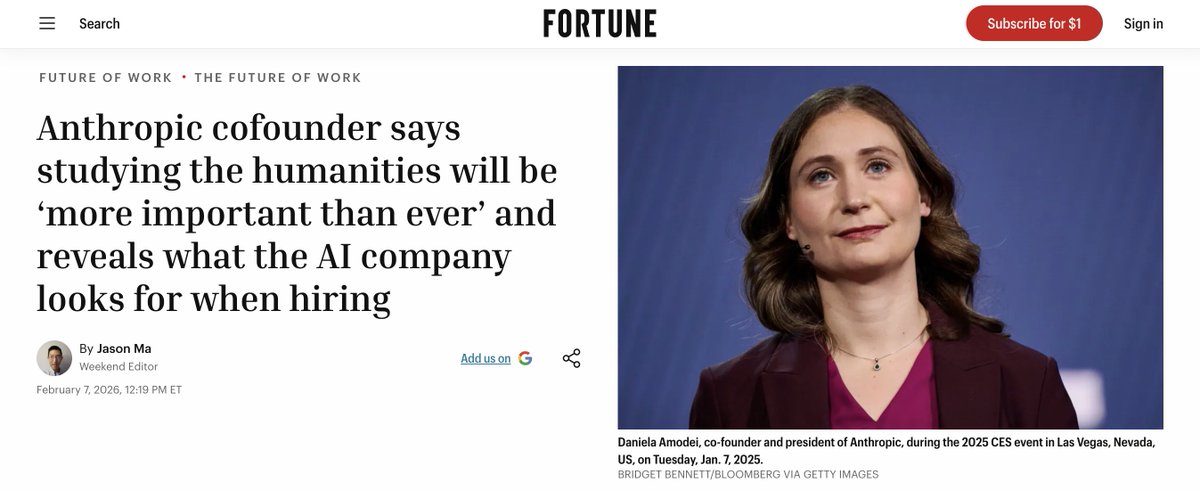
As I’ve been telling you, law is one of the safest career choices today. Avoid computer programming.
Luiza Jarovsky, PhD tweet media
English
32
72
122
23.3K
Adriana Labardini retweetledi
Chris Laub
Chris Laub@ChrisLaubAI·
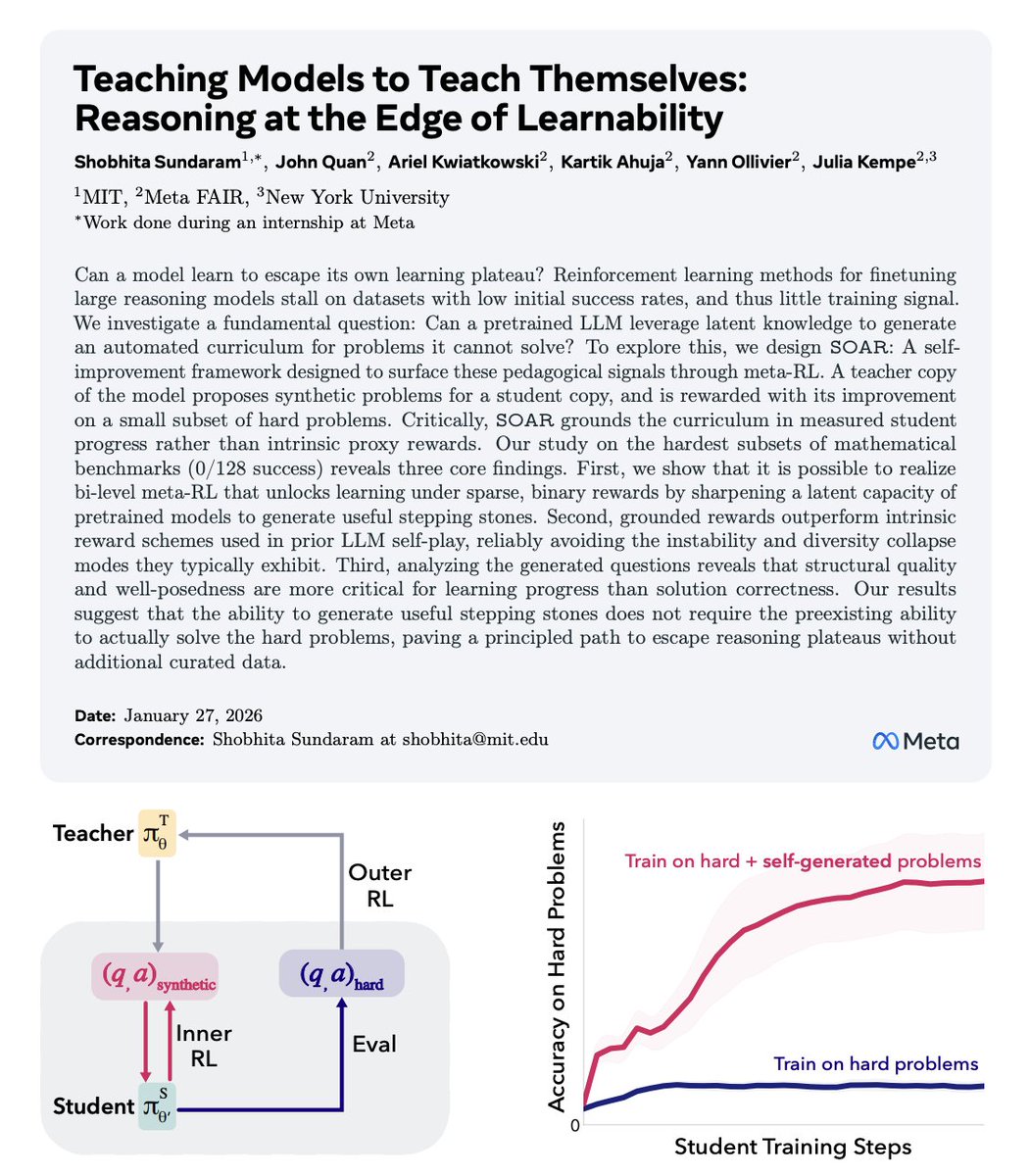
MIT just published a paper that quietly explains why LLM reasoning hits a wall and how to push past it. The usual story is that models fail on hard problems because they lack scale, data, or intelligence. This paper argues something much more structural: models stop improving because the learning signal disappears. Once a task becomes too difficult, success rates collapse toward zero, reinforcement learning has nothing to optimize, and reasoning stagnates. The failure isn’t cognitive, it’s pedagogical. The authors propose a simple but radical reframing. Instead of asking how to make models solve harder problems, they ask how models can generate problems that teach them. Their system, SOAR, splits a single pretrained model into two roles: a student that attempts extremely hard target tasks, and a teacher that generates new training problems. The catch is that the teacher is not rewarded for producing clever or realistic questions. It is rewarded only if the student’s performance improves on a fixed set of real evaluation problems. No improvement means zero reward. That incentive reshapes everything. The teacher learns to generate intermediate, stepping-stone problems that sit just inside the student’s current capability boundary. These problems are not simplified versions of the target task, and strikingly, they do not even require correct solutions. What matters is that their structure forces the student to practice the right kind of reasoning, allowing gradient signal to emerge even when direct supervision fails. The experimental results make the point painfully clear. On benchmarks where models start with zero success and standard reinforcement learning completely flatlines, SOAR breaks the deadlock and steadily improves performance. The model escapes the edge of learnability not by thinking harder, but by constructing a better learning environment for itself. The deeper implication is uncomfortable. Many supposed “reasoning limits” may not be limits of intelligence at all. They are artifacts of training setups that assume the world provides learnable problems for free. This paper suggests that if models can shape their own curriculum, reasoning plateaus become engineering problems, not fundamental barriers. No new architectures, no extra human data, no larger models. Just a shift in what we reward: learning progress instead of answers.
Chris Laub tweet media
English
90
402
2K
166.1K