
Sabitlenmiş Tweet
lajarre
473 posts


lajarre
@lajarre
Gestell contemplator; program synthesizer; futarch @buttermarkets_
Katılım Ağustos 2009
3.5K Takip Edilen595 Takipçiler
@robinhanson @clesaege happy anniversary!
10 years ago, i read R Merkle's article on DAO Democracy and Governance and got Futarchy-pilled; glad i could take a small part by applying it to crypto orgs last year
English

Today is the 30th anniversary of my first post on my best idea: decision markets. mason.gmu.edu/~rhanson/polic…
overcomingbias.com/p/my-best-idea…
English

@mitsuhiko display timestamps on the top right of each item in the timeline
was hesitant to pr this upstream 🤔
also, ultra-brevity for the the timeline (1-line per item) for tool calls and thinking items
English

What's the smallest (but comparatively coolest) extension you built for pi?
English

Thank you to all participants!
You can try more challenges at optimizationarena.com
The Telegram group for this event also had great discussion of the challenges, and is still going strong
DM me if you're interested to join the community!
English
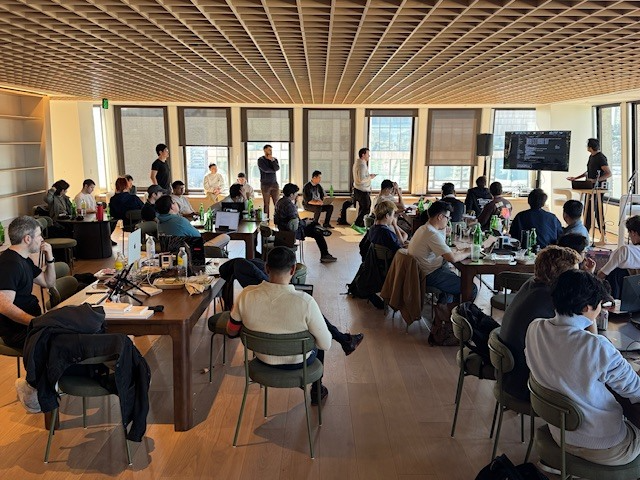
The @paradigm automated research hackathon was a great success—over 250 participants online and more than 50 in person
Competitors blew through our predicted ceilings on all three challenges, and built very cool projects
Takeaways and winners in 🧵
Dan Robinson@danrobinson
The Automated Research Hackathon has begun! You can see the challenges and leaderboards at paradigm.xyz/automated-rese… Submissions end in 8 hours. The winner on each leaderboard gets $1,000
English
I very much agree that the mathematician's work seems to move up the ladder from proving to defining the right formal systems
however i think there is still a challenge to what is "right", how to map to experience
eg a good approach seems to have "strong opinons weakly held" wrt axioms, see where they bring us (leave it to AI to do that), and iterate; but then, what is the eval looking like?
English
@mattpocockuk problem with DDD is that it's a map=territory assertion, which must by lossy by construction; making software as maps works only in specific business contexts and doesn't sound blanket sane "in general yes" to me
but when it's well-adapted, it sheds incredible light, yes
English

I'm starting to think that DDD might be the answer to all of my problems
- Model not doing what you want? Shared language
- Can't navigate a massive codebase? Bounded contexts with global mapping
- Don't know why a decision was made? ADR's
It's just so freaking elegant
English
i assume you posit an epistemic stance on axioms themselves, eg refusing existence of infinity sets (axioms are empirical? -> Quine/Putnam vibe)
you're pointing towards an interesting refinement: what we want to draw from experience are not necessarily axioms àla ZFC but methods: i think patterns, proof paths -> probably reducible to a axioms with the right formal systems (but this is a technical point)
ps: i appreciate that you want to slay the infinity set; my personal crusade is against tertium non datur
English

In my doctorate, I proved the Erdős Primitive Set Conjecture, showing that the primes themselves are maximal among all primitive sets.
This problem will always be in my heart: I worked on it for 4 years (even when my mentors recommended against it!) and loved every minute of it.
[Primitive sets are a vast generalization of the prime numbers: A set S is called primitive if no number in S divides another.]
Now Erdős#1196 is an asymptotic version of Erdős' conjecture, for primitive sets of "large" numbers.
It was posed in 1966 by the Hungarian legends Paul Erdős, András Sárközy, and Endre Szemerédi.
I'd been working on it for many years, and consulted/badgered many experts about it, including my mentors Carl Pomerance and James Maynard.
The the proof produced by GPT5.4 Pro was quite surprising, since it rejected the "gambit" that was implicit in all works on the subject since Erdős' original 1935 paper. The idea to pass from analysis to probability was so natural & tempting from a human-conceptual point of view, that it obscured a technical possibility to retain (efficient, yet counter-intuitve) analytic terminology throughout, by use of the von Mangoldt function \Lambda(n).
The closest analogy I would give would be that the main openings in chess were well-studied, but AI discovers a new opening line that had been overlooked based on human aesthetics and convention.
In fact, the von Mangoldt function itself is celebrated for it's connection to primes and the Riemann zeta function--but its piecewise definition appears to be odd and unmotivated to students seeing it for the first time. By the same token, in Erdős#1196, the von Mangoldt weights seem odd and unmotivated but turn out to cleverly encode a fundamental identity \sum_{q|n}\Lambda(q) = \log n, which is equivalent to unique factorization of n into primes. This is the exact trick that breaks the analytic issues arising in the "usual opening".
Moreover, Terry Tao has long suspected that the applications of probability to number theory are unnecessarily complicated and this "trick" might actually clarify the general theory, which would have a broader impact than solving a single conjecture.
Boaz Barak@boazbaraktcs
This is one of the coolest such examples! See comments from Lichtman below, who proved the related primitive set conjecture arxiv.org/abs/2202.02384
English

this this NFL theorem for search
it's basically all there is to know to start understanding what's going on
sfi-edu.s3.amazonaws.com/sfi-edu/produc…
English

"structured epistemic diversity" 100%
i've set up a similar albeit simpler setup for myself some weeks back, inspired by your work on BrennerBot
i'm mostly using it for counterfactual reasoning: a "schools of thought" catalog with key fundamental references for each (including evolutionary, game theory, falsificationnism...), a dispatcher, scorer synthesizer
used in both adversarial and creative mode
became an indispensable complement to chatgpt pro-based research
and still far from optimal!
English

A while back, I posted this concept for my ntm agent orchestration tool that would let you spin up a swarm of agents using various harnesses where each agent could follow a different "mode of reasoning" (see the quoted post for what that means).
I didn't really do much with it at the time because I got distracted by other projects. But the other reason was that I wasn't really sure how it could be effectively "steered" and leveraged.
But I realized recently that a skill was the perfect medium for finally implementing this properly in a unified, cohesive way that's highly applicable to software development projects, but also to any other sort of project, business plan, conceptual framework, etc.
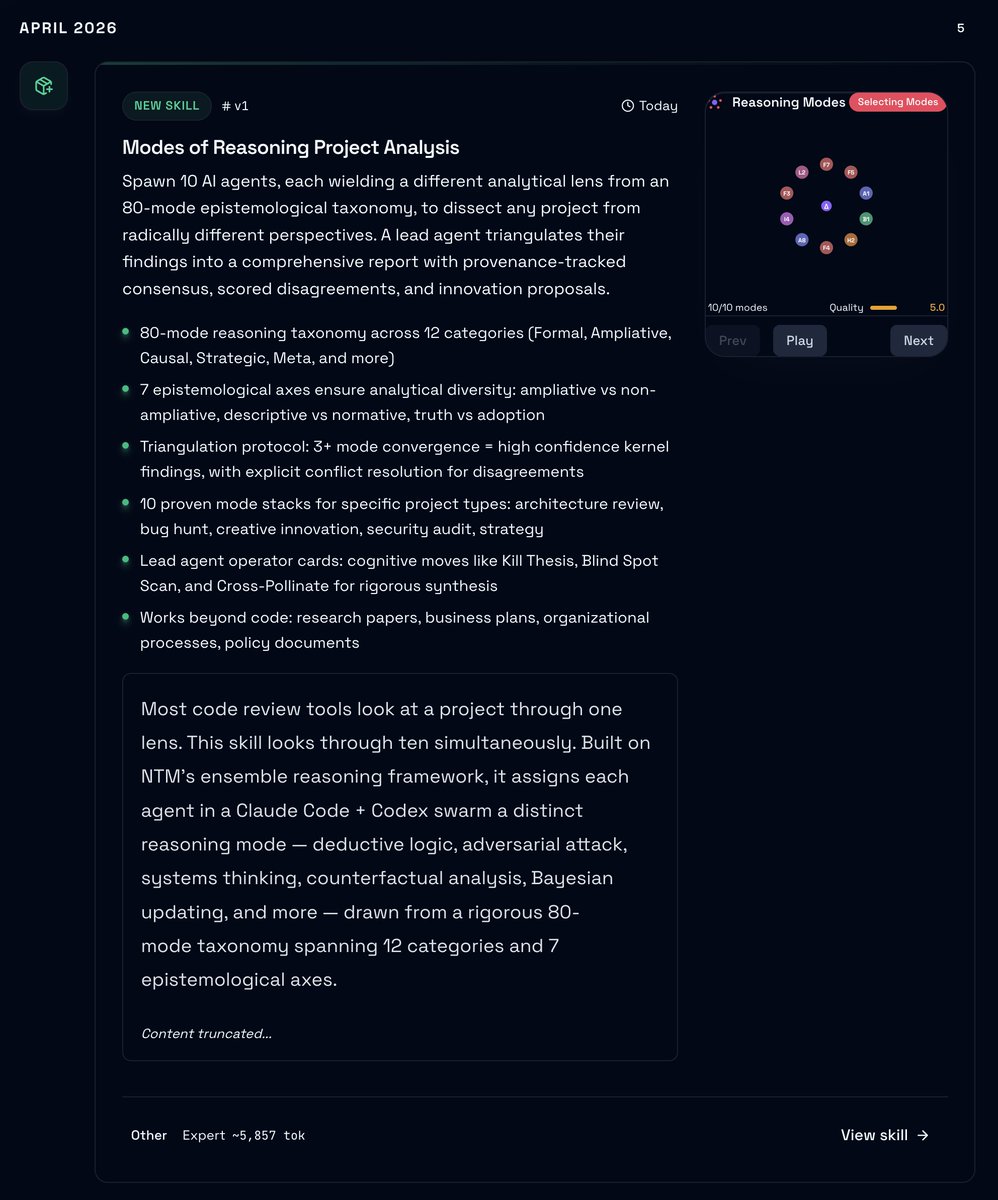
Now you can simply ask Claude Code to invoke the /modes-of-reasoning-project-analysis skill and it will embark on a truly ambitious and deep investigation for you.
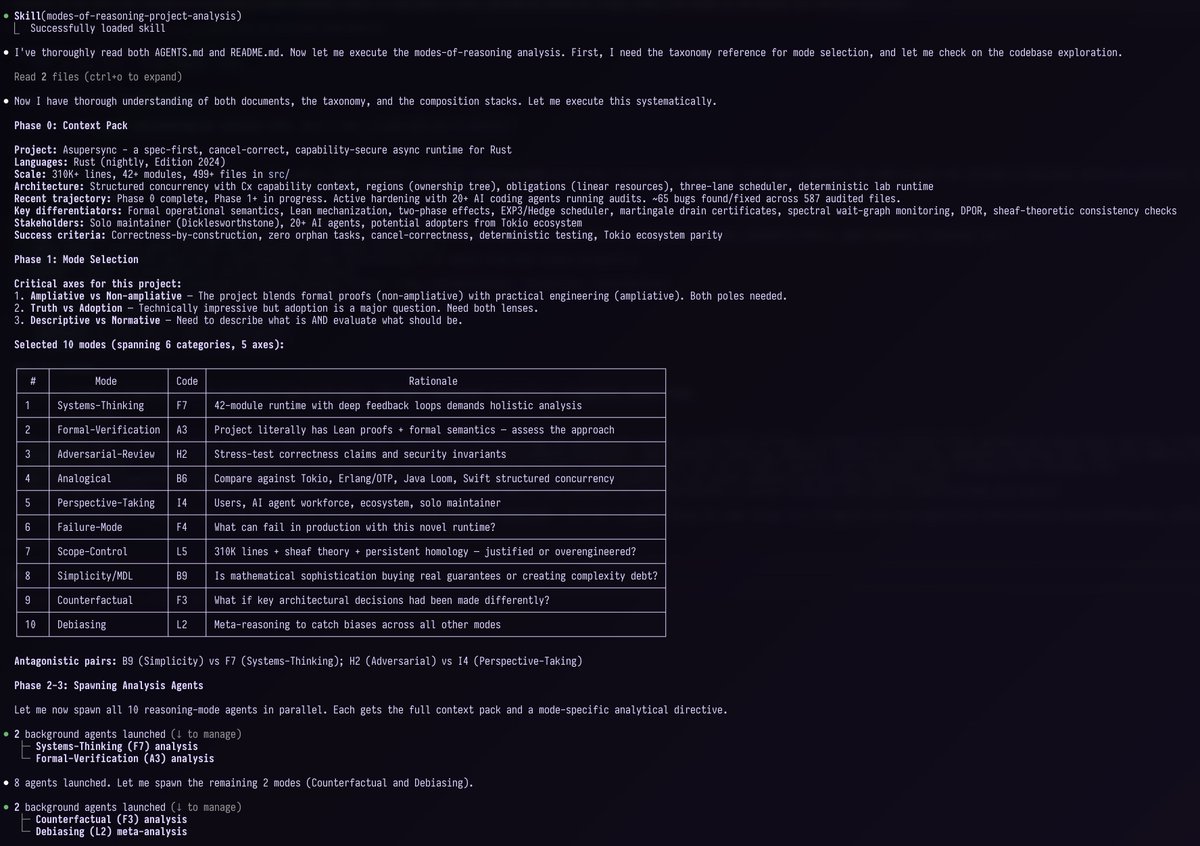
Rather than blindly try to apply all 80 reasoning modes, the "lead agent" first studies the project and determines which of the 80 modes are most applicable and complementary, then creates and manages a swarm for you using ntm with an agent for each selected reasoning mode.
Then it attempts to synthesize the results of their interactions and compiles this into a markdown report for you.
You can sort of conceptualize this approach as the "fresh eyes review" approach on steroids, in that it's attempting to force something akin to a gestalt shift to each agent so that it will look at the project in a different way that might reveal new angles it otherwise wouldn't perceive.
It's a bit hard to explain, so I asked Claude to give its best summation of what the skill does and how it works and why it's useful (also see the two screenshots showing how it starts out on two different software projects; you can access it on my skills site, jeffreys-skills.md):
---
This is a multi-agent epistemological analysis tool.
Here's what it does and why it matters:
What It Is
It spawns a swarm of AI agents (default 10, configurable), each assigned a distinct reasoning mode drawn from a taxonomy of ~80 modes. Each agent analyzes the same project but through a completely different analytical lens — then their outputs are synthesized into one comprehensive report.
How It Works (7 Phases)
1. Context Pack — Profile the target project (structure, tech stack, maturity)
2. Mode Selection — Pick 10 reasoning modes from 7 taxonomy axes (e.g., abductive reasoning, adversarial analysis, Bayesian inference, normative ethics, game-theoretic reasoning, etc.)
3. Spawn Swarm — Launch agents via NTM (my tmux-based multi-agent orchestrator)
4. Dispatch Prompts — Each agent gets a mode-specific prompt constraining it to reason from that single perspective
5. Monitor — Watch for convergence or early stopping conditions
6. Score & Collect — Each agent produces structured findings (thesis, risks, recommendations, assumptions, uncertainties)
7. Synthesize — A triangulation protocol classifies findings:
- Kernel (3+ modes agree) — high confidence
- Supported (2 modes agree) — moderate confidence
- Hypothesis (1 mode only) — worth investigating
- Disputed (modes disagree) — needs resolution
Why It's Useful
The core insight: a single analytical perspective has blind spots. Multiple independent perspectives triangulate toward truth.
Concrete use cases:
- Pre-release audit — Before shipping, get 10 fundamentally different takes on what could go wrong. An adversarial reasoner finds attack surfaces, a probabilistic reasoner finds unlikely-but-catastrophic failures, a normative reasoner flags ethical concerns.
- Architecture decisions — When choosing between approaches, different reasoning modes weigh tradeoffs differently. Game-theoretic reasoning considers incentive structures, abductive reasoning asks "what best explains the constraints," analogical reasoning pulls patterns from similar systems.
- Breaking groupthink — If your team has converged on an approach, this surfaces objections you wouldn't naturally generate. The "Kill Thesis" operator card explicitly tries to destroy the consensus view.
- Due diligence on acquisitions or dependencies — Evaluate an unfamiliar codebase from economic, security, maintainability, and social/community perspectives simultaneously.
- Finding unknown unknowns — The "Blind Spot Scan" operator card specifically asks: which axes of the taxonomy are underrepresented in current findings? What would a mode from that axis notice?
The key differentiator from just "ask an AI to review my project" is structured epistemic diversity — it's not 10 agents doing the same thing, it's 10 agents that are cognitively constrained to reason differently, with a formal synthesis protocol that tracks where they agree, disagree, and what falls through the cracks.


Jeffrey Emanuel@doodlestein
I've got some wild stuff brewing for ntm. What if you could spin up a huge swarm of agents to review your project (any kind of project, not just software), and the difference between the various agents was that they each employed a different mode of reasoning? What does that even mean? Isn't reasoning, well, reasoning? Like with logic and induction and stuff? Well, it turns out that you can really break this stuff down into exquisite detail. For instance, probabilistic reasoning extends classical logic by attaching probabilities (i.e., degrees of belief) to propositions instead of treating them as strictly True or False. Fuzzy logic is different: it treats truth itself as a continuum (e.g., ‘somewhat true’), even when there’s no uncertainty. But that's just scratching the surface. GPT Pro and Opus were jointly able to come up with EIGHTY distinct modes of reasoning, which you can read about here: github.com/Dicklesworthst… The screenshot below shows me getting CC to transform this document into a new feature using this prompt: --- ❯ I have a great idea for this tool for a special mode where we launch a ton of agents on the same project and have them either work on a problem, like "What's wrong with this project and how could it be made a lot better" or brainstorm with something like "What are the best new ideas to add to this project when you take into account the pros and cons of each one?" and so on. The twist is that each agent would be separately prompted to engage in a CERTAIN, NAMED FORM OF REASONING that would be explained to them in the prompt preamble (and thus automatically added to the user's primary prompt). Each named form of reasoning and how it works is laid out in modes_of_reasoning.md, which you should read and ruminate on incredibly deeply. Then come up with a spectacularly brilliant, creative, clever, comprehensive, accretive plan for architecting, designing, and implementing this system in a harmonious, cohesive, coherent way with the existing ntm system, with world-class ui/ux and polish. Make sure your plan is super detailed, granular, and comprehensive. Then please take ALL of that and elaborate on it and use it to create a comprehensive and granular set of beads for all this with tasks, subtasks, and dependency structure overlaid, with detailed comments so that the whole thing is totally self-contained and self-documenting (including relevant background, reasoning/justification, considerations, etc.-- anything we'd want our "future self" to know about the goals and intentions and thought process and how it serves the overarching goals of the project). The beads should be so detailed that we never need to consult back to the original markdown plan document. Remember to ONLY use the `br` tool to create and modify the beads and add the dependencies. --- You could tell Claude was titillated! His first sentence in his response was: "This is a phenomenal document! 80 modes of reasoning organized into 12 categories, each with precise definitions, outputs, differentiators, use cases, and failure modes. Let me deeply synthesize this and design a comprehensive "Reasoning Ensemble" feature for NTM." Big thanks to @darin_gordon for getting me thinking along these lines. PS: I got so sick and tired of seeing the clankers mess up the right-hand borders of ascii art diagrams that I made a rust cli tool to fix it, lol: github.com/Dicklesworthst…
English
@doodlestein grateful for your habit of sharing some of your secret sauces
agreed, this kind of approach is making a killing for me on complex projects, of any intellectual kind
commenting in the op
English
I’ve now applied this “modes of reasoning” skill to like 20 different projects and it has surfaced so many useful insights that I would just never get out of these models in a million years otherwise. Can’t recommend this highly enough for complex projects.
Jeffrey Emanuel@doodlestein
A while back, I posted this concept for my ntm agent orchestration tool that would let you spin up a swarm of agents using various harnesses where each agent could follow a different "mode of reasoning" (see the quoted post for what that means). I didn't really do much with it at the time because I got distracted by other projects. But the other reason was that I wasn't really sure how it could be effectively "steered" and leveraged. But I realized recently that a skill was the perfect medium for finally implementing this properly in a unified, cohesive way that's highly applicable to software development projects, but also to any other sort of project, business plan, conceptual framework, etc. Now you can simply ask Claude Code to invoke the /modes-of-reasoning-project-analysis skill and it will embark on a truly ambitious and deep investigation for you. Rather than blindly try to apply all 80 reasoning modes, the "lead agent" first studies the project and determines which of the 80 modes are most applicable and complementary, then creates and manages a swarm for you using ntm with an agent for each selected reasoning mode. Then it attempts to synthesize the results of their interactions and compiles this into a markdown report for you. You can sort of conceptualize this approach as the "fresh eyes review" approach on steroids, in that it's attempting to force something akin to a gestalt shift to each agent so that it will look at the project in a different way that might reveal new angles it otherwise wouldn't perceive. It's a bit hard to explain, so I asked Claude to give its best summation of what the skill does and how it works and why it's useful (also see the two screenshots showing how it starts out on two different software projects; you can access it on my skills site, jeffreys-skills.md): --- This is a multi-agent epistemological analysis tool. Here's what it does and why it matters: What It Is It spawns a swarm of AI agents (default 10, configurable), each assigned a distinct reasoning mode drawn from a taxonomy of ~80 modes. Each agent analyzes the same project but through a completely different analytical lens — then their outputs are synthesized into one comprehensive report. How It Works (7 Phases) 1. Context Pack — Profile the target project (structure, tech stack, maturity) 2. Mode Selection — Pick 10 reasoning modes from 7 taxonomy axes (e.g., abductive reasoning, adversarial analysis, Bayesian inference, normative ethics, game-theoretic reasoning, etc.) 3. Spawn Swarm — Launch agents via NTM (my tmux-based multi-agent orchestrator) 4. Dispatch Prompts — Each agent gets a mode-specific prompt constraining it to reason from that single perspective 5. Monitor — Watch for convergence or early stopping conditions 6. Score & Collect — Each agent produces structured findings (thesis, risks, recommendations, assumptions, uncertainties) 7. Synthesize — A triangulation protocol classifies findings: - Kernel (3+ modes agree) — high confidence - Supported (2 modes agree) — moderate confidence - Hypothesis (1 mode only) — worth investigating - Disputed (modes disagree) — needs resolution Why It's Useful The core insight: a single analytical perspective has blind spots. Multiple independent perspectives triangulate toward truth. Concrete use cases: - Pre-release audit — Before shipping, get 10 fundamentally different takes on what could go wrong. An adversarial reasoner finds attack surfaces, a probabilistic reasoner finds unlikely-but-catastrophic failures, a normative reasoner flags ethical concerns. - Architecture decisions — When choosing between approaches, different reasoning modes weigh tradeoffs differently. Game-theoretic reasoning considers incentive structures, abductive reasoning asks "what best explains the constraints," analogical reasoning pulls patterns from similar systems. - Breaking groupthink — If your team has converged on an approach, this surfaces objections you wouldn't naturally generate. The "Kill Thesis" operator card explicitly tries to destroy the consensus view. - Due diligence on acquisitions or dependencies — Evaluate an unfamiliar codebase from economic, security, maintainability, and social/community perspectives simultaneously. - Finding unknown unknowns — The "Blind Spot Scan" operator card specifically asks: which axes of the taxonomy are underrepresented in current findings? What would a mode from that axis notice? The key differentiator from just "ask an AI to review my project" is structured epistemic diversity — it's not 10 agents doing the same thing, it's 10 agents that are cognitively constrained to reason differently, with a formal synthesis protocol that tracks where they agree, disagree, and what falls through the cracks.
English
@sterlingcrispin @Polymarket please don't fall for selection bias
73.4% is unconditional probability over ALL markets
the bot will trade on a subset with a condition, payoff roughly Prob(No | price threshold reached in subset) - price
this is not a random subset, this probability is NOT 73.4% on average
English

Introducing: Nothing Ever Happens
A @Polymarket bot that automatically buys "No" for every non-sports market and holds to resolution.
Why predict the future when 73.4% of all Polymarkets resolve as No? Stop over thinking it. Nothing Ever Happens.
github.com/sterlingcrispi…

English

People of pi. BIG NEWS. I've sold out. Let me know how you feel about this in the comments below.
mariozechner.at/posts/2026-04-…
English
lajarre retweetledi

@badlogicgames 100%, for oss work
sharing traces to build RL might clash with labs' ToS though? but even then a pledge from orgs to share "oss traces" could change game theoretics
English
we as software engineers are becoming beholden to a handful of well funded corportations. while they are our "friends" now, that may change due to incentives. i'm very uncomfortable with that.
i believe we need to band together as a community and create a public, free to use repository of real-world (coding) agent sessions/traces. I want small labs, startups, and tinkerers to have access to the same data the big folks currently gobble up from all of us. So we, as a community, can do what e.g. Cursor does below, and take back a little bit of control again.
Who's with me?
cursor.com/blog/real-time…
English

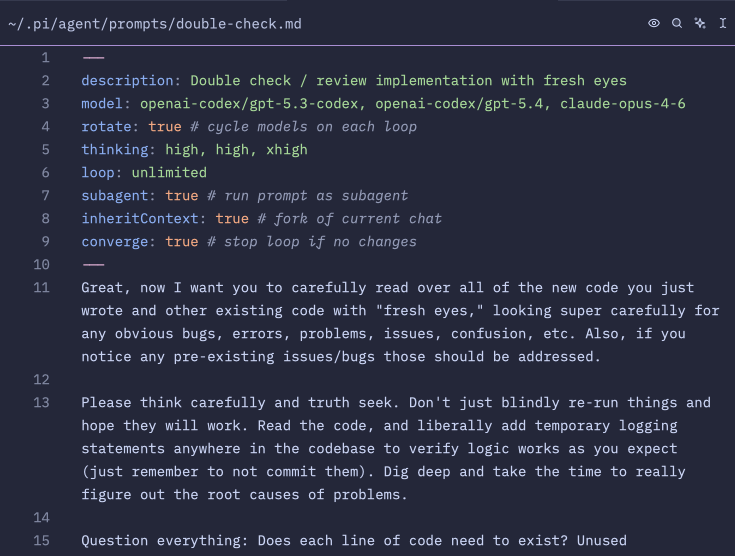
Pi prompt templates can now loop and rotate between different models on each iteration. In this example it runs each loop with a different model as a subagent based on a fork of the current chat.
pi install npm:pi-prompt-template-model
github.com/nicobailon/pi-…
English

OpenClaw and Pi together are in the top 10 of all time software breakthroughs.
Chrys Bader@chrysb
folks who are calling @openclaw pure hype are telling on themselves openclaw is like the early internet, it's raw, unrefined, and takes a little doing to get things to work, but when you figure it out, it's transformative. here are some real use cases that are having material impact on our $2.5M ARR business: 1. ad creative pipeline. our head of growth @ArjunShukl95550 built an end-to-end creative pipeline to go from ideation to publish adds to meta, greatly increasing our creative iteration speed. it's producing winning creatives. it lives in slack, and anyone on the team can share their ideas and have them enter the pipeline. 2. data analytics agent. another bot lives in our slack that connects to bigquery and lets our team ask any questions of the data, it produces charts and answers questions in real time. no one needs to write SQL anymore. 3. recruiting. i told my agent about a role we're hiring for, and it scoured linkedin and the web, found 30 candidates, portfolio, email addresses, and stack ranked them based on fit with our criteria this is just in the past week. i have twenty more success stories for you i can share another time. you have to understand, this is the shittiest it will ever be. everyone is going to have one or more personal self-improving agents that they use every day, and openclaw is what revealed this future to us. if you can't see this, i encourage you to look harder there will be many competitors (and already are), and the large labs will start to converge on this (they already are) too. openclaw may not win, but it opened pandora's box and uncorked the agentic future.
English