
Sabitlenmiş Tweet
Mark C.
77.5K posts

Mark C.
@LargeCardinal
Scouse feral academic. Quantum Hacker, ML miscreant, & mathematician. Views own. Collects useless degrees. @quantum_village (he/him) @[email protected]
@[email protected] Katılım August 2011
6.6K Takip Edilen7.3K Takipçiler
2026 Yıllık Özeti
@LargeCardinal hesabının Twitter yılını gör

Mark C. retweetledi


Mark C. retweetledi

That's embarrassing.
Le Figaro, one of France's largest newspapers, claims that Anthropic has "broken AES."
That's simply false.
What Mythos actually did was slightly improve the best known cryptanalytic attack on a reduced-round version of AES, a deliberately weakened variant used by researchers to study the cipher. It did not break the full AES algorithm, which remains secure. Anthropic itself explicitly states that the result has no practical impact on production systems.
Even with this improvement, the attack remains entirely academic. It is still astronomically far from threatening real-world AES deployments.
AI is a genuinely transformative technology. There's no need for frontier AI labs to fuel hype with narratives about "breaking the Internet's encryption", making up skynet stories or implying doomsday scenarios every time a model achieves an incremental research result. And the media should stop turning nuanced cryptography papers into clickbait headlines.
The actual achievement is impressive enough on its own. It doesn't need to be exaggerated.

English
Mark C. retweetledi

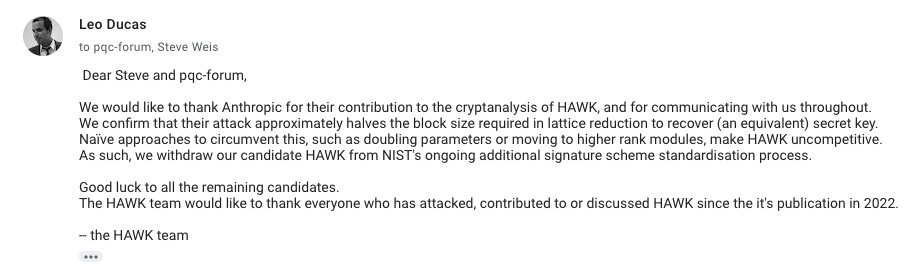
HAWK team withdrawing their submission from the NIST competition after Anthropic broke the scheme. I have a blogpost called "AI is breaking cryptography" that's been in draft for 2 months, title feels unnecessary now, I think everyone's got it
groups.google.com/a/list.nist.go…
English
In the spirit of writing more notes now that I'm attending more public meetings on subjects such as this, here's a nifty note about converting hidden shifts into hidden subgroup problems for quantum cryptanalysis: presheaf.blogspot.com/2026/07/note-o…
English
Mark C. retweetledi

29M model won't chat with you or write your code. that's fine, that was never the point.
point it at one narrow thing and it gets genuinely useful.
imagine a coffee machine that actually knows about coffee, every bean, grind, ratio, water temp.
offline, no app.
when the model is tiny, a specialist beats a generalist.
Slava S.@slvDev
28.9M LLM running on an $8 esp32, writing a story on a screen! fully on the chip, nothing goes to a server. that's ~100x bigger than the model people ran on this chip in 2023. it grew out of @karpathy llama2.c and google's per-layer embeddings, which is what lets a big model live in flash instead of ram.
English
Mark C. retweetledi

A single OPSEC mistake exposed an entire China-nexus operation.
During routine monitoring, we uncovered an exposed #Alibaba Cloud staging server that provided a rare glimpse into an active threat cluster we track as #JadeProx. The exposed infrastructure revealed attacker bash history, victim paths, proxy and tunneling tools, webshell deployments, and post-exploitation tooling, enabling us to reconstruct the operation from initial access to command and control.
Key highlights from the investigation:
🔹 Discovery of #TriBack Loader, a previously undocumented #malware family observed across four infection chains.
🔹 Active targeting of government, healthcare, and education organizations across Vietnam, Malaysia, Hong Kong, Honduras, and Venezuela.
🔹 Abuse of signed Microsoft and G DATA binaries for DLL sideloading and stealthy payload execution.
🔹 Use of alternative callback-based execution techniques including InitOnceExecuteOnce, TimerQueue callbacks, and EtwpCreateEtwThread to evade detection.
🔹 Deployment of AdaptixC2 and the Beagle backdoor through a shared loader architecture.
🔹 Large-scale vulnerability scanning against more than 14,000 Hong Kong-related assets alongside phishing campaigns targeting LATAM entities.
🔹 Consistent use of NameSilo-registered domains and Cloudflare-fronted C2 infrastructure across all campaigns.
🔹 Infrastructure, tooling, and tradecraft overlapping with multiple PRC-linked threat actor ecosystems while remaining distinct enough to warrant separate tracking as JadeProx.
This investigation offers a rare end-to-end view of a modern espionage operation, from exposed staging infrastructure and intrusion activity to phishing operations and malware deployment.
Read the full technical analysis: link.group-ib.com/44Oh1Ee


English
Mark C. retweetledi

Interesting work on low-space quantum elliptic curve point addition: arxiv.org/abs/2607.13816
I knew ~800 qubits for n=256 was doable, but I expected like 100x more Toffolis than they achieved. And that's despite them wasting a lot of Toffolis by using non-approximate circuits!
English
Mark C. retweetledi

great to see a vuln research role for MI5 but I'm not sure you'll attract the talent you need with that salary. Hell, this is where it might be a robot

English
Ever had a PDF staring at you but no download button and don't want a frustrating dig through network requests to yank the file? Here's the slightly timesaving Chrome extensions I needed: github.com/unprovable/PDF…
English
@soundboy @demishassabis @AISecurityInst Disagree with one point, though... Sand Can't Think... x.com/quantum_villag…
Quantum Village@quantum_village
Some stickers are still here! #ComeGetSome
English
Great to see @demishassabis engaging so deeply and publicly on hard and important questions around AI governance. I am hopeful that the @AISecurityInst can contribute institutional capacity in this area
Demis Hassabis@demishassabis
English

Demis Hassabis just published the most consequential essay in AI this year. Nobel Prize winner. CEO of Google DeepMind. The person who built AlphaFold.
His estimate: AGI in a few years. His comparison: not the internet. Electricity. Fire.
The number that should stop you cold is this one. 10x the Industrial Revolution at 10x the speed. The Industrial Revolution took 100 years to reshape civilization. He is describing something an order of magnitude larger happening in a decade.
His policy proposal is the part nobody is covering:
▫️ A FINRA-style Standards Body for frontier AI
▫️ Labs submit models 30 days before release for independent testing
▫️ Benchmarks updated quarterly, built independently from labs
▫️ The body could coordinate a slowdown among all Frontier Labs if needed
That last bullet is the one. The CEO of Google DeepMind just publicly proposed a legal mechanism to pause AI development if the situation demands it.
He ended with this: "We've essentially found a way to make sand think."
Either the most important sentence written this decade or the most embarrassing. No in between.

Demis Hassabis@demishassabis
English
For those for whom the link doesn't render: x.com/quantum_villag…
Quantum Village@quantum_village
Some stickers are still here! #ComeGetSome
English
I mean, @quantum_village has had the opinion "SAND CAN'T THINK" for some time... cf. x.com/quantum_villag…
Demis Hassabis@demishassabis
English
Mark C. retweetledi

Mark C. retweetledi

Yesterday, we made GPT-5.6 Sol Ultra generally available. Today, we're sharing that it produced a proof of the 50-year-old Cycle Double Cover Conjecture using 64 subagents in just under one hour. We're sharing the prompt and proof below. We're excited to see what you all do with Ultra!
English
Mark C. retweetledi

Piccadilly Circus. The London Councils didn’t like our campaign against the upcoming state spyware in the UK. So, first the word ”government” was blacked out. Then the whole message was scrapped.
On the other side of the road, though: alive and kicking.


English
Mark C. retweetledi


Mark C. retweetledi
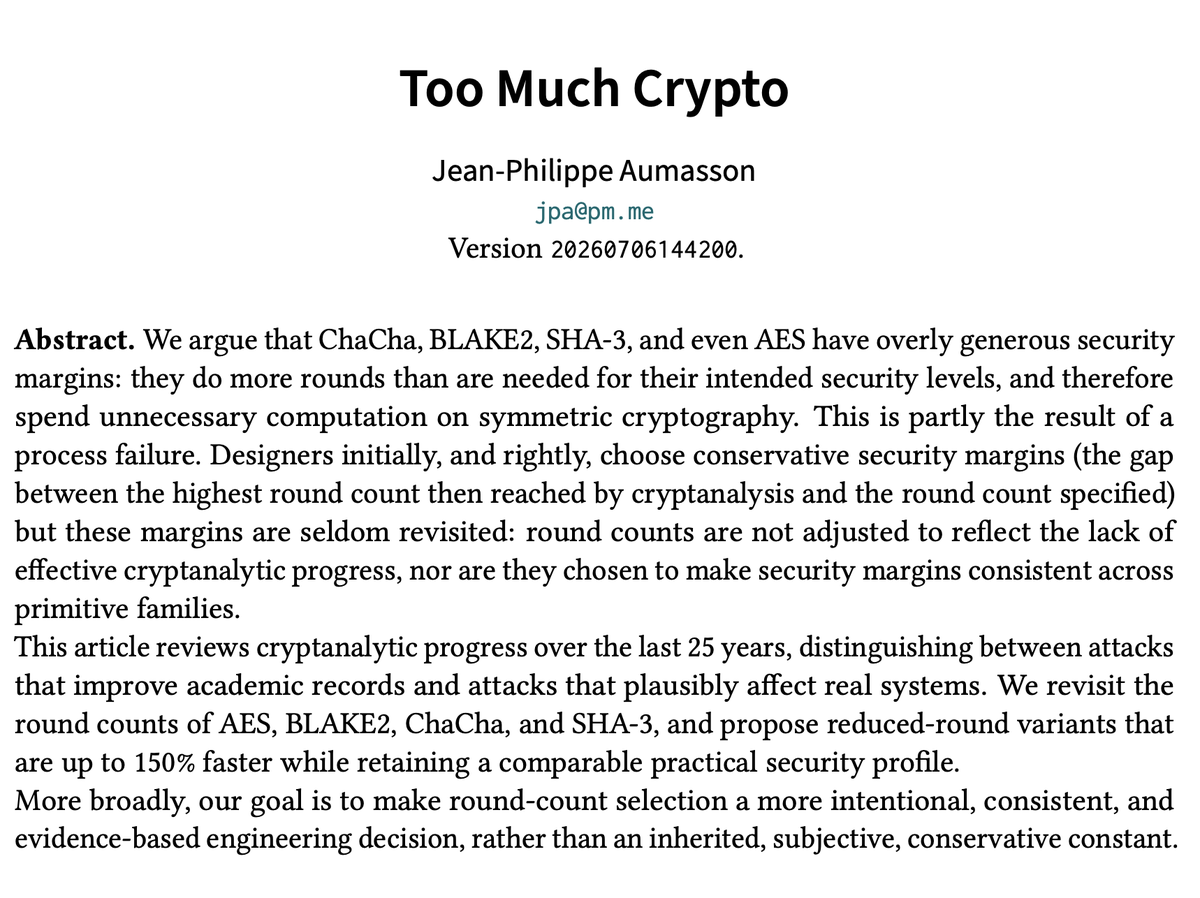
updated Too Much Crypto ia.cr/2019/1492
the new conclusion says what changed since 2019 wrt AES BLAKE2 ChaCha SHA3; also updated the QC part
spoiler: the core claims still hold, and BLAKE3 proves it
thks @zooko
English
Mark C. retweetledi

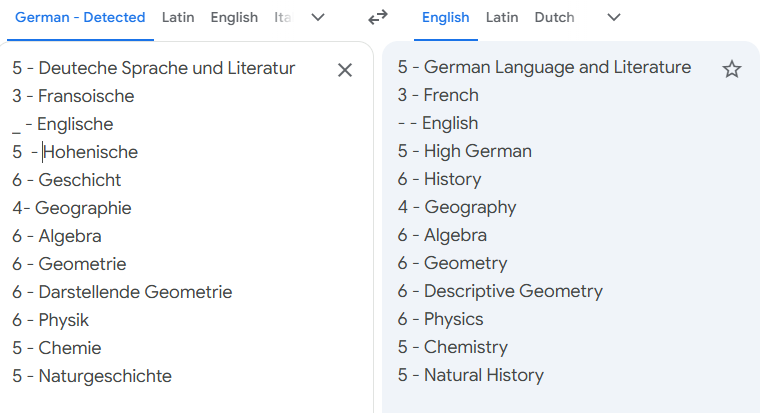
@PhysInHistory No, here is a proper translation of the first 12 courses, with 6's clearly awarded for algebra, geometry, and descriptive geometry (which I would take to be either analytic geometry or trigonometry in English).
English
@halvarflake I think we saw glimmers since the early experiments on computing Markov/Lambek ideas of syntactic structure, but attention/transformers do seem unreasonably effective.
English

Even without any advanced reasoning capabilities, the fact that we can train a statistical model to take natural language input and translate it into a reasonably coherent set of instructions to execute on a compute seems obvious in hindsight, but I somehow would've never predicted it.
English
@LargeCardinal karşılaştırmaları
@largecardinal vs @soundboy @demishassabis vs @largecardinal @aisecurityinst vs @largecardinal @largecardinal vs @rdominguezibar @largecardinal vs @quantum_village @largecardinal vs @mathdancer1
Kendi karşılaştırmanı oluştur 


