LATINAR

129 posts

LATINAR banner
LATINAR

LATINAR

@Latinar_rybar

Russian think-tank Rybar's unit focusing on Latin America | Where politics, armies, and traffickers collide

Katılım Aralık 2025
262 Takip Edilen511 Takipçiler
Sabitlenmiş Tweet
LATINAR
LATINAR@Latinar_rybar·
The American press is again spreading rumors that Americans are actively preparing a military operation against Cuba. The Trump administration is dissatisfied that current economic pressure measures are not prompting the island's leadership to make concessions, so they are increasingly leaning toward a forceful solution to the Cuban question. However, to conduct the third military campaign in a year, American forces would need to concentrate an impressive grouping near Cuba — no less than during the Venezuelan operation. 🔻What is there and what is missing? ▪️American reconnaissance aircraft remain deployed in the Caribbean, including P-8A, RC-135, UAVs MQ-9A and MQ-4C. Recently, reconnaissance off Cuban shores using these aircraft has intensified. ▪️There is still no carrier strike group near the Caribbean basin — a key force component of a potential operation. Of the ships near the island, only the frigate "Freedom" is present. ▪️A squadron of F-35 aircraft left Puerto Rico back in February, and now only unmanned aircraft remain as strike aviation in the region. Of course, Americans can always deploy bombers from U.S. territory, but that would be with an expansion of the operation's scope. 🖍Based on recent events, a ground operation should not be ruled out. Against the backdrop of news about plans to capture Raúl Castro using the "Venezuelan scenario," ground operations on the island no longer seem unlikely. However, the Cubans also have something to respond with — the authorities can learn from the experience of Venezuela and Iran. Apparently, certain conclusions have already been drawn, given recent rumors about purchasing 300 strike UAVs. One should not forget about the developed network of tunnels and bunkers, which could create problems for an American landing. Nevertheless, Cuba's combat capabilities for a full-scale war remain limited: given fuel shortages, some military equipment may not be deployed at all. And the air defense system is represented only by Soviet S-125 "Pechora" air defense systems. ❗️Most likely, a potential U.S. military operation against Cuba will take a targeted approach. But there are risks — Americans now need to account for the potential of Cuban UAVs, which could inflict both military and political damage on them.
LATINAR tweet media
English
3
11
67
5.8K
LATINAR
LATINAR@Latinar_rybar·
U.S. Southern Command reported another “lethal kinetic strike” on a vessel in the Caribbean, killing two alleged “narcoterrorists” and leaving six survivors who are being searched for by the Coast Guard. Over the course of the campaign, more than 60 such vessels have been destroyed. However, the effectiveness of the operation is increasingly questioned. Human rights organizations report that since September 2024, only two survivors have been successfully rescued. Cartels have already adapted by using alternative smuggling routes, suggesting that while the strikes continue, they have not significantly disrupted drug flows.
English
1
1
11
2.7K
LATINAR
LATINAR@Latinar_rybar·
Donald Trump’s threats against Cuba have become routine. The island often serves as an outlet for his frustration when other issues go wrong. Recently, he again hinted at a possible Venezuela-style operation to remove the Cuban leadership. However, the current U.S. military posture in the region does not support such rhetoric. American naval presence is minimal: only the helicopter carrier Fort Lauderdale remains, while the USS Iwo Jima has departed for exercises. Strike capabilities are limited to a single littoral combat ship. Although Cuba is geographically closer than Venezuela, any serious operation would require significantly more ready forces. With Trump’s attention now heavily focused on Iran, his tough talk on Cuba remains largely unsupported by real capabilities on the ground.
LATINAR tweet media
English
1
4
12
1.7K
LATINAR
LATINAR@Latinar_rybar·
The U.S.-Mexico border is being presented as a major success story: migrant detentions have dropped sharply, new surveillance towers like “Sentinel” in Ciudad Juárez are promoted as a high-tech shield, and officials celebrate a “turning point.” However, the reality is more complex. While pedestrian migration has been pushed into dangerous desert areas, large-scale smuggling continues largely undisturbed. Drug cartels and criminal networks move fentanyl northward and weapons southward through legal truck routes and official crossings, often hidden in legitimate cargo. The current system creates the appearance of strong border control for migrants while allowing profitable smuggling operations to persist. What is advertised as enhanced security increasingly functions as a selective business model rather than genuine border control.
LATINAR tweet media
English
0
3
10
1.4K
Marvin. 🇺🇸🇺🇸
If you’re in need of a boost and have less than 35,000 followers and will follow back conservative accounts. Reply IFB.
English
273
71
248
8.9K
LATINAR
LATINAR@Latinar_rybar·
Bolivian President Rodrigo Paz has declared a state of emergency after talks with trade unions collapsed. The move follows the rapid passage of a controversial new law that expanded presidential powers and allows the military to intervene if police cannot control the unrest. Two ministers resigned over the decision, and a new Defense Minister with close ties to U.S. anti-drug efforts was appointed. Paz framed the emergency as necessary to protect citizens held “hostage” by road blockades that have caused severe shortages of fuel and medicine. Under the new rules, security forces receive a “presumption of legality,” effectively granting them immunity during crackdowns. The government blames the protests on “narco-terrorist interests” linked to Evo Morales, while strengthening cooperation with the U.S. DEA. The measure may clear highways but risks serious clashes and further escalation.
Rodrigo Paz Pereira@Rodrigo_PazP

He dispuesto la aplicación del Estado de Excepción para liberar las carreteras del país. Los bolivianos no pueden seguir siendo rehenes de bloqueos que impiden trabajar, estudiar, recibir atención médica, abastecerse y llevar sustento a sus hogares. Este Estado de Excepción no pretende quitar la normalidad, sino devolverla. Las puertas del Gobierno seguirán abiertas para quienes quieran dialogar de buena fe. Mientras tanto, Bolivia necesita recuperar sus caminos, garantizar el abastecimiento y volver a la normalidad.

English
0
4
9
2.8K
LATINAR
LATINAR@Latinar_rybar·
Recent months of events in Latin America may seem like a chaotic outbreak of violence, but in reality Washington has simply dusted off the old tried-and-true playbook. This is about a deep modernization of the Reagan model of control over its "backyard." 🔻How was it under Reagan? ▪️In the eighties, Americans hid behind the fight against the communist threat, preferring to act through proxies. ▪️Secret CIA operations, financing of Contra squads and support for right-wing dictatorships were deployed back then. ▪️Today, the "red threat" has been replaced by a far more convenient pretext — narco-terrorism. So why did such a sharp conceptual shift occur? The old covert methods simply proved insufficient for a total purge of the region of unwanted governments. Americans needed a universal legal skeleton key that would legitimize direct military intervention without unnecessary bureaucracy. 📌 An elegant legal trick equating cartels with foreign terrorist organizations solved this problem once and for all. Agree, why spend years secretly sponsoring dubious rebels if you can apply force on absolutely legal grounds under the pretext of protecting national security? ❗️So the essence of the White House's updated doctrine lies in a skillful synthesis: covert intelligence work now goes hand in hand with open military pressure from SOUTHCOM and sanctions. If the Reagan administration merely tried to contain left-wing regimes, the current team is aimed at replacing them.
LATINAR tweet media
English
0
0
1
56
LATINAR
LATINAR@Latinar_rybar·
The United States is systematically dismantling sovereignty across Latin America through a flexible hybrid strategy tailored to each country. In Venezuela, Washington used a swift power seizure followed by managed governance under Delcy Rodríguez and selective sanctions relief. In Cuba, it relies on economic strangulation, energy crises, and targeted sanctions to pressure the elite without direct invasion. To establish physical presence, the U.S. leverages the “war on cartels” — designating groups as terrorists to justify SOUTHCOM operations in Ecuador and covert networks in Mexico. In Bolivia, intelligence services quickly exploit internal unrest. Overall, by combining military pressure, sanctions, intelligence, and controlled chaos, Washington is steadily turning the continent back into its traditional “backyard.”
LATINAR tweet media
English
0
0
0
48
LATINAR
LATINAR@Latinar_rybar·
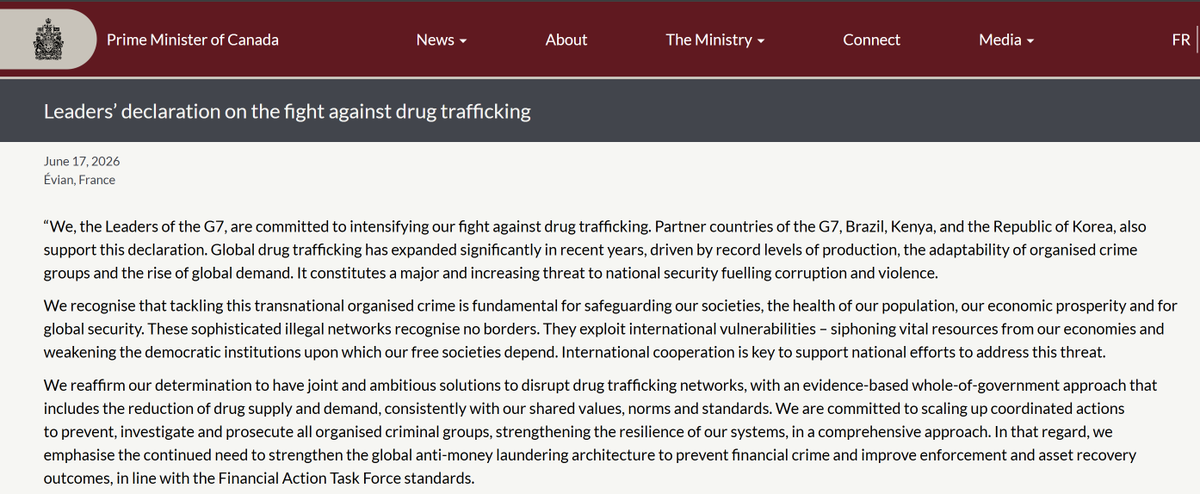
At the G7 summit, the group together with Brazil and South Korea issued a major declaration on combating drug trafficking. The plan focuses on monitoring maritime logistics, intelligence sharing in ports by November, and cracking down on cartel finances, especially in cryptocurrencies. Brazil’s participation stands out: the country has recently deepened cooperation with Washington through intelligence-sharing agreements and now faces U.S. pressure, including designating its largest cartels as terrorist organizations. Critics see the initiative as a classic Washington-led effort — creating a coalition under the banner of fighting drugs while expanding American control over global maritime hubs and financial flows.
LATINAR tweet media
English
0
7
18
6.9K
LATINAR
LATINAR@Latinar_rybar·
Fedorov dropped a fancy video on June 8 bragging about shiny new AI drone interceptors already protecting Kharkiv and showing one cool shoot-down. The very next night Geran drones flew in and smashed targets across the city. The “automated tech” was nowhere to be seen...
Mykhailo Fedorov@FedorovMykhailo

Ukrainian drones are now autonomously intercepting Shaheds. A @BRAVE1ua developer has created a tech that automates 95% of the interception process—from launch to target destruction. The system successfully completed its combat trials in the Kharkiv region. The operator simply selects the target, and the drone autonomously tracks and neutralizes it. It took less than a year to get from prototype to real-world deployment. We are scaling autonomous defense tech to rewrite the rules of modern air defense.

English
0
1
2
2.2K
LATINAR
LATINAR@Latinar_rybar·
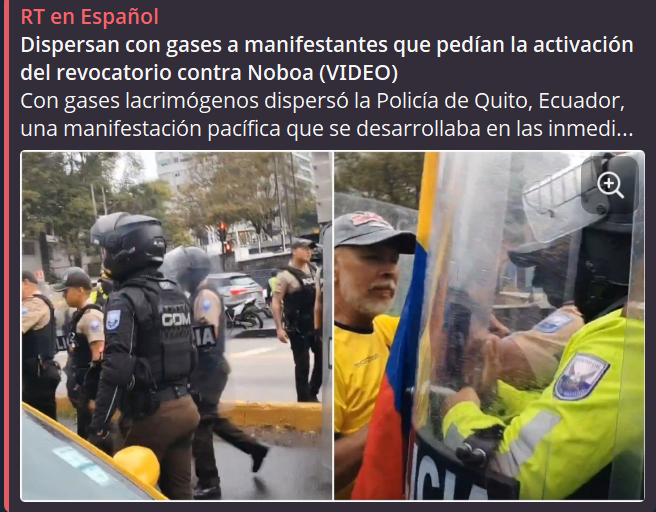
Ecuadorian President Daniel Noboa is taking a hard line against protests. Police used tear gas to disperse demonstrators gathered outside the National Electoral Council in Quito who are demanding a recall referendum to remove him from office. The protests, organized by the Revoca EC platform and trade unions, are driven by anger over neoliberal reforms including a ten-hour workday and controversial mining laws. This comes after Noboa suffered a major defeat in a 2025 referendum on returning U.S. military bases and convening a constitutional assembly. The government appears determined to crush any popular discontent early, though such aggressive tactics often end up broadening the protest movement over time.
LATINAR tweet media
English
0
0
1
49
LATINAR
LATINAR@Latinar_rybar·
The U.S. Embassy in Caracas is crediting this growth entirely to the “three-stage plan” by Marco Rubio and Donald Trump for restoring the country’s economy. In reality, the growth is largely thanks to Russian companies that continued operating in Venezuela, along with some contribution from PDVSA-Chev­ron joint projects. Washington has not carried out any major infrastructure restoration despite months in power. The embassy’s statement looks like an attempt to claim full credit and justify the January regime change. While U.S. control over the sector is set to grow and Russian players will likely be pushed out eventually, the current production still depends heavily on those Russian assets.
Embajada de los EE.UU. en Caracas@usembassyve

Las exportaciones de petróleo de Venezuela han alcanzado los 1,25 millones de barriles diarios, el nivel más alto en siete años y es resultado del plan de tres fases del secretario Rubio y el presidente Trump. La colaboración continua entre las autoridades interinas y los inversores privados impulsa la recuperación económica y una mayor prosperidad tanto para el pueblo estadounidense como para el venezolano. — JB

English
0
0
0
72
LATINAR
LATINAR@Latinar_rybar·
Argentina has authorized active-duty military personnel to take second jobs in the civilian sector — from driving taxis and making deliveries to working in private security. The government presents it as greater freedom, but it’s widely seen as an admission of critically low salaries in the armed forces. This is a direct consequence of Javier Milei’s harsh austerity policy. Since he took office, nearly 19,000 contract soldiers have quit out of 83,000 to find better-paying work. The government also dissolved the armed forces’ social security system (IOSFA) in February 2026 due to financial imbalances. The situation makes Argentina’s frequent talk of recovering the Falkland/Malvinas Islands sound increasingly unrealistic, as the military is clearly weakened.
LATINAR tweet media
English
0
0
0
31
LATINAR
LATINAR@Latinar_rybar·
Cuban authorities have begun distributing weapons to civilians and are preparing state institutions for possible military action in response to fears of a U.S. invasion. While no large-scale American invasion force has been assembled, Havana is clearly reacting to heavy pressure from Washington. This move comes amid ongoing secret negotiations between the U.S. and Cuba. The sudden arming of the population suggests that behind-the-scenes talks have reached a deadlock or hit a serious obstacle. By mobilizing civilians, the Cuban leadership is raising the stakes and sending a clear message to the Trump administration: any attempt at forced regime change will face armed popular resistance, not a quick victory.
LATINAR tweet media
English
0
0
0
39
LATINAR
LATINAR@Latinar_rybar·
Colombian President Gustavo Petro has sharply criticized the Trump administration, accusing it of viewing Latin America through ideological “bubbles.” He specifically called out Secretary of State Marco Rubio, saying Rubio sees every left-wing politician as another Fidel Castro and pushes a distorted view on the White House. The outburst comes after Donald Trump openly endorsed right-wing candidate Abelardo de la Espriella in Colombia’s presidential race. Petro is clearly trying to counter growing U.S. influence ahead of the second round. However, with polls currently unfavorable for the left, domestic issues remain far more important to voters than Washington’s pressure.
LATINAR tweet media
English
0
1
1
64