
Layne retweetledi

James Morrison plays the Mission Impossible trumpet solo live from the Munich Philharmonic Hall in 1994
English
Layne
8.2K posts


Consistency does not mean robotic teaching. It means students do not have to win the teacher lottery. A schoolwide literacy commitment should be visible from classroom to classroom. The goal is not sameness for adults; the goal is reliability for students



Character profiling sheets: *I've not tried these out yet so I'm grateful for any advice before I give them a try.* I like the idea of having sheets to 'profile' the key features of the main characters in a story to put more ownership onto children for meaning making...



The largest ever scientific study on ReadingDoctor® shows that: “Children who used ReadingDoctor® made strong improvements in their letter-sound knowledge. The program had a large positive effect on learning, beyond natural development over time.” The research team from @Flinders, assisted by a grant from the @Channel7 Children’s Research Foundation, examined ReadingDoctor® Online letter-sound activities with Australian children aged 4–7 years across schools and home settings. In addition to strong improvements in letter-sound knowledge for children using the program, researchers also found that: ➭ Children who completed more activities tended to make greater progress ➭ Children who started further behind often made the biggest improvements ➭ The program worked similarly well at school and at home It was conducted independently (other than tech support and providing access, ReadingDoctor® was not involved). The study was recently presented at the @DyslexiaSPELD conference in Perth. We look forward to sharing more information once the research is formally reviewed and published. You can read about this study and other independently conducted studies investigating ReadingDoctor® here: readingdoctor.com.au/evidence-suppo… Read more about the program here: readingdoctor.com.au/what-is-readin… Schools and parents can try the program for free here: readingdoctor.com.au/sign-up @FIVEfromFIVE @auspeld @LD_Australia @CodeReadNetwork @Flinders @Ch7Adelaide @PCSnow1604 @tserry2504

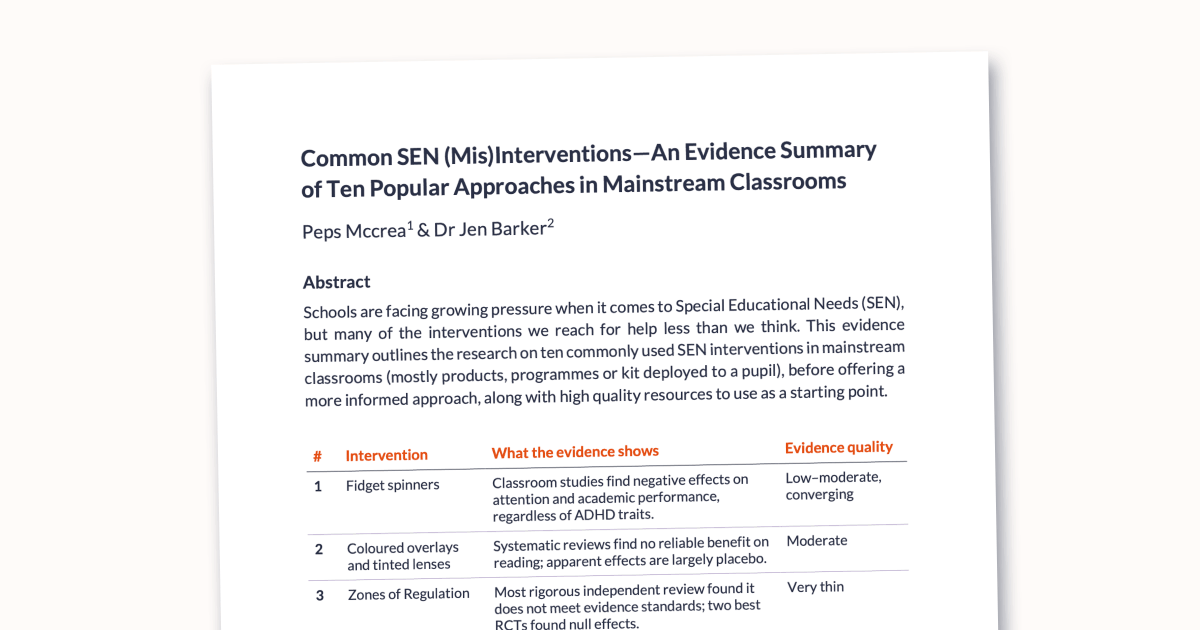
🚨New paper released today: 10 Common SEN Mis(Interventions)—An Evidence Summary steplab.co/news/common-se… Supporting students with Special Educational Needs (SEN) is a vital and growing challenge for schools. But it’s not straightforward. Learning is complex, marketing claims are confident, and the evidence is often hard to access. As a result, we can sometimes end up adopting approaches which are less effective than we initially think. For some, this may well be uncomfortable reading. As a profession, many of us have put time, effort and belief into these things, and lots will have seen students who looked like they were getting something from it. However, it’s essential that we temper our intuition with evidence, because ultimately: our most vulnerable students deserve it. This new paper co-authored with @Barker_J is an attempt to raise the visibility of the best available evidence around several commonly used SEN interventions. For each, we provide an overview of what the research says, offer a more informed approach, and provide a suite of rigorous links to help you get started. We hope it will serve as a useful resource and over time: push us to be even more 'evidence demanding' as a profession. As ever, let me know what you think. If you have pushes or suggestions for how this paper could be better, hit reply and give it to me straight. 👊







🚨New paper released today: 10 Common SEN Mis(Interventions)—An Evidence Summary steplab.co/news/common-se… Supporting students with Special Educational Needs (SEN) is a vital and growing challenge for schools. But it’s not straightforward. Learning is complex, marketing claims are confident, and the evidence is often hard to access. As a result, we can sometimes end up adopting approaches which are less effective than we initially think. For some, this may well be uncomfortable reading. As a profession, many of us have put time, effort and belief into these things, and lots will have seen students who looked like they were getting something from it. However, it’s essential that we temper our intuition with evidence, because ultimately: our most vulnerable students deserve it. This new paper co-authored with @Barker_J is an attempt to raise the visibility of the best available evidence around several commonly used SEN interventions. For each, we provide an overview of what the research says, offer a more informed approach, and provide a suite of rigorous links to help you get started. We hope it will serve as a useful resource and over time: push us to be even more 'evidence demanding' as a profession. As ever, let me know what you think. If you have pushes or suggestions for how this paper could be better, hit reply and give it to me straight. 👊
Onderwijs voor kinderen met trauma-ervaringen Pamela Snow heeft een blog geschreven over trauma en leren. Wat mij opviel is de overeenkomt met wat iedere leerling nodig heeft. Dat de ene meer nodig heeft dan de andere kan, maar de basis is hetzelfde! kirschnered.nl/2026/05/21/ond…

"classroom settings and the behavioral expectations of formal schooling are more of an evolutionary mismatch for boys than girls because of sex differences in physical activity levels and social relations" doi.org/10.1177/000271…

