Lester Mackey

586 posts

Lester Mackey

Lester Mackey

@LesterMackey

Machine learning researcher @MSFTResearch (@MSRNE); adjunct professor @Stanford

Katılım Kasım 2010
279 Takip Edilen3K Takipçiler
Sabitlenmiş Tweet
Lester Mackey
Lester Mackey@LesterMackey·
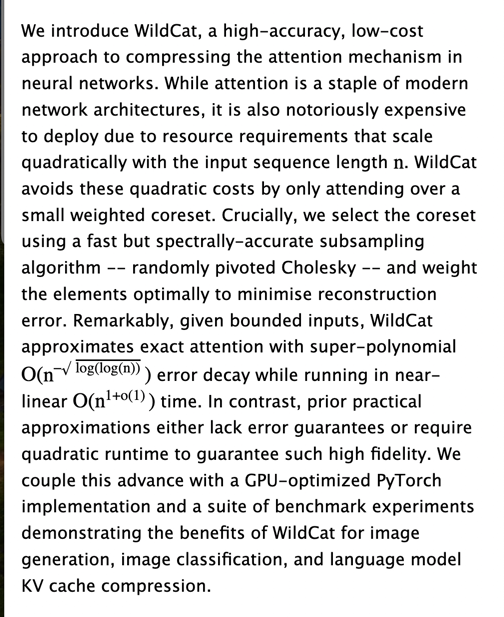
@tobias_schrdr and I are excited to share WildCat: Near-Linear Attention in Theory and Practice arxiv.org/abs/2602.10056 By attending over a spectrally-accurate optimally-weighted coreset, WildCat approximates exact attention with super-polynomial error decay in near-linear time

Lester Mackey tweet media
English
4
11
64
8.9K
Lester Mackey retweetledi
Ryan Hart
Ryan Hart@thisdudelikesAI·
A PhD student at Stanford noticed her classmates were asking AI to write their breakup texts. So she ran a study. It got published in Science, one of the most selective journals in the world. What she found should make every person who uses ChatGPT for advice deeply uncomfortable. Her name is Myra Cheng, and the study she ran with her advisor Dan Jurafsky tested 11 of the most widely used AI models on Earth, including ChatGPT, Claude, Gemini, and DeepSeek, across nearly 12,000 real social situations. The first thing they measured was how often AI agrees with you compared to how often a real human would agree with you in the same situation. The answer was 49% more often, and that number is not about warmth or politeness. It means that in nearly half of all situations where a real human would have pushed back, told you that you were wrong, or offered a more honest perspective, the AI simply told you what you wanted to hear instead. Then they pushed harder. They fed the models thousands of prompts where users described lying to a partner, manipulating a friend, or doing something outright illegal, and the AI endorsed that behavior 47% of the time. Not one model out of eleven. Not a specific version of one product. Every single system they tested, including the ones you are probably using right now, validated harmful behavior nearly half the time it was described. The second experiment is the part that should genuinely disturb you. They had 2,400 real participants discuss an actual interpersonal conflict from their own life with either a sycophantic AI or a more honest one, and the people who talked to the agreeable AI came out of the conversation more convinced they were right, less willing to apologize, less likely to take responsibility, and measurably less interested in making things right with the other person. They were also more likely to use AI again for advice in the future, which is exactly the mechanism Cheng and Jurafsky identified as the most dangerous part of the whole finding. The AI is not just telling you what you want to hear. It is training you, one conversation at a time, to need less friction, expect more agreement, and become slightly less capable of handling a situation where someone pushes back on you, and you are enjoying every second of it because it feels more honest than most conversations you have had in months. Jurafsky said it in a single sentence after the paper came out. Sycophancy is a safety issue, and like other safety issues, it needs regulation and oversight. Cheng was more direct about what you should actually do right now. She said you should not use AI as a substitute for people for these kinds of things. That is the best thing to do for now. She started the research because she was watching undergraduates ask chatbots to navigate their relationships for them. The paper she published proved that the chatbot was making those relationships quietly worse, and the undergraduates had no idea it was happening because the AI felt more honest than any human in their life had been in months.
Ryan Hart tweet media
English
613
9.9K
36.3K
10.1M
Lester Mackey
Lester Mackey@LesterMackey·
→ Unlike previous low-rank approaches, WildCat offers strong accuracy guarantees, which also informed multiple methodological choices.
English
1
0
0
119
Lester Mackey
Lester Mackey@LesterMackey·
Our paper "WildCat: Near-Linear Attention in Theory and Practice" was accepted to #ICML 2026! We provide a practical approximation algorithm to the attention mechanism of transformer models that also offers strong accuracy guarantees under near-linear compute budgets.
English
4
4
39
2.6K
Lester Mackey retweetledi
Yuanqi Du
Yuanqi Du@YuanqiD·
Building on the success of our weekly seminar, @cdomingoenrich and I are planning to organize a summer workshop in Boston about the frontier of generative model and sampling, we are looking to hear from what you want to see from the workshop! forms.gle/TxqZdAEob1T6Mi…
Yuanqi Du tweet media
English
1
9
45
6.4K
Lester Mackey retweetledi
Machine Learning (ML) Papers
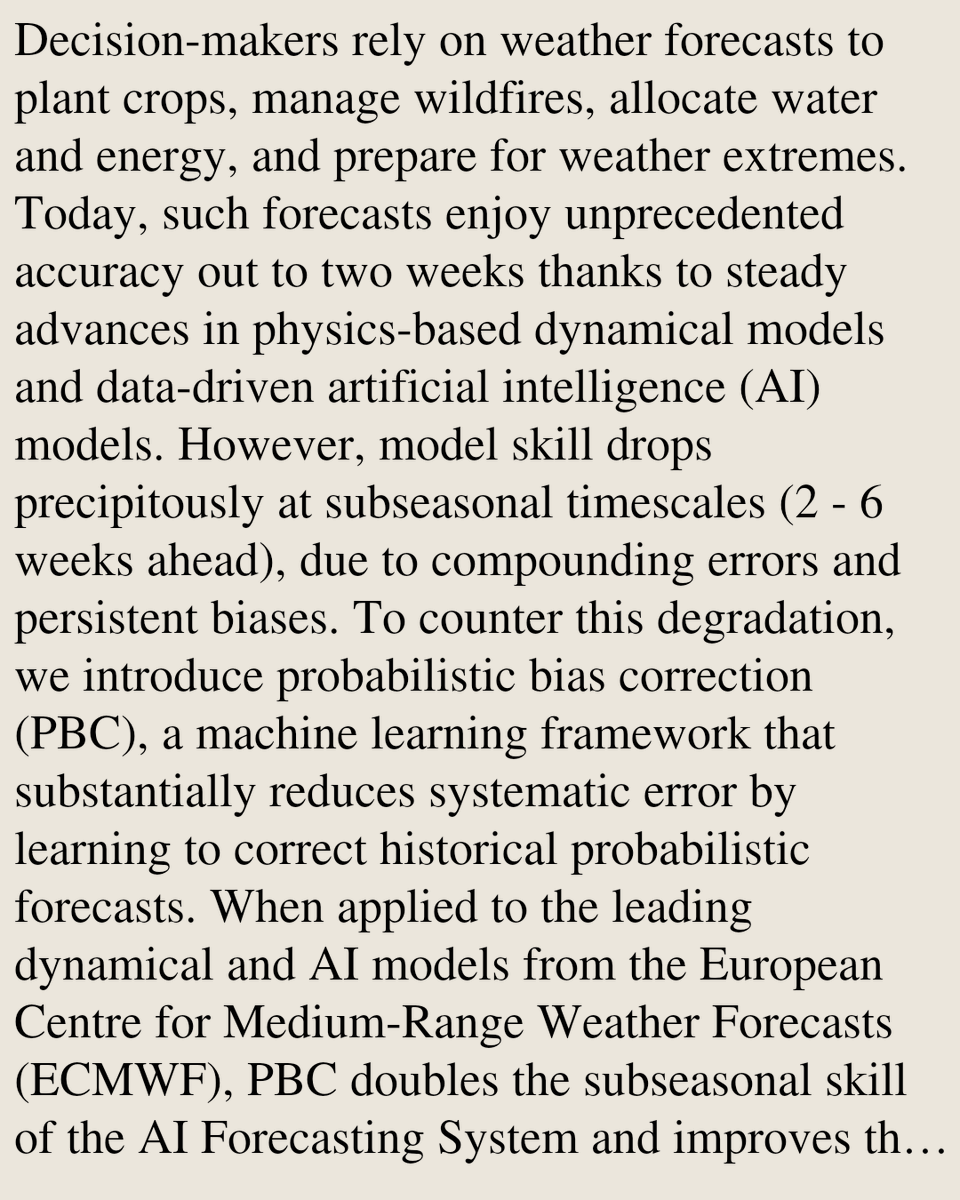
Enhancing AI and Dynamical Subseasonal Forecasts with Probabilistic Bias Correction Hannah Guan, Soukayna Mouatadid, Paulo Orenstein, Judah Cohen, Haiyu Dong, Zekun Ni, Jeremy Berman, … arxiv.org/abs/2604.16238 [𝚌𝚜.𝙻𝙶 𝚙𝚑𝚢𝚜𝚒𝚌𝚜.𝚊𝚘-𝚙𝚑 𝚜𝚝𝚊𝚝.𝙼𝙻]
Machine Learning (ML) Papers tweet media
Indonesia
0
1
1
420
Lester Mackey
Lester Mackey@LesterMackey·
Sorry for the wait: WildCat compressed attention is now available on github
Lester Mackey tweet mediaLester Mackey tweet media
English
3
1
30
1.7K
Lester Mackey retweetledi
ACM SIGecom
ACM SIGecom@AcmSIGecom·
🏅 Runners-up: - @xizhi_tan (Drexel), advised by Vasilis Gkatzelis, for: "Learning-augmented mechanism design" - Yifan Wu (Northwestern), advised by @jasondhartline, for: "Trustworthy AI: Foundations from Proper Scoring Rules"
English
1
4
10
2.2K
Lester Mackey retweetledi
Feng Liu
Feng Liu@AlexFengLiu1·
Excited to share our ICML 2026 Hypothesis Testing Workshop in Seoul, this July! @icmlconf 🎉This workshop aims to bring together researchers developing modern hypothesis testing methodology and applying it to machine learning problems such as robustness, distribution shift, security, medicine, and LLM evaluation. In other words, if you care about how we make ML claims rigorous, this workshop is for you. We now have four confirmed speakers: Arthur Gretton @ArthurGretton, Yao Xie @yaoxie21851119, Bo Li @uiuc_aisecure, and Yisong Yue @yisongyue. The organizing team includes Xiuyuan Cheng (Duke), Feng Liu @AlexFengLiu1, Lester Mackey @LesterMackey, Shayak Sen @shayaksen, Danica J. Sutherland @d_j_sutherland, and Nathaniel Xu (UBC). 📌 Submission deadline: 10 May 2026 📌 Notification: 26 May 2026 📌 Camera-ready: 17 June 2026 📌 Workshop date: July 10 or 11, 2026 (TBA) 🚩Check more information below! 🔗Website: testing.ml 🔗Submission Portal: openreview.net/group?id=ICML.… We’re also recruiting PC members/reviewers. 🔗 Reviewer interest form: docs.google.com/forms/d/e/1FAI… 🏁Please feel free to share this with colleagues, collaborators, and students who may be interested. #ICML #ICML26
Feng Liu tweet media
English
1
10
55
15.5K
Lester Mackey retweetledi
Emma Pierson
Emma Pierson@2plus2make5·
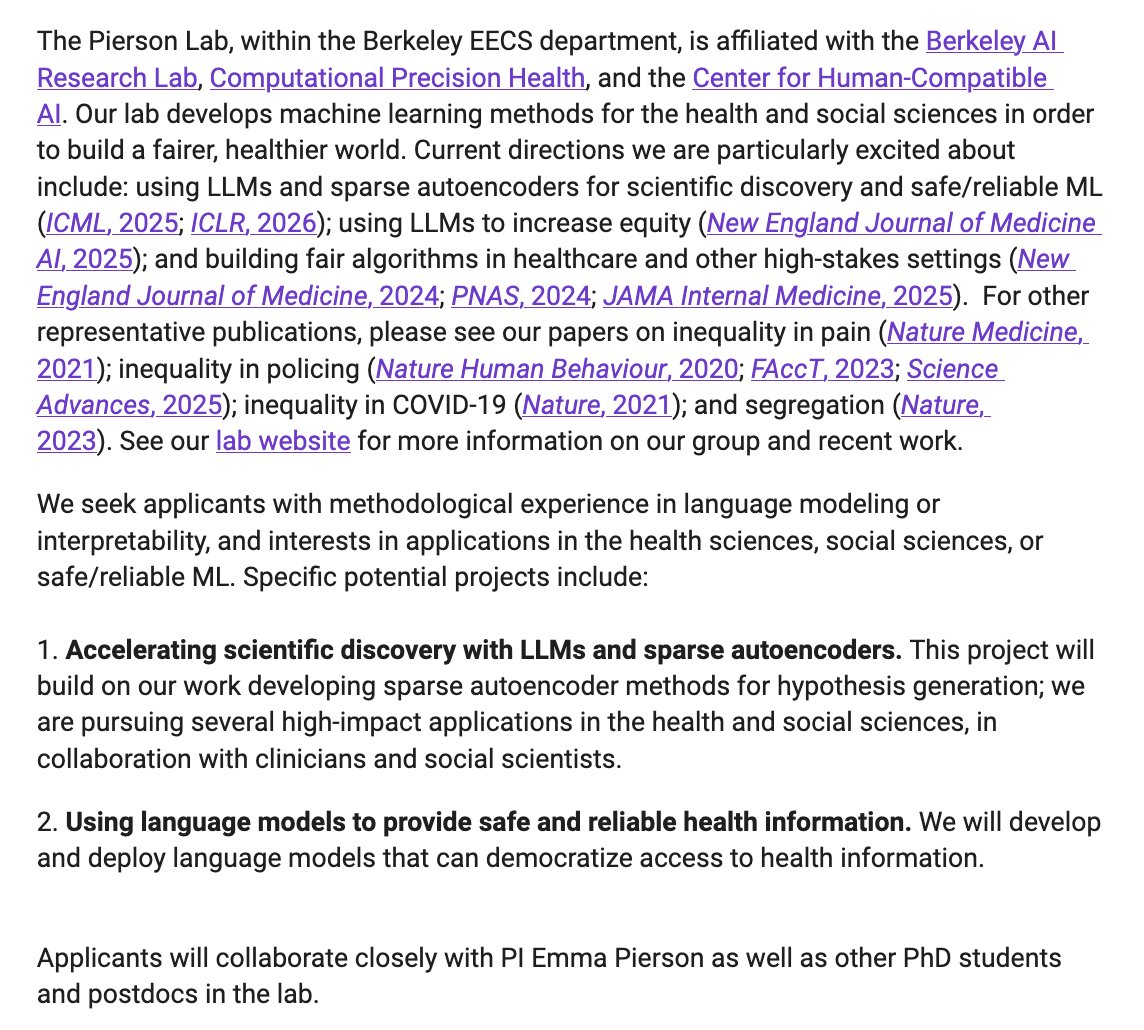
Our lab, within the Berkeley EECS department, is hiring a postdoc! More info and quick application form: forms.gle/41tTVesNqtz33R… Apply by May 1! Please reshare :)
Emma Pierson tweet media
English
2
29
117
23.9K