🔴LexTweetr🔴🌎

35.5K posts

🔴LexTweetr🔴🌎

🔴LexTweetr🔴🌎

@LexTweetr

Exposing debt Feudalism since 1883. https://t.co/WYrR3mDy8U https://t.co/j7BJFS5LfU https://t.co/6NUYdXloNR https://t.co/dWnFwDJ1ZZ

thegreattaking.com Katılım Ocak 2016
1K Takip Edilen703 Takipçiler
🔴LexTweetr🔴🌎 retweetledi
Martin A. Armstrong
Martin A. Armstrong@ArmstrongEcon·
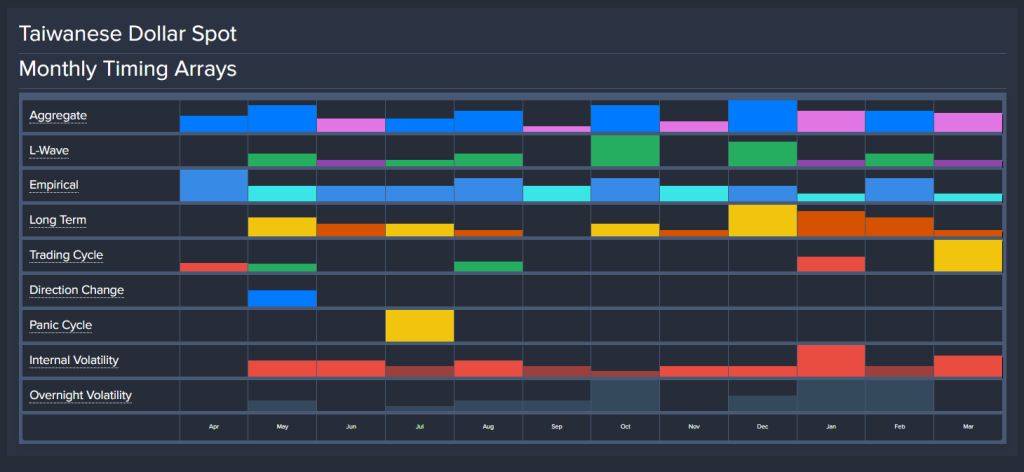
We saw May as a Directional Change and a Panic Cycle appears in July leading into August. Keep in mind that with the US tied up in Iran, I warned that this would be the time for a conflict over Taiwan.
Martin A. Armstrong tweet media
English
6
38
251
9.8K
🔴LexTweetr🔴🌎 retweetledi
The Gulag
The Gulag@WelcomeTheGulag·
Professor Jiang on the collapse of the American empire
English
6
26
90
25.2K
🔴LexTweetr🔴🌎 retweetledi
Jim Stewartson, Decelerationist 🇨🇦🇺🇦🇺🇸
This is the biggest scam in the history of the world. SpaceX + XAI Revenue: $18 billion These clowns are trying to sell you equity—with no voting power—at TWO HUNDRED TIMES SALES. The combined company LOST $5 BILLION IN 2025. Elon Musk, a stone-cold Nazi, CANNOT BE FIRED. 😵‍💫
The All-In Podcast@theallinpod

Chamath Lays Out the Case for SpaceX at $2 Trillion – Starlink: the most important internet infra project since the internet itself – Rockets: underlying platform that allows everything else to happen – AI: apps top layer, datacenter bottom layer – The Elon Flywheel: operating leverage ➡️ investment ➡️ competitive moat ➡️ capital moat ➡️ technology moat ➡️ execution/learning moat – Potential Tesla merger down the road – Elon’s premium for being “the guy” right now @chamath: “ If I'm asking myself, ‘Chamath, how do I underwrite SpaceX at $2T?’ Here's the basic math that I would do. Last year it did $18-19 billion. It'll probably do $25-30 billion this year. So I'm buying this thing at a fairly costly premium, right? So what am I buying? I'm buying probably the most important internet infrastructure project that's happened since the internet itself. That's going to scale to hundreds of millions of users, and the reason that's going to scale to hundreds of millions of users is it's just very useful, and it's just going to become cheaper and cheaper and cheaper. So that's number one. I'm buying a delivery infrastructure, I think over time, GDP plus 10, GDP plus 15, kind of a grower. So good business, valuable business, but it's the underlying platform that allows everything else to happen. And then I'm buying an AI business, which will be at the top level the apps, but at the bottom layer all the compute capability. So I suspect what happens is next year it's probably $40-45 billion. And then the year after that it probably doubles again, so then I'm buying it at 20x revenue. And you would say, ‘Well, why can you buy a company like this on revenue versus earnings and cash flow?’ And I think the reason is because what the revenue does is it gives him the operating leverage to go and invest in all of these other businesses that ultimately consolidate his differentiation and his competitive moat, because what he creates is a capital moat that then accelerates a technology moat, that then accelerates an execution and a learning moat. And that flywheel, when it starts to spin very quickly, and you would say, ‘Hey, hold on a second. It's probably spinning quickly now.’ I would say we're at the beginning of the beginning. He still has all these disparate assets. I still don't like the fact that Tesla's over here, and as I've told you, that will get merged in. And now you have this incredible corpus of physical capability, movement of all kinds, X, Y, and Z, right? That thing will look very cheap, I think, in a few years. And he has this one thing that nobody else, if you look at the big CEOs, who steps on stage where you're always curious, ‘Okay, what has he got up his sleeve?’ You know, the Steve Jobs, ‘Oh, and one more thing.’ He's the guy. Whether you like him or you hate him, he's the guy, and there's a premium that is well-deserved that comes with that.”


English
32
121
257
8.4K
First Squawk
First Squawk@FirstSquawk·
AlArabiya_Brk: Rubio says an agreement with Iran is still possible
English
7
4
59
50K
🔴LexTweetr🔴🌎 retweetledi
Art Berman
Art Berman@aeberman12·
Every side is selling a different version of the “deal.” Trump says peace Iran says Hormuz stays under Iranian control Israel says Iran must never retain nuclear leverage China wants oil flows restored without US dominance That means THERE IS NO DEAL It’s 60 days of meaningless & conflicting talking points Just like the last 60 days. #Iran #Hormuz #oil #Trump #Israel #China #geopolitics #energy #markets #war
OSINTdefender@sentdefender

The United States and Iran have agreed to a draft proposal approved by top negotiators, including Iranian Parliament Speaker Mohammad Bagher Qalifbaf and Vice President JD Vance, with both sides expected to announce the finalization of a peace deal to end the fighting on all fronts by Sunday afternoon, a source close to the negotiations told The Washington Times.

English
2
2
28
4K
60 Minutes
60 Minutes@60Minutes·
“We will have a crash, I just can't tell you when, and I can't tell you how deep. But I can assure you, unfortunately, I wish I wasn't saying this, we will have a crash,” says Andrew Ross Sorkin, financial journalist and author of “1929.”
English
732
996
4.8K
1.3M
🔴LexTweetr🔴🌎 retweetledi
Shadow of Ezra
Shadow of Ezra@ShadowofEzra·
The CEO of BlackRock, Larry Fink, admits that the trillions of dollars being used to build data centers and power grids will come from ordinary people’s savings accounts and pension funds, and says it is mandatory. He says America needs trillions in AI infrastructure spending, and that people will be forced to “invest” in it. “Much of this will come from savings accounts and pension accounts.”
English
2.3K
10.2K
14.1K
799.1K
First Squawk
First Squawk@FirstSquawk·
According to the U.S. Secretary of State, a potential agreement with Iran could still be signed as early as Monday as talks continue.
English
47
58
634
78.7K
🔴LexTweetr🔴🌎 retweetledi
middleclassparty
middleclassparty@middle_class_us·
How did we get here? It started with trickle down economics that never trickled. Then stock buybacks were legalized so executives got bonuses instead of workers getting raises. Then pensions were replaced with 401ks nobody knew how to use. Then jobs were shipped overseas. Then predatory lending crashed the housing market in 2008. Then taxpayers bailed out the banks. Then the banks and wealthy bought all the foreclosed homes at the bottom. That is when rent started climbing. Then we had the big print during Covid...which continues. Every single step was a policy decision. The middle class did not die of natural causes. It was dismantled piece by piece over 45 years.
English
47
109
250
3.9K
CNN
CNN@CNN·
AI is already leading to layoffs, but humans can't be entirely replaced. Here are steps you can take to protect your career. cnn.it/42VuEAB
CNN tweet media
English
87
86
210
84K
🔴LexTweetr🔴🌎 retweetledi
Bull Theory
Bull Theory@BullTheoryio·
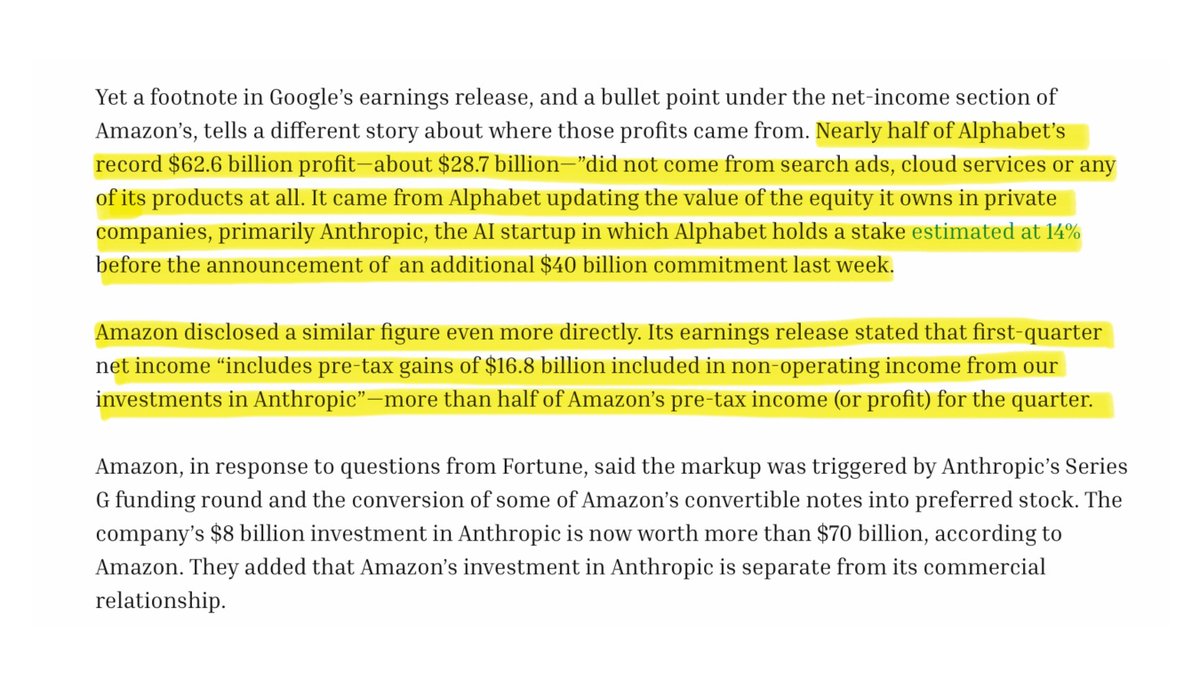
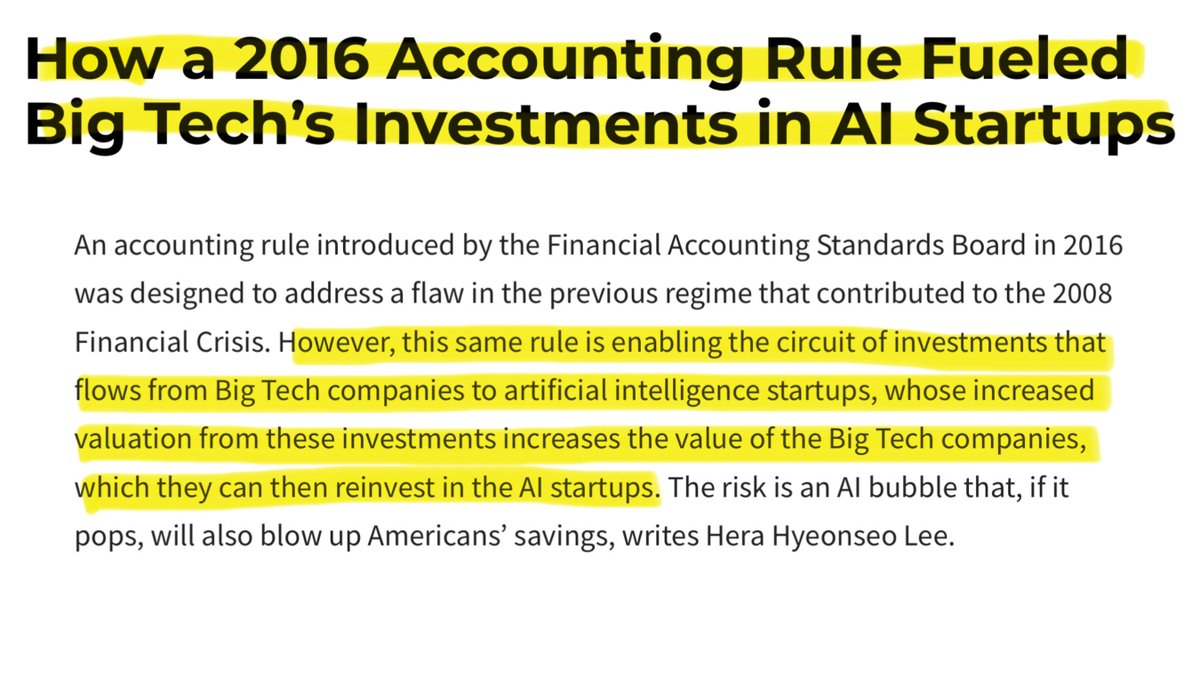
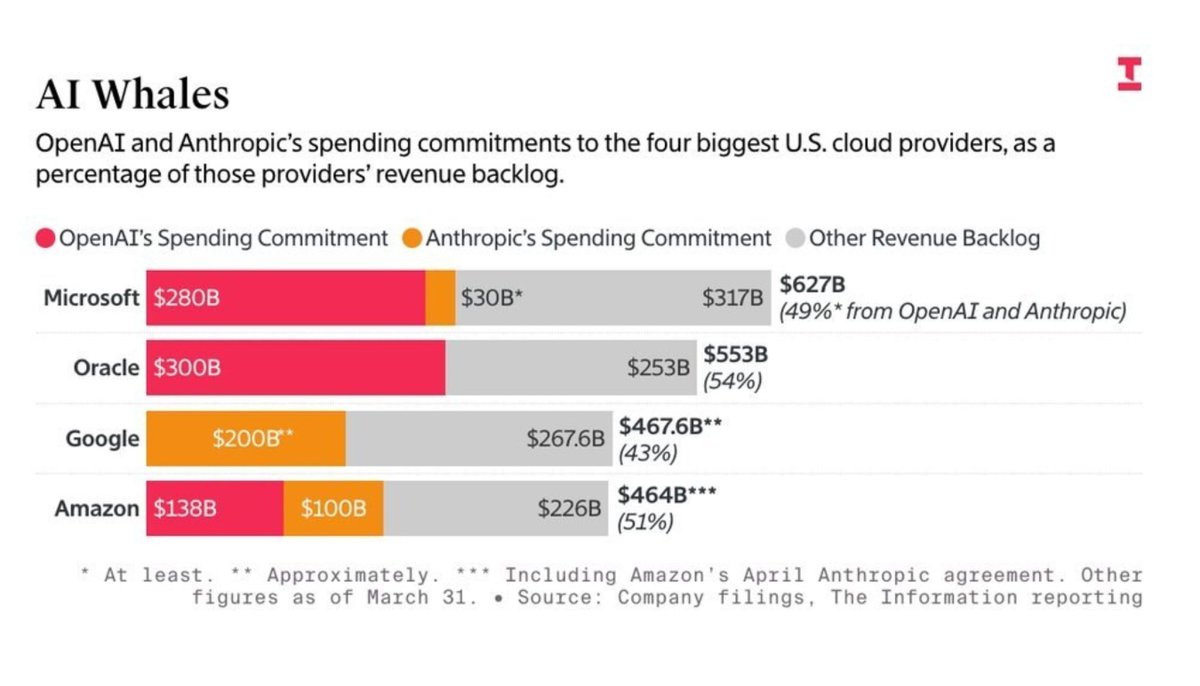
🚨 THE ENTIRE AI BOOM MIGHT BE BUILT ON FAKE REVENUE. Latest corporate filings show that OpenAI and Anthropic alone make up over half of the entire $2 trillion future cloud backlog held by Microsoft, Oracle, Google, and Amazon. This massive pipeline is actually being created through a circular accounting trick called a round trip revenue loop. But how it works ? A tech giant gives billions of dollars to an AI startup as an "investment". But hidden in the contract is a strict rule forcing the startup to hand that exact same money straight back to the tech giant to rent their computer servers. Look at the documented case of Microsoft and OpenAI. When Microsoft invested $13 billion into OpenAI, it didn't just give them cash; it gave them "cloud credits" to use Microsoft servers. OpenAI used those exact credits to train its AI models, and Microsoft then turned around and recorded that server usage as brand new "cloud revenue" from a customer. The tech giant is literally paying itself with its own money and calling it a sale. This is why OpenAI’s annual cloud bill has ballooned to over $60 billion, double its actual revenue of $25 billion, kept alive solely by this recycled funding loop. Anthropic runs the exact same play, spending $2.66 billion on Amazon Web Services in just nine months, which was basically 100% of all the money it earned at the time. This manufactured demand triggers a second accounting trick where tech giants book massive paper profits. Every time a startup gets a higher value from a new funding round, the tech giant updates the value of its investment on its books and counts that unearned paper gain as direct profit. In Q1 2026, Alphabet reported a record $62.6 billion profit, but $28.7 billion nearly half, was just a paper markup on its Anthropic investment. In the same quarter, Amazon reported $30.3 billion in profit, but $16.8 billion of it was just an Anthropic paper gain. While Amazon reported record profits, its actual free cash flow collapsed 95% to just $1.2 billion because it had to spend $44.2 billion in real cash to build physical data centers. This has created a massive danger where these giant companies rely heavily on just one or two unstable startups. Microsoft has 49% of its $627 billion future backlog tied to OpenAI, while Oracle has an incredible 54% of its entire $553 billion pipeline relying on OpenAI alone. This perfectly mirrors the 2001 dot-com crash when Global Crossing and Qwest Communications swapped identical fiber-optic network capacity with each other just to book fake sales. Qwest had to erase $1.4 billion in fake income, and Global Crossing went completely bankrupt. The only difference is that the dot-com swaps were illegal, but today's AI loop is fully legal under current accounting rules. This legal loop inflates tech company stock prices, forcing automatic retirement accounts and index funds to buy even more of these tech stocks. It is a self feeding loop where investments, sales, and stock prices all go up on paper without the AI technology ever making real cash profits.
Bull Theory tweet mediaBull Theory tweet mediaBull Theory tweet mediaBull Theory tweet media
English
654
2.3K
8.6K
2.4M
🔴LexTweetr🔴🌎 retweetledi
Philip Pilkington
Philip Pilkington@philippilk·
The fake revenue loop also seems to give rise to a proliferation of fake businesses that don’t employ people. Simulation economy. 🇺🇸🫧
Philip Pilkington tweet media
Bull Theory@BullTheoryio

🚨 THE ENTIRE AI BOOM MIGHT BE BUILT ON FAKE REVENUE. Latest corporate filings show that OpenAI and Anthropic alone make up over half of the entire $2 trillion future cloud backlog held by Microsoft, Oracle, Google, and Amazon. This massive pipeline is actually being created through a circular accounting trick called a round trip revenue loop. But how it works ? A tech giant gives billions of dollars to an AI startup as an "investment". But hidden in the contract is a strict rule forcing the startup to hand that exact same money straight back to the tech giant to rent their computer servers. Look at the documented case of Microsoft and OpenAI. When Microsoft invested $13 billion into OpenAI, it didn't just give them cash; it gave them "cloud credits" to use Microsoft servers. OpenAI used those exact credits to train its AI models, and Microsoft then turned around and recorded that server usage as brand new "cloud revenue" from a customer. The tech giant is literally paying itself with its own money and calling it a sale. This is why OpenAI’s annual cloud bill has ballooned to over $60 billion, double its actual revenue of $25 billion, kept alive solely by this recycled funding loop. Anthropic runs the exact same play, spending $2.66 billion on Amazon Web Services in just nine months, which was basically 100% of all the money it earned at the time. This manufactured demand triggers a second accounting trick where tech giants book massive paper profits. Every time a startup gets a higher value from a new funding round, the tech giant updates the value of its investment on its books and counts that unearned paper gain as direct profit. In Q1 2026, Alphabet reported a record $62.6 billion profit, but $28.7 billion nearly half, was just a paper markup on its Anthropic investment. In the same quarter, Amazon reported $30.3 billion in profit, but $16.8 billion of it was just an Anthropic paper gain. While Amazon reported record profits, its actual free cash flow collapsed 95% to just $1.2 billion because it had to spend $44.2 billion in real cash to build physical data centers. This has created a massive danger where these giant companies rely heavily on just one or two unstable startups. Microsoft has 49% of its $627 billion future backlog tied to OpenAI, while Oracle has an incredible 54% of its entire $553 billion pipeline relying on OpenAI alone. This perfectly mirrors the 2001 dot-com crash when Global Crossing and Qwest Communications swapped identical fiber-optic network capacity with each other just to book fake sales. Qwest had to erase $1.4 billion in fake income, and Global Crossing went completely bankrupt. The only difference is that the dot-com swaps were illegal, but today's AI loop is fully legal under current accounting rules. This legal loop inflates tech company stock prices, forcing automatic retirement accounts and index funds to buy even more of these tech stocks. It is a self feeding loop where investments, sales, and stock prices all go up on paper without the AI technology ever making real cash profits.

English
3
23
112
6.4K
🔴LexTweetr🔴🌎 retweetledi
QINTELPRO
QINTELPRO@QINTELPRO_·
Carroll Quigley - professor at Georgetown University’s School of Foreign Service for 30 years - was granted access to the private papers of an international network he described as the most powerful he had ever encountered. He published his findings in “Tragedy and Hope” (1966) - 1,348 pages of documented history. The publisher later destroyed the printing plates. Quigley publicly stated the book had been deliberately suppressed. What Quigley documented: Cecil Rhodes, the diamond magnate, established a secret society in 1891 with the explicit goal of extending British rule throughout the world. The society’s structure included an inner circle - the “Society of the Elect” - and an outer circle called the “Association of Helpers.” Rhodes’s will placed Lord Rothschild as trustee of the estate. Alfred Milner succeeded as administrator. The network evolved into the Round Table groups, which spawned the Royal Institute of International Affairs (Chatham House, 1920) and the Council on Foreign Relations (CFR, 1921). Quigley wrote: “I know of the operations of this network because I have studied it for twenty years and was permitted for two years, in the early 1960s, to examine its papers and secret records. I have no aversion to it or to most of its aims.” He agreed with their goals. He objected only to their secrecy. Bill Clinton - a Quigley student at Georgetown - named Quigley as a key influence in his 1992 presidential acceptance speech. The man who documented the secret society was an insider. His student became president.
QINTELPRO tweet media
English
10
76
154
13.3K