
London Longevity Network
111 posts

London Longevity Network
@LonLongevity
Building a vibrant Longevity community in London
London, United Kingdom Katılım Ağustos 2024
12 Takip Edilen63 Takipçiler

Londonmaxxing:
If you go to 3 interesting events a week in London, within 12 months you’ll either
• start a company
• find a job
• meet your cofounder
• end up in a strange Soho bar at 2am discussing AI
Probably all four.
If it’s worth leaving the house for, share below
English
London Longevity Network retweetledi
🚨 The Human Ageing Genomic Resources Are at Risk
For over 20 years, our Human Ageing Genomic Resources (HAGR) have supported ageing and longevity research worldwide (200,000+ users per year, 1,000+ citations, widely used by academic labs and longevity biotech).
Due to shifting UK government funding priorities, our infrastructure funding was not renewed in 2024, and these databases are now at risk of going offline.
We are raising funds to cover basic server costs and secure their continuity while we pursue long-term funding.
If these resources have supported your research, your company, or your thinking, please consider helping sustain them.
justgiving.com/page/human-age…
English
London Longevity Network retweetledi

We just open-sourced our tool for computational drug discovery. Think Claude Code, but for biology.
CellType@celltypeinc
We teach models to reason about biology. Today we're open-sourcing the tool we built to run that science. Think Claude Code, but for drug discovery. pip install celltype-cli
English
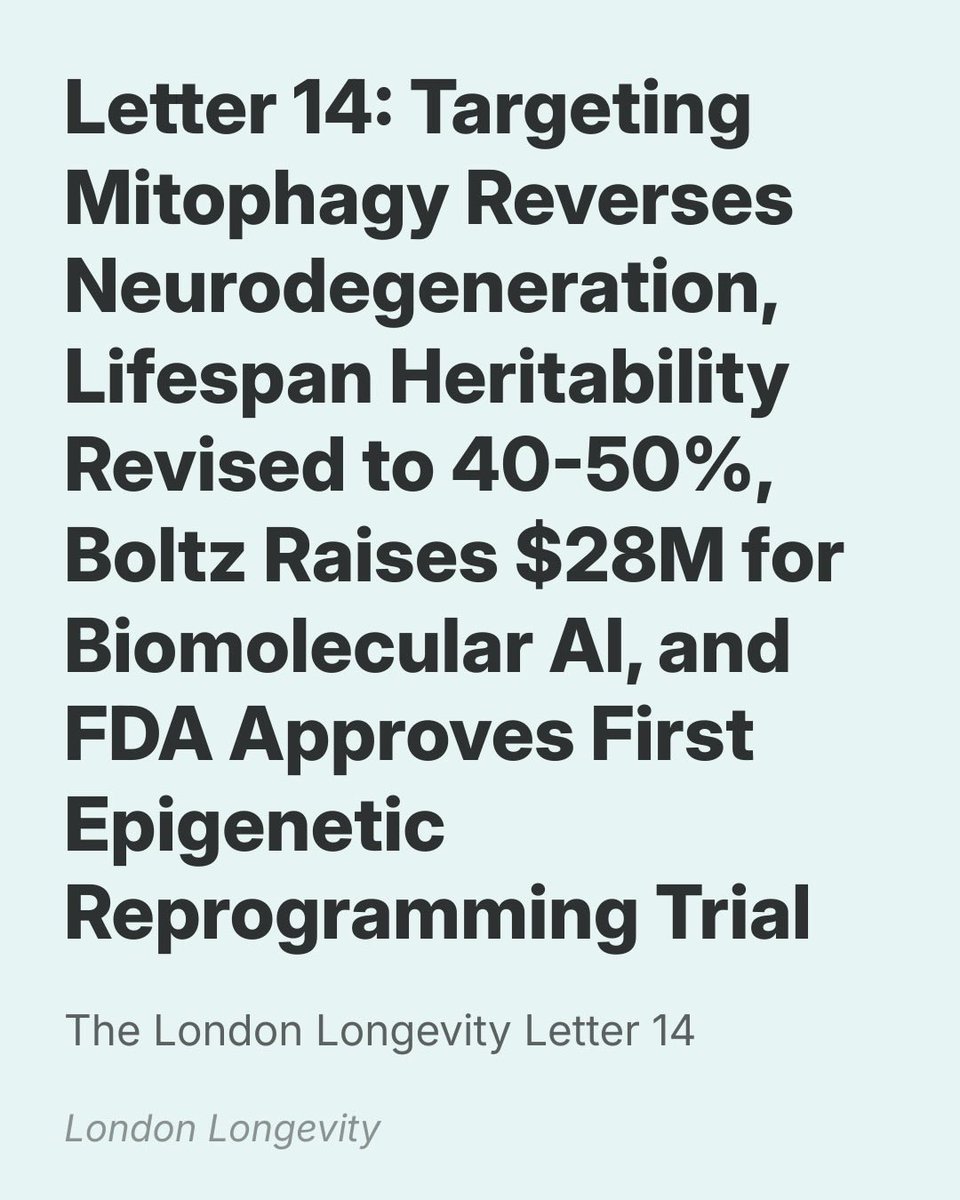
Check out Issue 14 of the London Longevity Letter below for a round-up of all that went down in Jan 2026 🧬⚡️
🔗 below
English
London Longevity Network retweetledi

Read Something Wonderful (about Biology)
We just released a curated list of 125+ essays about biology and science. These articles cover pharmaceuticals, the history of molecular biology, timeless arguments and theories, and more.
Check it out.🔻
English
“Anti-ageing” was skincare’s promise. Now it’s a longevity frontier.
Join us for Longevity Salon: The Skin Frontier — Measure. Repair. Reverse.
🧬 12 Nov | London
@MarkKotter @OliverZolmanMD @bio_mitra
🎟️ Free RSVP → luma.com/cd8hv4sf
#Longevity #AntiAgeing #SkinCare

English
London Longevity Network retweetledi
The supplement Urolithin A, in a small randomized, placebo-controlled clinical trial of adults (mean age 53 years), shifted the immune system away from age-related decline
nature.com/articles/s4358… @NatureAging
English
Issue 12 of our newsletter has just been sent out!
🔗👀 Click in below for an exciting announcement

English
check it out here: londonlongevity.substack.com/p/the-london-l…
English
Issue 11 of the London Longevity Newsletter out now 🗞️
English
Find it here: londonlongevity.substack.com/p/the-london-l…
English

London Longevity Network retweetledi

A friendly reminder that the Central Dogma is NOT "DNA -> RNA -> protein."
All that Francis Crick *actually* said was: “Once information has got into a protein it can’t get out again.”
This negative statement — namely, that some transfers of information seem to be impossible — was the entire synopsis of Crick’s idea.
The DNA -> RNA -> protein idea was popularized by James Watson in his 1965 textbook, "The Molecular Biology of the Gene," as a way of summarizing how protein synthesis takes place. But Watson’s explanation was misleading. And, as we now know, there are many exceptions to that "version" of the Central Dogma (including reverse transcriptase.)
In 1956, Crick was working on a lecture that would bring together what was then known about the “flow of information” between DNA, RNA, and protein in cells. Crick formalized his ideas in what he called the Central Dogma, and his original conception of information flow within cells was both richer and more complex than Watson’s reductive presentation.
Crick was aware of at least four kinds of information transfers, all of which had been observed in biochemical studies by researchers at that time. These were: DNA → DNA (DNA replication), DNA → RNA (called transcription), RNA → protein (called translation) and RNA → RNA (a mechanism by which some viruses copy themselves). To summarize his thinking, Crick sketched out these information flows in a little figure that was never published.
Crick’s diagram also included two types of information flow for which there was no experimental evidence, but which he surmised might be biochemically feasible; namely, DNA → protein and RNA → DNA.
The direct synthesis of proteins using only DNA might be possible, Crick thought, because the sequence of bases in DNA ultimately determines the order of amino acids in a protein chain. If this were true, however, it would mean that RNA was not always involved in protein synthesis, even though every study at that time suggested it was. Crick therefore concluded that this kind of information flow was highly unlikely, though not impossible.
Crick also theorized that RNA → DNA was chemically possible, simply because it was the reverse of transcription and both types of molecules were chemically similar to each other. Still, Crick could not imagine any biological function for this so-called “reverse transcription,” so he portrayed this information flow as a dotted line in his diagram.
The most significant part of Crick’s idea — and the part that Watson ignored in his oversimplification — was that there are three flows of information that cannot occur, due both to lack of experimental evidence and any plausible biochemical mechanisms. These were protein → protein, protein → RNA and, above all, protein → DNA.
(From the Archives) "Francis Crick Was Misunderstood."
Read & subscribe: press.asimov.com/articles/crick

English
💡And of course — a 𝗖𝗼𝗻𝘁𝗲𝗻𝘁 𝗥𝗼𝗮𝘀𝘁. Whatever you need feedback on, be it pitch decks or email copy, we’ll break it down and help build it back better.
🔗 Sign up luma.com/ot3vvw0r
English
Make sure to not miss out on the 𝗟𝗼𝗻𝗴𝗲𝘃𝗶𝘁𝘆 𝗪𝗼𝗿𝗸𝘀𝗵𝗼𝗽, where you’ll hear from experts on how to maximise your energy and focus on health even if you’re living the startup life.
English
We’re hosting an Open House in collaboration with @PLUGGED on 𝗙𝗿𝗶𝗱𝗮𝘆, 𝟭𝟮𝘁𝗵 𝗦𝗲𝗽𝘁𝗲𝗺𝗯𝗲𝗿!
Join us and PLUG IN for an 𝗮𝗹𝗹 𝗱𝗮𝘆 𝗰𝗼-𝘄𝗼𝗿𝗸𝗶𝗻𝗴 𝘀𝗲𝘀𝘀𝗶𝗼𝗻 with cracked founders followed by a social. ☕🧑💻

English