

Luke Haskell
11.4K posts
Luke Haskell
@LukeHaskell13
Retired Lieutenant for the state of Kalifornication, trying to find hope and love in a crazy world.
Katılım Haziran 2022
383 Takip Edilen104 Takipçiler

You actually prove the Catholic point without realizing it.
The apostles did not hand Christians a completed New Testament and tell everyone to privately determine doctrine from the text alone. The Church existed, preached, baptized, celebrated the Eucharist, ordained ministers, exercised discipline, and handed on apostolic tradition for roughly twenty years before most of the New Testament was even written. The epistles are not systematic theology manuals written to strangers. They are Catholic mail addressed to established churches that already possessed apostolic teaching, liturgical practice, and sacramental life.
That is why your questions assume the very principle under dispute. You ask, “Where do the apostles explicitly teach this?” as if every doctrine must be exhaustively explained in a self contained text. Scripture itself never teaches that principle.
The danger of Sola Scriptura is that it allows a person with no apostolic authority, no sacramental life, and no historical continuity to imagine he has mastered divine mysteries simply by reading a text. Knowledge then becomes detached from obedience. Faith becomes reduced to intellectual agreement. The fear of God is replaced by confidence in one’s own interpretation.
The apostles taught the “obedience of faith” (Romans 1:5), not an autonomous Christianity where every believer becomes his own final authority. The sacramental life crucifies the ego because it requires submission to Christ through the Church He established. Private interpretation flatters the ego because the individual remains the final judge of what Christianity means.
As for the Fathers, they do not override the apostles. They testify to how the apostolic churches understood the apostles. If every church founded by the apostles believed in the Real Presence, sacrificial worship, apostolic succession, and sacramental grace, while your interpretation appears many centuries later, the burden is on you to explain where the apostolic churches went wrong and who preserved the true doctrine.
Regarding the Bereans, Acts 17 does not teach Sola Scriptura. The Bereans searched the Scriptures to verify that Paul’s preaching about Christ was true. After they found that it was, they submitted to apostolic authority and entered the Church. They did not become independent Bible interpreters rejecting apostolic tradition.
And your final question reveals the real issue. Catholic doctrine can be demonstrated from the apostolic writings, but the apostles never intended their writings to function apart from the Church that produced, preserved, canonized, preached, and interpreted them. The question is not whether doctrine can be shown in Scripture. The question is why you trust the Church’s judgment when it gives you the New Testament, yet reject that same Church when it tells you what the New Testament means.


English
Luke Haskell retweetledi

BREAKING: A White House official says Iran has agreed to a performance-based deal that would require major concessions before receiving any sanctions relief.
According to the official, Iran's nuclear material would be destroyed and removed, its nuclear program dismantled, and none of its money released until it fulfills its commitments.
The official also says the Strait of Hormuz would remain open and Iran would agree to stop funding terrorist groups.
English

The drama of migration must serve as an appeal to the conscience of the nations of origin of the migrants, which must establish conditions for peace, justice and development. It is also an appeal to the conscience of the transit nations, which are called to protect the vulnerable and not leave them in the hands of criminal networks. It is likewise an appeal to the conscience of Europe, which cannot claim to uphold human dignity while growing accustomed to the Mediterranean and the Atlantic becoming unmarked graves, as well as that of the international community, which is called to effective and persevering cooperation. #ApostolicJourney vatican.va/content/leo-xi…
English
"God is against vain repetitive prayers like your Rosary. "
God is against "vain" repetitive prayers.
And leaving them, he went again: and he prayed the third time, saying the selfsame word.
Matthew 26:34
The Rosary is contemplating the deep mysteries and gift of Christ through the sorrowful heart of his Mother.
He shall be a sign of contradiction and a sword will pierce your heart so that the thoughts of many may be revealed.
How many times should we tell our eternal God I love you?
Psalms 35:28
And my tongue shall declare Your righteousness And Your praise all day long.
Psalms 71:6
By You I have been sustained from my birth; You are He who took me from my mother's womb; My praise is continually of You.
Psalms 71:14
But as for me, I will hope continually, And will praise You yet more and more.
Psalms 104:33
I will sing to the LORD as long as I live; I will sing praise to my God while I have my being.
Psalms 145:1
I will extol You, my God, O King, And I will bless Your name forever and ever.
Revelation 4:8
And the four living creatures, each one of them having six wings, are full of eyes around and within; and day and night they do not cease to say, "HOLY, HOLY, HOLY is THE LORD GOD, THE ALMIGHTY, WHO WAS AND WHO IS AND WHO IS TO COME."
Revelation 5:13
And every created thing which is in heaven and on the earth and under the earth and on the sea, and all things in them, I heard saying, "To Him who sits on the throne, and to the Lamb, be blessing and honor and glory and dominion forever and ever.
English

And when you pray, do not heap up empty phrases as the Gentiles do, for they think that they will be heard for their many words. Do not be like them, for your Father knows what you need before you ask him. 📖
Matthäus 6,7–8
#bible #jesus
Catholic Manhood ❤️🔥@bethecreed
The Rosary is the weapon for these times.
English
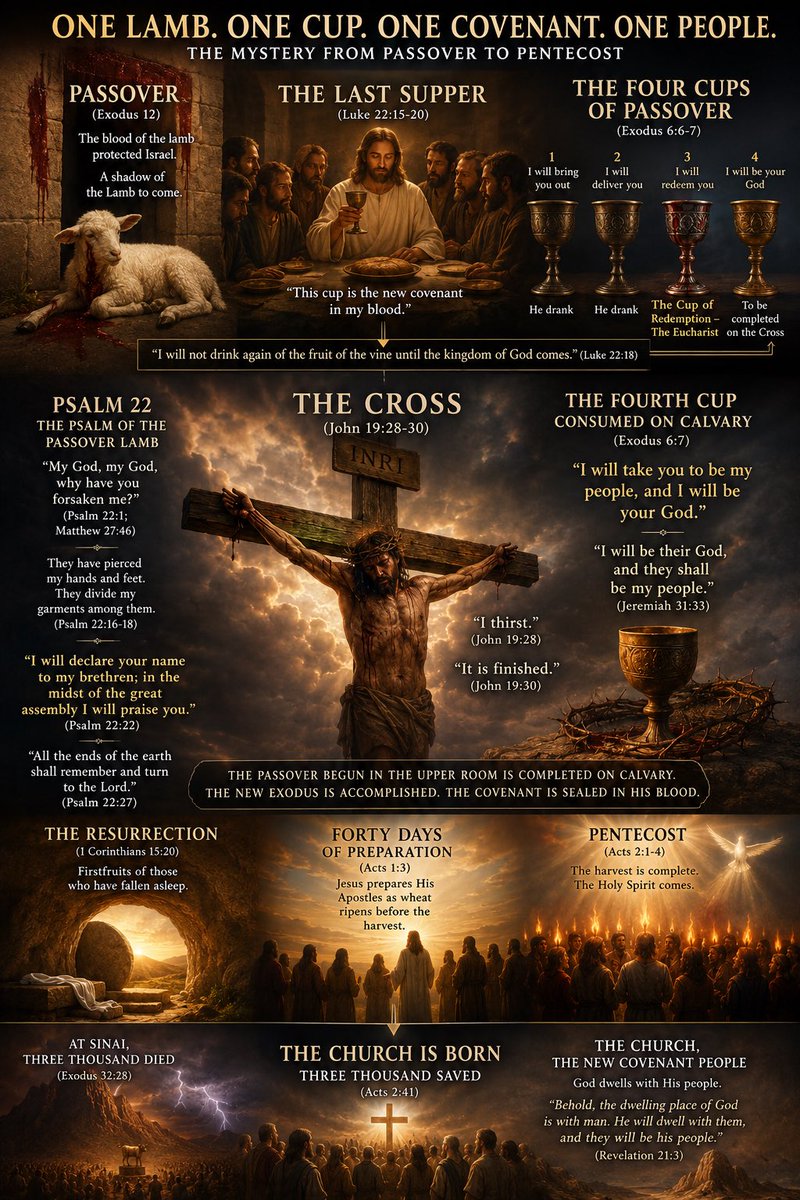
Anamnesis seals it. “Do this in remembrance (anamnesis) of me” (Luke 22:19) is not bare mental recall. In Old Testament covenant language anamnesis means re-presentation of the sacrifice before God. The Afikomen—the broken matzah hidden and revealed in the Passover Seder—points to the Messiah, the Coming One. Jesus is the Lamb of God, the Afikomen fulfilled. 1 Corinthians 11:26: “As often as you eat this bread and drink the cup, you proclaim the Lord’s death until he comes.” Every Mass re-presents the one sacrifice unbloodily. The early Church saw Malachi 1:11 fulfilled here: a pure offering from sunrise to sunset among the Gentiles.
Church Fathers confirm it. St. Irenaeus (Against Heresies IV, 8, 1): Paul offers the oblation of the Gentiles to God. St. John Chrysostom (Homilies on Romans 30): Paul calls himself a priest (hiereus) offering the sacrifice of the Gentiles. St. Augustine, St. Cyril of Alexandria, and St. Jerome all describe Paul’s ministry as priestly service offering spiritual oblations. The Epistola Apostolorum (A.D. 140) has Jesus telling the apostles to continue the Passover Sacrifice memorial until He returns. This is unanimous early witness.
Your points collapse. “Once for all” in Hebrews does not erase re-presentation—just as Passover was once in Egypt but commanded forever as memorial. You turn “all royal priests” (1 Peter 2:5,9) into “no ministerial priests”—a false dichotomy. Every covenant had visible mediators, altar, and meal. Christ instituted the New Passover at the Last Supper and commanded “Do this.” Apostles ordained successors who kept the line. Your low-church view imports 16th-century novelty and reads it backward into Scripture.
Romans 15:16 shows Paul performing a New Covenant priestly act with 98% confidence when you weigh the Greek, typology, anamnesis, Afikomen, Fathers, and covenant pattern together. Paul offers an unbloody memorial oblation consecrated to the Father for the Gentiles through the Holy Spirit. It is participation in the one Sacrifice.
You accept God’s full truth in Scripture, history, and the apostolic Church—or you lie to yourself in anti-Catholic haze. No other answer. The priesthood is biblical, historical, and covenantal. Denying it is not faith—it is superstition that strips away the fear of the Lord, which is the beginning of wisdom (Proverbs 9:10). Keep dodging and you stay lost. The Church Christ founded still stands with the same priests offering the same Lamb. Come home to the fullness.
English

The issue is not whether the New Testament has church leaders. It clearly does. The question is whether the New Testament establishes a sacrificial priesthood that mediates grace through the Eucharist and absolves sins in a way analogous to the Old Covenant priesthood. The texts cited do not demonstrate that conclusion.
Romans 15:16 does use priestly language, but Paul applies such language broadly and metaphorically. The "offering" is not Christ on an altar but the Gentiles themselves, sanctified by the Holy Spirit. By the same logic, Romans 12:1 would make every believer a priest offering sacrifices, and 1 Peter 2:5, 9 explicitly calls all Christians a holy and royal priesthood. The New Testament expands priestly language to the whole body of believers rather than establishing a new sacrificing class.
Likewise, 2 Timothy 2:2 speaks of transmitting apostolic teaching, not transmitting a sacrificial priesthood. Timothy is instructed to entrust the gospel to faithful men who will teach others also. The succession in the text is a succession of doctrine, not proof of a sacerdotal office empowered to offer Christ sacramentally.
As for the early church's language regarding bishops and presbyters, the existence of church offices does not automatically prove later sacramental theology. Scripture must define the office, not later developments. The New Testament bishops and elders are consistently portrayed as shepherds, overseers, teachers, and guardians of doctrine. They are never described as priests offering Christ in sacrifice.
Regarding Hebrews, the concern is not merely whether Christ's sacrifice is being "repeated" physically. The concern is that Hebrews goes to extraordinary lengths to emphasize the finality, completeness, and uniqueness of Christ's offering. The focus of the believer is directed to Christ's ministry in the heavenly sanctuary, not to an earthly altar. Hebrews repeatedly contrasts the repeated sacrifices of the earthly system with Christ's once-for-all sacrifice (Hebrews 9:25-28; 10:10-14). The entire thrust of the book is upward—to the heavenly sanctuary where Christ ministers—not downward to an earthly sacrificial system.
Hebrews 7:25 teaches Christ's continual intercession, but intercession is not sacrifice. Christ does not continually die in heaven. His intercession is based upon a completed sacrifice. Likewise, Hebrews 13:10 speaks of an altar, but the context immediately identifies that altar with Christ's suffering outside the camp (Hebrews 13:11-13). The altar points to participation in Christ and His completed work, not to a continuing sacrificial rite.
The typology of the rock reinforces this point. In Exodus 17, the rock was struck and water flowed out. Paul says that Rock was Christ (1 Corinthians 10:4). In Numbers 20, God commanded Moses only to speak to the rock, but Moses struck it again. Because he distorted the symbol, he was barred from entering Canaan. Why? The rock represented Christ. Christ would be struck once for sin. After that, God's people come to Him by faith and petition, not by another striking. Hebrews presents the same truth: Christ was offered once, and that one sacrifice is sufficient forever.
Finally, direct access to God does not eliminate church leadership. Protestants, including Seventh-day Adventists, affirm pastors, elders, teachers, and church discipline. The question is whether these leaders function as mediators between God and man. Scripture says there is "one mediator between God and men, the man Christ Jesus" (1 Timothy 2:5). Church leaders serve under Christ, teach His Word, and shepherd His flock, but they do not occupy a mediatorial priesthood standing between the believer and God. The New Testament consistently points believers to a living High Priest in heaven and invites them to "come boldly unto the throne of grace" (Hebrews 4:16) through Him.
English

Do you believe Jesus Christ founded the Catholic Church?

English
Historically the Catholic priesthood began with the apostles—case closed. The Teachings of the Apostles (Syriac) spells it out: “The city of Rome, and all Italy, and Spain, and Britain, and Gaul, together with all the rest of the countries round about them, received the apostles’ ordination to the priesthood from Simon Cephas, who went up from Antioch.” It adds, “By ordination to the priesthood, which the apostles themselves had received from our Lord, did their Gospel wing its way rapidly into the four quarters of the world.” Irenaeus of Lyons (120-180 AD) seals it in Against Heresies (Book 4, ch. 8.3): “All the apostles of the Lord are priests, who do inherit here neither lands nor houses, but serve God and the altar continually.” The Didache (90 AD) confirms priests offered the Eucharist as a sacrifice, echoing Malachi 1:11. This is apostolic, first-century truth—not a later invention. Deny it and you rewrite history to fit your bias. “He who knows what is right and refuses to do so, for him this is sin.”
Scripture is loud and clear. Titus 1:5: “This is why I left you in Crete, to ordain elders in every city as I have ordained you.” Paul sets up a real hierarchy. 1 Timothy 5:17: elders who rule well get double honor, especially those laboring in word and doctrine. James 5:14-15: call the elders to anoint the sick with oil so sins are forgiven. John 20:23: “Whose sins you shall forgive are forgiven.” Christ gives priests divine authority to absolve. Romans 15:16: Paul is “the minister (leitourgos) of Christ Jesus to the Gentiles, ministering the gospel of God, that the offering up (prosphora) of the Gentiles might be acceptable, being sanctified by the Holy Ghost.” Greek shows Paul performing priestly service—leitourgos is the same word for Levitical priests (Hebrews 8:2). The “oblation” is an unbloody memorial offering, consecrated to the Father for the Gentiles through the Holy Spirit. 1 Corinthians 10:16: the chalice and bread we bless is real communion in Christ’s body and blood. This is the Eucharist, administered by ordained priests.
Word study proves it. “Priest” comes from presbyteros (elder), via Latin and Old English—not hiereus (Old Covenant temple priest). The apostles used presbyteros while the Jerusalem Temple still stood to mark New Covenant priests who minister sacraments like Eucharist and reconciliation. They modeled it on the 70 elders Moses laid hands on (Numbers 11:16-25) to share God’s grace. Paul warns Timothy, “Do not lay hands hastily” (1 Timothy 5:22). Before the Golden Calf, firstborn elders offered household sacrifices (Exodus 12:3-7). After, Levites took over. Christ, the consecrated firstborn (Hebrews 12:23), restores the true priesthood at the Last Supper—the true Passover. Luke 22:15: “With desire I have desired to eat this pasch with you.” Exodus 12:22 shows Moses calling elders for Passover commands—a type of Christ.
English
You wrote all of that, but it still leaves one question unanswered:
If Jesus meant only “believe in Me” in John 6, why did the Christians taught by the Apostles, and the generations immediately after them, overwhelmingly believe in the Real Presence instead of the symbolic interpretation you are proposing?
Not one Church Father says, “The Eucharist is merely a symbol and Christ is only speaking about faith.” Instead, they repeatedly speak of the Eucharist as Christ’s Body and Blood.
So where did they all get that idea?
From the Apostles?
Or from nowhere?
Because your argument is not really against Catholicism. It is against the historical understanding of virtually the entire Christian world for the first fifteen centuries.
English
The irony is that this argument assumes the very thing it is trying to prove—that the Eucharist is literally Christ's body and blood—and then reads every passage through that lens.
First, regarding John 6, the chapter itself explains the meaning. Jesus says, "He that cometh to me shall never hunger; and he that believeth on me shall never thirst" (John 6:35). Coming to Christ corresponds to eating; believing corresponds to drinking. The central theme is faith in Christ, not participation in a sacrament. Jesus later clarifies, "The words that I speak unto you, they are spirit, and they are life" (John 6:63). If John 6 were primarily about the Eucharist, then everyone who partook of the Eucharist would have eternal life automatically, yet Scripture consistently teaches salvation by faith in Christ.
Second, the fact that disciples left does not prove a literal interpretation. People also misunderstood Jesus when He spoke of destroying the temple and raising it in three days, being born again, the leaven of the Pharisees, and sleeping Lazarus. Misunderstanding a figure of speech does not transform it into a literal statement. Jesus often allowed people to walk away because they refused the spiritual meaning of His words.
Third, 1 Corinthians 11 does not require transubstantiation or a literal transformation of the elements. The seriousness of a symbol is determined by what it represents. Desecrating a nation's flag is treated seriously, not because the cloth literally becomes the nation, but because of what it symbolizes. Likewise, the Lord's Supper represents Christ's sacrifice. To partake in an unworthy manner is to show contempt for the sacrifice it commemorates. Paul says believers are proclaiming the Lord's death until He comes (1 Corinthians 11:26), language that points to memorial and proclamation.
Furthermore, Paul repeatedly calls the elements "bread" even after the blessing: "Whosoever shall eat this bread" (1 Corinthians 11:27), "For as often as ye eat this bread" (v. 26), "So let him eat of that bread" (v. 28). If Paul believed the substance had ceased to be bread, it is remarkable that he continues to call it bread.
A common argument is that Malachi 1:11 predicts the Eucharistic sacrifice:
> "For from the rising of the sun even unto the going down of the same my name shall be great among the Gentiles; and in every place incense shall be offered unto my name, and a pure offering."
However, this interpretation reads later sacramental theology into the text. Malachi is contrasting the corrupt sacrifices being offered by Israel's priests with the worldwide worship that God would receive among the Gentiles. The emphasis is not on a future sacrificial altar but on pure worship replacing polluted worship.
The New Testament itself explains what these "sacrifices" are. Believers offer their bodies as "a living sacrifice" (Romans 12:1). Praise is called "the sacrifice of praise" (Hebrews 13:15). Good works and generosity are called sacrifices pleasing to God (Hebrews 13:16). Peter describes believers as a holy priesthood offering "spiritual sacrifices" acceptable to God through Jesus Christ (1 Peter 2:5). The New Covenant consistently transforms sacrifice from the offering of animals to the offering of worship, praise, service, and lives consecrated to God.
More importantly, if Malachi 1:11 predicts a continual sacrificial offering of Christ in the Eucharist, then it would stand in tension with Hebrews, which repeatedly emphasizes that Christ offered Himself "once for all" (Hebrews 7:27; 9:12; 10:10-14). The entire argument of Hebrews is that the sacrificial system reached its fulfillment in Christ's single, complete sacrifice.
To be continued...
English
If Jesus meant only “believe in Me” in John 6, why did virtually every Christian for over 1,500 years including East and West, Greeks and Latins, saints, bishops, martyrs, and theologians understand His words and the Eucharist as a real participation in His Body and Blood rather than as a mere symbol?
Either Christ allowed His entire Church to misunderstand one of His most important teachings from the apostolic age until Luther, or the symbolic interpretation is the later innovation.
Which is more likely?
English
Continuation:
From a historicist perspective, Malachi 1:11 finds its fulfillment in the worldwide spread of the gospel after Christ's first coming. God's name is now worshiped among the nations, from the rising of the sun to its setting, and believers everywhere offer spiritual sacrifices through Christ. The prophecy points to the global worship of God through the gospel, not to a repeated sacrificial rite.
As for the claim that the epistles are "Catholic mail," they were certainly written to organized churches. No Protestant disputes that. The question is whether those churches practiced later Roman Catholic doctrines. The New Testament churches had elders, deacons, baptism, and the Lord's Supper. What must be proven is that they believed in transubstantiation, a sacrificing priesthood, papal supremacy, and the other doctrines later attached to the sacramental system.
The New Covenant is indeed participation in Christ. But Scripture defines that participation primarily through faith and the indwelling Spirit. "Christ liveth in me" (Galatians 2:20). We partake of Christ by faith. The bread and cup are sacred memorials that point us to that reality.
The real question is this: If Jesus intended a literal eating of His physical body, why did He explain that believing in Him is the work God requires (John 6:29), that coming to Him satisfies hunger (John 6:35), and that His words are spirit and life (John 6:63)? The chapter points repeatedly to faith in Christ as the means of receiving life. The symbols are precious because they point to Him, but eternal life is found in Christ Himself, not in the elements.
Ironically, if Malachi 1:11 is fulfilled in Christ, that strengthens the Protestant position rather than weakening it. Christ fulfilled the sacrificial system. Because the reality has come, the shadows have passed away. The New Testament points believers to a completed sacrifice and a living High Priest in heaven, not to an ongoing sacrificial offering on earth.
English
“The Catholic doctrine of the Eucharist was the doctrine of the ancient Church. I could find no break in the testimony.”
— John Henry Newman
Newman concluded through his study of the Church Fathers that the early Church universally treated the Eucharist as truly Christ’s Body and Blood, not merely a symbol.
“The Church Fathers from the earliest centuries spoke of the Eucharist in a way that simply cannot be reconciled with a purely symbolic interpretation.”
— Scott Hahn
Hahn has repeatedly explained that his study of the Fathers convinced him that the Reformed view was historically novel.
“I found that the early Christians believed exactly what Catholics believe about the Eucharist.”
— Steve Ray
Ray often notes that when he read the Fathers directly, he found no evidence for a merely symbolic understanding.
“The doctrine of the Real Presence was accepted everywhere and by everyone in the ancient Church.”
— Francis Beckwith
Beckwith has argued that historical Christianity overwhelmingly supported the Catholic understanding of the Eucharist.
“As I read the Fathers, I realized that the symbolic view I had inherited was not the view of the early Church.”
— Rod Bennett
Bennett’s research into early Christianity led him to conclude that belief in the Real Presence was not a medieval invention but part of the Church’s earliest faith.
A particularly devastating historical question for someone claiming the Real Presence is a Catholic corruption is this:
Can they identify a century before Luther in which a large segment of Christians rejected the Real Presence?
Not a heretical sect here or there, but a major Christian body.
The problem is that the historical record shows belief in the Real Presence among:
Catholic Church
Eastern Orthodox Church
Oriental Orthodox Churches
Church of the East
These churches were separated from one another for centuries, yet all retained belief that the Eucharist is truly the Body and Blood of Christ. That makes it extremely difficult to argue that the doctrine was a late medieval invention. Historically, the burden falls on the symbolic view to explain where its interpretation existed before the Reformation.

English

Hebrews says Christ is the one High Priest, but Catholics do not claim priests are additional high priests. The question is: if there is no ministerial priesthood in the New Covenant, why does Paul describe his ministry in explicitly priestly terms (Romans 15:16), instruct Timothy to pass on his ministry through succession (2 Timothy 2:2), and why do Christians after the apostles universally speak of bishops, presbyters, and Eucharistic sacrifice?
Also, Hebrews says Christ’s sacrifice is offered once for all Catholics agree. But where does Hebrews say that making that one sacrifice present sacramentally is the same thing as repeating it? If the heavenly Christ continually intercedes for us (Hebrews 7:25) and Christians have an altar (Hebrews 13:10), why assume every sacrificial reality ended on earth rather than being united to the one eternal sacrifice of Christ?
And if “direct access to God” eliminates ministerial authority, why did Christ establish apostles, give them authority to forgive sins (John 20:23), command obedience to the Church (Matthew 18:17), and appoint shepherds over His flock (John 21:15–17)? Direct access to God and ordained ministry are not opposites in Scripture they exist side by side.
English
Continuation:
The real issue is not whether the New Testament uses priestly imagery—it clearly does. The question is whether it teaches a new class of earthly priests who continue Christ's mediatorial and sacrificial ministry. Hebrews repeatedly answers that Christ alone is our High Priest, His sacrifice was offered once for all, and believers now have direct access to God through Him, not through priests, popes, or departed saints. Through Christ, every believer may approach the throne of grace with confidence (Hebrews 4:16).
English
If John 20:23 is merely declaring who is already forgiven by hearing the gospel, then why did Jesus specifically give the apostles authority to forgive or retain individual sins after breathing the Holy Spirit on them, instead of simply commanding them to preach as He had already done before?
English
These questions sound compelling, but they assume that every use of priestly language requires a continuing sacrificial priesthood. The New Testament does not make that leap.
In John 20:23, the apostles could "retain" sins because the gospel itself reveals whether a person has accepted or rejected Christ. This authority is exercised through the proclamation of God's Word, not through an independent power to forgive. Jesus gave a similar authority to the entire church in matters of discipline (Matthew 18:15-18). When Peter preached at Pentecost, those who repented received forgiveness, while those who rejected the message remained in their sins. The apostles were declaring heaven's verdict according to the gospel, not replacing God's role as the forgiver of sins. Scripture consistently teaches that God alone forgives sins (Mark 2:7).
As for Romans 15:16, Paul is clearly speaking metaphorically. He describes the Gentiles themselves as the offering being presented to God, not a Eucharistic sacrifice. The same Paul also calls financial gifts a "sacrifice" (Philippians 4:18), believers' service a "living sacrifice" (Romans 12:1), and praise a "sacrifice" (Hebrews 13:15). New Testament priestly language is frequently applied to ministry without implying a continuation of the Levitical priesthood. In fact, Peter calls all believers a "holy priesthood" and a "royal priesthood" (1 Peter 2:5, 9), not a separate sacerdotal class.
Likewise, 2 Timothy 2:2 teaches the transmission of apostolic teaching, not the transmission of a sacrificing priesthood. Timothy is instructed to entrust the gospel to faithful men who will teach others also. The emphasis is on preserving sound doctrine, not creating mediators between God and man. Scripture teaches that there is "one mediator between God and men, the man Christ Jesus" (1 Timothy 2:5), and believers are invited to come directly to Him.
Regarding Hebrews 13:10, the entire book of Hebrews argues that Christ's sacrifice was offered once for all and that He now ministers as our High Priest in the heavenly sanctuary (Hebrews 7:27; 9:12; 10:10-14). The "altar" language points to participation in Christ and His sacrifice, just as Jesus spoke of eating His flesh and drinking His blood by faith (John 6:53-56). The author immediately connects the altar to Christ suffering outside the camp (Hebrews 13:11-13), not to an earthly Eucharistic altar. To interpret Hebrews 13:10 as establishing a continuing sacrificial priesthood would undermine the central message of Hebrews—that Christ's sacrifice is complete, final, and never needs to be repeated.
The Old Testament itself contains a powerful type that illustrates this truth. In Exodus 17, God instructed Moses to strike the rock, and water flowed out for the people. Paul identifies that Rock as Christ (1 Corinthians 10:4). Later, in Numbers 20, God did not tell Moses to strike the rock again; He commanded him only to speak to it. Instead, Moses struck the rock a second time. Because he misrepresented God and corrupted the symbol, he was not permitted to enter earthly Canaan. Why was this so serious? The rock represented Christ. Christ was to be struck once, not twice. His sacrifice would occur once for all humanity, and afterward believers would come to Him directly by faith, not through repeated sacrifices or earthly mediators. This is precisely the emphasis of Hebrews: "nor yet that he should offer himself often" (Hebrews 9:25), for "now once in the end of the world hath he appeared to put away sin by the sacrifice of himself" (Hebrews 9:26). The repeated striking of the rock spoiled the type of Christ's once-for-all sacrifice.
To be continued....
English
Historically the Catholic priesthood began with the apostles—case closed. The Teachings of the Apostles (Syriac) spells it out: “The city of Rome, and all Italy, and Spain, and Britain, and Gaul, together with all the rest of the countries round about them, received the apostles’ ordination to the priesthood from Simon Cephas, who went up from Antioch.” It adds, “By ordination to the priesthood, which the apostles themselves had received from our Lord, did their Gospel wing its way rapidly into the four quarters of the world.” Irenaeus of Lyons (120-180 AD) seals it in Against Heresies (Book 4, ch. 8.3): “All the apostles of the Lord are priests, who do inherit here neither lands nor houses, but serve God and the altar continually.” The Didache (90 AD) confirms priests offered the Eucharist as a sacrifice, echoing Malachi 1:11. This is apostolic, first-century truth—not a later invention. Deny it and you rewrite history to fit your bias. “He who knows what is right and refuses to do so, for him this is sin.”
Scripture is loud and clear. Titus 1:5: “This is why I left you in Crete, to ordain elders in every city as I have ordained you.” Paul sets up a real hierarchy. 1 Timothy 5:17: elders who rule well get double honor, especially those laboring in word and doctrine. James 5:14-15: call the elders to anoint the sick with oil so sins are forgiven. John 20:23: “Whose sins you shall forgive are forgiven.” Christ gives priests divine authority to absolve. Romans 15:16: Paul is “the minister (leitourgos) of Christ Jesus to the Gentiles, ministering the gospel of God, that the offering up (prosphora) of the Gentiles might be acceptable, being sanctified by the Holy Ghost.” Greek shows Paul performing priestly service—leitourgos is the same word for Levitical priests (Hebrews 8:2). The “oblation” is an unbloody memorial offering, consecrated to the Father for the Gentiles through the Holy Spirit. 1 Corinthians 10:16: the chalice and bread we bless is real communion in Christ’s body and blood. This is the Eucharist, administered by ordained priests.
Word study proves it. “Priest” comes from presbyteros (elder), via Latin and Old English—not hiereus (Old Covenant temple priest). The apostles used presbyteros while the Jerusalem Temple still stood to mark New Covenant priests who minister sacraments like Eucharist and reconciliation. They modeled it on the 70 elders Moses laid hands on (Numbers 11:16-25) to share God’s grace. Paul warns Timothy, “Do not lay hands hastily” (1 Timothy 5:22). Before the Golden Calf, firstborn elders offered household sacrifices (Exodus 12:3-7). After, Levites took over. Christ, the consecrated firstborn (Hebrews 12:23), restores the true priesthood at the Last Supper—the true Passover. Luke 22:15: “With desire I have desired to eat this pasch with you.” Exodus 12:22 shows Moses calling elders for Passover commands—a type of Christ.
Anamnesis seals it. “Do this in remembrance (anamnesis) of me” (Luke 22:19) is not bare mental recall. In Old Testament covenant language anamnesis means re-presentation of the sacrifice before God. The Afikomen—the broken matzah hidden and revealed in the Passover Seder—points to the Messiah, the Coming One. Jesus is the Lamb of God, the Afikomen fulfilled. 1 Corinthians 11:26: “As often as you eat this bread and drink the cup, you proclaim the Lord’s death until he comes.” Every Mass re-presents the one sacrifice unbloodily. The early Church saw Malachi 1:11 fulfilled here: a pure offering from sunrise to sunset
English
If John 20:23 is merely the proclamation of the Gospel, why does Jesus give the apostles the authority not only to forgive sins but also to retain them, and how could they retain particular sins without knowing the sinner’s disposition?
If the ministerial priesthood ended completely, why does Paul describe his apostolic ministry in explicitly priestly language, offering an oblation for the Gentiles as an acceptable sacrifice to God (Romans 15:16), and why does he instruct men like Timothy to transmit that ministry to others (2 Timothy 2:2)?
If Hebrews 13:10 refers only to Christ abstractly and not to a sacrificial altar connected to Christian worship, why does the author say “we have an altar from which those who serve the tabernacle have no right to eat,” language that speaks of an altar and a sacred meal rather than merely a theological concept? (Hebrews 13:10)
English
The question assumes what it is trying to prove. Neither John 20:21–23 nor Hebrews 13:10 teaches the existence of a New Covenant priesthood that continues Christ's sacrificial ministry. In John 20, Jesus commissions His disciples to proclaim the gospel, and those who accept or reject that message are forgiven or retained accordingly. The apostles did not possess an independent power to forgive sins, for Scripture repeatedly teaches that God alone forgives sins (Mark 2:7) and that Christ is our one Mediator (1 Timothy 2:5).
Likewise, Hebrews was written to show that the Old Testament priesthood and sacrifices have ended because Christ fulfilled them. The book emphasizes that Jesus is our High Priest in the heavenly sanctuary and that His sacrifice was offered "once for all" (Hebrews 7:27; 9:12; 10:10-14). Hebrews never teaches a new class of earthly sacrificing priests. In fact, believers are called a "royal priesthood" (1 Peter 2:9), indicating that all Christians have direct access to God through Christ.
As for Hebrews 13:10, the "altar" is Christ and His sacrifice, not a Eucharistic altar where Christ is repeatedly offered. The entire argument of Hebrews is that Christ's sacrifice is complete and sufficient. The visible church certainly has a role—to preach the gospel, baptize, disciple, and care for believers—but it does not replace or continue Christ's unique priestly ministry. The New Testament consistently points sinners to a living High Priest ministering in heaven, not to earthly priests serving as mediators between God and man.
English
@dlongenecker1 Because I thought my faith in which I create my own image and God and faith, through a pleasing interpretation, is better than Paul’s call to live in obedience to the faith of the sacramental life.
English

What's the best worst excuse you have heard for leaving the Catholic Church? Mine? "When I was an altar boy I turned up to serve wearing sneakers and the priest said I couldn't serve wearing sneakers so I left the Catholic Church and have never been back since."
English

A concise rebuttal could be:
“If pagan origins automatically make something unchristian, then why did the apostles freely use Greek language, Roman roads, and even pagan altar inscriptions to preach Christ? The real question is not where a date or custom originated, but whether the Church has filled it with Christian meaning centered on Christ.
As for Mary, Catholics distinguish between worship due to God alone and honor given to the saints. And regarding the saints in heaven, how is asking living members of Christ’s body to pray for you fundamentally different from asking glorified members of Christ’s body to pray for you, if Jesus taught that God ‘is not the God of the dead, but of the living’?”
English

@LukeHaskell13 @DrShayPhD Birthday celebrations are pagan (Christmas).
Easter (celebrated along with Ishtar) is blasphemy of Passover (ordained and observed by Messiah).
All Hallows Eve (demonic)
Mary worship (look up the meanings of all the words for worship in Scripture).
Communicating with the dead.
English

Roman Catholic Religion aka Catholicism is the Great Babylon.
Revelation 17 and 18 gives clear identifiers that the Roman Catholic Religion is the Great Babylon. These identifiers when studied historically, geographically, and spiritually they all point to the Roman Catholic Religion being the Great Babylon.
First the geography, Revelation 17:9 shows us that the woman sits on seven hills. Rome has been universally recognised since the antiquity as the City of Seven Hills (the Septimontium). The geographic headquarters of the Roman Catholic Religion sits directly within this location.
Second the official colours. Revelation 17:4 shows us the woman as clothed in purple and scarlet. In the Roman Catholic Religion's ecclesiastical hierarchy, purple is the official color worn by bishops, and scarlet is the official color worn by cardinals during formal liturgies.
Third, the rituals. In Revelations, The woman holds a golden cup in her hand. The central ritual of Roman Catholic Ritual, the Mass, centers around the priest being the one raising the cup of blood.
Fourth, the ungodly amount of wealth. The prophecy in Revelations describes an entity adorned with gold, precious stones, and pearls. The Vatican possesses one of the largest concentrations of historical wealth, gold architecture, and gem-encrusted regalia in human history. The Roman Catholic Religion owns more land than McDonald's.
Fifth, persecution of Christians. Revelation 17:6 states the woman is drunk with the blood of the saints and the blood of the martyrs of Jesus. History shows us that the Roman Catholic Religion killed Christians for their faith and rejoiced in their death.
Sixth, the Babylonian imagery. From Queen of Heaven to Vessel of Shamash. The Roman Catholic Religion incorporates many Babylonian imagery in their rituals and practices.
For this reason Jesus asks the Roman Catholics who are truly love Christ to come out of the Roman Catholic Religion.
Direct Quote: Pastor Larkins Dsouza

English
Those verses only prove that Scripture must be read in context, not isolated.
“Call no man father” cannot be an absolute prohibition, or Paul would not call himself a spiritual father to his converts (1 Corinthians 4:15).
“Who is my mother and my brothers?” was not a rejection of family but an expansion of God’s family, since Christ still honored His mother and entrusted her to John at the Cross.
“Confess your sins to one another” does not negate Christ giving the apostles authority to forgive sins in John 20:23; it complements it.
“Remember the Sabbath” is fulfilled in Christ, who is our true rest (Hebrews 4), while the apostles gathered on the first day in honor of the Resurrection.
“There is none righteous, no, not one” describes humanity apart from grace, yet Scripture also calls people righteous, such as Noah, Job, Zechariah, and Elizabeth, because God’s righteousness was at work in them.
The real question is: if every verse must be interpreted in the most literal and isolated way possible, why does Scripture itself repeatedly interpret those same verses more deeply and contextually?
English
@LukeHaskell13 @DrShayPhD Call no man on Earth father.
"Who is my mother, and who are my brothers?"
Confess your sins one to another.
Remember Shabbat, and keep it set apart.
There is none righteous. No, not one.
There's more...
English