Luke Lambourne

112 posts

Luke Lambourne

Luke Lambourne

@LukeLambs

Boston Katılım Mart 2014
690 Takip Edilen110 Takipçiler
Luke Lambourne retweetledi

Gökhan Hotamışlıgil
Gökhan Hotamışlıgil@ghotamis·
Excited to share our latest paper led by Renata Goncalves @RenataG81952725: CoQ imbalance drives reverse electron transport to disrupt liver metabolism. nature.com/articles/s4158… We uncover how altered CoQ redox balance triggers RET and rewires hepatic metabolism to offer critical insights into a decades old question. Meticulously mapping each one of the 11 sites of the mitochondrial electron transport chain in the liver showed site IQ as the sole source of excess mitochondrial ROS, produced via reverse electron transport. This defect is driven by CoQ imbalance in obesity, disrupts glucose metabolism. These findings may have implications for many diseases and open up new treatment possibilities where broad antioxidants have failed to generate therapeutic benefit. Our findings may also offer a potential mechanism and solution for the increased diabetes risk seen in a small fraction of statin users. Huge congratulations to Renata Goncalves @RenataG81952725 for leading this work and for her immense dedication and patience to bring it to a conclusion. Congratulations to all contributors from the @hotamisligil lab and our amazing collaborators Isabel Graupera @igraupe and Shawn Burgess @Isotopomer Curious? The 93-page-long peer review file is full of useful information and insightful discussions.
English
12
30
141
13.5K
Luke Lambourne retweetledi
Jeffrey Flier
Jeffrey Flier@jflier·
Using idc rates to optimize research deserves study and modification. But the approach just taken was designed not to improve the process, but to harm institutions, researchers and biomed research. Many supporting this action seem ignorant about the US biomed research ecosystem.
Jeffrey Flier@jflier

This approach to suddenly cutting @NIH grant indirect costs will cause chaos and harm biomedical research and researchers in hospitals, schools and institutes nationwide. A sane government would never do this.

English
11
17
91
21.1K
Luke Lambourne retweetledi
Mikko Taipale
Mikko Taipale@mike_tilapia·
Our latest paper is out! In collaboration with @DrAnneCarpenter, we conducted a systematic high-content screen to understand the role of protein mislocalization in diverse human disorders. 1/ cell.com/cell/fulltext/…
English
16
94
367
49.3K
Simon Kuestenmacher
Simon Kuestenmacher@simongerman600·
This “Inverted Globe” was part of a MoMa installation in 1943. I’d love to see one these in person. No idea where to find one of these. Does your town happen to have one of these? Source: buff.ly/2HCLz1g
Simon Kuestenmacher tweet media
English
2
6
39
9.3K
Luke Lambourne retweetledi
Jason Sheltzer
Jason Sheltzer@JSheltzer·
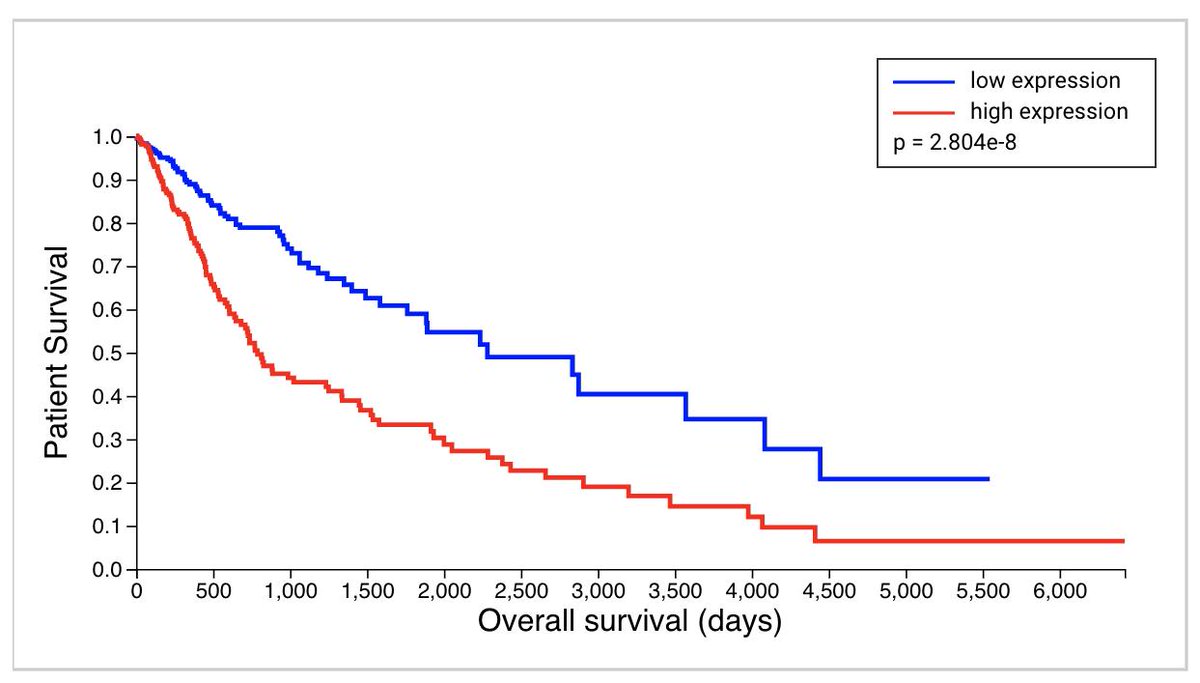
Let’s play a little game. Let’s say that you’re the CSO at a cancer pharma company, and you have to choose a target to go after. Here’s a gene – high expression is associated with poor prognosis in brain cancer. Looks like a good candidate for an inhibitor right?
Jason Sheltzer tweet media
English
67
1.4K
3.4K
0
Luke Lambourne
Luke Lambourne@LukeLambs·
@gangxue0502 Thank you! We just wrote our own python functions to visualize the splice forms. The problem with all the existing solutions was that we were only interested in the protein coding regions for our study. All the code is here: github.com/CCSB-DFCI/TF_i…
English
0
0
1
25
Gang Xue | 薛刚
Gang Xue | 薛刚@gangxue0502·
@LukeLambs So insightful work! Congrats, Luke!👏 I wonder how you visualize the alternative splicing among different isoforms, such as FigS3.A and B. Thanks so much for informing me which package you utilize~🙏
English
1
0
0
83
Luke Lambourne retweetledi
Michael Baym
Michael Baym@baym·
Prospective power analysis is hilarious because your replace an arbitrary guess of sample size with an arbitrary guess of the effect size you’ve yet to measure, do a touch of arithmetic, and suddenly it’s considered rigorous
English
26
51
504
153.7K
Luke Lambourne retweetledi
Oleg Kovalevskiy
Oleg Kovalevskiy@OVKovalevskiy·
@jankosinski @GoogleDeepMind Thank you Jan for the intensive testing and interesting findings! For the templates, it is the same cutoff as mentioned in the paper, i.e. 2021-09-30. We will add this to the Server FAQ for clarity and will let users know if we change this date
English
3
5
17
28.9K
Luke Lambourne retweetledi
Dr. Kaia Mattioli
Dr. Kaia Mattioli@kaia_mattioli·
excited to share the first story from my postdoc today!! we profiled hundreds of transcription factor (TF) isoforms & found that two-thirds of alternative TF isos differ from their cognate reference iso in at least 1 key molecular activity biorxiv.org/content/10.110…
English
10
56
245
42.9K
Luke Lambourne
Luke Lambourne@LukeLambs·
Based on these widespread differences in molecular functions, alternative isoforms of TFs form a crucial, but neglected, layer in the regulation of gene expression. Improving knowledge of this layer will be key to future progress in understanding cellular function and dysfunction
English
1
0
2
88
Luke Lambourne
Luke Lambourne@LukeLambs·
Alternative TF isoforms often had different localization and condensate formation properties from the corresponding reference isoform
Luke Lambourne tweet media
English
1
0
3
111
Luke Lambourne
Luke Lambourne@LukeLambs·
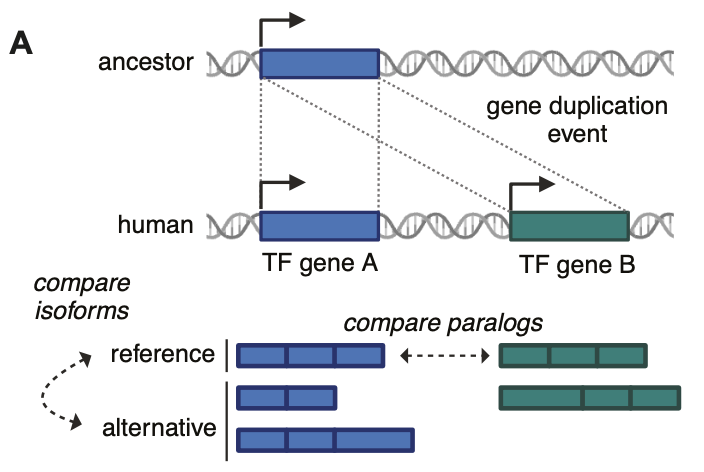
And, once you account for sequence identity, isoforms of the same gene are as different as paralogous genes
Luke Lambourne tweet mediaLuke Lambourne tweet media
English
1
0
2
58
Luke Lambourne
Luke Lambourne@LukeLambs·
Changes in binding to cofactors and signaling proteins were associated with changes in activation
Luke Lambourne tweet media
English
1
0
2
65
Luke Lambourne
Luke Lambourne@LukeLambs·
Of all protein-partners, it was the obligate dimerizing of TFs that was most preserved across different isoforms (e.g. bHLH-bHLH, bZIP-bZIP etc.) suggesting a need to preserve those for these alternative isoforms to function
Luke Lambourne tweet media
English
1
0
2
64
Luke Lambourne
Luke Lambourne@LukeLambs·
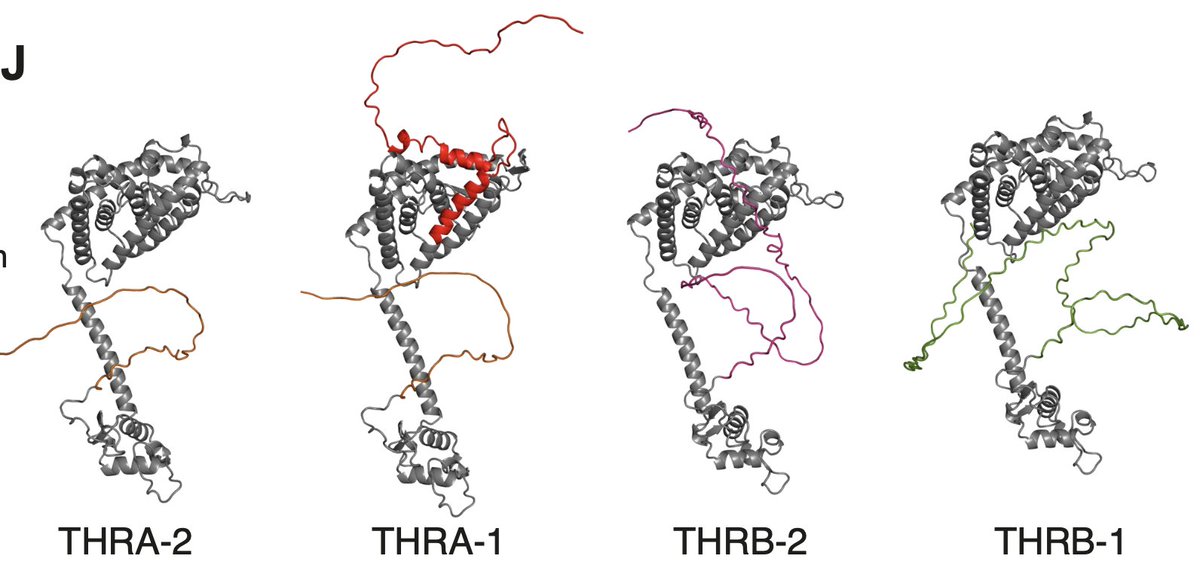
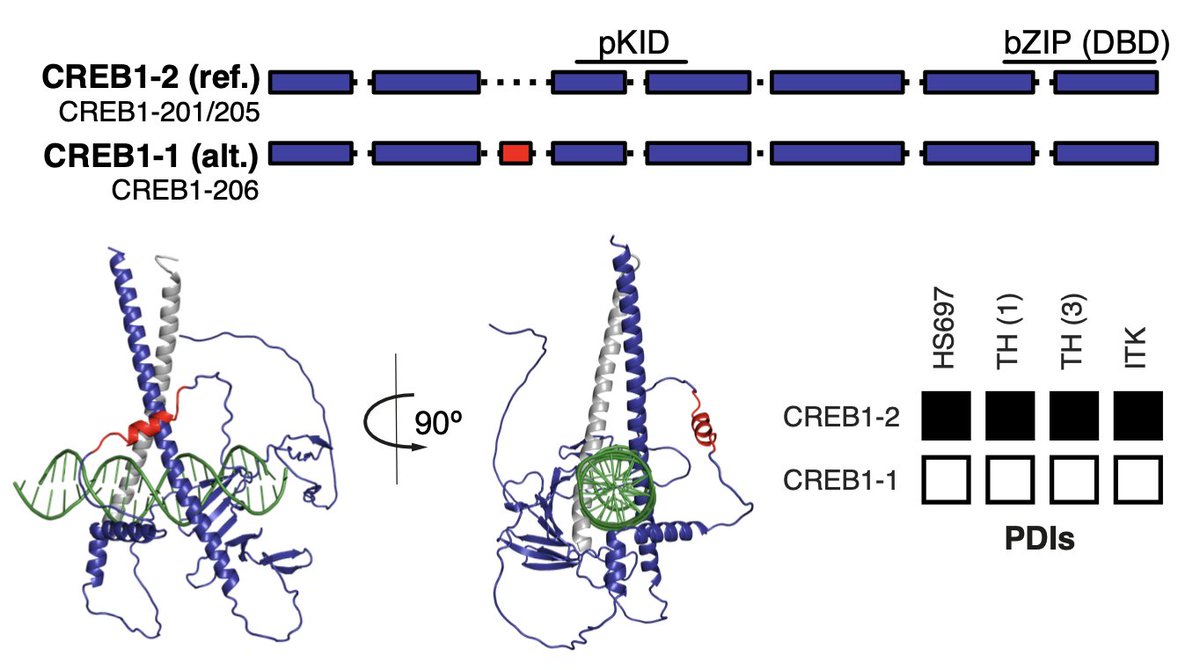
We found most alternative isoforms differed from the reference isoform of the same gene. Those differences are really challenging to predict from sequence features, e.g. differences in disordered regions far from the DNA-binding domain frequently affected DNA-binding
Luke Lambourne tweet media
English
1
0
2
51