Sabitlenmiş Tweet
Luke Turner
3.5K posts

Luke Turner
@LukeTurner_CFP
Financial advisor to business owners. Follow me to learn about what to do with your money. | Building @momentwealth | Tweets ≠ Advice
St Louis, MO Katılım Mayıs 2011
741 Takip Edilen2.3K Takipçiler

He sold his business for $9 million.
And finally got his life back.
He was 53.
Built the company from scratch.
15 years of payroll stress, client fires, hiring mistakes, and sleepless nights.
He was successful on paper.
But his life?
Constantly on call.
Always thinking about cash flow.
Always carrying the weight.
Then he sold for $9M.
Not a unicorn exit.
Not a headline on CNBC.
Just a solid, well-run business that gave him something most entrepreneurs never actually get:
Options.
After taxes, fees, and cleanup, he netted around $6M–$6.5M.
And for the first time in his adult life,
his money no longer depended on:
- one company
- one industry
- one bad quarter
- or him waking up stressed every Monday
That’s the part people miss.
The dream isn’t the sale price.
The dream is waking up and not being needed by a business to keep the machine running.
What we helped him realize
He didn’t need private jets.
He didn’t need yachts.
He didn’t need “$20M to feel safe.”
He needed a plan that showed him what his new life could actually support.
With a properly invested portfolio and a guardrails-based spending strategy,
his exit could support:
- $200K/year = conservative
- $225K–$275K/year = sustainable with flexibility
- $300K/year = possible with some guardrails
And here’s what that meant in real life
It meant:
- the house was paid for
- travel without guilt
- helping the kids with a down payment
- country club he wanted
- dinners out without thinking twice
- no more taking clients he hated
- no more building his entire identity around revenue
He didn’t retire to do nothing.
He retired from having to do everything.
That’s the entrepreneur dream outcome
Not just selling.
But turning the sale into:
Freedom
If you are running your business without a plan you are flying blind no knowing what is possible.
Follow Luke Turner if you are an entrepreneur who wants to get smarter with money.
English

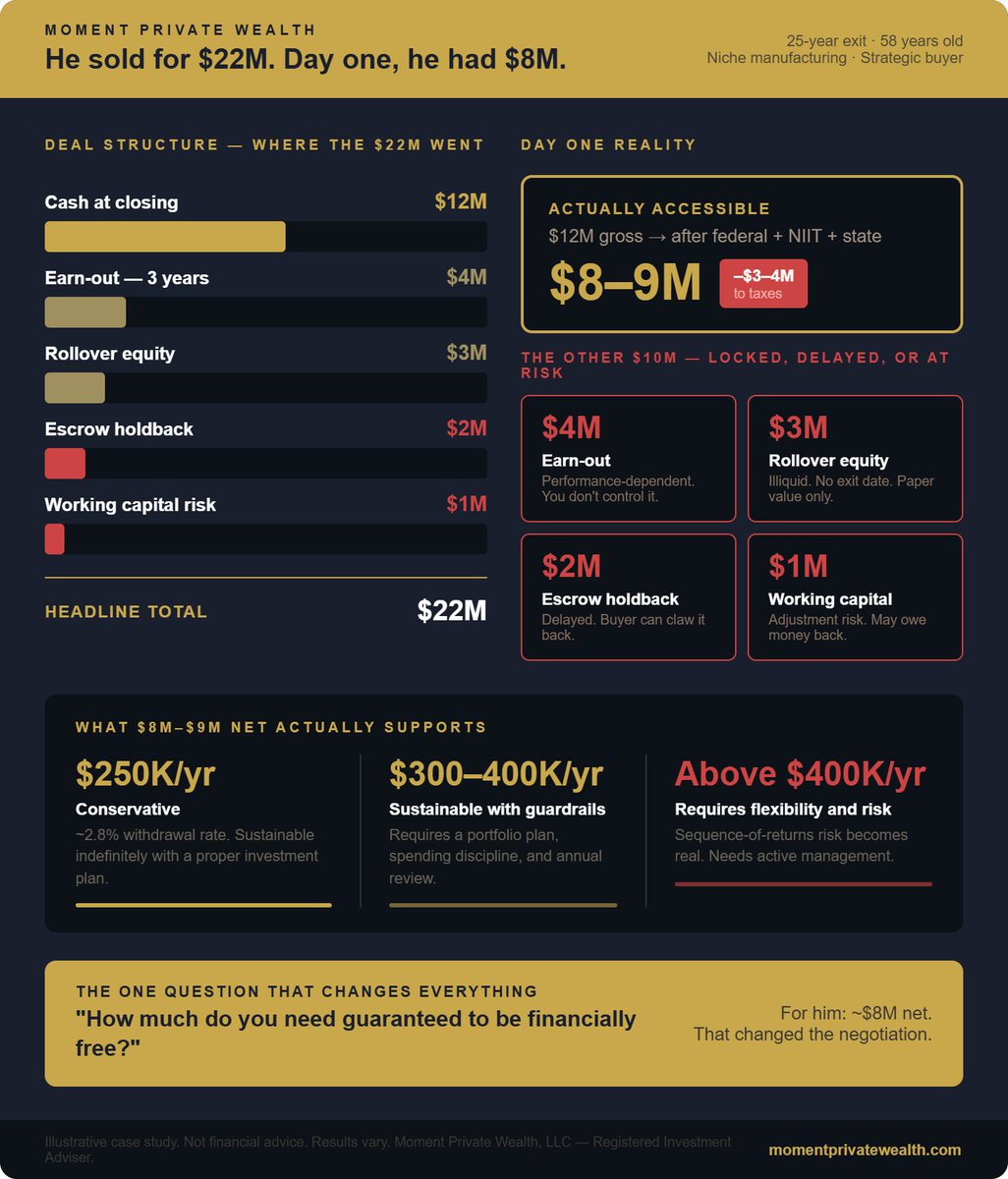
He sold his company for $22 million.
And only controlled $12 million of it.
He was 58.
Owned a niche manufacturing business.
Built it over 25 years.
Strategic buyer came in.
Strong multiple. Clean process.
Headline number: $22M
He thought:
“I’m done. I can live on this.”
But no one had walked him through the structure.
Here’s how the deal actually looked:
$12M cash at closing
$4M earn-out over 3 years
$3M rollover equity
$2M escrow holdback
$1M working capital adjustment risk
On paper: $22M
Day one reality?
He had access to $12M.
Then taxes hit.
After federal, NIIT, and state…
That $12M became closer to $8M–$9M net.
Everything else?
At risk
Delayed
Dependent on performance
Or locked up
This is where most founders get it wrong
They think:
“I sold for $22M.”
But you don’t live on:
Earn-outs
Escrow
Paper equity
You live on after-tax liquidity.
What we would help him do:
Before closing, we would reframed the deal around one question:
“How much do you need guaranteed to be financially free?”
For him, it was ~$8M net.
That changed the negotiation.
What we would push for:
1) Increased cash at close
2) Tighter earn-out definitions
3) Clear performance metrics he could control
4) Reduced ambiguity in working capital adjustments
5) Proper planning for the rollover equity
And after the deal:
We built a plan around the real number:
Not $22M.
$8M–$9M.
What that actually supports:
$250K/year = conservative
$300K–$400K/year = sustainable with guardrails
Above that = requires flexibility and risk
The shift
He stopped thinking like an operator.
And started thinking like an allocator.
Now he gets the outcome he wants. Selling his business and peace of mind around his finances.
Follow @LukeTurner_CFP if you are a business owner who is building to sell.

English

@SlackHookHQ Agreed.
That number doesn’t always translate to the lifestyle you had been living.
English

@LukeTurner_CFP I’ve seen this gap show up when founders anchor on the headline number instead of what’s actually investable.
Over time though, the biggest adjustment tends to be lifestyle expectations… especially once spending meets real withdrawal constraints
English

He sold his business for $8 million.
And thought he was set for life…He wasn’t!
He was 55.
Built a home services company over 17 years.
Got an offer. Took it.
$8M headline number.
Deal closed. Wire hit.
He though:
“If I just live on 5%, that’s $400K a year. I’m good, right?”
Not quite.
First, reality.
After taxes, fees, and adjustments…
That $8M became closer to $5.5M–$6M net.
That changes everything.
Because now:
$400K/year = 6.5%–7% withdrawal rate
That’s not a retirement plan.
This is where most business owners get tripped up.
They think in sale price.
But you live on:
- Net after tax
- Investable assets
- Withdrawal strategy
- Market reality
Not the headline number.
Here’s what we would help him do:
Segmented the proceeds:
- $2.5M long-term growth
- $2M income-focused allocation
- $1M liquidity / short-term runway
- Built a guardrails-based spending plan
- Start lower
- Increase in strong markets
- Adjust if needed in downturns
- Created a tax-aware withdrawal strategy
- Use taxable assets first
- Manage bracket exposure
- Plan future Roth conversions
What an $8M Exit Actually Supports
(After tax, properly planned)
- $180K/year = conservative
- $220K–$280K/year = sustainable with guardrails
- $300K+/year = possible, but needs flexibility and risk tolerance
The shift
He didn’t need to feel “restricted.”
He needed to feel in control.
Now he knows:
- What he can spend
- When he can increase lifestyle
- What happens if markets drop
- And how long it all lasts
Selling your business doesn’t make you financially independent.
A plan for the proceeds does.
At $8M, you’re not ultra-wealthy.
But with the right structure?
You’re free.
Most business owners spend decades building the business.
Don’t spend retirement guessing what you can afford.
Follow Luke Turner if you own a business and want to get smarter with your money.
English

@axiomalpha The issue with the OZ now is the deferral end at the end of this year.
English

@LukeTurner_CFP If he reinvests into an OZ fund (he could even set up his own) with some of the proceeds that would give him significantly more post-tax net cash
English

@LukeTurner_CFP This is crazy. Are you still using traditional bank accounts?
English

Jamie Dimon blackballed me in 2021.
Here is the story...Yes, it was a disaster.
Let's rewind 2 days prior to the disaster.
It was official, we were going to pull the rip cord and do the unthinkable.
Quit my job and start Moment Private Wealth.
We had finalized our operating agreement and were told to...
Open a bank account and fund it.
We proudly walked into Chase Bank to fund our business bank account.
And were hit in the teeth by Jamie.
"No sir you can't open a checking account here."
We were a competing business, so Jamie sent us on our way.
It was the first moment in entrepreneurship where we realized how cut throat it was going to be.
We immediately pivoted and found a new solution.
But it wasn't the 2nd option...We got denied by Bank of America.
But it wasn't the 3rd option...We got denied by Wells Fargo.
Eventually, we found a solution that worked for us but there is a lesson in this for you.
If you own a business or want to start a business, be prepared to be the problem solver.
Entrepreneurship is going to give you all sorts of problems you will need to solve.
If you work inside a business, be the problem solver. This is a skill that every business owner wants and craves.
Want to learn more about my journey as an entrepreneur?
Follow along @LukeTurner_CFP

English

He sold his company for $19 million.
But the structure mattered more than the price.
He was 56.
Owned a specialty distribution company.
Built it over 20 years.
A buyer came in with a 19M offer.
I have heard this before:
“Let’s get the deal done.”
But the headline number wasn’t the real story.
Because in most exits, price is only half the equation.
Structure determines what you actually keep.
The Initial Deal Structure Looked Like This
Enterprise Value: $19M
But the breakdown was:
- $11M cash at closing
- $4M earn-out tied to revenue targets
- $3M rollover equity into the new company
- $1M escrow for indemnification
On paper: $19M.
Reality?
He only controlled $11M on day one.
Then Taxes Enter the Conversation
After capital gains, NIIT, and state tax:
That $11M check was closer to $7.5M–$8M net liquidity.
The rest?
- Earn-out risk
- Escrow holdback
- Equity tied to the next sale
Which meant his retirement wasn’t funded yet.
This Is Where Early Planning Matters
We stepped in before the LOI was finalized and helped him think through three things:
1. Liquidity vs. Upside
How much money did he need guaranteed at closing to be financially independent?
For him, that number was about $8M after tax.
That changed the negotiation.
2. Earn-Out Risk
Earn-outs look great on paper.
But they depend on:
- Market conditions
- New ownership decisions
- Accounting definitions
- Operational control
We pushed to tighten the metrics and reduce ambiguity.
3. The Second Bite
The $3M rollover equity could be powerful.
If the new owners grow the business and sell again at a higher multiple?
That $3M could become:
- $6M
- $9M
- Even $12M+
But only if the founder is comfortable staying involved and taking that risk.
The Final Deal
I could see this deal restructured to:
- $13M cash at closing
- $3M rollover equity
- $2M earn-out
- $1M escrow
That one change increased his guaranteed financial security immediately.
And he still kept upside.
The Lesson
Founders obsess over the multiple.
But experienced sellers know the real questions are:
- How much cash do I get at close?
- What risk remains after the deal?
- Do I want a second bite or a clean exit?
- What does this look like after taxes?
Because 19M headline value can easily become $7M–$10M of actual liquidity.
And that difference changes everything.
Share this post if you got value from it.
English

Most business owners think their taxes are locked in after December 31.
That’s not always true.
There are still a few moves you can make before the filing deadline that could lower your tax bill if you act before you file.
1) Contribute to a SEP-IRA
If you’re self-employed or own a small business, you can still open and fund a SEP-IRA for last year until the tax filing deadline.
This can significantly reduce taxable income while building retirement savings at the same time.
2) Make a Traditional IRA contribution
Depending on your income, you may still be able to make a deductible IRA contribution for the previous tax year until April 15.
It’s one of the simplest ways to lower taxable income while investing for the future.
3) Fund your HSA
If you have a high-deductible health plan, you can still contribute to your HSA for last year.
HSAs are one of the most tax-efficient accounts because they offer:
- Tax-deductible contributions
- Tax-free growth
- Tax-free withdrawals for qualified medical expenses
4) Review your deductions before filing
A lot of business owners overpay simply because they miss expenses.
Before filing, review things like:
- Software and subscriptions
- Marketing and advertising
- Education or coaching
- Mileage and travel
- Home office expenses
Even small deductions add up.
5) Have a proactive review before filing
Last year I found a $100,000 miss on a clients tax return.
Even this late in the season, a second set of eyes can sometimes uncover deductions or strategies that were missed.
Most tax savings don’t come from loopholes.
They come from knowing which moves are still available before you file.
Business owners have you already filed, or are you still planning before the deadline.
Follow @LukeTurner_CFP if you are a business owner who wants to get smarter with money.
English

He sold his company for $24,500,000.
And got a call from a lawyer 11 months later.
The deal had closed.
Money wired.
Escrow funded.
Celebration dinner done.
He thought the risk was behind him.
Then a former employee filed a lawsuit.
The claim?
Workplace discrimination tied to events two years before the sale.
The new owner called him immediately.
“This happened on your watch.”
And technically… they were right.
Here’s what most founders don’t realize.
When you sell your business, many of your insurance policies are claims-made policies.
That means they only cover claims filed while the policy is active.
Once the business is sold, those policies often terminate.
So if a lawsuit shows up after closing?
Your old insurance might not cover it.
Even if the incident happened years earlier.
The solution is called Tail Insurance.
Also known as extended reporting coverage.
It allows you to report claims after the policy ends for incidents that occurred before the sale.
Without it?
You could personally face claims related to:
Employment practices (EPLI)
Directors & officers liability (D&O)
Professional liability
Cyber incidents
Certain product liability issues
All tied to actions that occurred before you sold the company.
What we see in the past as recommendations before closing:
1) 6-year D&O runoff coverage
2) EPLI tail coverage
3) Review of claims-made professional liability policies
4) Alignment with the reps & warranties insurance timeline
5) Coordination with the escrow indemnification period
It cost roughly 1.5–2.5x the annual premium.
Which sounded expensive at the time.
Until the lawsuit appeared.
Because the tail coverage was in place…
The insurer stepped in. Instead of potentially losing millions from a recent liquidity event, you are protecting the downside.
Here’s the lesson.
Selling the business doesn’t eliminate your risk.
It just shifts it into the past.
And lawsuits love the past.
Especially when new owners and their lawyers start digging.
Most business owners spend years preparing the company for sale.
Very few prepare their insurance stack for what happens after.
If you’re within 12–24 months of an exit, make sure someone reviews:
1) Claims-made policies
2) Tail coverage options
3) Reps & warranties insurance
4) Escrow exposure
Follow @LukeTurner_CFP to learn the ins and outs of selling your business.
English

He sold his company for $62 million.
And didn’t feel what he expected.
No fireworks.
No overwhelming relief.
Just… quiet.
He was 63.
Built the business over 28 years.
Family-owned. Capital-efficient. Highly profitable.
A strategic buyer offered $62M.
He signed.
Wire hit.
I have heard this thought before:
“Now what?”
Everyone talks about the valuation.
No one talks about the vacuum.
Because once you sell at that level, three things hit at once:
1.You’re wealthy.
2.You’re liquid.
3.You’re no longer the founder.
That last one is the hardest.
The Reality of a $62M Exit
After taxes, fees, and adjustments,
his net liquidity was closer to $40M–$45M.
Still life-changing.
But not infinite.
And here’s the part most founders underestimate:
Wealth concentration risk doesn’t disappear.
It transforms.
Instead of one business risk,
you now face:
- Investment risk
- Tax drag
- Estate tax exposure
- Family governance risk
- Behavioral investment risk
At this level, mistakes compound differently.
What We Would Help Do
Before closing:
- Structured gifting to trusts to cap future estate exposure
- Modeled capital gains, NIIT, and state residency impact
- Designed a post-sale investment policy statement
- Segmented capital into lifestyle, growth, and legacy buckets
After closing:
- Built a guardrails-based income system
- Stress-tested spending from $1M–$2M per year
- Mapped estate tax exposure under multiple growth scenarios
- Created a family governance structure for next-gen involvement
What $40M+ Really Supports
If invested prudently:
- $1M/year = conservative
- $1.5M/year = sustainable
- $2M/year = confident with oversight
- Above that? Requires intentional structure
At this level, you don’t need a withdrawal rate.
You need:
A capital allocation strategy.
A tax minimization roadmap.
An estate compression plan.
A purpose.
The Unexpected Part
He didn’t struggle with money.
He struggled with identity.
For 30 years, he was:
The operator.
The problem-solver.
The decision-maker.
Now he had capital.
And time.
That shift is harder than the deal.
A $62M exit isn’t about retiring rich.
It’s about managing complexity.
You don’t “set it and forget it” at this level.
You design:
- Income
- Risk
- Legacy
- Family structure
- Philanthropy
- Governance
The business was simple compared to that.
Does this sound a lot like you or someone you know?
Schedule a time with @LukeTurner_CFP
English

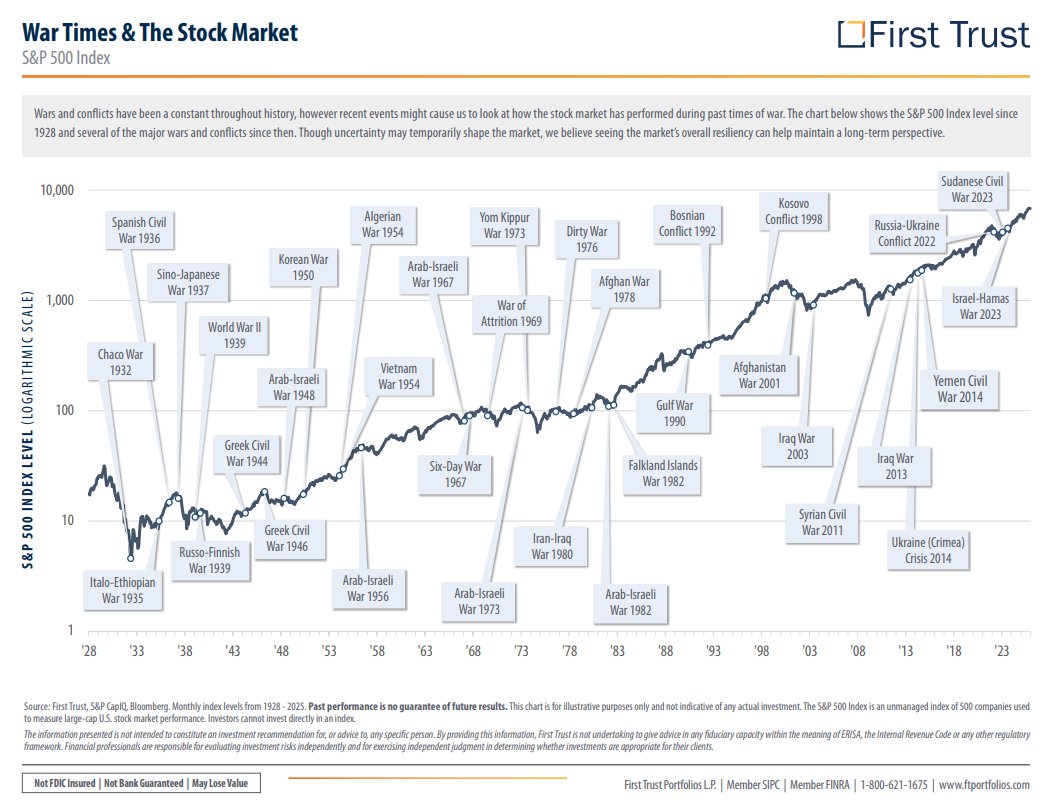
Wars bring unknowns to the stock market.
History has rewarded those who do this ⬇️
1) Stay the Course
Volatility is the price of admission to get long-term returns.
These are the times that we can expect you have to earn it.
Don't read the news everyday looking to change course. Stick to the plan you have in place.
This image is a perfect example of the reward of long term investing. You get the returns by staying in the game.
2) Rebalancing vs Reacting
Sticking to the plan doesn't mean doing nothing. Chances are we will see a divergence in a few segments of the market.
US Stock ⬆️
International Stock ⬇️
No one knows but what we can do is systematically buy stocks on sale and sell stocks at all time highs.
3) Asset Allocation
If you want higher returns, you need more in stocks.
If you want more stability, you need more in bonds.
Keep it simple...But the best plan is the one you stick with.
Follow @LukeTurner_CFP and share this information if you found it valuable.

English

He sold his company for $18 million.
And almost lost $4 million after closing.
The deal was done.
Wire hit.
Press release out.
Champagne opened.
He thought the risk was behind him.
It wasn’t.
Six months after the sale, a lawsuit surfaced.
A product defect claim tied to work done two years before closing.
The buyer came back immediately.
“This falls under reps and warranties.”
And technically… they were right.
Here’s What Most Business Owners Don’t Understand
When you sell your business, you make representations and warranties about:
- Compliance
- Pending litigation
- Product liability exposure
- Environmental issues
- Employee matters
- Contracts
If something surfaces post-closing?
The buyer can claw back money from the escrow.
Or worse pursue indemnification beyond it.
The Problem
He had:
- Standard general liability
- Basic umbrella coverage
- No tail coverage
- No reps & warranties insurance
His policies didn’t properly extend past closing.
There were gaps.
The buyer’s legal team moved fast.
$4M was tied up in escrow.
For 18 months.
The Exit Almost Unraveled
Not because the business was bad.
Because insurance wasn’t structured for a sale.
He built the company for 20 years.
Negotiated the multiple perfectly.
And almost let a P&C oversight blow up the outcome.
Here’s What Should Happen Before Closing
If you’re selling, you need to review:
- Tail coverage on claims-made policies
- Directors & Officers (D&O) runoff coverage
- Employment practices liability (EPLI)
- Product liability exposure
- Environmental risk
- Cyber liability
- Reps & Warranties insurance
Most brokers insure you to operate.
Very few insure you to exit.
Different mindset.
Different risk.
The Lesson
Your biggest liability exposure often starts
after the sale.
Because once the buyer owns it,
they have lawyers whose job is to find recovery.
Selling the company doesn’t end your risk.
It just changes the form of it.
The multiple matters.
But protecting the proceeds matters more.
If you’re 12–24 months from a liquidity event, don’t just optimize valuation.
Stress-test your insurance stack.
Because nothing feels worse than winning the deal and losing the money.
Repost this and comment below what you learned.
English

He sold to private equity for millions.
What know one told him before closing…
He was 52.
Built a $12M EBITDA company.
Growing. Profitable. Tired but not done.
He had two real options:
Sell 100% and walk away.
Or partner with private equity.
He chose PE.
Not because it paid the most upfront.
Because it gave him leverage.
What Selling to Private Equity Actually Gives You
Most business think think PE means:
- Loss of control
- Pressure
- 5-year clock
Sometimes that’s true.
But the upside?
You get:
- Institutional capital
- Acquisition funding
- Better banking relationships
- Professionalized systems
- Strategic advisors
And most importantly:
You de-risk personally
while still keeping upside.
The First Bite
He sold 70%.
Took meaningful money off the table.
Paid down personal risk.
Funded his family’s future.
He no longer had 99% of his net worth tied to one company.
That alone changes how you sleep.
The Second Bite
He rolled 30%.
Private equity helped:
- Add two acquisitions
- Upgrade leadership
- Expand margins
- Tighten reporting
- Scale sales
Three years later?
Enterprise value nearly doubled.
His minority stake was worth more than what he initially rolled.
That’s the second bite.
You use someone else’s capital
to multiply what you already built.
The Real Pros of Selling to PE
- Liquidity without walking away
- Shared risk
- Professional growth
- Multiple expansion on the next exit
- Optionality
⸻
Who It’s Right For
Business Owners who:
- Still have energy
- Want to scale bigger
- Are comfortable sharing control
- Want to de-risk but not disappear
It’s the cleanest way to:
Take chips off the table
and still swing for another home run.
Most people think selling is about getting out.
Sometimes it’s about leveling up.
Let’s hear what you learned from this post in the comments below.
English

He sold his business for $22 million.
And regretted it within a year.
Not because it was a bad deal.
Because it was the wrong structure.
He got the headline number he wanted.
Great multiple.
Strong buyer.
Press release-worthy exit.
But here’s what he didn’t focus on:
- 40% was tied to an earn-out
- Performance targets were aggressive
- Definitions of EBITDA were “adjusted”
- Working capital true up at close
- He had a 3-year employment agreement
On paper: $22M.
In reality?
After taxes, earn-out miss, and legal friction…
He cleared closer to $13M.
And he had to work longer than he wanted to.
⸻
Here’s the truth about selling:
The valuation gets attention.
The terms determine reality.
You don’t retire on the multiple.
You retire on:
- Net after-tax proceeds
- Cash at closing
- Risk tied to earn-outs
- How long you’re required to stay
- What control you keep (if any)
⸻
The 5 Questions Founders Rarely Ask
Before signing an LOI, ask:
1. What percentage is guaranteed at close?
2. How realistic are the earn-out targets?
3. What happens if the economy slows?
4. How does working capital adjustment affect me?
5. Am I emotionally okay working for someone else?
Because once you sign, leverage shifts.
⸻
Compare That to Another Client
Sold for slightly less $20M instead of $22M.
But:
- 90% cash at close
- Smaller earn-out
- Clean 12-month transition
- Clear definitions in the purchase agreement
- Tax modeling done before the deal
He walked with more certainty.
More control.
And less stress.
Sometimes the lower headline number is the higher real outcome.
⸻
Selling a business is not about winning the auction.
It’s about controlling the structure.
Multiple matters.
But:
Structure > Multiple
Liquidity > Ego
Net after tax > Gross headline
Most founders spend decades building value.
Don’t lose it negotiating the wrong things.
English

He thought he was choosing a buyer.
He was actually choosing his future.
He had three offers on the table.
Private equity.
A strategic competitor.
And a buyout from his leadership team.
All within a few million dollars of each other.
His banker kept saying:
“It’s basically the same money. Just pick the cleanest deal.”
But this wasn’t about money.
It was about who he was going to be on the other side of the sale.
For 22 years, he was:
The founder.
The decision-maker.
The final word.
The guy everyone waited on.
After closing?
That changes.
The only question is how much.
If He Sold to Private Equity
He’d still be CEO.
But now:
Monthly board meetings
Growth targets set by someone else
Leverage on the balance sheet
A 5-year clock ticking
He’d have liquidity.
But he’d also have pressure.
Second bite of the apple?
Yes.
Full control?
No.
If He Sold to a Strategic
He’d get the biggest check upfront.
But within 12 months:
His brand would disappear
His systems would get integrated
His team would report to someone else
His name would slowly fade from the building
Clean exit.
Clean break.
Clean ego hit.
If He Sold to Employees
He’d protect the culture.
Keep the mission alive.
But:
Slower payout
Seller financing risk
More complexity
More patience required
Legacy wins.
Speed loses.
He sat in my office and finally said:
“I don’t know who I am if I’m not running this.”
That’s the real conversation most founders avoid.
Not:
“What’s the multiple?”
But:
“Do I still want to be in the arena?”
Because here’s the truth:
At this level, the difference between $28M and $31M
doesn’t change your lifestyle.
But the structure changes your life.
Selling to PE means you’re betting on yourself again —
with someone else’s capital.
Selling to a strategic means you’re closing the chapter.
Selling to employees means you’re choosing legacy over liquidity.
None of them are wrong.
But only one fits who you are right now.
Most founders think the deal is about money.
It’s not.
It’s about control.
Identity.
Energy.
And how much runway you have left in you.
Choose the buyer that matches the next version of you.
Not the last one
English

@LukeTurner_CFP loved reading this. your breakdown of pre and post exit planning is spot on.
English

He was about to sell for $25 million.
And walk into retirement with no plan.
He was 58.
Tech-enabled service business.
Scaling for a decade.
Buyer lined up. $25M valuation. All cash.
I have heard something similar 60 days before closing
“We’re selling. I’ll probably just live off 3%. That should be safe, right?”
He’d done everything right in the business but had no plan for what came after.
No entity structure.
No gifting plan.
No tax modeling.
No idea how much he could spend or give without blowing up the next 30 years.
He was about to make the single biggest deposit of his life
…into an account with no instructions.
How we would think about helping (Before and After the Exit)
Segmented the proceeds:
- $10M for long-term growth
- $8M for flexible, tax-efficient income
- $5M transferred into a family trust with future gifting strategy
- $2M in liquidity and opportunity capital
- Established a charitable gifting plan (DAF + CRT) to offset part of the gain
Created a spending policy using guardrails so he could live well and adjust over time
- Integrated estate tax planning to cap future exposure
- Built out a full cash flow map across brokerage, 401(k), Roth, real estate, and trusts
- Modeled the plan through age 100 under stress-tested market assumptions
He didn’t need a “safe withdrawal rate.”
He needed a wealth operating system.
We built one.
And now?
- He travels more than he works
- Pays less tax than expected
- Has total visibility into spending, giving, and legacy
- And knows exactly when to dial income up or down
💸 What You Can Spend After a $25M Exit
(If planned correctly)
- $500K/year = ultra-conservative
- $750K/year = flexible with margin
- $1M–$1.2M/year = confident, sustainable, guardrails-based
- $1.5M+/year = aggressive, but possible with controls
A $25M exit isn’t freedom by default.
It’s just potential.
The difference between the owner who stays wealthy…
and the one who slowly bleeds it away?
Planning.
Tax. Income. Risk. Legacy.
All tied together in one system.
The sale isn’t the finish line.
It’s the fork in the road.
Make it count.
English

He had three offers for his company.
All within $2 million of each other.
One from Private Equity.
One from a strategic competitor.
One from his own management team.
Everyone around him kept asking:
“Which one pays the most?”
Wrong question.
The real question was:
“What life do you want after this closes?”
Because who you sell to doesn’t just determine price.
It determines control.
Risk.
Culture.
Time horizon.
And whether you ever see a second dollar.
The Three Paths
1️⃣ Sell to Private Equity
You usually:
- Sell 60–80%
- Roll 20–40% equity
- Stay on 3–5 years
- Grow aggressively
- Aim for a second exit
Upside:
- Second bite of the apple
- Institutional capital
- Faster scaling
Tradeoff:
- Board oversight
- Aggressive growth targets
- Less autonomy
- You’re not the only decision maker anymore
You de-risk personally.
But you’re still in the arena.
2️⃣ Sell to a Strategic Buyer
You usually:
- Sell 100%
- Cash out fully
- Possibly sign a 1–3 year transition agreement
Upside:
- Clean exit
- Highest upfront price (sometimes)
- No rollover risk
Tradeoff:
- Your company likely gets absorbed
- Culture changes
- Your name eventually disappears
You maximize certainty.
But you give up upside.
3️⃣ Sell to Employees (ESOP or Internal Buyout)
You usually:
- Transition gradually
- Structure seller financing
- Maintain legacy
- Preserve culture
Upside:
- Protect your people
- Keep mission intact
- Tax advantages (if structured correctly)
Tradeoff:
- Lower immediate liquidity
- Longer payout timeline
- Higher execution risk
You prioritize legacy over speed.
What He Chose
He didn’t pick the highest bid.
He picked the offer that matched:
- His burnout level
- His desire for a second run
- His family’s risk tolerance
- His need for liquidity
He sold majority to PE.
Rolled equity.
Took enough off the table to retire if he wanted to.
And stayed because he wanted to not because he had to.
That’s the difference.
⸻
The Decision Framework
Before you compare offers, answer this:
- Do you want to work 5 more years?
- Do you want upside or certainty?
- Is legacy more important than price?
- How much is “enough” for your family?
- Can you emotionally handle losing control?
Because at this level, the delta in price matters less than the structure.
Most founders think selling is a financial decision.
It’s not.
It’s a life decision with a financial wrapper.
Choose the buyer that fits the life you want not just the headline number.
If you got value from this post ♻️repost it and share it with a friend.
English