Lights of Z’Tar retweetledi
Lights of Z’Tar
14K posts


Lights of Z’Tar
@M0im3m3
Salty Statistician Scientist 🇺🇸. Loud fools get blocked. I don't read DMs. He/Him/His.
United States Katılım Ekim 2015
198 Takip Edilen229 Takipçiler

Lights of Z’Tar retweetledi

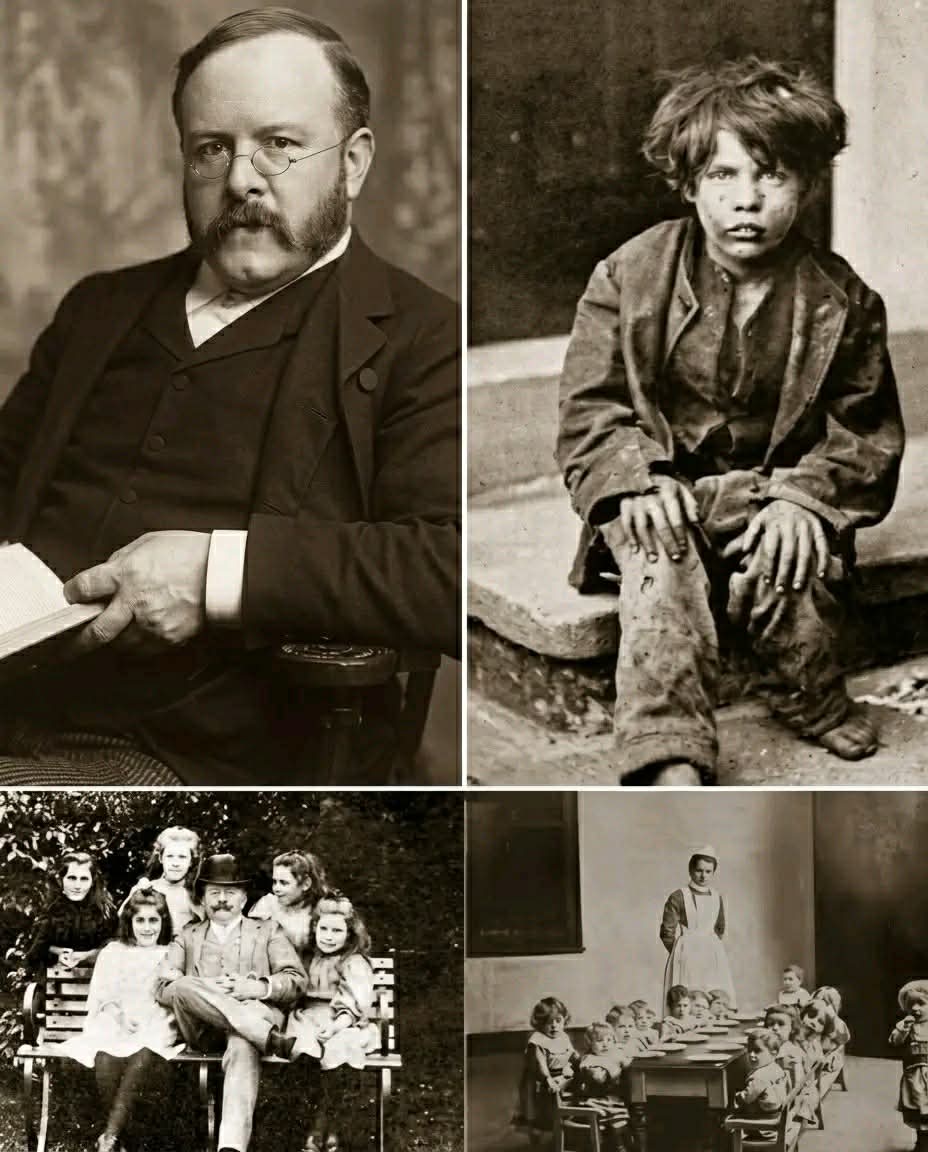
A 7-year-old boy slept under a bridge in London. No shoes. No food. No one who knew his name. A young stranger stopped and asked him a simple question — and what the child said next changed history forever.
His name was Jim. The year was 1866. London was choking under black factory smoke, and the East End was a maze of sewers, starvation, and invisible children. Jim was one of them — filthy clothes, matted hair, eyes that held pain no child should ever know.
Thomas Barnardo was just a 21-year-old medical student, quietly preparing to travel to China as a missionary. Then he met Jim crouched in a doorway, shivering.
"Are there more like you?" Thomas asked.
"Heaps of 'em, sir," Jim whispered. "More than I can count. We sleep where the dogs won't go."
A few days later, Jim was dead. He died alone in the cold, another child the city had simply forgotten to notice.
Thomas Barnardo never boarded that ship to China.
Instead, in 1870, he opened a small home for abandoned boys in East London. Above the door, he hung a sign that read:
"No destitute child will ever be refused admission."
One night, the home was full and he turned a boy away. Two days later, that same child was found dead from hunger and cold. Thomas wept. He made a vow he never broke: the door would always open.
When critics told him he was crazy and would run out of money, he kept building. More homes. Foster families. Vocational training. He gave street children — children people called "rats" — a trade, a name, and a future.
He didn't ask for papers. He didn't ask for backgrounds. He simply opened the door.
By the time Thomas Barnardo died in 1905, he had rescued more than 60,000 children from the streets of Britain.
Today, Barnardo's is still one of the UK's largest children's charities — still keeping a dead boy's whispered words alive, 160 years later.
Everything began with one man who stopped walking, looked down, and truly saw a child that the rest of the world had decided wasn't worth seeing.
Tag someone who still believes one person can change everything. 💙
English
Lights of Z’Tar retweetledi

【衝撃】ワニに足を噛まれた10歳少女、校外学習で習った「まさかの裏技」で生還
・米フロリダ州の湖で、10歳の少女が体長2.7mの巨大アリゲーターに襲われる
・絶体絶命の瞬間、彼女はワニのテーマパークで教わった「鼻の穴に指を突っ込む」という秘策を実践
・ワニが息苦しさで口を開けた隙に脱出し、奇跡的に軽傷で生還


日本語

English



A few good books worth reading:
- Atlas Shrugged by Ayn Rand - a classic that celebrates builders. Once you read it, you’ll notice the same characters and events taking place today.
- The Changing World Order by Ray Dalio - great for understanding how civilizations rise and fall and how crypto can help create better countries.
- From Third World to First by Lee Kuan Yu (founder of Singapore) - talks about building a new country, worth reading for understanding nation-building.
English
Lights of Z’Tar retweetledi

A few good books worth reading:
- The Very Hungry Caterpillar by Eric Carle - a classic that celebrates builders. Once you read it, you’ll notice the same characters and exits taking place in the Valley today.
- If You Give a Mouse a Cookie by Laura Numeroff - great for understanding how incentive cascades shape civilizations and how crypto can help align stakeholders.
-Where the Wild Things Are by Maurice Sendak (founder of an unclaimed island) - talks about sailing off and becoming king of the locals, worth reading for understanding nation-building.
Brian Armstrong@brian_armstrong
A few good books worth reading: - Atlas Shrugged by Ayn Rand - a classic that celebrates builders. Once you read it, you’ll notice the same characters and events taking place today. - The Changing World Order by Ray Dalio - great for understanding how civilizations rise and fall and how crypto can help create better countries. - From Third World to First by Lee Kuan Yu (founder of Singapore) - talks about building a new country, worth reading for understanding nation-building.
English
Lights of Z’Tar retweetledi

4:00am
A 54‑year‑old man being managed for prostate enlargement, was rushed in with acute urinary retention and severe pain.
DOCTOR: Good morning, sir. What happened to the catheter we passed yesterday?
PATIENT: I removed it.
DOCTOR: Why did you do that? You were supposed to leave it for two weeks.
PATIENT: I wanted to sleep with my wife.

English
Lights of Z’Tar retweetledi

🦔Deloitte is cutting parental leave from 16 weeks to 8 weeks, reducing PTO by 5 to 10 days, eliminating $50,000 in IVF and adoption reimbursement, and freezing pension accruals for employees in internal support roles including admin, IT, and finance, effective January 2027. The company employs 181,000 people in the US and posted $35.7 billion in revenue last year, up 8%. A spokesperson described the changes as tailoring benefits to better align with the marketplace.
My Take
Deloitte charges clients hundreds of thousands of dollars to advise them on workforce strategy while cutting parental leave in half and eliminating IVF coverage for the people keeping its own systems running. The internal support staff losing these benefits aren't junior consultants billing 70-hour weeks on client engagements. They're the IT, finance, and admin employees whose work makes the billable side of the business function.
I don't buy the marketplace alignment argument. Deloitte grew revenue 8% last year and posted $35.7 billion. This isn't a company making hard choices under financial pressure. It's a company making easy choices because the job market is weak enough that it can. Cutting parental leave and IVF coverage isn't trimming a perk. It's a decision about whose family planning the company considers worth supporting, and the answer landed on the employees with the least leverage to push back. That lets me know everything about how these companies view the people who aren't directly billable.
Hedgie🤗

English
@archeohistories That was "corpulent" back in the days, now that's probably the average for Americans.
English

The love chair was a device created by a French furniture manufacturer to allow the corpulent British King Edward VII to have sex with two women simultaneously while protecting them from being crushed by his weight...
King Edward VII was the son of Queen Victoria — namesake of the Victorian Era. He was also so freak nasty that our boy was nicknamed "Edward the Caresser."
Yes, according to Edward VII: The Prince of Wales and the Women He Loved, a book by historian and journalist Catharine Arnold, Edward had a line of sex workers, socialites, actresses, and aristocrats knocking at his bedchamber. And he was so audacious with his open displays of affection for these women that he designated a pew at his coronation for "the King's special ladies." His wife, Queen Alexandra, knew of his affairs and showed kindness toward the women she shared Edward with, even allowing his mistress, Alice Keppel, to visit Edward on his deathbed.
As a young man, the perpetually pleasure-seeking Albert, Prince of Wales (later King Edward VII) was responsible for commissioning arguably one of the most famous pieces of erotic furniture of all time – the love chair. It took the form of a brocade 'bunk bed' of stacking seats, complete with stirrups to hold the legs of not one, but two different partners.
'A threesome chair', if you will, designed for a royal with famously gargantuan sexual appetites...
King Edward VII's love chair, known as the ‘siège d'amour’ in French, epitomised opulence and sensuality. And, possibly more importantly, it allowed the overweight king-to-be to have sex with two women at the same time without crushing them. It was a surprisingly beautiful piece of furniture, manufactured by Louis Soubrier, a famed cabinetmaker of the Rue du Faubourg Saint-Antoine. Clearly there could be nothing but the best for a member of the British royal family.
It's worth noting at this point that by the time of his coronation in 1902, King Edward VII had an impressive 48-inch waist and was clinically obese, a symptom of a life-long love affair with fine food and even finer alcohol.
According to contemporary reports, the playboy Prince of Wales would regularly sit down to five meals a day, comprising mostly ten-course affairs. All of this was washed down with large volumes of fine wine and champagne, hence his rapidly expanding waistline. This is where the siège d'amour came in.
The famous love chair, kept at the famed Parisian brothel Le Chabanais, allowed the unathletic Bertie to have relations with two women simultaneously, all with the minimum of effort to himself, or risk to them. It also ensured his stomach was kept out of the way.
So, how did it work? Picture, if you will, the hedonistic Prince Albert (referred to as 'Dirtie Bertie' by the tabloids of the time, as well as 'Edward the Caresser') standing upright, while one companion reclined on her back before him, and another lay beneath her. The women placed their feet into specially made bronze stirrups, intricately carved into the chair's frame, to help them stay in position.
A replica of the siège d'amour went on show from 2015 to 2016 at the exhibition 'Splendour and Misery: Images Of Prostitution 1850-1910’, at the Musée D’Orsay in Paris. A replica is also exhibited in the Sex Machines Museum in Prague.
The original is believed to have been sold at a private auction – presumably to a very discreet collector – in 1990s.
No, the siège d'amour wasn’t the only piece of erotic furniture that the playboy prince kept at Le Chabanais...
Another of the future king's favourite diversions was to carouse with multiple women in a luxurious copper bath decorated with a half-woman, half-swan figurehead, filled to the brim with champagne, in which he splashed and cavorted with his multiple female partners. Sounds chilly, but certainly decadent.
© History Extra
#archaeohistories

English
Lights of Z’Tar retweetledi

RFK Jr: "A Democratic senator claimed it's mathematically impossible to have a drug drop by 600%. I said, 'Well, if the drug was $100 and it raises to $600, that would be a 600% rise. If it drops from $600 to $100, that's a 600% savings.'"
Trump: "Right"
English
Lights of Z’Tar retweetledi

An Iranian child prodigy and gifted musician, Sana Hamifar, captures hearts with her incredible skill on the Santur.The Santur is a traditional Persian trapezoidal hammered dulcimer, played with two delicate wooden mallets (mezrabs) to produce a mesmerizing, crystal-clear sound.
#Santur
English

@DanDeFiEd Here’s the paradox ..
Italians talk about how they do everything slowly.. enjoying it. But they take their coffee in less than one second and leave in a rush.
English

Italian efficiency when it comes to coffee should be studied.
In Italy:
- Walk into a bar and look at the guy
- Un caffe
- 30 seconds later it’s ready
- Shoot it
- Leave €1
- Walk out
In the US:
- Join a line
- Wait
- Order coffee
- Answer 12 questions: Size? Milk? Roast? Sugar? Temperature? Colombia beans? Name? How do you spell it?
- $12.34
- Ask for a 20% tip. Click 5 times on a ipad to have a custom tip
- Tap phone
- ask where to send the invoice
- Wait again on a different line
- Someone call a name that sounds similar to mine
- get the coffee
- too hot, can't drink it
- finally at temperature
taste like shit
English
@0x4Graham @DanDeFiEd Do they make matcha the traditional way in SBUX? I don't think so. I know they don't use ceremonial grade matcha, and my guess is that they mostly just add matcha powder to drink.
English

@DanDeFiEd Only reason there's a long queue at coffee shops today is because they sell Matcha which takes forever to make.
Down with Matcha.
English
@DanDeFiEd You missed the part where the Italian waiter drops an insult behind your back as you depart
English

Tulsi Gabbard has been told by the White House that she has until the midterms to pack up and leave, according to sources I've spoken to in recent weeks. sherwood.news/power/whos-nex…
English
Lights of Z’Tar retweetledi

The creator of Linux, Linus Torvalds, just unknowingly obliterated Elon Musk in one sentence:
English
@archeohistories Syria, Japan and India are all on the same continent: Asia.
English
In 1885; Philadelphia, three women stand shoulder to shoulder in a photograph that shouldn't exist...
Anandibai Joshee traveled from India carrying a grief no mother should bear. At fourteen, she held her dying infant in her arms, helpless because not a single doctor in her region would treat women. That loss became her fuel. She crossed an ocean to learn what could save the next mother's child.
Beside her, Kei Okami from Japan. She didn't just want to study medicine; she needed to prove that a woman's hands could be as skilled as any man's with a scalpel. And Sabat Islambouli, who journeyed from Syria, determined to bring modern medical knowledge back to women who had none.
The Woman's Medical College of Pennsylvania was their battlefield. While America debated whether women even had the intellectual capacity for higher education, these three dissected cadavers, memorized surgical techniques, and mastered anatomy in their traditional dress. They were outsiders twice over: foreign and female in a profession that wanted neither.
Graduation should have been their triumph. Instead, it became the starting line for three vastly different fates.
Joshee's story breaks your heart. She returned to India as the nation's first female physician, ready to fulfill her purpose. Tuberculosis had other plans. She died at twenty-one, her practice never established, her dream barely tasted.
Okami made it further. She returned to Japan, led an entire gynecology department, became exactly what she set out to be. Then the Emperor refused to meet with her. Why? Her gender. She walked away from it all in protest, choosing dignity over compromise.
Islambouli? She actually got to live it. She practiced medicine across the Ottoman Empire, from Damascus to Cairo, treating patients until 1941. Decades of work. Thousands of lives touched.
Three women. Three continents. One photograph that captured a moment when the impossible became briefly, defiantly real. They did this before women could vote, before anyone believed they should. That frame holds more courage than most of us will ever need to summon.
The Woman's Medical College of Pennsylvania wasn't just progressive for admitting women. It actively recruited international students, making it a rare beacon for women worldwide who had no other path to medical education. By 1885, it had already graduated dozens of female physicians when most American medical schools still barred women entirely.
Anandibai Joshee's husband, Gopalrao, was actually the one who encouraged her education, which was radical for the time. He was twenty years her senior and faced severe social backlash in India for supporting his wife's ambitions. Their correspondence with American missionaries ultimately led to her admission to the college.
When Joshee graduated, Queen Victoria sent her a congratulatory message. The irony? British colonial rule in India had done little to advance women's healthcare, yet the Queen celebrated one Indian woman's achievement abroad. Another interesting detail: Kei Okami's resignation wasn't the end of her story. She later opened her own private practice and became a prominent figure in Japanese women's education, proving that institutional rejection couldn't stop her impact.
(Colorized Photo)
#archaeohistories

English
Lights of Z’Tar retweetledi

So the new CEO decides it's time to rid the company of slackers.
On a tour of the facilities, he notices a guy leaning against a wall.
The room was full of workers.
Seeing a chance to show he meant business, he says to the guy, 'How much money do you make a week?' A little surprised, the young man says, 'I make $400.
Why?' The CEO says, 'Wait right here.'
He walks back to his office and comes back in two minutes.
He hands the guy $1,600 in cash and says, 'Here's four weeks' pay.
Now get out and don't come back!'
Feeling like a boss now, the CEO looks around and says, 'Does anyone want to tell me what that goofball's job was around here?'
From across the room, a voice says, 'Pizza delivery guy from Domino's.'

English

RFK Jr has:
- Cut off a raccoon dick
- Eaten a dog
- Chainsawed off a whale head and strapped it to his minivan
- Put a dead bear cub in his station wagon and dropped it in Central Park
This is what we know about. Imagine what we don't know.
English
@Roarfter @Breaking911 I don't know, White people do it in their house shooting up their ex-partner's families & pets.
These look like middle/high school girls maybe rivals from across town. I don't see knives or guns, and humans nails aren't claws you use them too much they snap and smart for days.
English