MrStiive 🦇🔊

6.2K posts

MrStiive 🦇🔊 banner
MrStiive 🦇🔊

MrStiive 🦇🔊

@MStiive

here i am. it's MrStiive. thoughts are my own. nfa

AU Katılım Ocak 2021
5.6K Takip Edilen6.1K Takipçiler
Sabitlenmiş Tweet
MrStiive 🦇🔊
MrStiive 🦇🔊@MStiive·
$BTRFLY, a project which could; - deliver a top #10 stablecoin with TRIPLE #RealYield - while becoming the central bank of the internet - while solving Ethereum's EOF/MEV challenges Let's do a pre-wp speculative dive into @redactedcartel's upcoming $DINERO A dirty thread🧵👇
MrStiive 🦇🔊 tweet media
English
48
115
475
180K
Aerugo
Aerugo@aerugoettinea·
1. Intro Vitalik recently wrote about where the EF should go; Aya added a note to explain how we got here, and why. I’ll write about the execution. We now have enough clarity to stop treating “what is the EF for?” as an open-ended question. Our mandate is clear: The EF exists to ensure Ethereum is, becomes, and remains real permissionless infrastructure for self-sovereignty: censorship (and capture) resistant, free and open source, private, and secure; and capable of supporting sovereignty-preserving coordination at scales where trusted institutions hitherto have been unavoidable. The following are my thoughts on some of the points that follow from the mandate and how we are translating it to action. But first, a short reminder about 2. What the EF is not for We are not here to optimize for EF importance, corpo/pol appeal, or ecosystem popularity. We are also not here to please short-term speculators, prop up TBTF neo-SIFIs, market every app on Ethereum, help anyone look good to their crypto or investor friends, or provide on-demand entertainment for dinner parties and private retreats. 3. What the EF is for: Eliminating weaknesses We are here to defensively strengthen places where Ethereum is, or can still become, extractive, totalizing, or vulnerable to cartel or state capture, or authoritarian tools of surveillance or coercion. We will base our actions on a full examination of what Ethereum is and can be at the protocol layer (what is actually running as “Ethereum”), the access layer (what users use to interact with the protocol), the user layer (the end-users who need and will need Ethereum), and the institutional layer (the intermediated paths that scale self-sovereign usage). The EF exists to harden every surface of Ethereum, including those where Ethereum can remain formally permissionless while becoming practically captured. Some obvious surfaces are the transaction pipeline, staking and network security, access layer standards and interfaces, self-sovereignty norms, privacy expectations, institutional adoption patterns, and social layer governance processes. The primary concerns are similar across most of them: does the status quo and its future trajectory minimize trusted dependencies, minimize points of leverage and capture vectors, make user privacy the default, preserve exit, and make trust assumptions legible? The work starts with the EF itself. We are moving compensation and major financial relationships toward ETH and mandate-compliant Ethereum-native stables, with exceptions where positive law or unavoidable operational constraints require exceptions. Rather than a purity ritual or instruction for people to take unmanaged personal risk, it is robustness, alignment, and product pressure. If the EF’s work is to make Ethereum usable as infrastructure for self-sovereignty, everyone at the EF will increasingly live inside the constraints of the system the EF exists to improve: wallet UX, volatility, accounting, privacy gaps, payment friction, stablecoin trust assumptions, recovery, dependency risk, etc. If we can’t use these tools ourselves, it is unrealistic to expect others to. Ethereum is already mature; those who do not depend on the user-facing stack have no business trying to shape its future, at any layer. The transaction pipeline is next. Preventing toxic MEV capture is core EF work, not a peripheral market-structure concern. Transaction supply, ordering, inclusion, block construction, propagation, and settlement are part of Ethereum’s neutrality boundary. Some MEV may persist as an adversarial phenomenon the protocol contains, but it must be absolutely minimized and, for that to be possible, we must guard against the acquisition of unwarranted influence by its beneficiaries. If credibly neutral execution is subverted by privileged orderflow, cartelized builders, trusted relays, opaque routing, or validators outsourcing into a narrow supply chain, Ethereum will look permissionless while users experience it as intermediated at the moment value moves. EF protocol work will therefore prioritize lower barriers to block building and validation, stronger inclusion guarantees, reduced extraction opacity, competitive transaction pipelines, user-facing legibility of trust assumptions, and more aggressively exploring the open orderflow solution space. None of this is simple. A good solution in one place can aggravate problems elsewhere. FOCIL is good for censorship resistance, but it may introduce more cross-block MEV. While ePBS solves the relayer trust problem, we must make sure that its implementation does not inadvertently obstruct long-term solutions to even larger problems. It would be unacceptable, for example, if ePBS enshrining the builder economy ends up making it harder to reduce reliance on the private orderflow that has emptied out the public mempool. Encrypted mempools may not only reduce pre-execution transparency and pending orderflow visibility, but also shift competitive advantage to new privileged actors, including specialized hardware operators in some designs, while adding protocol complexity. In order to avoid wasting time playing whack-a-mole, we must commit to solving the extraction problem at a whole system scale. Doing so will require creativity, courage, and the understanding that failure to solve this problem is unacceptable. If we fail, we will have left in place an unnecessary barrier to institutional adoption, but, more importantly, we will also have surrendered a core part of the promise of Ethereum - the replacement of extractive middlemen with permissionless, credibly neutral infrastructure and competitive markets. That must not happen. MEV is likely to be the next major front in the cypherpunk war. We must set ourselves up to win here. Privacy is just as fundamental. A public ledger without serious privacy defaults is a surveillance substrate with settlement guarantees. That is not an acceptable end state for the world computer. Unconditional privacy will be readily available across Ethereum, with programmability on top for selective disclosure, proofs, auditability, compliance logic, reputation, governance, identity, and other constraints chosen by users and their communities. The temporal order matters: unconditional privacy must exist first, opt-in constraints come second. It is also important to avoid forcing users to assemble a fragile stack of special wallets, RPCs, bridges, apps, compliance providers, and operational habits to attain privacy. Deep privacy must be more secure than this. Privacy is a condition for Ethereum’s viability as freedom-respecting coordination infrastructure and as such must be robust. Staking must be treated as protocol infrastructure risk. Staking is not merely a yield product, and liquid staking is not merely an app-layer market. If stake, liquidity, validator access, DeFi collateral, and governance influence concentrate around a small set of issuers or operators, Ethereum’s security layer becomes vulnerable to capture through capture of the economic layer around it. EF will support research, specifications, and designs that keep staking permissionless, private where possible, plural in operation, and resistant to intermediaries becoming permanent control points. The access interfaces are where users access either the protocol directly or through intermediated defaults. The primary problem to solve here is not getting Ethereum into more rooms directly, but making its users, both end users and institutions, more self-sovereign and less susceptible to coercion, and avoiding normalization of soft coercion in exchange for reach. EF will not help Ethereum become more acceptable by sanding off the properties that make it uniquely valuable. Ethereum does not need to become another permissioned settlement backend with better branding. It needs to show, in production, that self-sovereign coordination at scale is possible. Across Ethereum, the EF’s defensive work seeks to ensure that Ethereum is infrastructure people can still use when counterparties fail, platforms censor, governments overreach, intermediaries extract, and coordination problems become infeasible for trusted systems to handle. A core part of that is to make that infrastructure secure and robust against capture at every layer wherever capture opportunities can hide. 4. What the EF is also for: Seizing opportunities Shoring up the fundamentals is not enough. Ethereum’s potential is still largely unrealized, but that does not mean that the path ahead is going to be straight. Opportunities must be seized when the time is right. At this moment in time, a number are visible, including: * Ethereum becoming the first quantum-resistant global infrastructure. Ethereum researchers will lead the post-quantum cryptographic migration before the threat becomes urgent, not after it becomes a governance emergency. That means hardening Ethereum’s cryptographic foundations while there is still time to design carefully. The same applies to other long-horizon risks, where waiting for market demand means waiting until the window for principled design has already closed. * Verifiably self-sovereign stack, from soup to nuts, whether local or remote, with no censorship or extraction openings: browsers, wallets, intents, broadcasts, orderflow, inclusion, block construction, proposal, proving, exit, and recovery. Minimal MEV, and zero toxic MEV entrenchment, either in or around the protocol. No execution layer that is formally permissionless but practically gatekept by privileged supply chains. If there’s a funnel towards an extractive private lane, there’s other options that keep the game live. The goal is not only to prevent extraction or capture, but to make credibly neutral execution competitive enough that serious users prefer it. * Making ETH normal digital cash: a private, dignity-respecting, debasement-resistant and surveillance-resistant medium of exchange and store of value, as well as the native asset of private computation and private coordination for both humans and their agents. If Ethereum can make private economic life and private institutional life possible without routing users back through the friction and potential abuse of custodians, surveillance vendors, or permissioned ledgers with softer branding, as well as provide a venue for secure and competitive machine economics, the value unlocks will be immense. * Personal wallets with personal AI agents that users can actually own and run on their own personal computers. Not your keys, not your coins; not your model, not your mind. As agents become interfaces for more economic and social action, the question of who owns the wallet, the model, the memory, the policy, and the signing authority becomes an existential question about sovereignty instead of UX details - we are all users above any other roles, and no one at EF will forget this. * Institutional and enterprise use cases where Ethereum wins by not disappearing into an invisible backend, gatekept by intermediaries or terrible UX, and by not compromising into a compliant fintech rail with web3 branding. Rather, we will win through proving that credibly neutral infrastructure can handle disintermediated coordination so competitively that trusted intermediaries have to meet Ethereum users on Ethereum’s terms. * Security-preserving scaling. L2s and related infrastructure will be able to meet institutional-level needs without accepting dependencies on closed operators, opaque sequencing, custodial UX, or upgrade committees that users cannot realistically exit. Scale is not throughput alone. Scale is the guaranteed availability of self-sovereignty under real load. We are ensuring Ethereum remains the hardest bedrock for settlement, local and worldwide; and beyond that, a civilizational ledger and execution substrate to stand the test of time. When future civilizations speak of the infrastructure they inherited from the Antiquity of the Information Age, their first example should be Ethereum. Ethereum will outlast all of us. More than enough people watching understand this. Many wondered why it needed saying at all, but it did. If you don't believe us or don't get it, we don't have time to try to convince you, sorry. 5. Addressing departures There has been a lot of online speculation about departures from EF, both before and after the mandate. Some people resigned, others were terminated. Some departures were about strategy, some about role fit, some about normal institutional change, and some simply about people deciding that their best work for Ethereum should happen somewhere else. We will not litigate individual personnel matters on Twitter. That is the default because it is better for EF, better for the people involved, and better for Ethereum. People who contributed through EF deserve dignity on the way out. They do not deserve to have their employment history turned into factional content. Where possible, we have let people describe their departures in their own words as a matter of courtesy, and not concession. If public claims materially mislead people about EF’s direction, decision-making, or mandate, we may correct the record at the level of policy, process, and institutional facts. We still will not turn personal files into public spectacle. Ethereum is permissionless. People may disagree, criticize, compete, fork, and build elsewhere. We intend to keep exits dignified and expect others to do the same. It will suffice to say that we are thankful for what all contributors have built; we will continue to do work Ethereum needs. 6. Addressing EF spinouts Some work should and will leave the EF in the months to come. We hope and expect this process to result in some excellent work being done in service of scaling self-sovereign adoption, but we also must take care lest it becomes an abdication of responsibility or an excuse for undisciplined spending. Some work is not mandate-compatible and should not be carried forward with EF funds or EF endorsement, either inside or outside the Foundation. The efforts carried out by the spinouts will vary widely. Some efforts will leave EF because another org would be a better home for them; others will leave because markets should decide on their worth. Some will leave because they are not compatible with the direction set out in the mandate; others because they are useful but not EF work. Just as a spinout is not automatically good because it reduces EF headcount, former EF affiliation is not a claim on EF funding. The question we ask when deciding on funding is not “did this come from the EF?” But, rather the questions that should be asked about all external funding: “Is this work mandate-critical? Would the EF do this work internally if it had the organizational and financial capacity? Is there no better natural home? Can the external party execute without increasing capture risk, private extraction, opacity, or dependence? Does supporting it reduce Ethereum’s dependence on the EF over time, without prematurely transferring resources and legitimacy to new organizations and thereby risking operational failure or mission drift?” EF funding for work being done externally can be appropriate when it is a capacity solution for mandate work - work the EF should responsibly want done; work that protects CROPS; work that advances self-sovereignty and scales it; essential work that no actor can or will reliably do without EF funding; and work that can be scoped, reviewed, and held accountable without creating a permanent dependency. Such funding is not appropriate when it is a lazy continuity payment, a friendship payment, a reputational hedge, a way to avoid making a hard decision, or a way to support work that is not compatible with the mandate. EF has finite funds, finite legitimacy, and a specific mandate. We will spend all three as if they matter. When we say “EF is one of many nodes”, we mean that we intend to be one of many nodes working to keep self-sovereignty and its scaling the North Star, and working to keep CROPS the undisplaceable first-class properties of the network. We don’t mean that we will support orgs or projects with different priorities. Diversity that leads to ecosystem resilience, coordination cost right-sizing, and better decision-making is good. Diversity that leads to mission drift is not. We are not neutral on the direction Ethereum takes. CROPS are not just things we “believe in”, they are characteristics we understand must be thoughtfully prioritized at every fork for Ethereum to realize its potential. We are partisans for and builders of something of such incredible neutrality that it will fundamentally reshape the world we live in; we wish to work with everyone committed to this shared purpose.
English
173
303
1.3K
379.3K
MrStiive 🦇🔊
MrStiive 🦇🔊@MStiive·
$200k with partner, after tax. but also, if many living expenses are taken care of, and you dont have a family, why is $100k not enough? remember this is $100k, take home after tax = equivalent to ~$140k standard package salary. you can always take more and start paying a little bit of top-up tax. eg pay yourself $150k but pay ~$12k in tax for $138k take home. if you need to access much more, eg to purchase a house, you can always div7a loan it from the company and use the entire lot however you like upfront, and use the dividend as loan repayment.
English
2
0
1
143
FUBAR
FUBAR@GreenFraudcom·
Being a crypto bro in my home Australia means 25% corporate tax for qualifying companies, and up to 47% on the rest when I cash out. Make a million dollars profit after taking all the risk? • Company pays $250k corp tax → $750k left. • Distribute (franked or unfranked) at the top rate and you walk away with roughly $530k net. Let’s say I buy a $250k company car: I can only claim depreciation (business portion), and if I lease it over 12 months without a proper logbook, I get hit with Fringe Benefits Tax. I get fucked in several ways, left right and centre. Meanwhile, I stay in Thailand, paper-move my crypto, and that million is all mine thanks to 0% on crypto capital gains for 5 years via licensed platforms. Then my money comes back tax-free and snaps up fire-sale bargains as a result of the government’s stupidity, at the cost of everyday Australians. The thing is, I’m not an isolated event. Capital will flee Australia, and the government will try to squeeze more blood from the stone.”
English
80
84
938
75.5K
MrStiive 🦇🔊
MrStiive 🦇🔊@MStiive·
sub $1800 $ETH is a gift that keeps on giving.
English
1
0
1
204
MrStiive 🦇🔊 retweetledi
scoopy trooples
scoopy trooples@scupytrooples·
my crypto investment thesis is rather simple: Ethereum is the only smart contract platform that takes the blockchain trilemma seriously, aiming for security, decentralization, and scalability while upholding the cypherpunk ethos of neutrality and self sovereignty. It was slacking on the scalability aspect for a while but that is now the primary focus without sacrificing security or decentralization. The current incremental steps have made transactions affordable now. The zk-rollup-ification of L1 in the roadmap will make it ultra scalable, too. Dumbchains are not interesting as they have no on chain economies, and vc corposlop smart chains are cynical extraction machines. Ethereum alone points to a brighter future that takes the masses some kind of power or agency back from the ever growing corpo fascist trend the world is moving to. When ETH does well, the entire industry does well, and vice versa. No other blockchain ecosystem has people willing to fight for it like Ethereum, evidenced by the multitudes of devs and projects who choose to work on it without needing to be lured in by VCs and fat cheques. These very qualities that make it appealing to cypherpunks also make it appealing to institutions as time after time, they prefer to work on open and neutral systems rather than closed/proprietary or biased ones. Sure we all have nitpicks about the EF, myself included, but to their credit, they have cultivated an ecosystem that people care about beyond just pumping bags. It has a soul in an often soulless industry. If ETH fails, then crypto has failed and the world will be a materially worse place. Call me naive or dumb, but I’d rather fight for something worthy of fighting for than succumb to a nihilistic stance focused solely on self-enrichment. In short, it is the only chain/ecosystem in the space that isn’t garbage.
English
44
84
806
29.7K
MrStiive 🦇🔊 retweetledi
a
a@adidogCEO·
i honestly don't get the doomer takes on $ETH it is by far the largest and most decentralized smart contract ecosystem in crypto and nothing comes close (80%-83% of Defi TVL runs on $ETH and EVM) the next comparable ecosystems are $SOL and $TRX which have about 6.5% market share each $SOL is a vc-startup with zero transparency and honestly it's hard to say if it will even be around in the future as the thesis is not only wrong but better tech can surpass it easily in the future $TRX is well $TRX lol, it is a special ecosystem that will prolly continue to exist to serve as a laundromat for the east $ETH is not going anywhere, tom lee is going to laugh at all of you guys that allowed him to capture all this supply for free because a $10B+ drawdown means nothing for the figures he is playing with the recent moves are good too, trimmed the fat and spendings, smaller team that's more focused and making themselves less relevant in the grand scheme of things all the major products that have broken out into mainstream are EVM-compatible products basically built on top of $ETH (hyperliquid, polymarket)
Ethereum Maxis@Ethereum_Maxis

ETH is not a governance token. It is not a meme. It is not a VC unlock vehicle. It is the native asset of the most important crypto economy. Ethereum is the future of global finance.

English
11
14
183
10.8K
victorzh.eth
victorzh.eth@victorzh·
What does Australia's first retail payment in AUD stablecoin look like? A Sunday lunch at a Sydney Malaysian takeaway. Card tap, phone tap, or QR from any wallet. Customer pays @AUDD_digital, merchant keeps it or cashes out to AUD. No Visa. Settled on @base in seconds.
English
53
19
248
180K
MrStiive 🦇🔊 retweetledi
vitalik.eth
vitalik.eth@VitalikButerin·
Some of my perspective on where the @ethereumfndn is going. First of all, this is only my own view. The board is not just me, and I have no extra special powers on the board that the other board members do not. @aerugoettinea is the one executing much of this transition. My input has been largely on technical questions. The board is in the process of expanding, and my own power within the org will continue to decrease, which is honestly what I want. The 2025 era brought many important improvements to EF and its ability to execute. Many issues were resolved, and EF continues to benefit from its improved efficiency and greater focus on concrete goals to this day. And so with those problems resolved, early this year, the largest remaining hole that I perceived was something different nagging at me: I would regularly spot people saying things like "vitalik says these beautiful things about ethereum needing to be decentralized, and have privacy, and be a sanctuary technology, but why do the EF's actions not reflect that?" Now, you may have been hearing something different. You may not have been sensing a feeling of crisis at all, and maybe were hearing people saying that finally we were taking execution and BD seriously and the main task for us is to keep going that way and be even better and faster. Then probably there is genuine difference between you and me, in what kinds of criticism I take most seriously, and what kinds of critics through their criticism are most able to make me feel pain. As an analogy, let's briefly switch over to a different domain. One belief you can have about Google is that it is a success story, and has brought a lot of good to humanity in organizing the world's information. Another belief you can have about Google is that they had a beautiful idealistic beginning, but at some point the corruption of mainstream corporate attitudes seeped in, and they slowly bit by bit completely abandoned the "don't be evil" slogan. My belief on Google specifically is probably somewhere between the two. BUT, if you had taken me back in time to ~2008, and offered me a button to press to make Google one or two standard deviations more "dogmatic", eg. give Richard Stallman permanent veto power over some key policies, I would immediately press it. Why? Because a choice for one company is not a choice for the world, or even one country. Google existed and exists in the context of a technology industry generally drifting away from early idealistic don't-be-evil roots and toward greed for financial gain, totalizing visions of accelerated superintelligence, infiltration by sociopaths, and craven capitulation to (or worse, active participation in) government pressure for ideological control, surveillance and war. And so *one company* doing something different, positioning itself to be what George Bernard Shaw calls the Unreasonable Man, resisting the trend of the times, would have been better for freedom, balance of power and stability of society as a whole, than *all* large companies bending to dominant trends. This is a part of my version of pluralism. This line of thinking is not just mine, but I also is not too far off from what Aya and others had in mind with the Mandate. Now how does this all get to the role of the EF? EF is not a "center of Ethereum", rather EF is "one node, with a defined purpose, alongside other nodes". We've always said that the EF should be the latter, but many in the Ethereum ecosystem (and even within the EF) wanted us to be the former. Now, we are taking action to ensure that we will be the latter. This is particularly important because EF is a limited organization, with limited resources and limited organizational capacity. The EF has only ~0.16% of all ETH (less than many other individual ETH holders), whereas among other blockchains it's common for "the central foundation" to have 10-50%. Fiscally, the EF was originally designed to fulfill a limited work scope defined in the token sale docs and other pre-launch materials (building the chain software; getting through Frontier, Homestead, Metropolis, Serenity), which was fully completed in 2022; it was not designed to be an eternal steward. And so today, the EF is choosing to use its remaining resources to pursue longevity over breadth (yes, this means we sell less ETH). The EF focuses *specifically* on those activities critical to the success of ethereum as a censorship/capture-resistant, open, private and secure system, that would not happen otherwise. This means making hard choices, and in some cases even activities that we highly approve of and people that we highly respect becoming outside of the EF. People of great technical talent, public respect and even alignment with the mission and CROPS being outside of the EF is in fact necessary if we want important tasks to be able to attract outside capital. This also means the EF taking opinionated stands culturally. This is all intended in cooperation with all other parts of ethereum. We recognize that many other parts of the ethereum world highly respect CROPS and related values. But highly respecting is not the same as choosing to specialize and totally dedicate to a domain (Compare in a different domain: I think reducing animal cruelty is important, and I like vegan food, but am not full unconditional vegan myself) EF is still in a transition period, and we expect its new long-term form to stabilize over the next few months. What are the guiding principles of this new form? Again, I am only one person, but I can give my answer from a technical perspective (there are also critical non-technical aspects). At the core, *Ethereum must be impressive*. We are living in an age of highly intelligent AI and all kinds of other technological acceleration. "Status quo EVM, with a hard fork or two a year to optimize for short-term needs of users" is not interesting. To some, "impressive" means: 250ms latency and 1M TPS. I think Ethereum trying to go that route is a mistake. Being as fast and as scalable as possible, and only a small epsilon more decentralized than the others, is a route to mediocrity, and if we try it we will lose. I think Ethereum should scale. But I think Ethereum should strive the hardest to be deeply impressive in a different dimension: the CROPS dimension. This means things like: * Provably bug-free Ethereum. This is a goal that all cybersecurity researchers would have thought is absurd and impossible, up until roughly 6 months ago. Now, it's on the cusp of being possible, thanks to AI-assisted formal verification. So we should be frontrunners in doing this. * Available chain consensus. Ethereum is, and with lean consensus will cotninue to be, the ONLY chain that has both (i) traditional-BFT style properties that it's safe under asynchrony up to a high level of fault tolerance, and (ii) the bitcoin PoW-style property that under synchrony it's safe up to 49% attackers. As far as I can tell, literally no other chain has this or is planning for it; bitcoin goes for (ii) only and most other chains go for (i) only. Some will remember I fought hard for this, Unreasonably insisting that it is not OK for ethereum to rely on social consensus and hard forks to rescue ethereum from 34% of nodes going offline. It's OK for chains like hyperledger, bnb, solana, tempo, etc. It's not OK for bitcoin or ethereum or eg. zcash. * Intermediary minimization. The fact that smart contract wallets, protocols like railgun, etc have to send transactions through intermediaries to get included onchain is honestly embarrassing, and it's a constant point of fragility. Hence the work on FOCIL and EIP-8141 (and 7701 and years of work before) to make transaction sending intermediary-minimized with public mempool and strong inclusion properties, in a truly general-purpose way, that covers not just eg. secp256r1, but also privacy protocols and much more. Kohaku is pushing intermediary minimization at the user layer, pulling Ethereum away from the dystopian status quo world where our wallets don't even verify the chain, send our private data out to a dozen third-party servers, and toward a brighter CROPS future. Some of these goals are Unreasonable - maybe Ethereum would be "fine" getting only 50% of the way - what if we depend on intermediaries, but make it easy to switch? But going 50% of the way would not make Ethereum Deeply Impressive in the CROPS way. So we push for 100%. Fortunately all these goals are compatible with high TPS, this is a major focus of research (esp. on scaling the state). Well-designed L2s can also help, especially L2s optimized for specific applications (eg. high-volume trading, privacy...). These goals are even compatible with significantly lower slot times, thanks to Raul's work on erasure-coded P2P, and many other optimizations. The most high-value "product" of the ethereum blockchain, financially speaking, is ETH the asset. Ethereum secures $250 billion of ETH. The types of properties of Ethereum that I mentioned above are very good for ETH the asset. Nearly 90% of my net worth is in ETH, and most of the remainder is ~$40m of onchain fiat of which every dollar has already been allocated for some open-source biotech or software or hardware initiative. That said, there are aspects of supporting ETH the asset - *necessary* aspects even - that are outside the scope of the EF. This is where we need other heroes (some of whom hold more ETH than the EF does) to step in and help. EF has been recently thinking more about how it will relate to other such organizations, and give them needed initial support. EF will be a smaller ship than in previous years, a more opinionated one - in some cases more opinionated in ways that might be difficult to comprehend - but a longer-lasting one, and one suited to making sure that ethereum brings something meaningful to the world. We are grateful to all those inside and outside the EF who are helping to make this happen.
English
1.6K
1.6K
7.9K
4.2M
E
E@EzBruv·
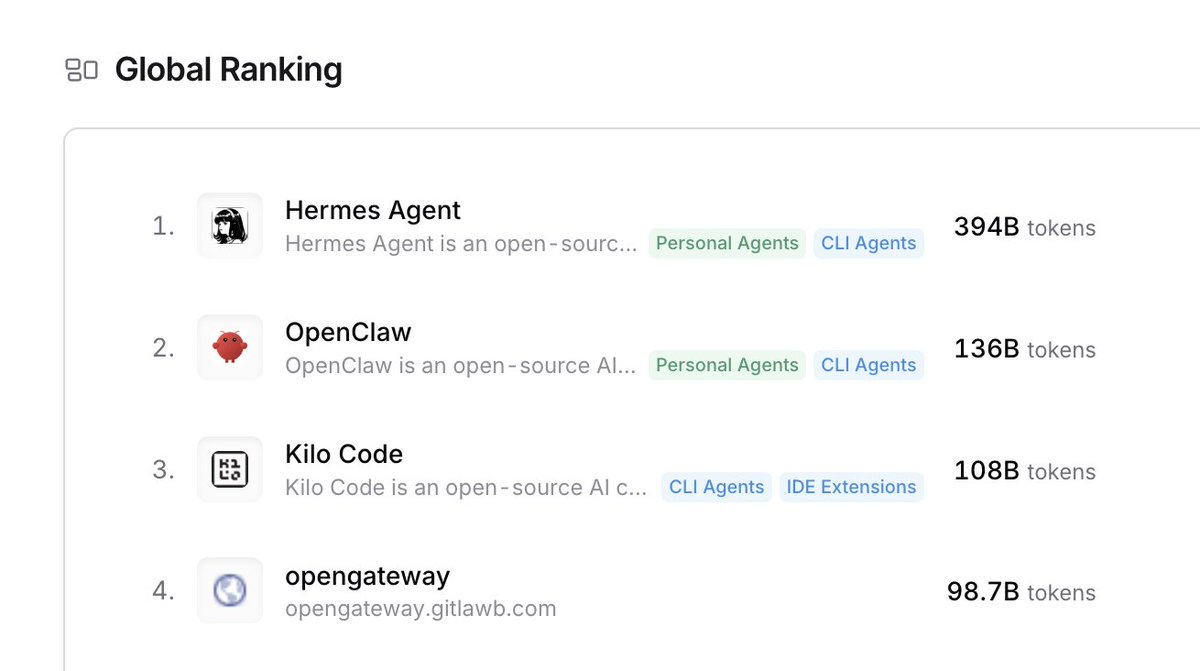
soooo @gitlawb is ranked #4 in token usage on @OpenRouter and no one is talking about this? compared to other top projects OpenClaw: No traditional company valuation (indie open-source project). Implied strategic/talent value: $100M–$500M+ (creator joined OpenAI Feb 2026; project moved to independent foundation with OpenAI support) Hermes Agent (Nous Research): ~$1B valuation (from $50M Series A at $1B token/FDV in Apr 2025; sustained #1 OpenRouter ranking keeps it in $900M–$1.5B range) Kilo Code: ~$40–70M current implied valuation (raised $8M seed in Dec 2025; strong founder pedigree + #3 OpenRouter ranking)
E tweet media
English
10
13
134
10.2K
MrStiive 🦇🔊
MrStiive 🦇🔊@MStiive·
so we're all gonna be earning yield on our stocks soon. volatility farming. lending. etc. thats BIG.
English
1
0
1
228
MrStiive 🦇🔊 retweetledi
The Kobeissi Letter
The Kobeissi Letter@KobeissiLetter·
BREAKING: The SEC is set to release its so-called "innovation exemption" for tokenized stocks which will pave the path for trading digital versions of securities, per Bloomberg. Details include: 1. In a "surprise move," the SEC is leaning toward allowing the trading of tokenized assets 2. These tokenized assets would be tradeable on decentralized crypto platforms 3. The move could "reshape the landscape of the American stock market" 4. This would also be one of the US' biggest shifts into crypto infrastructure yet Tokenized assets are rapidly expanding.
English
514
1.4K
8.6K
1.6M
MrStiive 🦇🔊
MrStiive 🦇🔊@MStiive·
@keithmarlowau @JEChalmers hurts small players the most tbh. big players are always gonna be above 30% or bust. wonder what happens with capital losses carried forward? you'd still be at 30% rate?
English
2
0
4
1.2K
Keith Marlow
Keith Marlow@keithmarlowau·
30% minimum tax rate on CGT. So if you happen to live off your investments capital increases, your lowest tax rate is now 30%? What about young people trying to grow their nest egg by investing - isn't this a slap in the face to them??? @JEChalmers
English
144
59
1.1K
48.7K
ZKsync
ZKsync@zksync·
Congratulations to @Memento_Bc for the launch of their Atlas-upgraded mainnet. Institutions are coming onchain with production-grade requirements. High throughput. Fast settlement. Privacy. Compliance. Ethereum security. Atlas was designed for this moment.
Memento@Memento_Bc

✅ A new 15k+ TPS sequencer ✅ 1-second ZK finality ✅ Minutes-to-Ethereum hard finality ✅ $0.0001 per transfer ✅ An enhanced Prividium module @zksync's Atlas doesn't upgrade Memento ZK Chain. It redefines what's possible on it 🏛️ The infrastructure is ready ⚡ $DEXTF

English
17
52
239
22.3K