
Nick Rowe
14.3K posts
Nick Rowe
@MacRoweNick
Amateur Mechanic. Professional Economist (retired). Better at fixing cars, because I can usually figure out what the designer intended.
Near Ottawa Katılım Ekim 2015
256 Takip Edilen4.7K Takipçiler

I think the answer is Yes.
Simplest model: the only goods are: apples; apple trees (an asset).
Diminishing MU of apples means harvest fluctuations reduce E(U(C)).
If I raise/cut my C more in good/bad harvests, my E(U) falls, but your C fluctuates less, so your E(U) rises.
English
Possibly stupid (shower thought) Micro question:
If I make my demand curve more elastic than is privately optimal, does that benefit others?
(I adjust more to supply shocks (both directions), so others don't need to adjust as much.)
(Thinking gas prices, of course.)
English

1. When they get to 90% of cars, the estimates I've seen are that they can 'platoon' to approximately double road capacities. But that doesn't change the fundamentals. The latent demand for transport is very large. (Jevons Effect here as well.)
2. Yes, it would be most efficient to apply it to all cars, but if reformers focus on that they will fail.
(Both of these are referenced in the article!)
English
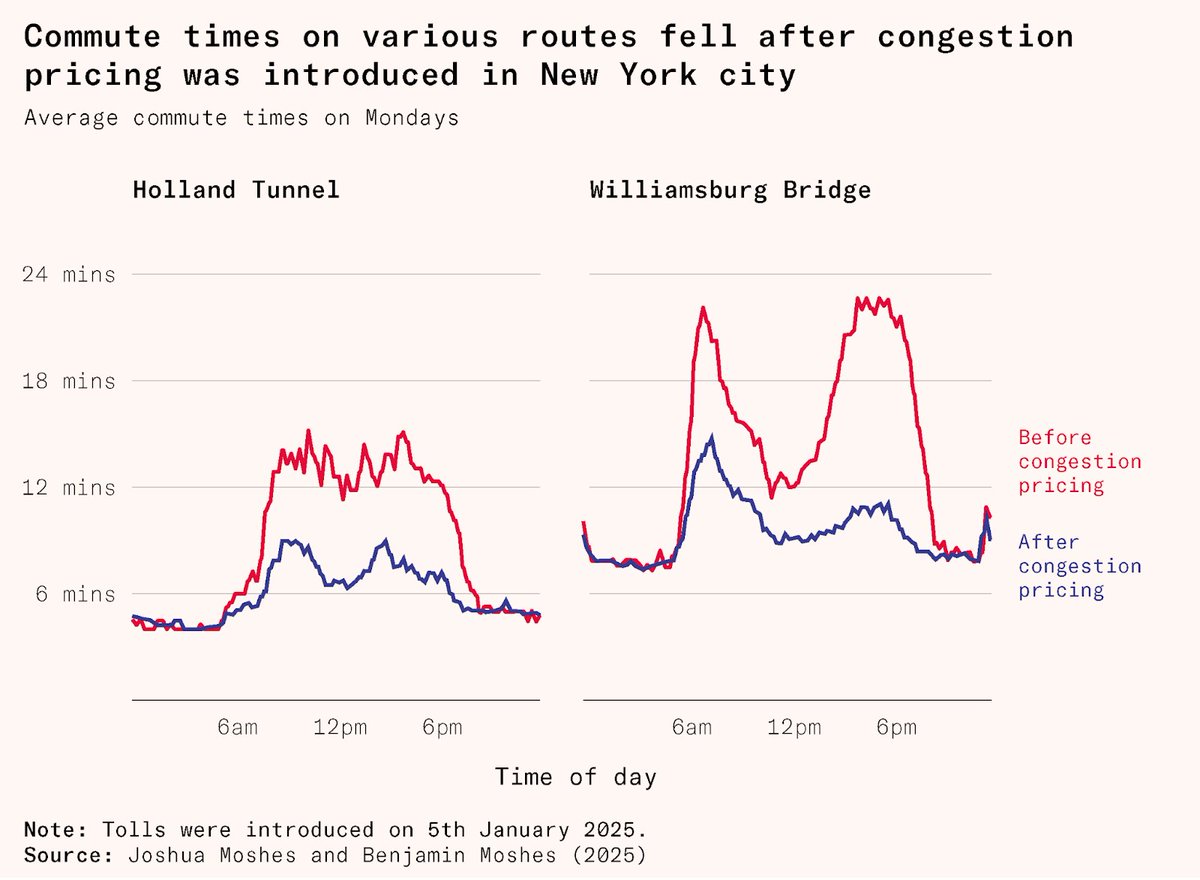
We need a tax on self-driving cars.
Beneath eight states of the American Great Plains lies the Ogallala Aquifer, one of the largest bodies of groundwater on Earth. For centuries, extraction was constrained by the modest capacities of wind and hand power. At that rate, this 'fossil water' resource was effectively limitless. Farmers could draw as much as they wanted without ever running it down.
worksinprogress.co/issue/escaping…
But in 1949 Colorado Farmer Frank Zybach invented centre-pivot irrigation. Combined with electricity and the centrifugal pump, farmers could now draw thousands of gallons per well per minute, enough to irrigate 40 acres at a time. Since then, the aquifer has gone down 10%, losing a Lake Erie's worth of water. It is down 50% in the dry parts, where it recharges just 0.02 inches per year. Without intervention, modern pumps will bring about the total end of irrigated farming in the arid parts of the Great Plains in 20-30 years.
This is what I call the Ogallala Trap. Technological change can create a new tragedy of the commons. The telegraph enabled the destruction of the passenger pigeon; sonar, radar, and diesel enabled the industrial trawling that devastated the North Sea cod in a decade; chlorofluorocarbons came close to destroying the ozone layer.
Self-driving cars are about to do the same thing to roads. When you can sleep, work, or drink with friends in a moving vehicle, you will take many more journeys by car. Roads, which are free at the point of use almost everywhere, will grind to a halt. People who have to go to the office or the hospital will be stuck sharing the road with people having beers, working remotely, and taking naps.
There is a fix, but it depends on acting now, before autonomous vehicles go mainstream. Voters balk at being charged more for something they already depend on. The tax needs to come in as soon as possible. Waymos are already in dozens of cities and do millions of journeys per month. We have very little time left. If we want to save our roads from omnigridlock, we must introduce road pricing for autonomous vehicles.
English
@AndyHarless I think it's useful to distinguish "long-run", in the sense of full price & wage adjustment, from "very long-run", in the sense of the stocks of capital goods adjusting too.
English

@MacRoweNick Maybe it just comes down to a long-run vs. short-run thing. In the long run, with full price and wage adjustments, a capital-augmenting technological change raises rates. In the short run, it raises unemployment and pushes rates down. So the yield curve should get steeper.
English
A new technology (AI/whatever) will not cause real wages to fall unless it causes a rise in land rents (natural resources) or machinery rents (capital).
(Otherwise workers/employers could/would just revert to the old technology, and increase their wages/profits.) 1/
English
@ritwik_priya Well, *almost* no one, and it was *almost* 7,000ft.
youtube.com/watch?v=ViFmRQ…

YouTube
English

The Himalayas are not the Alps sweetie. No one skiis down a 7 thousand-er.
Mikita 🇧🇾🫡@mikitaposts
You have 1.4 billion people and the Himalayas and you could only find TWO athletes??? 😭😭😭😭 are you deadass???
English
Nick Rowe retweetledi

@Noahpinion @ScottSumnerTMI @GarettJones @GlennLoury @DrSamuelGregg @MacRoweNick @C_Harwick 6. But the reality is that conventional centre-right politicians are being displaced by national populists not because they did not pay attention to economists, but because they did.
lorenzofromoz.net/p/why-we-shoul…
English

Those who see big value in nations limiting who can immigrate into them should also see big value in units like states, cities, & neighborhoods similarly limiting entry. Where legal, that should be easier to change than national policy. Suspicious if they not push for that.
English
I understand what Warren is saying here (at least, I *think* I do).
Let me give my (massively over-) simplified interpretation: 1/
Warren B. Mosler@wbmosler
@farmerrf Markets (in the context of institutional structure) sort out relative value, but not 'absolute' value in terms of a currency. That information comes exogenously, in this case prices paid by gov. when it spends provides information for market prices to then be in that numeraire.
English