Macro Stig

403 posts

Macro Stig

Macro Stig

@Macro_stig

Cusp of Global Markets, Macro and Public Policy

Katılım Haziran 2020
472 Takip Edilen108 Takipçiler
Martin Shkreli
Martin Shkreli@MartinShkreli·
semis peak cycle right about now
English
193
114
2.6K
361.4K
Macro Stig
Macro Stig@Macro_stig·
@jturek18 @Brad_Setser But KRW is also because of resident outflows no. All the domestic savings surplus is getting invested in US equities
English
1
0
0
58
Jon Turek
Jon Turek@jturek18·
@Brad_Setser Its insanity. KRW too. Looks to be a 10% current account surplus this year.
English
2
1
15
1.6K
Macro Stig
Macro Stig@Macro_stig·
A sane voice on this issue, at a time when some of the leading economists are trying to sensationalize !
Izabella Kaminska@izakaminska

A note on the increasingly frustrating dollar swap line confusion. While the ESF definitely has a shady history in which it doubles up as black ops financing arm of the US Treasury, when it comes to the UAE situation, it's simple dollar liquidity mechanics that are the issue in this case. To understand this you need to go back to your Zoltan Pozsar 101, about how shadow dollar liquidity actually flows through the system. This explains entirely what's going on at the moment. Adam Tooze would have you think otherwise and brings up the ESF's shadowy history as a source of slush funds to add intrigue to the situation. (While it's not untrue, it's besides the point). And now Brad Setser is speculating there may be "something radically new about the US providing dollar credit to a country that itself has pledged to invest in the US" and that this "looks like the US government is financing a off balance investment fund outside Congressional scrutiny, with the Emirates getting the upside ..." But I'm pretty sure that this is not the case. It's an entirely obvious and transparent situation. First of all, the original WSJ story that flagged the UAE situation talked about swap lines not ESF-funded Argentina-style swaps. These are entirely different arrangements. For one, the ESF is a Treasury-powered vehicle and usually operates via finite credit facilities. It is also usually arranged between respective sovereign Treasuries. A swap line, however, is Fed-initiated and potentially limitless. It is an arrangement between fellow central banks. Now, if you speak to central bankers in the know, they will tell you that despite the central banking framing, it's not entirely the case that the Treasury has no influence on the initiation or not of a swap line. But this doesn't change the mechanical structure, which sits outside of the Treasury system — and imposes on it only in so much as central bank profits or losses ever do. The WSJ may have got the nomenclature wrong, but I doubt it. As to why the UAE, despite having pledged to invest in the US, needs dollars? I'd argue it's because the original investment is mostly an expression of allegiance, and a signal that the UAE trusts the US to defend its property rights more so than any other superpower and is prepared to fund its military-industrial reconstitution... since the protection of its property rights also hangs in the balance. If the UAE decides to fund these investments with USTs, this mostly constitutes a transfer of that economic value from the Treasury to the private sector. There needn't be a liquidity event associated with the transfer if it's mediated, as it has been, at the US Government level and extended via a co-investment with the US into newly forged equity investments. The UAE leg, in that sense, becomes a promise to expire its outstanding claim over the US Treasury in exchange for x shareholding (49% one would presume) in the newly forged company. Think of it more like an asset swap, wherein its debt-based assets are swapped into equity assets underpinned by USG co-investments. The actual liquidity to start the venture up would likely come exclusively from the US side, with the funding essentially already raised by way of the defense industrial allocations in the BBB. In that scenario, the investments act more like a quid pro quo with an ally, to ensure the US can raise the money it needs via formal channels, without fear that its bond markets do a Liz Truss. But it's very unlikely that the UAE plans to fund these American investments entirely with UST reserve assets. Much more likely, it plans to deploy its trillion-dollar sovereign wealth fund chest, as well its future oil revenue, to meet most of the $1.4 trillion investment it has promised over 10 years. In that case, what the UAE would really be doing is merely bouncing back dollar liquidity that's already coming its way from existing USD-denominated assets straight back into American investments. The only difference is that on this occasion, it has agreed to transfer some level of influence over how those investments will be steered. This makes sense if the true purpose of the arrangement is to help reindustrialise the US, as the USG sees fit, so that it can better provide regional security and defy industrial decoupling with China. Why does it make sense for the UAE? Since some 50% of its SWF is already invested in the US, if America loses in a war with China or Iran, so does the UAE. It needs a strong and autonomous America with trusted supply chains to defend it. In some respects, this is an echo of how China funded its own industrialization. In 1979 under Deng Xiaoping’s broader “Reform and Opening-Up,” China brought in its Equity Joint Venture Law, creating the main channel through which foreign capital first entered China’s industrial economy. The main difference here is that in China's case, the co-investments were with Western private sector companies or multinationals. In America's case it is wooing capital from fellow sovereigns, with whom it can establish related defense agreements. Statecraft 101. Why dollar swap lines then? Well, if a good chunk of UAE dollar liquidity is drawn from oil sales, this is self-evidently currently under pressure. And while the UAE probably has many other sources of dollar income, it's what happens at the margin that matters. Under a peg system even a small marginal fluctuation in flows can put pressure on the system. All the more so, if foreign residents are moving money out of the UAE because of regional volatility. A country like the UAE, in such circumstances, faces the same problem as a distressed bank. It finds itself technically dollar-asset rich, but simultaneously dollar-liquidity poor. The options it has on the table in that case are either to abandon its peg temporarilly, liquidate its assets at potentially firesale prices compounding the problem (definitely suboptimal), borrow from the market, or seek the one thing it doesn't have under a pegged system: Access to a dollar lender of last resort. With the UAE likely to become a formal ally, extending lender of last resort facilities to help it manage local dollar liquidity issues, seems the obvious way to go for the US. In a sense it becomes the first official member of what Robert McCauley sees as the emergence of a new dollar swap-line diplomacy club. [Which could, in my mind, be the makings of a new type of IMF system.] For a country that already operates under a soft form of dollarization, it's not too great a leap. References below:

English
0
0
0
50
Max Rockatansky
Max Rockatansky@Cycle_Watcher·
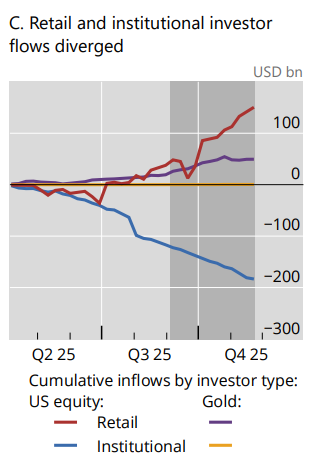
Both Citadel and JPM noting a change in the behavior of Retail over the past month... "Today’s relief rally brings confirmation that the shift in retail behavior that we have observed over the past month is persisting: retail moved from ‘buying the dip’ (e.g. this time last year), to now skipping the dips, selling into rallies, and positioning more defensively, report. Overall, retail activity remained extremely subdued this week, driven by net selling in single stocks and weak ETF purchases. Even more so today, despite oil posting its largest decline since 2020 and VIX breaking below 20, intraday retail flows showed no signs of strengthening." (JPM) "The most notable change has been a decisive rotation into puts. Over the past two weeks, total retail put activity has surged to the 99th percentile relative to all other 10-day trading periods since the start of 2020. Call activity has simultaneously fallen into the 70th percentile (in just the 13th percentile versus the past 1 year). This divergence culminated in a rare inflection point on April 2nd, when more puts than calls were traded by retail at Citadel Securities – only the sixth such occurrence in the history of our platform." (Citadel)
English
49
131
1K
551.5K
Macro Stig
Macro Stig@Macro_stig·
@dandolfa Classic economic speak but surprised at the assertive tone. If you say - ‘contributes to higher deficits’, I would imagine the answer is yes.
English
0
0
0
108
Macro Stig
Macro Stig@Macro_stig·
@LucyyKT How many times have people asked world ranked #4 to retire ?
English
0
0
0
59
DR. LUMAR
DR. LUMAR@LucyyKT·
For the life of me, I’ll never understand why he didn’t just retire after the Olympics.
English
195
110
16.3K
2.7M
Samir Arora
Samir Arora@Iamsamirarora·
You can be better on every statistic and still lose- such is life.
Samir Arora tweet media
English
297
229
2.2K
235.2K
High Yield Harry
High Yield Harry@HighyieldHarry·
Can someone explain to me why Bitcoin is going down, but Gold is going up, like I’m a young child, or a golden retriever.
English
2.5K
160
8.5K
1.8M
Alex Prompter
Alex Prompter@alex_prompter·
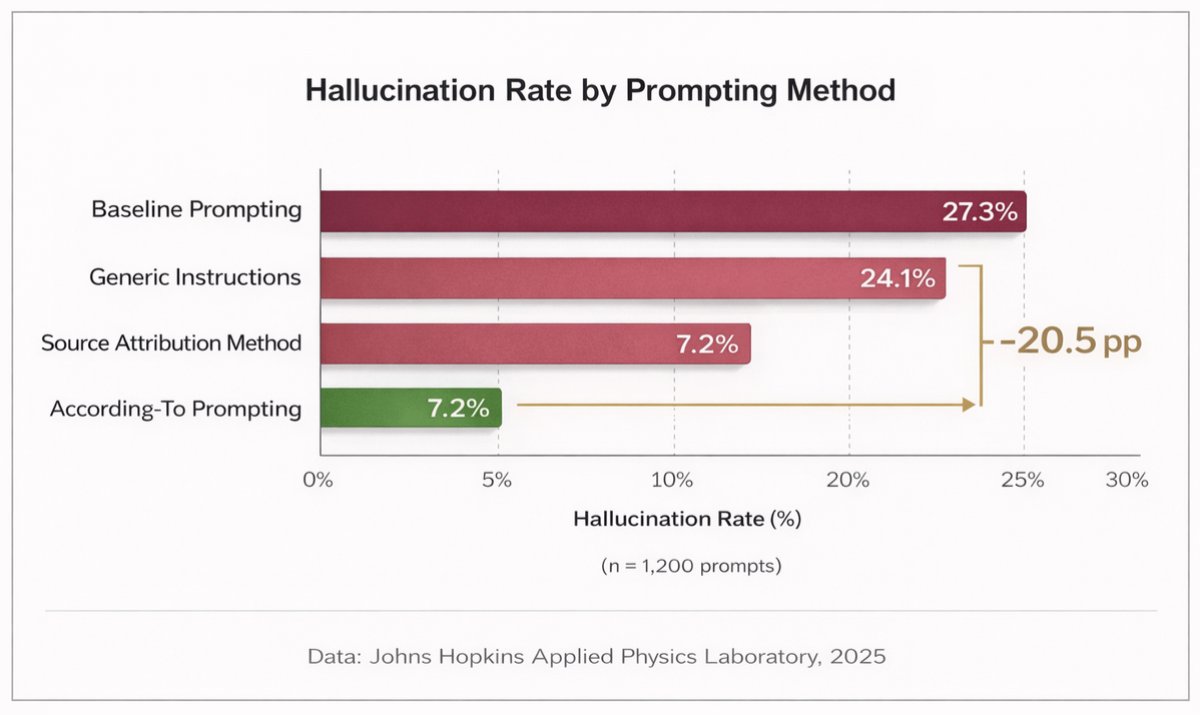
🚨 ChatGPT lies to you 27% of the time and you have no idea. A lawyer just lost his career trusting AI-generated legal citations that were completely fake. But Johns Hopkins researchers discovered something wild. Adding 2 words to your prompts drops hallucinations by 20%. Here's the technique that forces ChatGPT to tell the truth:
Alex Prompter tweet media
English
164
340
2.8K
868.2K
Macro Stig
Macro Stig@Macro_stig·
@mark_dow For what it’s worth / at the margin, US fiscal deficits have surprised vs expectations and that’s what investors care about. Bessent talking about less than 6% of GDP, at a time when EU is exploding. So one would expect a decline vs where we were year beginning no ? @jasonfurman
English
0
0
0
499
Dow
Dow@mark_dow·
One economist to the other: “OK, fine, so it doesn’t work in practice. But does it work in theory?” In a collateral based global financing system, Treasuries are the ultimate financial currency. People have been alleging a relationship between Treasury yield levels and deficits for 40 years despite there being little to no evidence of it in the data.
Jason Furman@jasonfurman

If you're not surprised & puzzled about Treasuries being <4% then you're either a seer, incurious or have better things to wonder about. Large deficits (albeit smaller than expected), capital demand, Fed independence risk, persistent inflation, uncertainty, all go the other way.

English
18
38
202
61.8K
Macro Stig
Macro Stig@Macro_stig·
I have seen this chart floating around showing that tech capex is responsible for 30-40% of the GDP growth. Is it possible to point me to the source calculations or report pls ?
Macro Stig tweet media
English
0
0
0
19
Macro Stig
Macro Stig@Macro_stig·
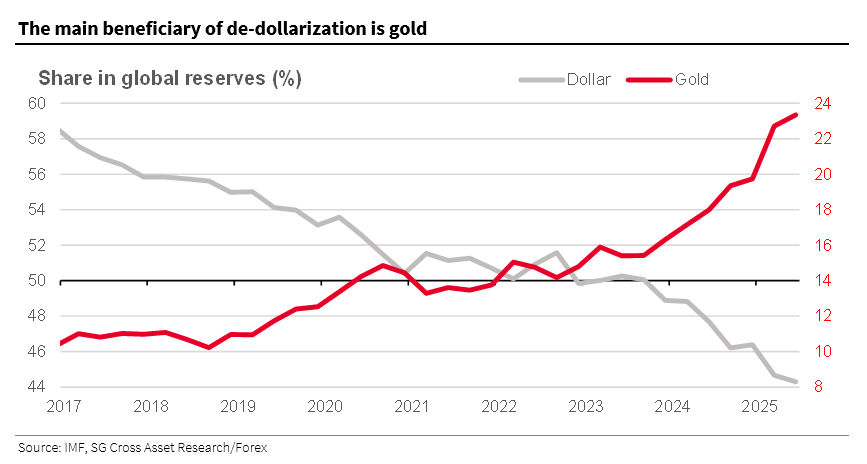
@zerohedge How are they getting USD share at 45% ? Isn’t that at 57-58% ?
English
0
0
0
190
zerohedge
zerohedge@zerohedge·
all you need to know
zerohedge tweet media
English
57
363
1.6K
218.7K
Macro Stig
Macro Stig@Macro_stig·
Difference vs Ackman, Sachs and the likes: they have been sort of consistent in their defense of Trump or conservative policies. @chamath was very much in Jason’s camp during early days of All-in and super critical of Trump and conservative agenda. And now just want to be the next Sachs in Sachs’ absence.
English
1
0
15
6.3K
Joseph Carlson
Joseph Carlson@joecarlsonshow·
A day ago Chamath defended the harsh tariffs on China. Now that a huge portion of them are removed he will defend them being removed and explain how this was a great strategic move. If they were doubled, instead of removed, he would explain doubling them is the best move. Do you see the pattern here?
English
544
576
9.8K
527.3K
Macro Stig
Macro Stig@Macro_stig·
@realKunalAShah “We” ? :) are we also taking ownership of all the wrong men at the right places ? :)
English
0
0
0
185
Kunal Shah 🗽
Kunal Shah 🗽@realKunalAShah·
I repeat - Scott Bessent is the most important person in the world at this moment. We put the right man in the right place at the right time
English
11
5
67
13.5K
Macro Stig
Macro Stig@Macro_stig·
@elerianm Most neoliberal commentators loved Milei’s chainsaw strategy: which lead to worst near term economic sentiment with no change in President’s popularity. I wish long term thought leaders provide the same leeway to other leaders.
English
0
0
1
444
Mohamed A. El-Erian
Mohamed A. El-Erian@elerianm·
A previously improbable scenario has materialized: In a reversal of the typical positive correlation, the recent worsening in US economic sentiment has coincided with the President's increasing popularity.
English
105
73
475
70.7K
Macro Stig
Macro Stig@Macro_stig·
To be fair though / multiples look extra compressed because earnings cut come with a delay, as analysts don’t do it in run time. Every sell-off or melt-up is driven by valuations unless earnings revisions start coming through Wait 1-2 months, earnings will downgrade by 10-15%, that will mathematically boost valuations by that much.
English
0
0
0
191
Bill Gurley
Bill Gurley@bgurley·
@chamath I think the quote was “multiple compression is a bitch.” And it may have been someone else. 🤣 still works here.
English
9
1
346
27.2K
Macro Stig
Macro Stig@Macro_stig·
Kalecki Levy to the win :) both things are true. Short term pain due to the public sector retrenchment will be offset by the private sector. Corporate profits to gdp are at historical highs - which will moderate - but economy will not be in a free fall. Plus this combination is ideally better.
English
0
0
3
457
Dario Perkins
Dario Perkins@darioperkins·
Bessent says the US economy is "brittle" after years of fiscal deficits. I'd argue the exact opposite - deficits kept the private sector is surplus, which has made private balance sheets stronger...
English
41
47
304
33.6K