Maina King'ori

3K posts

Maina King'ori banner
Maina King'ori

Maina King'ori

@Mainakingori

Nairobi, Kenya Katılım Nisan 2011
294 Takip Edilen499 Takipçiler
Maina King'ori retweetledi
Unfiltered
Unfiltered@quotesdaily100·
TIME IS NOT TREATED THE SAME EVERYWHERE: 1. Germany: Being late is disrespectful. Meetings start to the second. Punctuality here is not a habit. It is a moral standard. 2. Brazil: An invitation for seven means nine. Relationships matter more than schedules. Rigidity kills the atmosphere. 3. Japan: Trains run to the minute. A sixty second delay comes with a formal public apology. Time is a system. The system is everything. 4. India: Events begin when people arrive. The gathering defines the time. Presence matters more than precision. 5. Polynesian cultures: Time was tied to stars, seasons, and the ocean. Circular, not linear. The clock came later and from somewhere else. 6. United States: Time is money. Literally. Every hour is billable. Every minute is scheduled. Rest has to earn its place. 7. Spain: Lunch at three. Dinner at ten. The day bends around the person. Not the other way around. 8. Ethiopia: A different calendar entirely. Thirteen months. New Year in September. A different year than the rest of the world. Time here is a cultural choice, not a global agreement. 9. France: August belongs to rest. Emails go unanswered. Shops close. Nobody apologizes for this. Leisure is a right, not a reward. 10. Kenya: The clock starts at sunrise. Six in the morning is hour zero. Noon is hour six. Time is built around light, not an arbitrary number on a wall. 11. China: One time zone for the entire country. A landmass that should span five. In the far west the sun rises at ten in the morning. Unity was chosen over accuracy. 12.Australia: Aboriginal communities have always read time through seasons, animal movements, and the stars above. For over sixty thousand years the land itself served as the calendar. No clock was ever needed. Nature told them everything. 13. Mexico: Mañana means not right now. Urgency is often self-imposed. The present moment has its own demands and they are considered legitimate. 14. Greece: A guest arrives at any hour. You welcome them fully. The clock adjusts to the person. The person never adjusts to the clock. 15. Scandinavia: Months of darkness then months of endless light. The body follows seasons, not schedules. This is ancient. Science is only now catching up. 16. Nigeria: Start times are a suggestion. What matters is that everyone arrives, connects, and the evening becomes what it was meant to be. The experience always outranks the schedule. 17. Indonesia: Jam karet. Rubber time. Time stretches around mood, traffic, and social obligation. Rigidity is considered uncomfortable, not professional. 18. Russia: Eleven time zones. Vast winters. Long silences. Time here is treated with patience that outsiders often mistake for slowness. 19. Egypt: One of the first civilizations to invent a calendar. Yet modern Egyptian social time is deeply flexible. Hospitality always comes before the clock. 20. Congo: Community shapes the day more than any schedule. Time belongs to the people in the room, not the hands on the clock. 21. Philippines: Filipino time is a known and accepted reality. Six in the evening means seven or eight. Arriving before the host is ready is the real social mistake. 22. Vietnam: Built on endurance and long horizons. Planning here thinks in years and generations. Short deadlines feel foreign to a culture that measured time in struggles spanning decades. 23. Tanzania: Pole pole. Slowly slowly. A phrase that governs daily life. Rushing is not a virtue here. Moving with intention is. 24. Argentina: Dinner at ten. Parties at midnight. The night is its own world. Compressing it into earlier hours would make it something lesser. 25. Turkey: A meeting can become a meal can become a long evening. Nobody considers this a deviation. It is simply what time is for. 26. Iran: Its own solar calendar. New Year on the spring equinox. Time tied to nature, poetry, and a civilization so old that modern urgency feels like a passing trend.
English
71
1.1K
5K
703.1K
Maina King'ori
Maina King'ori@Mainakingori·
@JesterSirr Was in Habaswein, Wajir county. Picked up bunch of supplies at local shop. Time to pay I realised had forgotten wallet. Lady at the counter told me its okay, come and pay when you get the wallet. Never forgotten that experience.
English
2
1
22
1.5K
SirJester
SirJester@JesterSirr·
Riding to the next village(15kms) to buy some goats when a stranger young lady stopped me & handed me 3ltrs of milk to deliver to another stranger in the village. No questions asked. Ladies and Gentlemen, welcome to Mashinani life.
SirJester tweet media
English
57
445
3K
67.5K
Maina King'ori
Maina King'ori@Mainakingori·
@javahouseafrica May he rest in peace; thanks to your patronage over the years, you introduced his genius to us 🙏🏾
English
0
0
3
440
Java House ☕
Java House ☕@javahouseafrica·
We are saddened by the passing of Patrick Mukabi, whose art brought Nairobi’s stories and spirit into our spaces at Java House. His legacy lives on in every brushstroke. Rest well, Patrick Mukabi. Our heartfelt condolences to his family, friends, and the creative community.
Java House ☕ tweet mediaJava House ☕ tweet mediaJava House ☕ tweet mediaJava House ☕ tweet media
English
16
429
1.1K
25.7K
Maina King'ori retweetledi
I. Cox
I. Cox@IanECox·
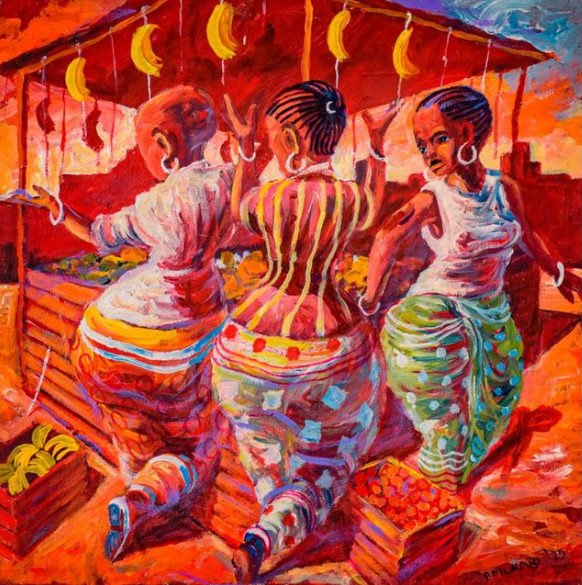
Patrick Mukabi (1969-2026) 🇰🇪🎨 Few Kenyan institutions captured the cheerful bustle of middle-class aspiration quite like Java House. Its walls, adorned with the robust, kanga-clad women of Patrick Mukabi, offered a visual anthem to everyday resilience: market traders with baskets balanced on heads, mothers whose ample forms suggested both abundance and endurance. Mukabi, who died this month after a long battle with diabetes that culminated in amputation and intensive care, painted a Kenya that was neither idealised nor pitied but simply observed.. with warmth, volume, and unapologetic colour. Born in Nairobi in 1969, the fourth of seven children, Mukabi (known affectionately as “Panye”) began drawing young, inspired by Catholic imagery and encouraged by a father who worked for Kenya Railways. After a certificate in graphic design at what is now the Technical University of Kenya, he returned to his first love: painting, mostly in acrylic on canvas. His focus was the human figure, above all women engaged in the ordinary commerce of life.. hawking, carrying, conversing. Layers remained visible; the process was transparent, much like the man. His style was instantly recognisable: voluptuous forms rendered with directness and dignity, sunlight suggested rather than depicted, movement captured without fuss. Critics sometimes called it accessible; in truth, it was democratic. Art, for Mukabi, belonged not in rarefied galleries but on the walls of cafés where ordinary Kenyans met over coffee. Java House commissioned him extensively; his work also graced airports and private collections. He exhibited in more than 20 countries, yet never lost the habit of teaching. At Dust Depo, his studio beside the old Railway Museum.. practically on the tracks of his family’s history.. he ran an open-door academy. Aspiring artists, local and foreign, found space, advice, and often materials. Children’s classes on Saturday mornings (some televised as “Uncle Supuu” on Citizen TV) introduced a generation to brushes and bold hues. Many of Kenya’s younger painters passed through his mentorship; he was, as one curator put it, the closest thing the scene had to a godfather. Generosity came naturally, sometimes to his financial detriment. He gave works away cheaply or for free, undervaluing his own output in a market that rarely rewarded seniority. Mukabi’s own life had railway rhythms: travel, teaching, exhibition. He spoke of Michelangelo as a mentor across centuries and painted from live models in later series such as “Cover Girls,” celebrating fuller-figured women who would never grace magazine covers but possessed their own majestic presence. Barefoot in the studio, he claimed he could not think with shoes on.. a small eccentricity that fitted the man who taught toddlers to slather paint “like jam on bread.” In recent years illness confined him to Kenyatta National Hospital. Fellow artists organised benefit exhibitions, “Mali Safi” among them, to cover mounting bills. The shows celebrated his legacy while quietly underscoring a familiar Kenyan story: a towering talent who gave more than he received. Patrick Mukabi leaves behind a visual vocabulary that has become part of Nairobi’s everyday scenery. His women endure.. self-assured, labouring, luminous.. on café walls where new generations sip coffee and, perhaps, notice the art for the first time. In a country still learning to value its own makers, he painted abundance where others saw only survival. Kenya’s art world is poorer for his passing; its walls, richer for his brush.
I. Cox tweet mediaI. Cox tweet media
Mbugua Ng'ang'a@MbuguaNganga

I mourn the passing of Patrick Mukabi, the artist behind the iconic paintings in all Java House wall paintings. As a newbie journalist, my bery first assignment was to cover the story of how Mukabi memorialised the 1998 bombing of the US embassy in Nairobi. I have followed his work over the years and my best series from his collection was Market Women. Mukabi did a lot of work teaching youngsters to paint. But above all, he immortalised many aspects of Nairobi social life. He is a national treasure. The city of Nairobi owes him a great of gratitude. We need a City Arts Council to recognise such artists Wangui Maina and Dennis Onsarigo.

English
8
222
534
21.2K
Maina King'ori retweetledi
Sony Thăng
Sony Thăng@nxt888·
The hardest thing to explain to someone inside the imperial consensus is the concept of structural violence. They understand individual violence. One person harms another person. There is a perpetrator and a victim and a clear causal chain. What they cannot see, what the entire educational and media apparatus has been carefully designed to prevent them from seeing, is the violence that happens when a system is arranged so that certain people predictably die, predictably suffer, predictably lose, not because any individual decided to harm them specifically but because the overall arrangement of power requires their subordination. The people of the Global South do not die of poverty because individual Americans wish them dead. They die because the international economic architecture, the terms of trade, the debt structures, the conditions attached to IMF loans, the intellectual property regimes that prevent technology transfer, the agricultural subsidies that undercut developing world farmers, is arranged, in aggregate, in a way that concentrates wealth in already wealthy countries and extracts it from already poor ones. And that architecture was designed. It was negotiated. It was implemented by specific people in specific rooms making specific decisions about who would benefit and who would not. This is violence. It does not look like violence because no one is pulling a trigger. But the deaths it produces are just as dead. And when you try to explain this to someone whose entire identity rests on the belief that what they have they earned, and what others lack they failed to achieve, you are not making a political argument. You are dismantling the story that makes their life make sense. They will not thank you for it. They will defend against it with everything they have. Because the alternative, accepting that their comfort is downstream of other people's dispossession, is not a policy position. It is an identity catastrophe.
English
85
1.9K
4.1K
74.8K
Maina King'ori retweetledi
António Guterres
António Guterres@antonioguterres·
The absence of permanent African seats on the Security Council is indefensible. The Security Council must reflect today’s world. This is 2026 — not 1946. Whenever decisions about Africa and the world are on the table, Africa must be at the table.
English
1.3K
3.9K
12.9K
544.8K
The Kenyan Vigilante
The Kenyan Vigilante@KenyanSays·
Bikers crossing Suguta Valley came face to face with gun-wielding locals wanting a ride on their superbikes. Often called the “Valley of Death,” Suguta is a volatile region in northern Kenya, notorious for banditry and cattle rustling. (Courtesy Time Master)
English
32
222
1K
96.9K
Maina King'ori retweetledi
Engineer Faisal
Engineer Faisal@PyeparFaisal·
The Indian police came up with this campaign to curb excessive honking in Mumbai 😂
English
908
11.7K
48.1K
1.4M
Maina King'ori retweetledi
Middle East Eye
Middle East Eye@MiddleEastEye·
“I wonder why the representative of a country with the blood of innocent Sudanese on its hands is allowed to address this esteemed council.” Sudan envoy Al-Harith Idriss criticised the UAE’s participation at a UN Security Council on Thursday, calling out its support for the RSF.
English
40
1.1K
2.4K
61.2K
Maina King'ori retweetledi
Middle East Eye
Middle East Eye@MiddleEastEye·
In Sudan's city of El-Fasher, over 2,000 people were killed in just two days as the UAE-backed Rapid Support Forces stormed the city, executing civilians and destroying entire neighbourhoods. A quarter of a million people - half of them children - are trapped under siege with no food or medicine.This video investigates how Sudan’s war has escalated into mass killing, why the RSF is targeting Black and Indigenous communities, and why the world chose to till look away as as atrocities unfolded in Darfur.
English
20
390
497
24.6K
Maina King'ori retweetledi
Rep. Ilhan Omar
Rep. Ilhan Omar@Ilhan·
Sudan is facing the world’s worst humanitarian crisis and a genocide. Tens of thousands dead. 12 million displaced. The images of the RSF seizing El Fasher are horrific. The UAE and other arms dealers to the RSF and RSF-aligned militias must be held accountable.
English
3.1K
18.4K
58.4K
2.5M
#FellowKenyan.
#FellowKenyan.@Martinlilac·
@AfricaFirsts @summarizest Mwenye alileta the first explorers to mt kenya was a kamba called Kivoi. To the kamba Kirinyaga is pronounced as Kíínyaa... Mzungu akaskia Kenya. 😂
Filipino
1
0
6
270
Africa First
Africa First@AfricaFirsts·
How Kenya 🇰🇪 got its name. Kenya originates from "Mt. Kĩrĩnyaga," meaning "Mountain of Whiteness" in Kikuyu, referencing the snow-capped peak of Mt Kenya. British coIonists mispronounced it as "Kenya," which became the country's name.
Africa First tweet mediaAfrica First tweet media
English
7
33
132
9.4K
Maina King'ori
Maina King'ori@Mainakingori·
Thanks @BBCAfrica for the platform to talk about the current situation with #humanitarianaid. Also amazing panel. #humanitarian #emergencies @careusa
CARE ESA Region@CAREECSARegion

As the effects of #aid cuts continue to deepen, @Mainakingori , @care's Roving Humanitarian Dir. spoke on @bbcswahili on which sectors are affected first, as well as how #women & #children are impacted. 🎙️The entire interview: bbc.com/swahili/bbc_sw… #TBT cc @CAREGlobal

English
0
0
0
59
Yoko
Yoko@Kibet_bull·
Cash is the Answer Ministry (CITAM)
Yoko tweet media
English
164
3.4K
10.6K
347.8K