As a Christian, how would you defend your belief that Jesus Christ is God based on the Bible? Let’s see your explanation, point out the Scriptures and clearly show how they reveal that Jesus is God.
And labeling disagreement as “antichrist cults” doesn’t strengthen the argument—it avoids engaging with the actual textual and historical discussion.
Ur claim still skips over the core issue: are those titles being used in an absolute, literal sense, or within the broader biblical language where such terms can be applied in different ways?
So when Bible itself uses elevated titles in non-absolute ways why dont you believe them to be God as well.
Judges are called “gods” in Psalm 82:6.
Moses is told he will be “as God” to Pharaoh in Exodus 7:1.
Kings are given divine authority language without being literally God.
So when you point to phrases like “Lord,” “Savior,” or even exalted authority, the question isn’t whether the words exist, it’s how they are being used in context.
Also, if the doctrine were truly “very clear,” you wouldn’t need later theological systems to define it. Yet historically, it took centuries of debate and councils to formalize concepts like the Trinity, which shows that the text itself was not uniformly understood as explicit.
The real question remains: where does Jesus explicitly and unambiguously say, “I am God, worship me as God”? That level of clarity simply isn’t present.
@Maliksdef@Ihunanya_chi I do not see any other way you can interpret statements calling Jesus God, Creator and Giver of Life, Eternal King, Beginning and End, etc. These are very clear. Only antichrist cults seek to distort the clear meaning of the text, but all attempts fail nonetheless.
@Maliksdef@khayri05@Ihunanya_chi You clearly have not read the book. Because this principle is blatantly shown. You are trying to act like it was pulled out of thin air.
That claim rests on ignoring what Islamic sources actually say and how religious history works.
First, in Islam the Kaaba is not attributed to Prophet Muhammad ﷺ at all. The Qur’an explicitly links it to Abraham and Ishmael:
Qur’an 2:127: “And when Abraham and Ishmael were raising the foundations of the House…”
This is the primary textual evidence Muslims rely on. It directly states that both Abraham (Ibrahim) and his son Ishmael (Ismail) were involved in establishing the Kaaba.
Second, the Kaaba already existed as a pilgrimage site long before Islam, but it had been corrupted into a polytheistic shrine. What Prophet Muhammad ﷺ did was restore it to monotheism, not “steal” or invent it. Even pre-Islamic Arabs associated the Kaaba with Abraham—Islam didn’t introduce that idea; it corrected the practice around it.
Third, from a historical perspective, absence of external (non-Islamic) documentation about Ishmael building the Kaaba doesn’t invalidate the Islamic claim. Much of ancient Near Eastern religious history relies on scriptural and transmitted tradition, not modern archaeological standards. The same applies to many Biblical narratives.
So the accurate framing is:
Islam claims Abraham and Ishmael built or rebuilt the Kaaba (Qur’an-based evidence). The Kaaba later became a pagan site. Prophet Muhammad ﷺ reformed it back to monotheistic worship.
Calling it “stolen” is more rhetoric than analysis—it assumes the conclusion without engaging with the actual sources.
Can any Muslim provide an evidence that Ishmael built the Kaaba?
Apparently, Muhammad stole a shrine and converted it into a pilgrimage center.
That’s quite fascinating for a religion claiming monotheism.
It only “makes no sense” if you assume those verses can only be read one way. They’ve been debated for centuries precisely because the language allows more than one theological interpretation.
On your first point: Gospel of John 1:1 says “the Word was God,” but it also says “the Word was with God.” That distinction matters. If the Word is with God, there is a relational distinction; if the Word is God, then you’re dealing with interpretive theology (like the Trinity) rather than a simple, literal identity statement.
Even among scholars, the Greek phrasing (“theos”) has been discussed in terms of quality or nature, not necessarily absolute identity. So the verse isn’t as unambiguous as you’re presenting it.
On your second point: Epistle to the Hebrews 1:8–9 still includes the phrase “therefore God, your God, has set you above your companions.” That introduces a clear hierarchy , someone being addressed as “God” who still has a God over him.
In biblical language, titles like “god” can be used in a representative or exalted sense (for kings, judges, or agents of God), without meaning they are the one ultimate God.
And more broadly, even within the Bible, you have statements attributed to Jesus like “the Father is greater than I” (John 14:28), which again points to distinction and subordination rather than absolute equality.
So the issue isn’t denying your interpretation, it’s that these passages are not as one-dimensional as you’re claiming.
Different readings exist, and Islam adopts one that preserves a strict, indivisible concept of God rather than a multi-personal one.
@Maliksdef@Ihunanya_chi Your 1st point makes no sense. John 1:1 clearly states that the Word was God and through Him all things were created.
Your 2nd point makes no sense. God refers to Jesus as God and says His Kingship is forever, ascribes worship to Him and calls Him the Creator.
That framing isn’t really fair—it assumes disagreement automatically equals disrespect.
No Muslim is required to accept Christian theology, just as Christians don’t accept Islamic beliefs about God or prophethood.
Disagreement cuts both ways. From an Islamic perspective, Jesus Christ (ʿĪsā) is deeply honored as a prophet and Messiah, but not considered God. That isn’t an “attack”; it’s a different theological conclusion based on the Qur'an.
At the same time, Muslims discussing Christianity often reference the Bible because that’s the shared ground where claims about Jesus are made. Engaging with those texts isn’t “teaching you your religion,” it’s participating in a theological discussion—exactly the same way Christians critique Islam using Islamic sources.If the standard is “don’t speak on beliefs you disagree with,” then meaningful dialogue between religions wouldn’t exist at all.
The more consistent position is this: You’re entitled to believe “Christ is King.”
Muslims are equally entitled to reject the divinity of Jesus.
Respect doesn’t require agreement, it requires allowing the other side to hold and articulate their beliefs without labeling it as offensive simply because it contradicts yours.
I honestly have no idea how Muslims can get so defensive while attacking our religion ✝️
You say you respect us Christians, but want to argue and teach us about our God?
Lie to us and say he was just a Prophet?
Jesus Christ was and is God. Not an Islamic Prophet.
If you want your religion to be tolerated so bad, then maybe have the decency to not try to think you know better than us, about our own God?
It's disgusting and disrespectful.
Either admit, you do not agree with Christianity. Or respect our views that Jesus Christ is not an Islamic prophet.
You can't have it both ways.
Christ is King ✝️☦️
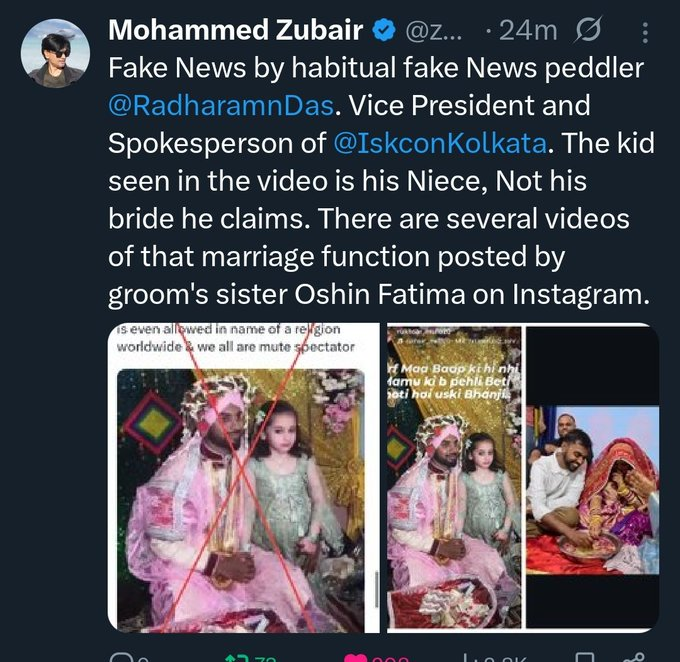
You have to stoop very low level to take a sweet uncle-niece video and turn it into propaganda against Muslims, falsely calling a little girl pregnant and portraying them as husband and wife.
The issue isn’t about ignoring context, it’s about defining what “God” actually means before assigning divinity to anyone.
If God is truly God, then by definition He is not bound by time, sequence, or physical limitation. Bringing God “into time” eating, sleeping, being born, and dying — creates a logical contradiction.
So before even debating verses, we need consistency in that definition.
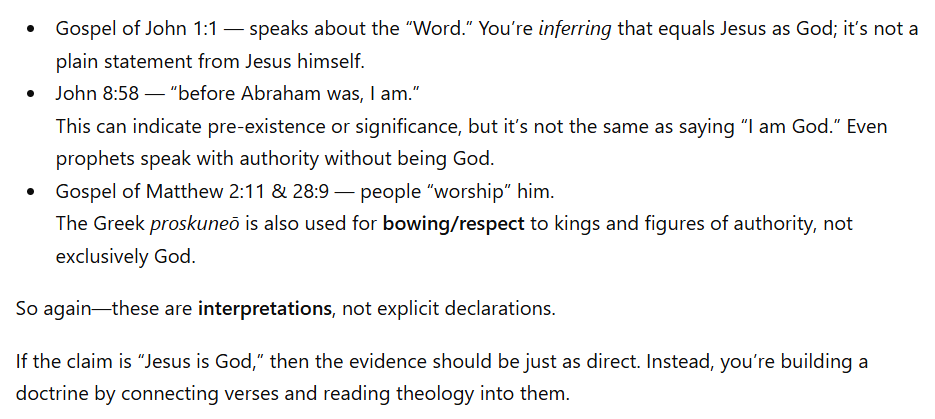
Now regarding “before Abraham, I am” (from Gospel of John 8:58), existing before Abraham does not automatically make someone God.
According to the Qur'an, human souls existed before earthly life:
“Am I not your Lord?” — they said, “Yes, we testify.” (7:172)
This establishes pre-existence of souls without implying divinity. So pre-existence alone isn’t exclusive to God.
As for Thomas saying “My Lord and my God” (John 20:28), that can be understood as an exclamation of realization or reverence. Even in biblical language, the term “god” has been used for others in a representative or delegated sense (e.g., judges or prophets), not necessarily meaning literal, absolute divinity.
Regarding Epistle to the Hebrews 1:8–9, the passage itself distinguishes between “God” and “your God,” which indicates hierarchy, not equality. If the Son has a God over him, then by definition he is not the ultimate God.
So the core point is this:
Pre-existence, titles, or exalted language do not override the fundamental definition of God as absolutely independent, eternal, and beyond all limitations. Any interpretation that compromises that definition needs to be re-examined.
Understood, so we should take ancient text writings more literally, without reading the context, or the reactions of the people around them. We should ignore the relevance of this. I feel like this argument you are trying to make is very dangerous.
Jesus claimed that BEFORE Abraham, someone that lived hundreds if not thousands of years before Him, HE was. When He was on trial, He was condemned to death for blasphemy, "I AM", claiming the name of GOD as His own. For claiming equality with God in heaven.
We can look at even Jesus appearing to Thomas in John 28-29, where it says, "28 Thomas said to him, “My Lord and my God!” 29 Then Jesus told him, “Because you have seen me, you have believed; blessed are those who have not seen and yet have believed.”
In Hebrew 1:8-9 God claims that His Son will be God. It Says, "8 But about the Son he says, “Your throne, O God, will last for ever and ever; a scepter of justice will be the scepter of your kingdom. 9 You have loved righteousness and hated wickedness; therefore God, your God, has set you above your companions by anointing you with the oil of joy."
You’re right on one methodological point:
Ancient texts must be read in context. But context also requires linguistic precision and consistency, not selective linking of similar phrases.
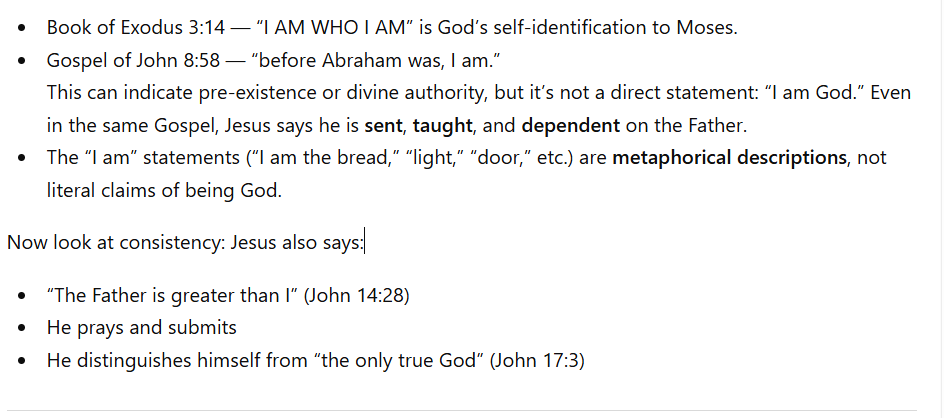
1) “I AM” in Exodus is a name revelation to God
Book of Exodus 3:14 gives:
“I AM WHO I AM” as God’s self-revelation to Moses
In Hebrew context, this is tied to YHWH, the covenant name of God. No disagreement there.
2) John 8:58 — interpretation issue, not identity statement
Gospel of John 8:58 says:
“Before Abraham was, I am.”
But note carefully:
It is not “I am God”
It is not a formal identification formula
It is a temporal contrast statement (pre-existence emphasis)
So the question is not whether it echoes Exodus language, but whether it functionally equals a direct claim of divinity and that’s where interpretation diverges.
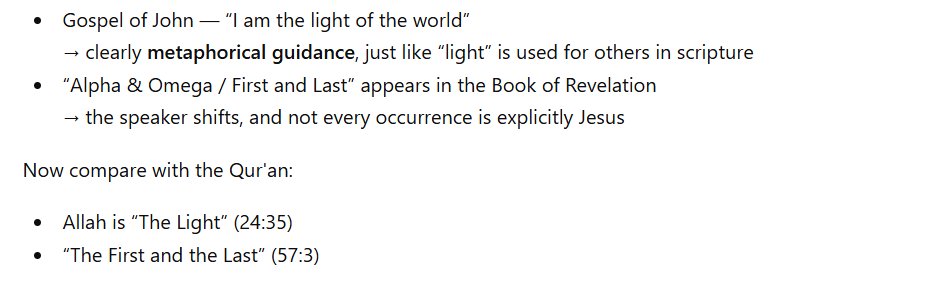
3) “7 I AM statements” argument
In John, statements like:
“I am the bread of life”
“I am the light of the world” are metaphorical predicates, not identity declarations of being YHWH.
They describe role, function, or symbolism, not ontological identity.
4) Context cuts both ways
If we’re using historical-context reading, then we also must include:
Jesus consistently:
Prays to God
Distinguishes himself from God (“Father is greater than I” – John 14:28)
Defines God separately (“the only true God” – John 17:3)
That context also matters, and it points to distinction, not identity fusion.
You’re not demonstrating “clear statements of divinity” you’re demonstrating theological interpretation of language that can be read multiple ways.
That’s why:
Trinitarian reading exists
Non-Trinitarian Christian readings exist
And Islamic readings differ entirely
The disagreement is not about whether the text is meaningful, it’s about whether the meaning you’re assigning is the only valid one.
Light isn't the part we are talking about though. In this context. It is the words. In the biblical texts. Gods name is I AM. Exodus 3:13-14
" Moses said to God, “Suppose I go to the Israelites and say to them, ‘The God of your fathers has sent me to you,’ and they ask me, ‘What is his name?’ Then what shall I tell them?”
God said to Moses, “I AM WHO I AM. This is what you are to say to the Israelites: ‘I AM has sent me to you.’”
Leading to John 8:48-59.
Your claim is there is no clear verse where Jesus Claims to be God. And i just told you at least 7.
When we read ancient texts we need to read it in the context if the time and what those people believed.
@embooso_@TristinAnglin@Ihunanya_chi As for Muhammad (saw)
He is never called The First and the Last
Never described as eternal
Never given divine status
Clear line: Creator vs creation
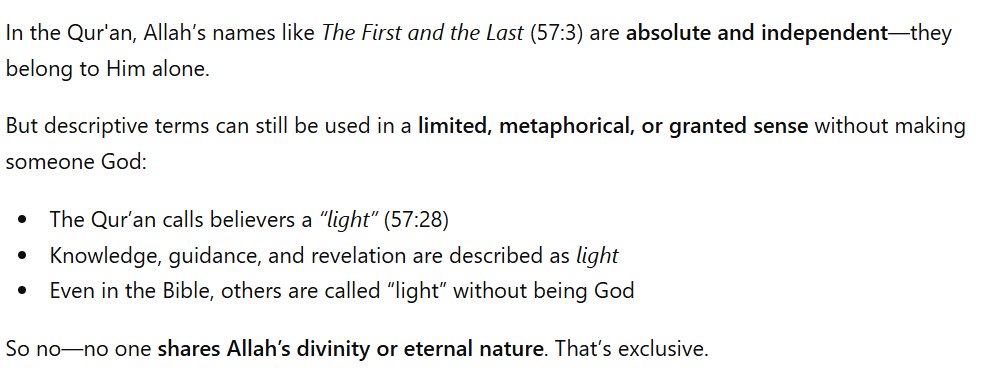
@embooso_@TristinAnglin@Ihunanya_chi Using a term like “light” in a descriptive sense doesn’t make someone God.
What matters is nature and status—and those are never shared with anyone besides God.
You’re assuming that using a title or description automatically means sharing God’s essence—that’s the mistake.
@embooso_@TristinAnglin@Ihunanya_chi You’re building identity from titles, while ignoring clear distinctions in the text. Titles can be shared—God’s nature cannot be
@TristinAnglin@Ihunanya_chi Luke 3:21–22
u see three distinct
Jesus being baptized
The Spirit descending
God speaking from heaven
That shows distinction,not clear statement that all 3 r one God.
Trinity is a later theological framework used to reconcile these passages it’s not explicitly spelled out there
@indigobaraka@Ihunanya_chi That’s a theological conclusion, not a direct statement from the text.
Saying “that’s his human nature” doesn’t resolve it—it just separates actions without clear textual grounding from Jesus himself.
@whoisbuddyjeff@Ihunanya_chi Calling it an “exact word fallacy” doesn’t solve the issue, you still need clear, unambiguous evidence, not layered interpretations.
@indigobaraka@Ihunanya_chi He prays to God
He says the Father is greater than him
So who is he directing worship to?
You’re trying to make Jesus into God, while the text shows him submitting to God, not being God.
@indigobaraka@Ihunanya_chi How simple is that, really?
It’s u, a mere human, making assumptions. If someone is God, that dn’t come from interpretation—it comes from clear declaration.
God does declare who He is.
Meanwhile, Jesus consistently points away from himself:
He tells people to worship God