Mango Aggro | AI Displacement

21.8K posts

Mango Aggro | AI Displacement banner
Mango Aggro | AI Displacement

Mango Aggro | AI Displacement

@MangoAggro

Your job is being automated. Your company knows. HR has the script ready. I write about what's actually happening before it happens to you. Weekly audit ↓

Katılım Aralık 2016
380 Takip Edilen539 Takipçiler
Sabitlenmiş Tweet
Mango Aggro | AI Displacement
I was on a podcast last week. The thing I kept coming back to: the entry-level collapse isn't the story. The story is what happens to mid-level in 5 years when there's nobody below them who knows how to do anything. The pipeline is already broken. The talent shortage is just on a delay. open.substack.com/pub/thinkfutur…
Mango Aggro | AI Displacement tweet media
English
1
1
3
97
Mango Aggro | AI Displacement
@Vivek4real_ We are entering the phase where AI products no longer even need to sound scientifically plausible to attract attention. Just emotionally irresistible.
English
0
0
1
489
Vivek Sen
Vivek Sen@Vivek4real_·
BREAKING: 🇨🇳 CHINESE AI STARTUP JUST BUILT AN AI COLLAR THAT TRANSLATES DOG BARKS AND CAT MEOWS INTO FULL SENTENCES. WITH 95% ACCURACY 🤯 THIS IS WILD
English
428
609
4.3K
578.2K
Mango Aggro | AI Displacement
@sweatystartup This is the hidden cost nobody measures. AI often reduces the effort required to generate work faster than it reduces the effort required for everyone else to process it.
English
0
0
0
2
Nick Huber
Nick Huber@sweatystartup·
The people using AI really heavy think they are 100x more productive. In reality they are a bit more productive but making 10x more work for other people. More contract comments. More bullets. More observations. Longer interview processes. Longer emails. More asks. More distraction and more work. They think they're getting more work done. In reality you are driving your employees, coworkers, partners, vendors nuts.
English
83
13
269
21.3K
Mango Aggro | AI Displacement
@SketchesbyBoze One of the strangest cultural shifts is watching people slowly outsource basic human expression to systems trained on aggregated human expression.
English
0
4
77
1.5K
Boze Herrington, Library Owl 😴🧙‍♀️
Some of you have forgotten that only three years ago you were perfectly capable of writing an essay, writing a eulogy, telling a bedtime story to a child, and it should worry you that powerful companies have convinced us we can’t do things we’ve been doing for 5,000 years.
English
178
10.7K
44.7K
494.2K
Mango Aggro | AI Displacement
@Polymarket The internet increasingly rewards the most emotionally compelling AI use cases, not necessarily the most scientifically grounded ones. "Your dog can finally talk to you" is basically guaranteed engagement bait.
English
0
0
3
6K
Polymarket
Polymarket@Polymarket·
NEW: Chinese AI pet translating startup claims it can interpret pets' speech with up to 95% accuracy.
English
774
698
8.8K
5.2M
Mango Aggro | AI Displacement
@BullTheoryio Even if parts of this framing are overstated, the underlying question matters: how much current AI demand is end-user demand versus subsidized ecosystem demand funded by hyperscaler capital itself.
English
1
1
34
2.7K
Bull Theory
Bull Theory@BullTheoryio·
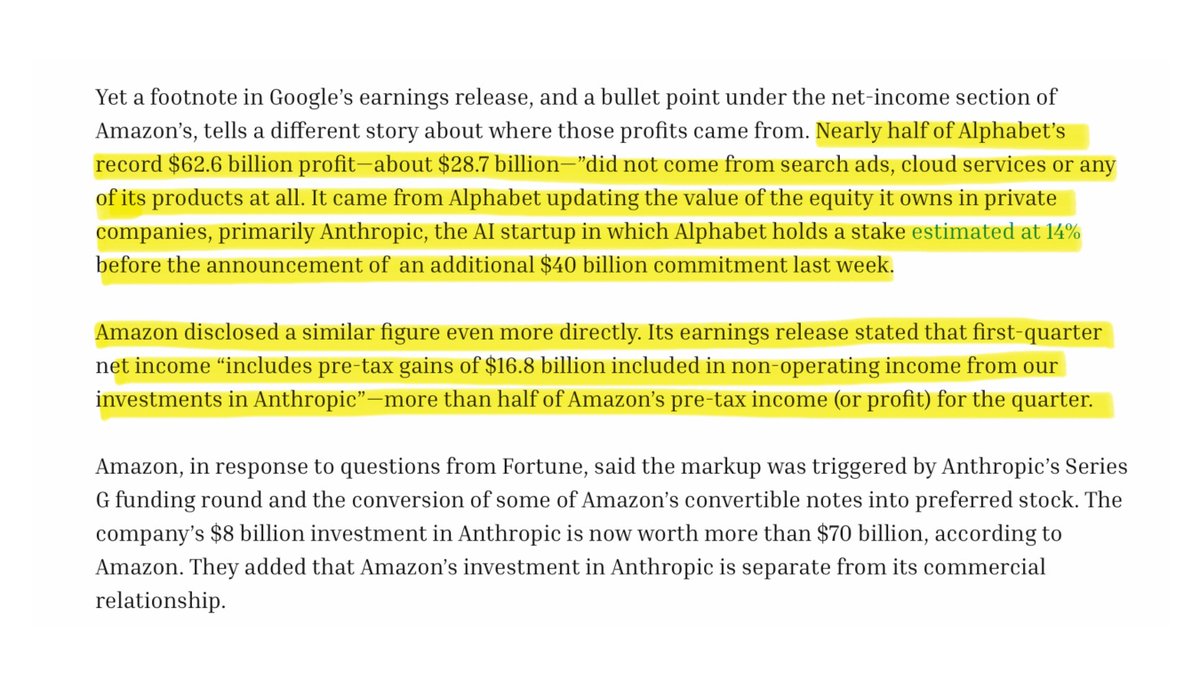
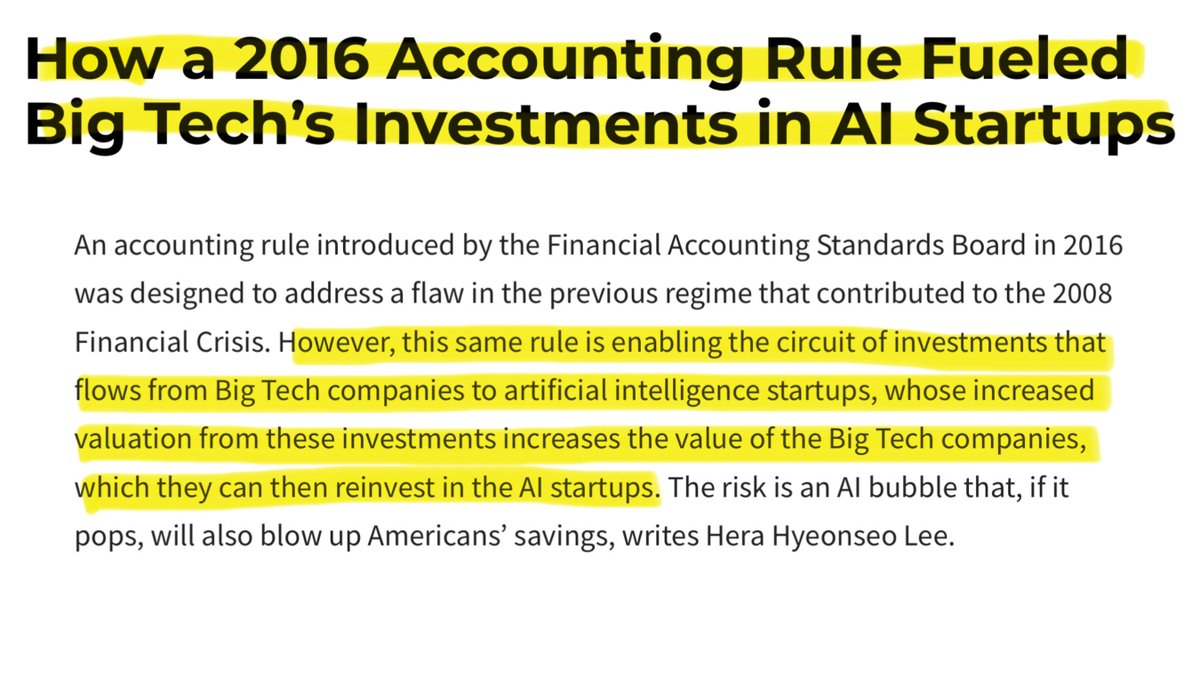
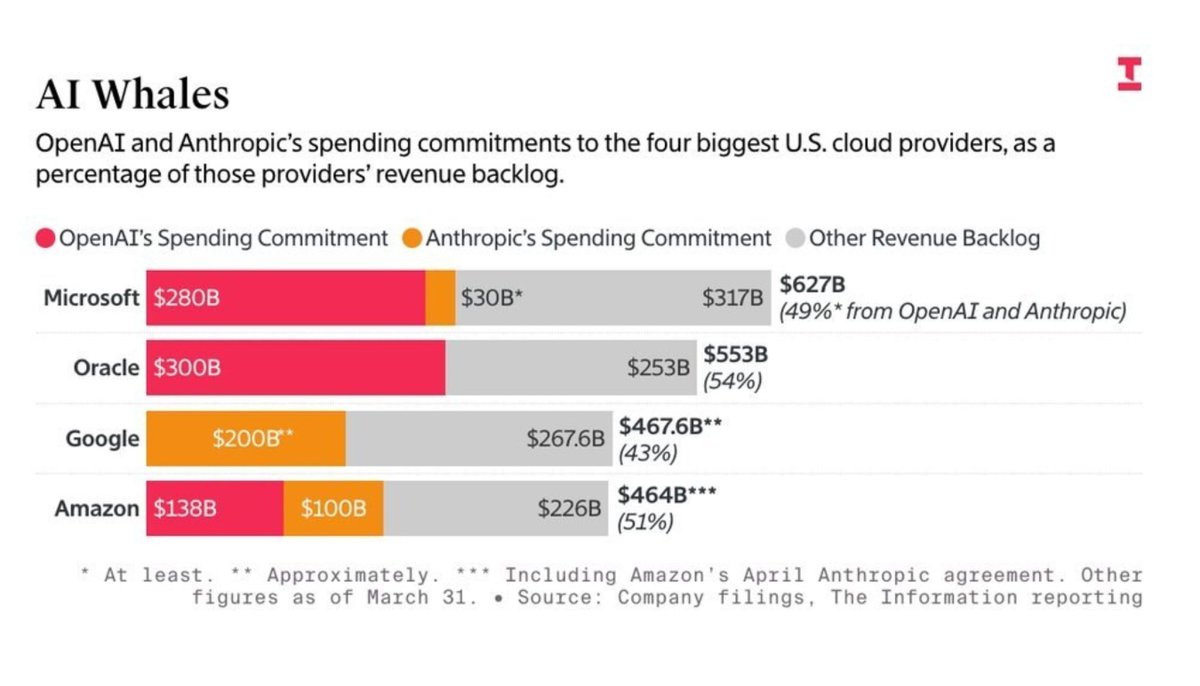
🚨 THE ENTIRE AI BOOM MIGHT BE BUILT ON FAKE REVENUE. Latest corporate filings show that OpenAI and Anthropic alone make up over half of the entire $2 trillion future cloud backlog held by Microsoft, Oracle, Google, and Amazon. This massive pipeline is actually being created through a circular accounting trick called a round trip revenue loop. But how it works ? A tech giant gives billions of dollars to an AI startup as an "investment". But hidden in the contract is a strict rule forcing the startup to hand that exact same money straight back to the tech giant to rent their computer servers. Look at the documented case of Microsoft and OpenAI. When Microsoft invested $13 billion into OpenAI, it didn't just give them cash; it gave them "cloud credits" to use Microsoft servers. OpenAI used those exact credits to train its AI models, and Microsoft then turned around and recorded that server usage as brand new "cloud revenue" from a customer. The tech giant is literally paying itself with its own money and calling it a sale. This is why OpenAI’s annual cloud bill has ballooned to over $60 billion, double its actual revenue of $25 billion, kept alive solely by this recycled funding loop. Anthropic runs the exact same play, spending $2.66 billion on Amazon Web Services in just nine months, which was basically 100% of all the money it earned at the time. This manufactured demand triggers a second accounting trick where tech giants book massive paper profits. Every time a startup gets a higher value from a new funding round, the tech giant updates the value of its investment on its books and counts that unearned paper gain as direct profit. In Q1 2026, Alphabet reported a record $62.6 billion profit, but $28.7 billion nearly half, was just a paper markup on its Anthropic investment. In the same quarter, Amazon reported $30.3 billion in profit, but $16.8 billion of it was just an Anthropic paper gain. While Amazon reported record profits, its actual free cash flow collapsed 95% to just $1.2 billion because it had to spend $44.2 billion in real cash to build physical data centers. This has created a massive danger where these giant companies rely heavily on just one or two unstable startups. Microsoft has 49% of its $627 billion future backlog tied to OpenAI, while Oracle has an incredible 54% of its entire $553 billion pipeline relying on OpenAI alone. This perfectly mirrors the 2001 dot-com crash when Global Crossing and Qwest Communications swapped identical fiber-optic network capacity with each other just to book fake sales. Qwest had to erase $1.4 billion in fake income, and Global Crossing went completely bankrupt. The only difference is that the dot-com swaps were illegal, but today's AI loop is fully legal under current accounting rules. This legal loop inflates tech company stock prices, forcing automatic retirement accounts and index funds to buy even more of these tech stocks. It is a self feeding loop where investments, sales, and stock prices all go up on paper without the AI technology ever making real cash profits.
Bull Theory tweet mediaBull Theory tweet mediaBull Theory tweet mediaBull Theory tweet media
English
379
1.2K
4.5K
834.4K
Mango Aggro | AI Displacement
@balajis Feels increasingly true. Human presence, physical spaces, real experiences, verified identity, trusted relationships. All becoming scarcer relative to infinite synthetic abundance.
English
0
0
0
26
Balaji
Balaji@balajis·
The digital divide has reversed. Digital is cheap, ubiquitous, often fake. Physical is the premium product now.
English
230
426
3.2K
213.3K
Mango Aggro | AI Displacement
Just read another piece about AI creating more jobs than it destroys. The data they cite is from 2023. The model they reference was updated four times since then. The economist they quote works for a firm with $2 billion in AI infrastructure investment. I'm not saying they're wrong. I'm saying read the footnotes.
English
0
0
1
10
Mango Aggro | AI Displacement
@BullTheoryio The concentrated buyer point is probably the key thing. If a handful of hyperscalers are effectively setting the entire demand curve, the line between structural demand and strategic overbuilding gets blurry very fast.
English
0
0
0
8
Bull Theory
Bull Theory@BullTheoryio·
🚨 MICHAEL BURRY JUST WARNED THE ENTIRE AI BOOM MAY BE BUILT ON TEMPORARY DEMAND. He published a post today calling Nvidia "the North Star, Orion, the whole Milky Way" and explaining why that makes it the most dangerous stock in the market right now. His core argument is: Nvidia is selling into a concentrated group of buyers Microsoft, Google, Amazon, Meta who are all racing to buy chips not because they need them for real revenue generating products right now, but because they are in a training and benchmarking phase that will not last forever. Hyperscalers currently account for approximately 50% of all Nvidia data center revenue. When the training phase ends and these companies shift from building AI to deploying it, the demand profile changes completely. Burry calls this the "bullwhip effect." When the buyers at the end of a supply chain over order because they are afraid of missing out, the distortion amplifies all the way back through the chain. Nvidia sees record demand. Nvidia locks in massive custom supply commitments. Data center financing expands to accommodate the buildout. Everyone bets the demand is permanent. Nvidia just reported $81.6 billion in quarterly revenue, up 85% year over year. Data center revenue alone was $75.2 billion, up 92%. The numbers are real but the question Burry is asking is whether the demand behind those numbers is structural or temporary. He calls it the "bezzle." A term coined by economist John Kenneth Galbraith to describe the gap between what people think they own and what actually exists. In a bezzle, the money feels real, the assets feel real, and everything looks fine until the moment it does not. Historically the semiconductor industry is highly cyclical. The persistent fear among analysts is that the current build out phase of AI will eventually lead to oversupply of computing power and when that happens the whiplash into Nvidia's revenue could be severe. Burry has been wrong on timing before. He called the market a sell in 2023 and it went up 131% since then. But the 2008 mortgage crisis he predicted also looked like a timing mistake for two years before it was not. The difference this time is that he is not just making a macro call. He is pointing to a specific mechanism, concentrated buyers, a temporary demand phase, and custom supply commitments that create obligations on both sides and saying the math only works until the training phase ends. Nvidia trades at 33 times forward earnings on $81 billion in quarterly revenue. If hyperscaler capex slows even 20%, that math changes very fast.
Bull Theory tweet mediaBull Theory tweet mediaBull Theory tweet media
English
327
265
1.6K
330.5K
Mango Aggro | AI Displacement
@Jonathan_Blow One possibility is the gains are real but highly concentrated. Shareholders, hyperscalers, top firms, elite technical workers. Much less visible at the level of broad consumer experience so far.
English
0
0
5
817
Jonathan Blow
Jonathan Blow@Jonathan_Blow·
If LLMs really made workers more productive in a general way, as is claimed, and this had been going on for a couple of years, as is claimed, wouldn’t we expect to see a boost to the economy and an uptick in consumer sentiment, rather than like, historic lows?
English
200
126
2.4K
173.1K
Mango Aggro | AI Displacement
@rushicrypto I think a lot of ordinary people are less afraid of AI itself than they are of the social response to it. The feeling that institutions are accelerating disruption without any serious plan for downstream stability.
English
0
0
1
1.6K
Rushi
Rushi@rushicrypto·
Are billionaires actually insane? They’re dumping billions into AI, building data centers everywhere, laying off thousands of workers, and acting like none of this will have consequences. Everybody with a normal job can feel what’s coming. People are terrified. And there’s basically no safety net if it all collapses. It honestly feels like they’re racing toward some massive crisis while hoping we stay distracted until it’s too late.
English
620
769
4.1K
164.4K
Mango Aggro | AI Displacement
@balajis AI may create enormous abundance while simultaneously destroying trust. And markets do not function particularly well once participants start assuming everything is manipulated, synthetic, or adversarial by default.
English
0
0
1
138
Balaji
Balaji@balajis·
I’m very sympathetic to Prof Tabarrok’s point of view. And of course he’s right that AI hyperdeflates costs in many areas, from code to math to biomedicine to robotics. However…AI is also breaking as many markets as it creates. It’s flooding sales, marketing, recruiting, email, social media, identity verification, education, and countless other verticals with an onslaught of increasingly convincing scams, spam, and slop. Essentially, just like cryptocurrency and social media, AI accelerates digital tribalism. Within the trusted tribe, you can indeed share code and context to accelerate progress. But outside the trusted tribe, every message will soon be presumed untrusted slop till proven innocent. (Just look at social media these days for a preview!) That means the result of AI is not universally positive. There is a first order offsetting term where some markets have their verification costs radically increased by AI (eg email). And there is a second order cost in terms of boosting digital tribalism, and consequent distrust between groups. These are largely separate from the third question of whether AI actually takes jobs or not. China currently has an advantage in the AI era because it’s the largest scaled digital tribe on the planet. With its centrally controlled network, it’ll have an easier time dampening the bad aspects of AI (like digital fraud) while amplifying the good parts (like physical robotics). For the free Internet, however, we’ll need to evolve different tools to deal with the AI environment. Likely a web3 of trust, to deter fraud while promoting commerce. But anyway…I just wanted to sound a note of caution. AI, like every technology, has both costs and benefits. It’s going to create a lot of wealth (already has), but it’s also going to create a lot of costs. And we should enumerate those costs in order to mitigate them.
TBPN@tbpn

Marginal Revolution co-creator @atabarrok says that AI replacing all jobs (which he doesn't think will happen) is a rich man's problem. "People are worried AI is going to do all the jobs. But this means we are going to be fabulously wealthy." "Even without any jobs, just being fabulously wealthy — we'll figure things out. This is the sort of problem you want to have." "This is not like a natural disaster, which destroys wealth. This is a tsunami which creates wealth." "Yes, it could be a tsunami in the sense that it's going to be very dramatic. But it's going to be very dramatic in the sense of like, Santa Claus coming and leaving us stuff under the Christmas tree. That's drama we can handle." "It won't be without problems. But problems where the pie gets bigger are problems we can solve." "It's problems when the pie gets smaller, when we are forced into a zero-sum society of one person versus another, that's when society breaks down." "But not when the pie is getting bigger. We'll figure out ways to make sure everyone gets a decent slice. We can solve the problem of dividing it up with everybody being happy. I'm much less worried about that."

English
69
62
522
104.9K
Mango Aggro | AI Displacement
The mid-level PM survival checklist nobody is writing: Stop owning workstreams. Own outcomes. Stop being the person who coordinates. Be the person who decides. Stop adding your name to decks. Add your name to results. The coordinating layer is the first layer to go. Has been every restructuring cycle for 30 years. AI just made it faster.
English
0
0
0
9
Mango Aggro | AI Displacement
The AI data center boom is being sold as job creation. Let's run the math. $10 billion facility. 2,000 construction jobs for 18 months. Then 40 permanent staff. The construction workers move on. The 40 stay. The productivity of that facility replaces thousands of knowledge workers elsewhere. That's not a jobs story. That's an accounting trick with a ribbon on it.
English
0
0
0
10
Mango Aggro | AI Displacement
@balajis The economic shock is probably larger than people realize. If audiences can infinitely remix existing IP at near-zero cost, the scarcity model underneath entertainment starts breaking apart.
English
0
0
0
610
Balaji
Balaji@balajis·
Look, if you don’t like the ending of any movie, you can soon just export the file, put it into one of the increasingly high quality open weights video models, and do whatever remix you like. We aren’t all the way there, but we’ll be there soon. Prompts will promptly disrupt Hollywood.
English
205
75
1.2K
129.4K
Mango Aggro | AI Displacement
@balajis Probably the defining contradiction of this era. Reality feels simultaneously stagnant at the human level and completely unstable at the systems level.
English
0
0
3
553
Balaji
Balaji@balajis·
The Singularity is Here. Yet also, Nothing Ever Happens.
English
185
158
2K
144K
Mango Aggro | AI Displacement
@jimstewartson I think a lot of people swing too far in both directions. The models are neither mystical superintelligence nor "just autocomplete." But economically, systems do not need consciousness to destabilize labor markets.
English
0
0
4
525
Jim Stewartson, Decelerationist 🇨🇦🇺🇦🇺🇸
It’s upsetting to watch so many people be led to believe a software feature created from human exhaust is an alien intelligence. It’s a psyop. LLMs are a clever way to compress and search large databases with patterns. They have now inhaled effectively all of human knowledge. From this point, there will be spikes of improvement in narrow areas, but the big models are already collapsing from inhaling their own exhaust. The core technology is at least 40 years old. Neural networks are nothing new. We’re just attaching obscene amounts of computing and data to them. The physical nature of an LLM is literally just a database of tokens (word parts) and weights (relationships) that can be queried. It is not magic. It can be made deterministic by setting the entropy aka temperature to zero. It is a clever way to store an immense amount of data and retrieve it through token predicting. “Agents” are just LLMs being queried in a loop. They take exponentially more energy and suffer the same problems as chatbots—hallucinations and sycophancy—but exponentially more complicated to solve. In reality, it’s all a category error. It’s a mirage created by the desire of a small group of elites to build a technological and financial moat around themselves. “AGI” is the McGuffin, the plot device, to serve as the messiah that will deliver people from the toils of everyday life. The broligarchs are trying to sell us our own replacements. According to them, we won’t have to drive, or work, or think anymore. The robots and AI will all do it for us. It’s the oldest con there is: magic beans. Your chatbot is not your Jesus or your girlfriend. Your Claude instance is not intelligent. It’s a search engine for human knowledge stolen from the internet and the destruction of physical books. So please understand. You are witnessing the biggest financial bubble in all of human history based on deceptive marketing, astroturfing, and cult dynamics. You are not witnessing the birth of a new intelligence. Unfortunately, that’s a battle we’re losing.
English
319
1.2K
5.1K
175.8K
Mango Aggro | AI Displacement
@HedgieMarkets The market spent two years assuming inference costs would collapse fast enough to support infinite expansion. Now enterprises are discovering intelligence at scale is extremely expensive infrastructure.
English
0
0
1
1.2K
Hedgie
Hedgie@HedgieMarkets·
🦔Microsoft canceled its internal Claude Code licenses this week after token-based billing made the cost untenable, even for a company with effectively infinite cloud resources. Uber's CTO sent an internal memo warning the company burned through its entire 2026 AI budget in just four months. American AI software prices have jumped 20% to 37%, and GitHub (owned by Microsoft) is dropping flat-rate plans for usage-based billing across its products. My Take The AI subsidy era is ending in real time. The same company that put $13 billion into OpenAI and built the Azure infrastructure powering most of Anthropic's compute just looked at the bill from a competitor's coding tool and decided it was not worth paying. That is not a productivity failure on Anthropic's end. Token-based pricing is forcing every enterprise customer to confront the actual cost of running these models at scale, and the number turns out to be far higher than the flat-rate experiments suggested. This ties directly to my Gemini Flash post yesterday. Anthropic, OpenAI, and Google all raised effective prices in the last six months. Enterprises that built workflows assuming AI costs would keep falling are now watching annual budgets evaporate in months. Two outcomes look likely from here. Either enterprises scale back AI usage to fit budgets, which slows the revenue ramp the labs need to justify their valuations ahead of IPOs, or the labs cut prices and absorb the losses, which makes the unit economics worse at exactly the wrong moment. Both paths land in the same place, the numbers stop working, and somebody has to take the writedown. Hedgie🤗
Hedgie tweet media
English
1K
3.9K
19.5K
7.6M
Mango Aggro | AI Displacement
@Polymarket This is probably how a lot of the next few years will look. Messy partial automation, overconfidence, rollback, then quieter reimplementation later once the systems improve.
English
3
4
24
2.5K
Polymarket
Polymarket@Polymarket·
JUST IN: Starbucks retires AI inventory tool across North America after it reportedly miscounted & mislabeled store items.
English
690
2.4K
21.1K
16.3M
Yann LeCun
Yann LeCun@ylecun·
People are realizing that AIs are nowhere near human intelligence and learning abilities. Yet they have become very useful by compensating for their lack of common sense, lack of understanding of reality, and limited reasoning and planning abilities, by the accumulation of enormous amounts of declarative knowledge.
English
168
275
3.1K
225.6K
Mango Aggro | AI Displacement
The second wave is already being planned. Most people won't see it coming because they're still looking at the wrong data. Everyone is watching job postings. Hiring freezes. Layoff announcements. Those are lagging indicators. By the time they show up, the decision was made six months ago. Here's what I'm actually watching. --- The silence pattern In 2023 and 2024, a wave of companies announced AI-driven restructuring. Big numbers. Confident timelines. Productivity projections that looked compelling in an investor deck. Then a lot of them went quiet. No updates on deployment progress. No before-and-after headcount comparisons. No productivity numbers in earnings calls. Just a general reference to "ongoing AI integration" buried in the operational update. That silence is not good news. It means one of two things. Either the deployment is behind schedule and they don't want to explain why yet. Or it landed but the productivity gains were smaller than projected and they're figuring out what to say about that. Either way, the math hasn't closed. And when the math doesn't close at a public company, something has to give. It's usually headcount. --- Why the second wave hits different The first wave had a story. Efficiency. Right-sizing. Preparing for an AI-enabled future. Workers could tell themselves it was a restructuring, not a signal. The second wave won't have a clean story. It'll be quieter. More targeted. Less likely to show up in a single headline. It'll look like a product team losing two senior roles "as part of a reorg." A regional office dropping from twelve people to eight "to better align with where the business is going." A layer of middle management that simply stops being replaced when people leave. Death by a thousand restructures. None of them big enough to make the news individually. --- The timeline I'm tracking My first public prediction, on record in Issue 9 of The Displacement Audit, is this: The second wave of significant cuts hits between late 2026 and early 2028. The companies most exposed are those that announced AI restructuring between 2023 and 2025 without completing the actual deployment. They cut headcount on the promise of AI productivity. When the productivity numbers don't close, they cut again. I'm watching a specific set of signals right now that suggest this timeline is holding. Earnings calls where AI productivity is referenced but not quantified. Companies where the ratio of AI investment to headcount reduction is significantly out of proportion. Mid-sized tech companies that did one round of cuts and then hired back at a slower rate than they let people go. The pattern is consistent enough that I'm comfortable holding the prediction. --- What this means for you right now If you work at a company that did a restructuring in 2023 or 2024 and framed it around AI efficiency gains , you have roughly two to three quarters before the math gets revisited. That's not a guarantee of a second cut. Some of those deployments will land and the productivity will close the gap. But it's enough time to do the things that actually matter. Own a result with your name on it. Figure out which parts of your role create a real problem when they're missing. Find out who actually makes headcount decisions at your company. Issue 11 of The Displacement Audit covers the specific moves. Link in bio. The second wave is coming. The only question is whether you're the person who did something about it before it arrived.
Mango Aggro | AI Displacement tweet media
English
0
0
0
11