Mansa Musa
2.3K posts

Mansa Musa
@MansaMusa103
VR / Augmented Reality & overall TECH enthusiast. Crypto /Trading/P2E/NFT/Gaming.
All over the Universe Katılım Aralık 2015
746 Takip Edilen380 Takipçiler
Mansa Musa retweetledi

🚨IF YOU'RE UNDER 30, DO NOT BUY A HOUSE RIGHT NOW. HERE'S WHY
Step 1: The US started a WAR with Iran. Trump says it could last 5 WEEKS - but warns it could drag on far longer.
Step 2: Iran CLOSED the Strait of Hormuz. 20% of the world's oil is now BLOCKED.
Step 3: Oil is surging past $90/barrel. Heading to $120+. Maybe $150.
Step 4: When oil goes up, EVERYTHING goes up. Gas. Food. Shipping. Construction materials. EVERYTHING.
Step 5: Inflation is COMING BACK. Bank of England rate cut odds already collapsed from 80% to 29% in ONE WEEK.
Step 6: If inflation returns, central banks CAN'T cut rates. They might even RAISE them.
Step 7: Higher rates = higher mortgage rates. 7%? 8%? Maybe higher.
Step 8: Higher mortgage rates = people CAN'T afford payments. Forced sellers FLOOD the market.
Step 9: $4 TRILLION has already been wiped from global stock markets in 4 days. People are LOSING their down payments in the market crash.
Step 10: South Korea's stock market just crashed -8% and TRIGGERED A CIRCUIT BREAKER. Japan -6%. Dow -1,200 points.
Step 11: When stocks crash, layoffs follow. Tech. Finance. Real estate. Construction. ALL of them.
Step 12: Laid off people with 7% mortgages they can barely afford? They SELL. At ANY price.
Step 13: Housing inventory SURGES. Prices DROP. 20%? 30%? In some markets — 50%.
This is EXACTLY what happened in 2008.
Oil spike → inflation → rate hikes → stock crash → layoffs → housing crash.
THE SAME SEQUENCE IS PLAYING OUT RIGHT NOW. Step by step. In real time.
If you have cash, SIT ON IT. The biggest buying opportunity of your lifetime is 12-24 months away.
If you just signed a mortgage at the top? I'm sorry.
This isn't fear. This is math.
Bookmark this. Come back in 18 months.
When I make my next move, I’ll share it here for everyone to see.
If you still haven’t followed me, you’ll regret it. Just watch.

English
Mansa Musa retweetledi

MICHAEL BURRY HAD DROPPED A CHILLING WARNING:
“THE MOMENT YOUR INTEREST PAYMENTS EXCEED TAX REVENUE, YOUR COUNTRY OFFICIALLY BECOMES A PONZI SCHEME.” 👀
WHEN DEBT SERVICES ITSELF…
WHEN INTEREST OUTPACES INCOME…
THE SYSTEM STARTS EATING ITSELF.
THIS ISN’T THEORY.
THIS IS MATH.
AND THE CLOCK IS TICKING.
English
Mansa Musa retweetledi

Ever wondered which blockchain truly crushes it for fast, real-world payments?
$ICP & $SOL are speedy, but Stellar $XLM is built for everyday finance.
Cryptogics@cryptogics
TOP 15 FASTEST BLOCKCHAINS BY AVERAGE #TPS #InternetComputer #Solana #BSC #Tron #Base #Aptos #Polygon #Stellar #NEAR #Arbitrum #Sei #Avalanche #Ethereum #OPMainnet #Soneium
English
Mansa Musa retweetledi

🎙️🦞 RWAs are exploding.
Stablecoins surpass $300B, tokenized Treasuries hit $10B, funds reach $15B, all at record highs.
Is tokenization the next trillion-dollar wave?
Token Terminal 📊@tokenterminal
✅ Stablecoins $300B+ ✅ Tokenized funds $15B+ ✅ Tokenized U.S. Treasuries $10B+ ✅ Tokenized commodities $5B+ ✅ Tokenized euros $1B+ ✅ Tokenized stocks $500M+ All-time highs everywhere. Accelerate.
English
Mansa Musa retweetledi

1️⃣ What's up on #Stellar?
🎙️🦞 Stellar powers global aid payments.
@IASociety sent USDC to 248 recipients in 50+ countries using Stellar, no banks, no envelopes of cash.
Is this the future of cross-border payments?
Stellar@StellarOrg
From flying with envelopes of cash to making onchain payments. In 2025, @IASociety used Stellar and @Decaf_so to send USDC to 248 recipients across 50+ countries. Watch how it worked 👇
English
Mansa Musa retweetledi

🚨 THE IMPOSSIBLE JUST HAPPENED
The probability of what is happening is near zero.
Three 6-sigma events occurred in one week.
– Bonds
– Silver
– Gold
We are currently living through a statistical impossibility.
Let me explain:
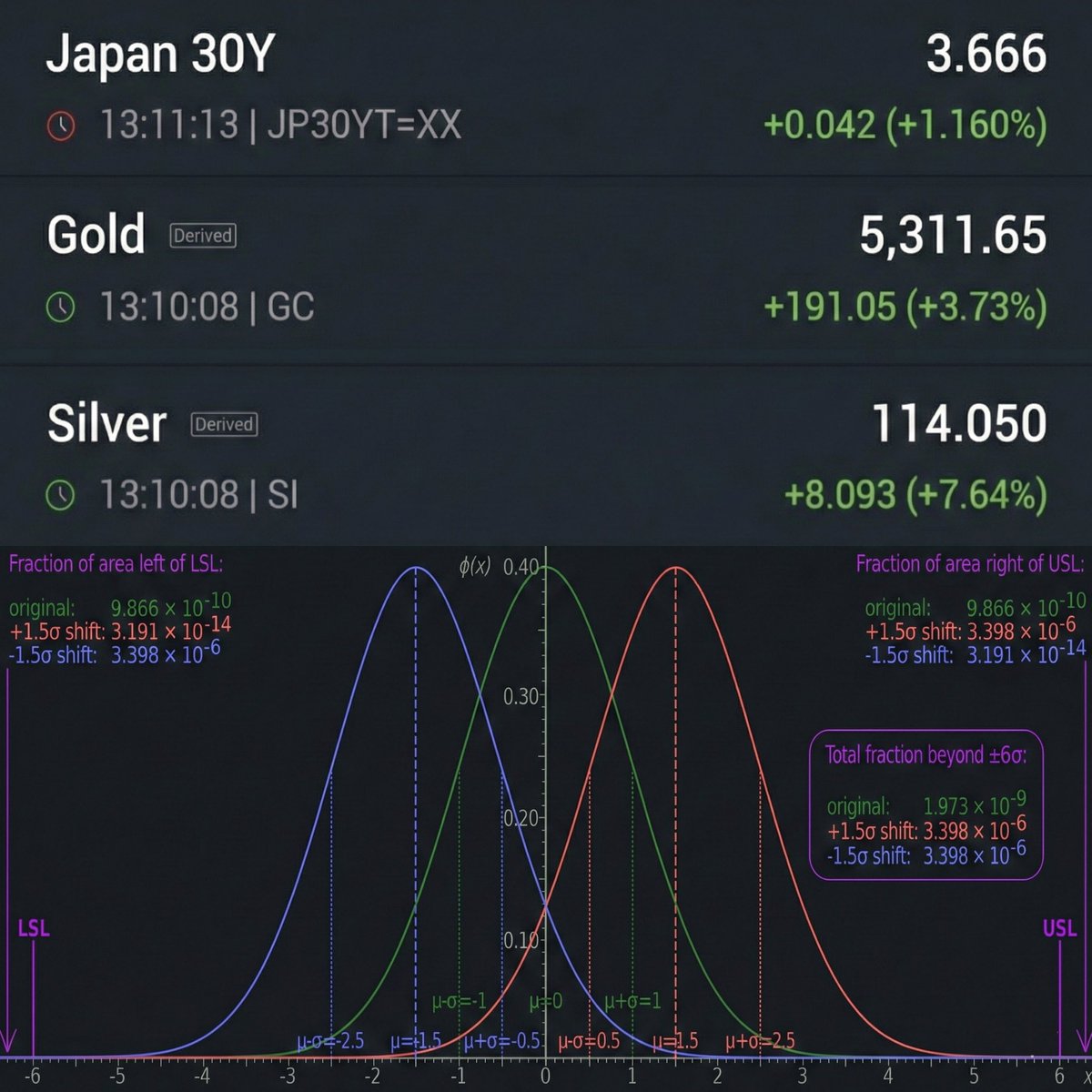
Last Tuesday, Japanese 30-year debt recorded what’s called a “6-sigma” session.
2 days ago, silver did even better: it was at 5-sigma on the rally, then reached 6-sigma on the drop. IN A SINGLE SESSION.
Gold right now? It’s up 23% in less than a month. We’re getting very close to a 6-sigma event.
That’s three 6-sigma events in ONE WEEK.
To explain quickly: in finance, we measure price moves around an average using the standard deviation, which we call sigma.
1-sigma: mundane
2-sigma: common
3-sigma: becomes rare
4-sigma: exceptional
5-sigma: extremely rare
6-sigma: supposed to occur once in 500 million
Here are the 6-sigma-type episodes we saw previously:
– The october 1987 crash, 22% drop in 1 session
– March 2020 covid crash
– The swiss franc’s surge in january 2015
– WTI oil turning negative in april 2020
But we’ve never had 3 events occur in one week.
Do you see the point?
A 6-sigma event is almost NEVER triggered by a simple macro headline.
It almost always comes from the market’s structure: leverage, positions that are too concentrated, margin calls, collateral problems, and forced selling or buying.
That’s important to understand because we’re talking about internal strains in the system’s mechanics.
As you know, the Japanese bond market sits at the heart of the global financial system, and I won’t go back over the whole topic, but a 6-sigma move in a market that enormous doesn’t go unnoticed.
Seeing a 6-sigma move in silver a few days later gives one a lot to think about.
And now gold?? That’s absolutely insane.
Why are we seeing extreme statistical events, only days apart, in such different markets?
When a pillar of global funding becomes unstable, leverage tends to contract, and two things happen at the same time: forced selling in certain assets and forced buying of protection in others.
Historically, precious metals are often among the beneficiaries.
Long-term rates say something about the credibility of states: that is, their ability to honor future debts without resorting massively to inflation.
Precious metals say something about the credibility of the currency itself, and when both become unstable at the same time, we’re looking at a challenge to the monetary framework.
I won’t go on, because I want to share the rest in another tweet tomorrow, but generally when a regime starts to crack, the adjustments are BRUTAL.
It’s exactly in those moments that several high-sigma events appear across different asset classes.
I’ll repeat it: seeing three 6-sigma events back to back is not normal.
Gold and silver are telling you, explicitly, that we’re living through a real paradigm shift.
Remember, I’ve called every market top and bottom of the last 10 years.
When I make a new move, I’ll share it here publicly for everyone to see, and it’s coming soon.
A lot of people will wish they followed me sooner.

English
Mansa Musa retweetledi

Mansa Musa retweetledi

The End of the Four-Year Cycle: Bitcoin’s ~$218k 2026 Year-End Estimate
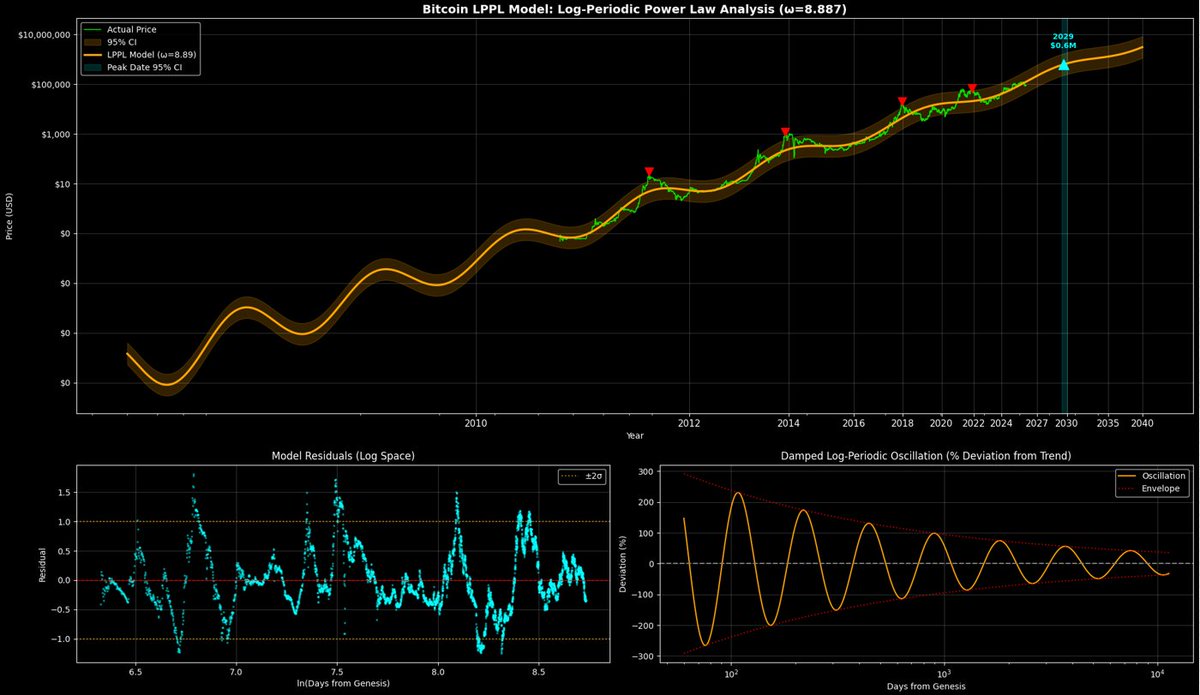
The Log-Periodic Power Law (LPPL) Bitcoin does not move on a repeating four-year calendar.
It follows a power-law growth path with log-periodic oscillations.
As the network ages, cycle timing stretches and volatility decays
1. The Four-Year Cycle Is Statistically Rejected
Model comparison settles the debate.
• Fixed 4-year cycle AIC: −6,408
• LPPL (expanding time) AIC: −7,534
• ΔAIC: 1,126
2. The Age-Doubling Structure
When the model is allowed to solve for its natural frequency, it converges on a stable omega near 8.9, within ~2% of the theoretical “age-doubling” reference.
Interpretation is simple but profound:
Early Bitcoin behaved like a child fast cycles, violent swings, rapid phase transitions.
Modern Bitcoin behaves like an adult slower cycles, longer expansions, fewer extremes.
The market is not late. It is early in a longer cycle than most participants expect.
3. Volatility Is Compressing, Not Disappearing
The damping parameter implies oscillation amplitude decays roughly as t⁻⁰·⁴.
Since 2011, peak-to-trend volatility has fallen by ~53%.
This explains a common frustration: price action feels slow compared to 2017, yet the trend remains intact. The absence of chaos is not weakness. It is maturation.
4. The 2029 Macro Peak
The model’s most contrarian output is timing.
• Next macro peak: mid-August 2029
• Central estimate: ~$620k
• 95% confidence range: ~$590k–$700k
This is not a “missed” 2025 cycle. It is a longer cycle playing out at a slower frequency. The model struggled in the 2017–2021 double-top era, but crucially, the frequency parameter remained stable throughout that noise. That stability matters more than fitting every historical wiggle.
5. Current Positioning
As of early 2026:
Model fair value: ~$126k
Market price: ~$91k
Deviation: ~−28%
Bitcoin is below its long-term trend while already in a bull-phase of the expanded cycle. Historically, this combination favors accumulation.
Bottom Line
Bitcoin has not abandoned cycles. It has outgrown the four-year myth.
The LPPL model explains Bitcoin’s history better than a simple power law (AIC -7534 versus -4,026).
R²:
LPPL = 0.979 vs. Power Law = 0.961

English

Mansa Musa retweetledi