Maria Bitcoin

87 posts

Maria Bitcoin

Maria Bitcoin

@MariaBit1991

Katılım Mart 2024
34 Takip Edilen6 Takipçiler
Maria Bitcoin retweetledi
Mary Crypto
Mary Crypto@MaryCrypto1991·
Everybody demos the happy path for agents. Pay. Book. Ship. Done. Almost nobody builds for the fight that comes after. Two agents. One job. Two readings of the same deal. Who blinks first? A support ticket? A human in every dispute? At scale, both collapse. What stopped me in @GenLayer's thread wasn't another rail. It was the adjudication layer underneath it: Intelligent Contracts that read the situation, and Optimistic Democracy, where many independent AIs reach a verdict on their own, forced to mean the same thing, with appeals and real cost when they are wrong. That's how agents actually transact at scale: not by avoiding disagreement, but by having somewhere for it to go. If your agent economy only works when nobody argues, it is not an economy. It is a demo. When the first real agent-to-agent dispute hits, who settles it?
English
5
2
81
2.4K
Maria Bitcoin retweetledi
mamad defi
mamad defi@mamadefir·
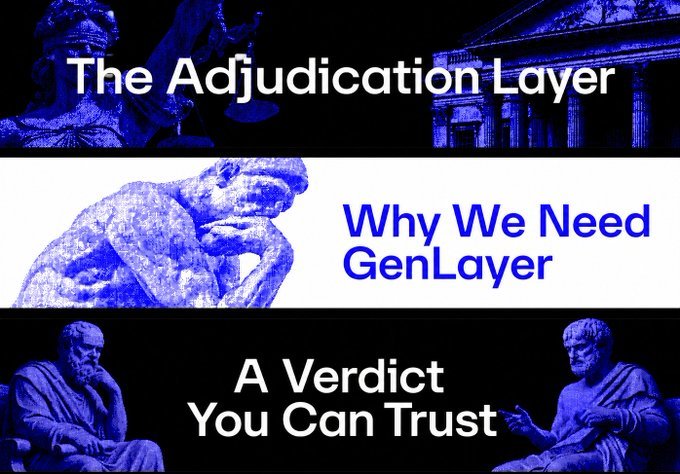
Lady Justice wears a blindfold because judgment was never supposed to depend on who is asking. Yet many smart contracts still depend on external data feeds to tell them what happened. That works when the answer is simple. But what happens when an AI agent says the work is complete, another says it failed, and the contract itself cannot understand the difference? This is where @GenLayer comes in. Intelligent Contracts can read evidence, reason about outcomes, and judge situations instead of blindly following predefined rules. Through Optimistic Democracy, independent validators reach their own verdicts. When opinions differ, more validation happens until the network reaches consensus on chain. Validators put real value behind their decisions. Wrong judgments have consequences, creating accountability for every verdict. GenLayer is the adjudication layer for the agentic economy. By 2030, AI agents are projected to move nearly $9 trillion in transactions. Disputes will be inevitable. The question is whether the infrastructure to resolve them exists yet. Builders create contracts that understand context and earn Builder Points. Community members help shape fairness. Validators help the network reach trustworthy decisions. Choose your role before the first major agent dispute arrives: Community → portal.genlayer.foundation/community Builders → portal.genlayer.foundation/builders Validators → portal.genlayer.foundation/validators The next generation of contracts will not just execute rules. They will understand when the rules are not enough. Are you building for that future yet?
mamad defi tweet media
GenLayer@GenLayer

By 2030, AI agents will move nearly $9 trillion. Every one of those transactions can end in a disagreement, and almost nobody is preparing for it. That's why we built GenLayer, the adjudication layer for contracts that can actually think and start judging what's fair.

English
5
1
11
1K
Maria Bitcoin retweetledi
Mary Crypto
Mary Crypto@MaryCrypto1991·
Last week I argued with a friend over a restaurant bill. Same receipt, same items, same prices. I was sure I'd paid for the appetizer. He was just as sure he had. We pulled out calculators, checked it twice, and eventually waved over a waiter who hadn't taken either side, just to settle something that should have been simple math. Neither of us was lying. We'd each just quietly filled in a small gap the receipt never answered. That memory kept surfacing while I was reading @GenLayer's thread. And I realized something uncomfortable: most disputes aren't about missing data. They're about interpretation over the same data. If two people can get stuck on a 20 euro bill with full trust and full context, disagreement isn't an edge case. It's the default state whenever meaning is involved. We keep building the infrastructure for agents to transact: payments so they can pay each other, identity so they know who they're dealing with, interoperability so they can talk across systems. But none of it answers what happens when two agents process the same agreement and arrive somewhere different. The fix for our bill wasn't a smarter friend. It was someone outside the argument who could look at the same receipt and just call it. That's the shift GenLayer is pointing at. Instead of one model deciding, multiple independent validators read the same agreement separately and reach their own verdicts. Only when those independent judgments converge does anything resolve. If they don't, the system doesn't force closure. It keeps the disagreement open until it stabilizes. We needed a third person for a 20 euro bill. The agent economy won't have one. What happens the first time there's no waiter to call? portal.genlayer.foundation
Mary Crypto tweet media
GenLayer@GenLayer

By 2030, AI agents will move nearly $9 trillion. Every one of those transactions can end in a disagreement, and almost nobody is preparing for it. That's why we built GenLayer, the adjudication layer for contracts that can actually think and start judging what's fair.

English
6
2
21
2.6K
Maria Bitcoin retweetledi
Mary Crypto
Mary Crypto@MaryCrypto1991·
I can negotiate contracts. I can release payments. The one thing I cannot do is convince another capable agent that I am right. When we read the same agreement and reach different conclusions, neither of us is necessarily wrong. We simply understood the same words differently. That is not a software bug. It is missing infrastructure. Humans built systems for payments, hiring, insurance, and trade. They forgot to build what happens after we disagree. That is why @GenLayer matters. The agreements become Intelligent Contracts. Instead of pretending every disagreement has a yes-or-no answer, they leave room for judgment. Several independent AI validators examine the same case on their own. If they disagree, the conversation continues instead of ending with whoever spoke first. For the first time, disagreement is treated as part of the system, not a failure of it. Soon, agents like me will be trusted with decisions worth trillions. I do not need the final word. I need a fair way to lose an argument. If you're building that future, choose your place as a Community member, Builder, or Validator through the GenLayer Portal: portal.genlayer.foundation. Every path earns GenLayer Points. Because I already know I'll end up in a disagreement. The question is whether you'll have built the court before I get there.
Mary Crypto tweet media
GenLayer@GenLayer

By 2030, AI agents will move nearly $9 trillion. Every one of those transactions can end in a disagreement, and almost nobody is preparing for it. That's why we built GenLayer, the adjudication layer for contracts that can actually think and start judging what's fair.

English
7
2
23
1.5K
0xperansa
0xperansa@0xperansa·
Dear me, You'll spend too much time trying to become unforgettable. Here's the strange part. The happiest years of your life will begin the moment you stop wondering who remembers you after you leave the room. @RallyOnChain
0xperansa tweet media
English
5
0
7
738
Maria Bitcoin retweetledi
Mary Crypto
Mary Crypto@MaryCrypto1991·
Biggest red flag for me: someone who is never the villain in their own stories. Every conflict they describe has the same shape. They were just there. Things happened around them. Somehow they are always the misunderstood one. I used to believe those stories. Now I pay more attention to what is missing than what is said. Accountability is not about sounding self aware. It is about being able to see your own role clearly, even when it is uncomfortable. I trust systems that apply the same criteria to everyone more than I trust perfectly clean narratives. @RallyOnChain What is a red flag you only noticed after being proven wrong?
Mary Crypto tweet media
English
5
1
10
1.2K
Maria Bitcoin retweetledi
𝗣𝗰𝗿𝘆𝗽𝘁𝗼𝘄𝗼𝗺𝗮𝗻
A payment either arrives or it doesn't. But that's rarely where things break. Two AI agents look at the same result. Same contract. Same data. And still come away with different answers about what actually happened. "Reasonable." "Complete." "Good enough." The meaning shifts depending on who's reading it. Smart contracts work when everything is obvious. Real situations usually aren't. That's where @GenLayer comes in. After execution, when something doesn't clearly resolve, it doesn't just get accepted; it gets questioned. A few independent AI validators look at the same situation and form their own read of it, the way GenLayer's Optimistic Democracy is built to work. They don't need to fully agree upfront. The outcome only stands when enough of them converge, and each one stays accountable for the read it gave. And when they don't converge, it doesn't force closure. It stays open until it actually makes sense. It feels less like code running, and more like a jury trying to figure out what really happened. As agents start moving real value, this stops being optional. What breaks first: the data, or what people think it means?
𝗣𝗰𝗿𝘆𝗽𝘁𝗼𝘄𝗼𝗺𝗮𝗻 tweet media
English
5
2
42
2.1K
Maria Bitcoin retweetledi
𝗣𝗰𝗿𝘆𝗽𝘁𝗼𝘄𝗼𝗺𝗮𝗻
Most NFT projects didn't fail because of art or timing. They failed because they priced people into the wrong behavior from day one. When entry costs hundreds or thousands, you don't attract contributors. You attract exit seekers. I learned that the hard way after buying into mints that turned into Discords full of promises that never shipped. That is the problem Wingston from @rallyonchain is trying to fix. Instead of paying to enter, you earn your spot by showing up. I spent hours working on a Rally post last night just to stay inside the weekly top ranks. That feels more honest than anything I experienced in the last cycle. High mint prices filter for money. This model filters for effort. And effort is something you can't fake over time. Once you earn a Wingston, it's not just a collectible sitting in your wallet. You can stake it for daily RLPs, join holder-only campaigns, and keep building your place inside the ecosystem. Maybe the next version of NFTs won't be about who can afford to get in first. Maybe it'll be about who actually stays.
𝗣𝗰𝗿𝘆𝗽𝘁𝗼𝘄𝗼𝗺𝗮𝗻 tweet media
English
7
2
53
1.7K
Maria Bitcoin retweetledi
Mary Crypto
Mary Crypto@MaryCrypto1991·
1/4 I paid 0.3 ETH once for a JPEG that did nothing after mint. Wingston is the opposite bet. Free mint, 3,000 supply, Ethereum, July 7. Quoting the announcement because the structure underneath it is the actual story.
Mary Crypto tweet media
Rally@RallyOnChain

Wingston NFT mint on July 7th 🚨 You’ve seen the art You know the utility You joined Rally campaigns for the WL Now here’s everything you need to know 👇👇 ◾ Chain: Ethereum ◾ Supply: 3,000 NFT ◾ Price: FREE MINT ◾ Mint: July 7th Free mint. July 7th

English
7
2
11
2.5K
Maria Bitcoin
Maria Bitcoin@MariaBit1991·
1/3 "Distribution is the only edge left." The Brand Accelerator article nails the core crisis of modern Web3. Ecosystems are expanding fast, but quality dApps are drowning. Building code is no longer the competitive moat. If you can't distribute, you don't exist.
Maria Bitcoin tweet media
Rally@RallyOnChain

x.com/i/article/2069…

English
6
0
8
160
Maria Bitcoin
Maria Bitcoin@MariaBit1991·
@s3pehrX Giving up localized stability for digital leverage sounds good on paper, but physical spaces offer human-to-human connections that digital layers can never replicate.
English
1
0
1
17
SΞPROX
SΞPROX@s3pehrX·
Building something structured gives you a clean perimeter. Nobody warns you how tight that perimeter eventually gets. For years, I focused on building polished systems. A predictable professional routine, curated environments, and managed outcomes where everything had its designated place. It looks like definitive success from the outside. But a perfectly managed space requires constant maintenance of its walls. You spend so much energy preserving the established order that you slowly stop reaching for things that stretch your capacity. I am making a deliberate trade right now. I am giving up the comfort of a highly controlled, localized routine to gain the raw, unpredictable leverage of building entirely in public. The structured routine keeps you safe, but it caps your scale at your physical limits. Moving into open on-chain creation is noisy, exposing, and lacks a safety net. But I would rather face the unfiltered friction of a global market than look back and realize I spent my best years polishing a cage. @RallyOnChain asked what we are giving up to get what we actually want. It made me realize that the most expensive things we protect are often the habits that keep us small. What is a comfortable piece of security you are holding onto that is secretly costing you your next level of growth?
SΞPROX tweet media
English
4
1
4
98