Jake H

25.4K posts

Jake H banner
Jake H

Jake H

@MarketPicker

Founding member of @DormRoomCap. Market participant (equities/options). Likes/Retweets are not an endorsement.

USA Katılım Ekim 2013
815 Takip Edilen854 Takipçiler
Sabitlenmiş Tweet
Jake H
Jake H@MarketPicker·
The Path to Becoming a Millionaire lnkd.in/dZMrwVR
English
1
1
29
0
Pablo Corral MD
Pablo Corral MD@drpablocorral·
👉 Oral PCSK9 Inhibition: High-Efficacy Lipid Lowering Moves to the Oral Era 📍 Randomized evidence shows substantial LDL-C reduction (~50%) with oral PCSK9 inhibitors vs placebo 📍 Consistent effects across atherogenic parameters: ApoB ↓ ~40–50% Non-HDL-C ↓ ~45% Lp(a) ↓ ~15–25% 📍 Safety profile comparable to placebo, including: No excess adverse events No signal for diabetes within available follow-up 1️⃣ MK-0616 (Enlicitide): Phase 3–Level Evidence 👆 LDL-C reduction ~60% at dose-aligned analyses 👆 ApoB reduction ~50%, supporting particle-level impact 👆 Minimal heterogeneity at consistent dosing 👆 Concordant reductions in non-HDL-C and Lp(a)  Pharmacodynamic profile: 👆 Tight coupling between LDL-C and ApoB reduction 👆 Consistent effect across study designs when exposure is standardized 2️⃣ AZD0780 (Laroprovstat): Mechanistic and Clinical Signal Demonstrates significant LDL-C lowering in randomized trials 👆 LDL-C reduction ~50% 👆 Directionally consistent reductions in ApoB and other lipid parameters 👆 Contributes to reproducibility of oral PCSK9 pathway inhibition  Pharmacological attributes: 👆 Oral delivery with measurable systemic effect 👆 Supports class-level biological validity 📍 Integrated Lipid Effects LDL-C reduction parallels ApoB lowering, consistent with enhanced clearance of ApoB-containing particles Non-HDL-C reduction reflects broad impact on atherogenic lipoproteins Lp(a) lowering is present but quantitatively smaller, aligning with partial LDL receptor–mediated clearance 📍 Conclusion Oral PCSK9 inhibition achieves high-intensity lipid lowering with consistent effects across atherogenic markers and a favorable short-term safety profile. 👆 Next step: demonstration of cardiovascular outcomes to define its role in risk reduction strategies. 🔓 Open Access 🔗sciencedirect.com/science/articl… @society_eas @nationallipid
Pablo Corral MD tweet media
English
4
18
50
2.5K
Jake H
Jake H@MarketPicker·
Feel almost like @Brady_H out here or something. 😅
Jake H tweet mediaJake H tweet media
English
0
0
0
9
Jake H
Jake H@MarketPicker·
@Brady_H About two-three years straight (with occasional breaks in there of course).
English
0
0
0
58
Brady Holmer
Brady Holmer@Brady_H·
Tracking food and counting macros is a total pain in the ass. But I’ve been doing it for a few months, have found the process to be very valuable in informing my nutrition. I have even made some changes because of it. Anybody else track (regularly)?
English
83
2
130
46.1K
Jake H
Jake H@MarketPicker·
Worrying about food ingredients? This is the risk perception gap | The risk perception gap: excessive concern about things that pose little risk and insufficient concern about things that pose greater risk news.immunologic.org/p/worrying-abo…
English
0
0
0
11
Jake H
Jake H@MarketPicker·
@goneers The data continues to get better. That’s how science works…
English
0
0
0
3
Jake H
Jake H@MarketPicker·
Tellit Likeitis@Tellit007

A 32-year-old with LDL-C or ApoB of 160 is not in immediate danger. They are in the early chapters of a long book. The outcome of which will entirely depend on the start and duration of the intervention. Saying someone is not in immediate danger is the most dangerous sentence in preventive cardiology. Not because it is wrong today. Because it frames the question as whether danger is present rather than whether it is accumulating. Atherosclerosis starts before age 20. The Bogalusa Heart Study found fatty streaks in coronary arteries of teenagers. The PDAY study found advanced lesions in young adults killed in accidents. The plaque was not caused by a single bad year of eating. It was caused by years of ApoB-containing particles crossing the arterial wall, binding to proteoglycans, oxidizing, and triggering the inflammatory cascade that slowly narrows the lumen. The number that kills you is not the level. It is the level multiplied by the years. Ference, Braunwald, and Catapano modeled this in Nature Reviews Cardiology in 2024. Mendelian randomization data: five years of lower LDL-C from birth produces about 22% less cardiovascular risk. Forty years produces about 54%. ASCOT-Legacy followed patients for 20 years after a 3.3-year statin trial. The group that got the drug first still had fewer coronary events two decades later. The Kaplan-Meier curves never converged. The window at 32 matters in a way the window at 62 cannot replicate. Yes of course, the ultimate outcome of all our stories is known. None of us are getting out of here alive. But if you don't want to expedite your demise, or spend the last miserable years of your existence on this marvelous blue marble dragging oxygen bottles around, early intervention for longer is best. Choose wisely my friends.

English
0
0
0
79
Jake H
Jake H@MarketPicker·
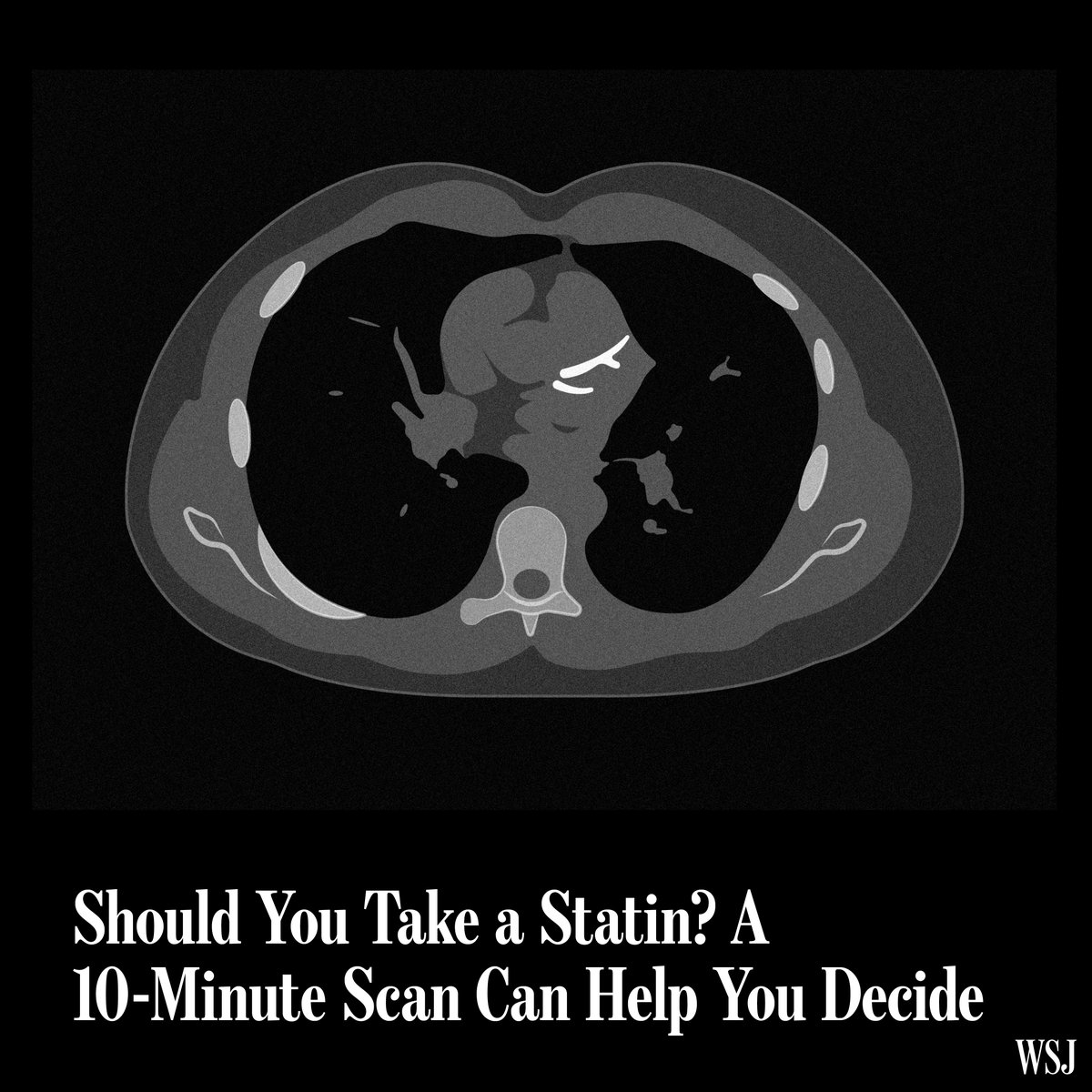
@WSJ I think my only issue with this framing (as a non-expert) is the idea of a younger individual (e.g., 20-45 years old) with elevated LDL-C/apoB (e.g., above 130) who has a CAC of zero thinking or being told they don’t need to worry about their cholesterol. @Drlipid @MohammedAlo
English
4
0
3
1.4K
The Wall Street Journal
Measuring cholesterol levels has long been the main way doctors assess the risk of heart disease. Increasingly, people are opting, too, for a simple, relatively affordable test: a coronary artery calcium scan. Here’s more to know about the scans: 🔗 on.wsj.com/420z0pJ
The Wall Street Journal tweet media
English
19
27
172
92.8K
Jake H retweetledi
The Kobeissi Letter
The Kobeissi Letter@KobeissiLetter·
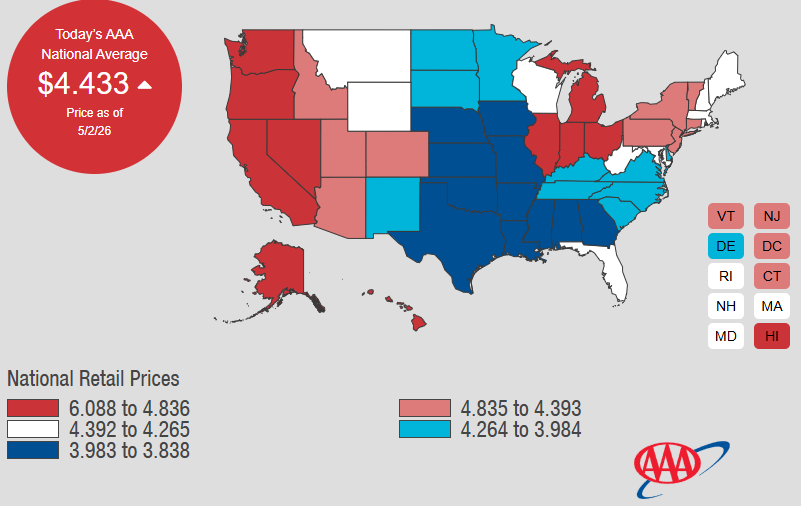
BREAKING: The average price of a gallon of gas in the US surges to $4.43/gallon, now up +61% since December. Americans will spend ~$90 billion more at the pump in a year than they would with gasoline at $3.00.
The Kobeissi Letter tweet media
English
366
968
3.2K
229.9K
Jake H retweetledi
Siim Land
Siim Land@siimland·
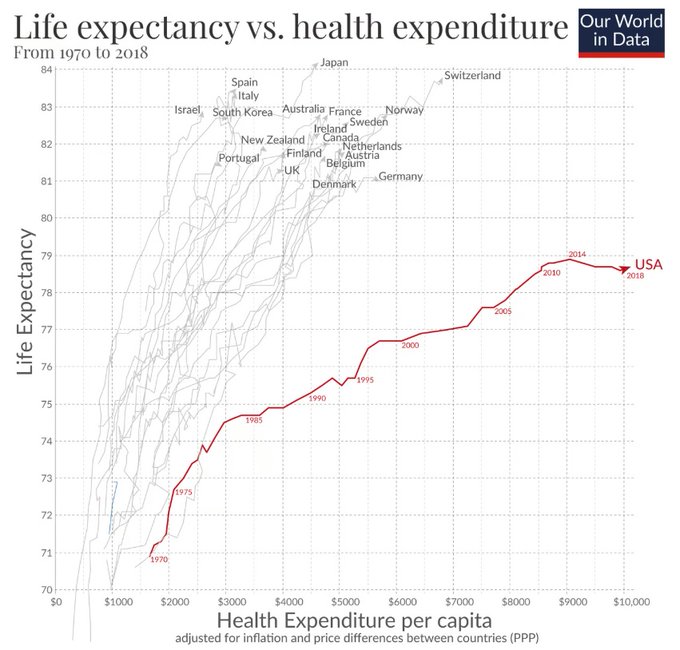
The USA is the wealthiest country in the world and spends 3-4x more on healthcare than any other high-income country, yet it has a life expectancy that's 3-4 years lower Many people blame the high rates of obesity and a highly processed diet for this, but the truth is a lot more nuanced than that⬇️⬇️
Siim Land tweet media
English
33
32
166
21.5K
Jon
Jon@Jon_8675309·
@SamaHoole It’s not so much the pharma industry, it’s the big group primary care doctors that get extra visits for Rx renewals. Talk for five minutes, bill for $500. After patent expiration that is.
English
1
1
3
344
Sama Hoole
Sama Hoole@SamaHoole·
Statin guidelines over 50 years: 1970s: "Total cholesterol over 280 is high." Result: a relatively small market. 1988: "Actually, 240 is high." Result: millions more added overnight. 2001: "Actually, focus on LDL. Get it under 100." Result: tens of millions of new customers. 2013: "Forget the numbers. Use a risk calculator." Result: over 50 million Americans recommended statins. 2018: "Widen the criteria. Include borderline risk." Result: even broader eligibility. 2026: "We should consider statins for children." Result: eventually everyone is a patient. The goalposts didn't move because the science changed. They moved because the market needed to grow.
English
29
248
775
21.8K
Jake H
Jake H@MarketPicker·
@SamaHoole The data continued to get better…that’s how science works. It’s not a grand conspiracy.
English
3
0
1
291
Mark Kaplan
Mark Kaplan@markkaplan20·
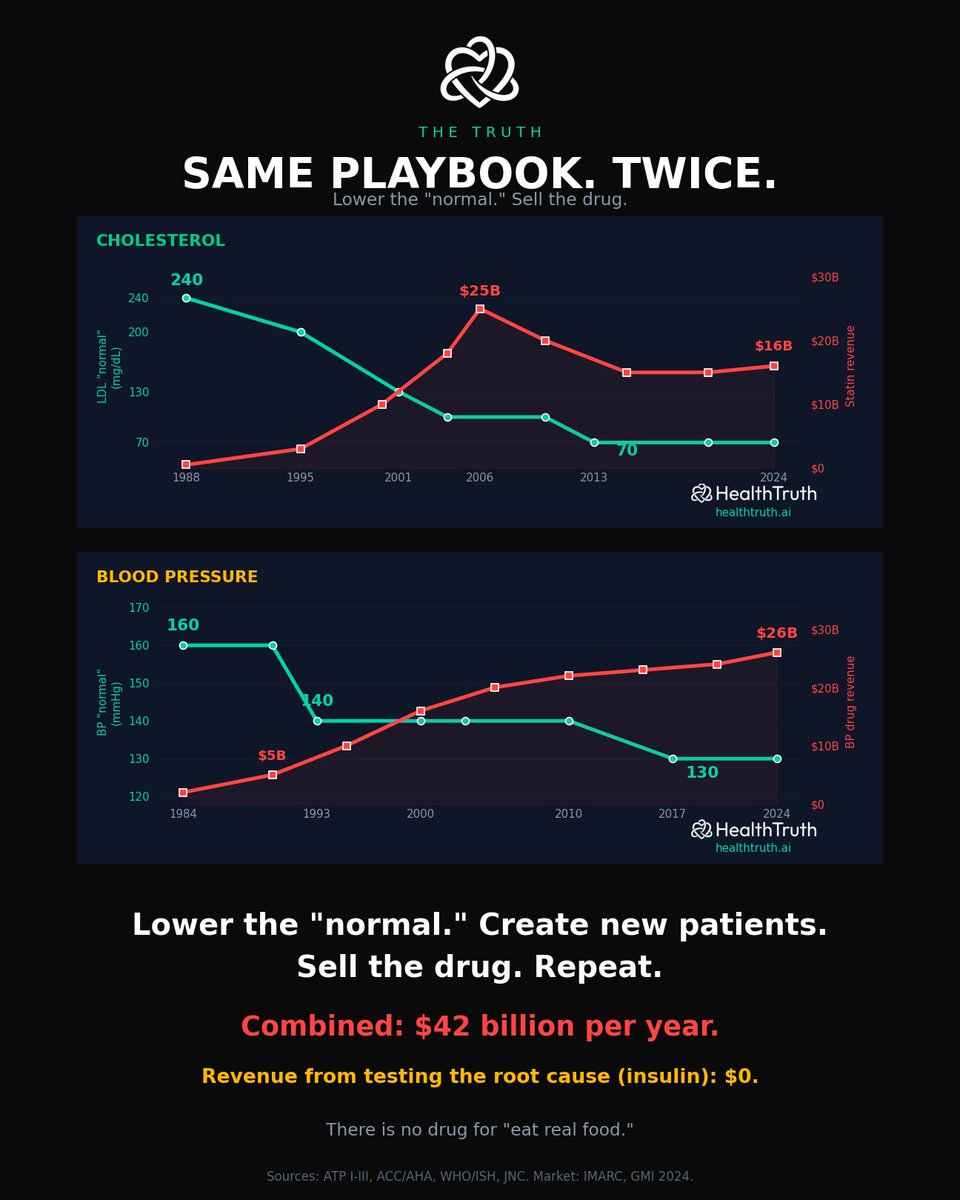
Look at the pattern. Cholesterol. They lowered "normal" LDL from 240 to 70. Statin sales climbed to $25 billion at peak. Blood pressure. They lowered "normal" from 160 to 130. Drug sales climbed to $29 billion. Same playbook. Lower the definition. Create millions of new patients. Sell the drug. In 2017 alone, 31 million Americans went to bed healthy and woke up hypertensive. The American Academy of Family Physicians refused to endorse the new guidelines. They cited conflicts of interest on the panel. Combined: $46 billion per year in drugs. Revenue from testing the root cause: $0. Sources: ATP I-III (NCEP), ACC/AHA 2013/2017, WHO/ISH, JNC5/7. Market: IMARC, GMI 2024.
Mark Kaplan tweet media
English
2
0
4
248
Mark Kaplan
Mark Kaplan@markkaplan20·
They told you cholesterol is killing you. Cholesterol is a hero molecule. Every cell in your body needs it. Your brain is made of it. Your hormones are built from it. They told you salt is killing you. Salt is an essential mineral. Your nerves need it to fire. Your muscles need it to contract. Your heart needs it to beat. They made these two essential parts of human biology into villains. Then they sold you $46 billion in drugs every year to fight them. Here is what they never told you. The lower your cholesterol goes, the more you die. 12.8 million people studied. U-curve confirmed in every age and sex group. The lower your salt goes, the more you die. 130,000 people studied. 49 countries. U-curve confirmed. Two scapegoats. Two drugs. One lie. They never tested the real cause. Insulin resistance. The root of heart disease. The root of diabetes. The root of high blood pressure. There is no drug for it. There is no billing code for it. So they never looked. Insulin.
Mark Kaplan tweet media
English
10
35
112
6.2K
Stathi
Stathi@stathi_·
@MarketPicker @MohammedAlo If you assume the environmental mismatches are immutable, sure, for secondary prevention definitely, for primary prevention less so. Dr Alo is bought and paid for. Ignore him
English
1
0
1
23
Layne Norton, PhD
Layne Norton, PhD@BioLayne·
Ever hear the term reverse causality? No. You haven’t
English
16
1
50
43.6K
Jake H
Jake H@MarketPicker·
@Brady_H My first time using gels at all today. Found these to be pretty good taste-wise:
Jake H tweet media
English
0
0
1
479
Brady Holmer
Brady Holmer@Brady_H·
I actually look forward to taking gels on runs. They taste great. Give you energy. Make you faster.
English
21
2
162
14.6K