
Kubai wamagata
10.8K posts



Is Makau Mutua the Reincarnation of Mulu Mutisya?
Ahmednasir Abdullahi SC@ahmednasirlaw
Prof, come on...!
Indonesia
Kubai wamagata retweetledi

Kubai wamagata retweetledi

We all need to read and keep reading. Especially history, sociology, philosophy with focus on political philosophy, and liberation literature/poetry. Because it's very obvious some of us do not read but want to argue here all day when we don't even have a grasp of the basics
English

@wmnjoya @Dr_AustinOmondi Iwinjo? Its important to read. Just imagine, she is not even going to send you an invoice.
English

My dear brother, Mau Mau fought against land alienation, police violence and lack of sovereignty. They were not alone. The trade unionists, Dini ya Msambwa and Barsirian arap Manyei were also in colonial detention at the same time. What made the status of the Mau Mau different is that the British decided to also engage in collective punishment of the Kikuyu Embu and Meru and pretend that the struggle was ethnic, not political.
So few Kenyans know that the Maasai, the Kamba and the Luhya participated in the Mau Mau. Chief Mukudi of Samia was detained by the British for administering the Mau Mau oath. I saw ES Atieno Odhiambo mention some Luo soldiers in the Nairobi ranks of the Mau Mau but I lost the reference. I'll keep looking for it.
Independence isn't liberation. It's the management of the colonialist state by Africans.
The whites were not chased out. They are still here. They still own land, plantations, mines and major installations. They gave us CBC. They just got a military agreement in Mombasa which exempts soldiers from prosecution. Wazungu didn't leave. They retreated from visibility, but not from power.
Until the late 1950s, the British had no intention of leaving. In their dream, Kenya was to be a multi-racial state. Shortly after, they aimed to leave in 1975. Then after, they decided to leave in 1963, but before they did that, they needed to ensure that Kenya was left in the hands of the sympathizers, your Lancaster people and the #IwenttoAlliance's.
Whites remained in the independence government, protected by Sir Charles Njonjo of Kabeteshire. Bruce Mackenzie was Ministry of Agriculture. Humphrey Slade the Parliament speaker. Goeffrey Griffin, a former information officer, started Starehe. Carey Francis moved to Pangani High School. In 1972, UoN students were violently suppressed by the police after complaining about the architecture department being staffed by wazungu faculty who were failing the students. Guess who was in charge of Nairobi Provincial Police? James Myles Oswald, who had killed many Mau Mau fighters.
The decision of the British to hand over the state to Africans was forced by the African resistance, of which Mau Mau was a major player. The British realized that it would be too expensive to keep suppressing rebellion, especially because the Mau Mau started to regroup in 1961. Plus the whole pan-African world's imagination was captured by the resistance. It was cheaper for the British to have African elites, your favorite Lancaster guys, rather than settlers, in charge. But overall, the British remained in charge from London.
Forcing the British to hand over the colonial state doesn't mean we were liberated. It just means we got black settlers in charge of the state, instead of white ones.
Reading helps even the best and the brightest.
English
Kubai wamagata retweetledi

Kenya’s greatest challenge isn’t just policy failure, it’s a crisis of thought. Are we trapped in elite mediocrity, chasing Western narratives while neglecting the deep wisdom within our own roots? In this episode, “Our Elites Not Organic to Society,” @wmnjoya asks: Why do we seek answers from a collapsing global order, yet shy away from our indigenous knowledge? Without a strong philosophical foundation, our institutions remain fragile and disconnected from who we are.
Join the conversation
YouTube: youtu.be/MYQv0Xwex7U?si…
Spotify: open.spotify.com/episode/6OL9i2…
@Maskani254 @Siasaplace @nisisikenya @CivicVoiceInt #IWentToAlliance #TheElephant #EliteMediocrity #Governance

YouTube
English
Kubai wamagata retweetledi

Nyali leads Kenya’s coast in beachfront land prices based on the latest HassConsult report, ahead of Lamu and Mombasa.
Top coastal areas and prices per acre:
Nyali — Sh146 million
Lamu Island — Sh140 million
Mombasa — Sh120 million
Shanzu — Sh99 million
Bamburi — Sh97 million
Diani — Sh65 million
Kilifi — Sh47 million
Watamu — Sh45 million
Mtwapa — Sh44 million
Kikambala — Sh36 million
Malindi — Sh26 million
Vipingo — Sh19 million
English
Kubai wamagata retweetledi

Kubai wamagata retweetledi

Lady Justice Bellinda Akoth Akello, Judge of The Environment and Land Court

English
Kubai wamagata retweetledi


Kubai wamagata retweetledi

Kubai wamagata retweetledi

Kubai wamagata retweetledi

Kubai wamagata retweetledi

Kubai wamagata retweetledi

🚨🚨MAN LOSES LAND AFTER 60 YEARS - COURT HANDS PROPERTY TO FAMILY WHO OCCUPIED, BUILT, AND BURIED THEIR DEAD THERE
In a deeply unsettling decision, the Court of Appeal of Kenya sitting at Nyeri in Ishmael Joram v Ephantus Muriithi Obadiah upheld a ruling that stripped a registered land owner of his property, not because he sold it, not because of fraud, but because he stayed away too long. The dispute traces back to 1961 when the respondent’s father allegedly entered the land, built houses, planted coffee, and settled his family there. Decades passed. The registered owner worked in Nairobi, visited occasionally, issued verbal warnings, wrote demand letters, even filed a suit - yet never removed the occupiers. By the time the dust settled, the court delivered the blow: the land now belongs to the occupiers under adverse possession.
What makes this judgment even more dramatic is the evidence the court relied on. The occupiers had built homes, planted crops, and, in what may be the most emotionally powerful detail, buried family members on the land, including the respondent’s wife and children. Meanwhile, the registered owner admitted he saw houses, coffee, and tea bushes on his land but took minimal action for decades. The Court of Appeal, composed of Justice S. ole Kantai, Justice Mumbi Ngugi, and Justice Ali-Aroni, was blunt: verbal warnings, demand letters, and half-hearted litigation do not stop time from running in adverse possession. If you do not effectively assert your ownership, you may quietly lose your land, even while holding a valid title.
This judgment is less about new law and more about a brutal reminder: title deeds are powerful, but silence can destroy them. Many Kenyans own land in rural areas while living in towns, assuming registration alone protects them. This decision sends a chilling message: if someone occupies your land openly, builds, farms, and you do not decisively act, the law may eventually side with the occupier. And perhaps the most frightening part is this: the dispute began in 1978, dragged through generations, and ended in 2026, with the registered owner losing everything. If someone is quietly sitting on your land today, this ruling is not just news, it may be your future.
Kindly retweet.

English
Kubai wamagata retweetledi
BREAKING FROM THE ELC: COURT DECLARES LAND BUYERS TRESPASSERS AFTER WIDOW SOLD ESTATE LAND
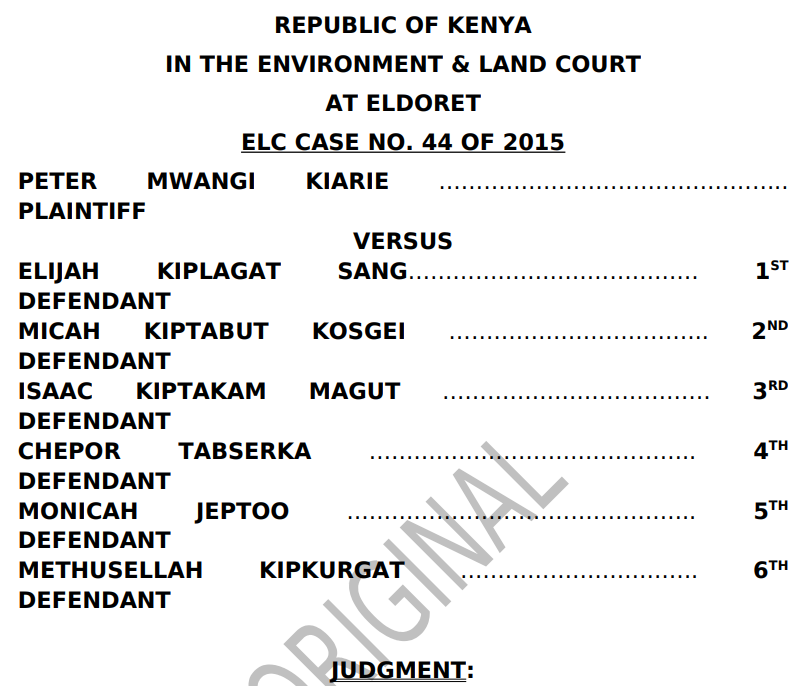
This is the nightmare many Kenyans quietly live with. You buy land from a widow, she shows you the title, takes you to an advocate, signs agreements, receives your money, and even allows you to take possession. You fence, farm, build, and raise your family for years; believing the land is yours. That is exactly what happened in Peter Mwangi Kiarie v Elijah Kiplagat Sang & 5 Others (ELC No. 44 of 2015, Eldoret). Several buyers purchased portions of a 50-acre parcel from a widow who was an administrator of her late husband’s estate. They paid hundreds of thousands, took possession, and some stayed on the land for nearly two decades. Then years later, the deceased’s son walked into court and called them trespassers.
The ELC delivered a painful but powerful ruling: one administrator cannot sell estate land alone. The court held that where there are co-administrators, they must act jointly. Since the widow sold the land without the consent or participation of her co-administrator son, the sale agreements were declared invalid, despite buyers having agreements, witnesses, advocates, and years of occupation. Even worse, the court found that the purchasers could not rely on the doctrine of innocent purchaser, because they failed to conduct proper due diligence, confirm ownership, or verify authority to sell estate land. Years of possession, development, and even sympathy could not override the law.
This judgment is a harsh wake-up call across Kenya. Many families quietly sell inherited land before succession is properly finalized. Many buyers trust widows, elders, brokers, and even some lazy advocates, then move in and develop the land. But this ruling sends a chilling reminder: if the seller lacked legal authority, your land can disappear years later. And to families quietly selling estate land without full authority, the court has spoken: culture, family arrangements, and informal consent cannot replace legal capacity. For those already caught in such disputes, this judgment is both a warning and a beacon, because where illegal sales occur, courts are increasingly stepping in to untangle the mess, refund buyers, and restore lawful ownership.
Kindly repost widely🙏🙏
English

Kubai wamagata retweetledi

Popat v Popat the High Court & Court of Appeal, argued by Njoroge Regeru SC is one of the best pieces in Succession Jurisprudence. Also get to read the Estate of Re GKK by Lenaola J as he then was!
Very critical for those interested in the current Succession Public Matters. ✅️✅️
English
The Gachagua Nderitu Clause I doubt can pass section 5 Testamentary freedom test:
That whoever challenges this Will In court on the mode of distribution, shall not be a beneficiary of the estate. If it had been challenged, that provision would not stand. ✅️
English