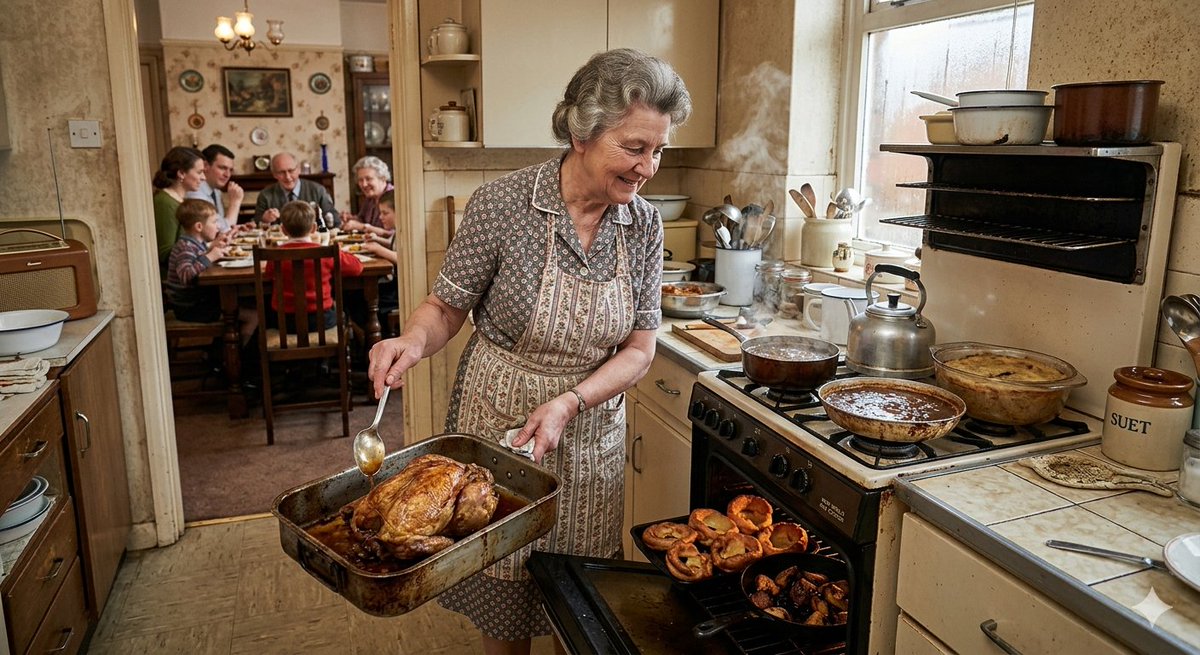
Sunday lunch at your grandmother's table in 1960:
- A proper joint, roasted in its own dripping
- Yorkshire puddings made with real beef drippings and farm eggs
- Roast potatoes cooked in the beef fat
- Gravy from the pan juices
- A pudding with suet
- A wedge of cheddar to finish
- Three generations around the table for two hours
Sunday lunch at most British tables now:
- A supermarket chicken roasted in sunflower oil
- Frozen Yorkshire puddings from Aunt Bessie's
- Roast potatoes from a bag
- Gravy from a Bisto packet
- Trifle from the Tesco chilled aisle
- Forty-five minutes, two generations if you are lucky
The Sunday lunch was the centre of the British week for four hundred years.
A 2022 poll found 42% of British households no longer cook one with any regularity. Among under-35s, 61%.
Four hundred years of habit ending on the watch of a single generation.
Haggis is the single food item currently banned from import into the United States of America because it contains sheep's lung.
Sheep's lung has been declared, by the USDA, an inedible offal. The ban was imposed in 1971 and remains in place.
The Scottish reaction to this ban has, for fifty years, ranged from bafflement to mild amusement. Sheep's lung has been eaten in Scotland, daily, without incident, for approximately eight hundred years. It is the binding ingredient that holds the minced sheep's heart, liver, onion, oatmeal, suet, and spices together inside the stomach casing. It is the reason haggis exists.
Scottish children are fed haggis on Burns Night, 25th of January, every year. They eat it at school. At home. At pubs. At weddings. At every ceremony the national poet is toasted at.
Burns Night is, in Britain, effectively the last public occasion on which a whole generation still encounters a dish made from an animal's lungs, heart, and liver, stuffed into its own stomach, and eaten communally.
This used to be normal food. Every rural British household knew some version of it. Faggots in the Midlands. Brawn everywhere. Black pudding in Lancashire. Drisheen in the West Country. The whole animal was used because the whole animal was available and it was cheaper than buying specific cuts.
Now, once a year, the Scottish remind everyone else that this food exists. The rest of the year, it is marketed as a quaint regional oddity for tourists.
The nutritional profile of a traditional haggis is substantial. Per 100 grams: 14g protein, 22g fat, significant B12, iron, zinc, and the specific fat-soluble vitamins that concentrate in organ meat.
The Americans have been missing out for fifty years because of a regulatory decision made in 1971 on the basis of a sanitary concern that was probably already obsolete.
The Scots have been eating it the whole time.
The Scots have not died of it.
The reason why phones have become a problem is because parents want to be their kids friends, instead of their parents, so they don’t want to say no to not having a phone - and instead want the state to do that for them.
It’s a job for school rules and parents - not legislation
@seagull4a@SamaHoole 1964 AI is so poor it makes it look like 1940s. From 1940 to 1954 rationing prevented a big roast that might last 4 days. You posts are dripping in errors you need to beef them up cos this is some gravy you are trying to sell.
@SamaHoole Fascinating thread, not least to realise that a large joint of roast beef was clearly the weekly norm, even in poorer families. It’s now very much a rare treat in my house due to cost!
Dry dripping on bread, with a pinch of salt, was, for approximately four hundred years, one of the most common things a British child ate when he came in from school.
The dripping was what was left in the pan after the Sunday roast. Beef fat, mostly, sometimes with a dark jelly at the bottom where the juices had settled. Your mother spooned it into a white enamel bowl, covered it with a plate, and kept it on the cold shelf in the pantry. It lasted a week. Sometimes two. It fried the Monday bubble and squeak, the Tuesday eggs, the Wednesday onions. On Thursday afternoon, before it ran out, you got a slice of bread spread with the stuff, a pinch of salt cracked on top, and that was tea.
It was a treat. It was also just food. A child in 1930 would have looked at you blankly if you had suggested that beef dripping on bread was in any way remarkable. It was what was in the bowl. It was free. It tasted of Sunday lunch three days later.
Beef dripping is approximately 50% monounsaturated fat, 40% saturated fat, and carries the fat-soluble vitamins A, D, E, and K from the pasture the cow grazed on. The cow ate grass. The grass had been growing on British soil since the end of the last Ice Age. The fat was the end product of ten thousand years of continuous ruminant grazing. A slice of bread and dripping delivered, for roughly the price of the bread, a dose of fat-soluble vitamins and usable calories that the rest of the British afternoon was going to need.
Nobody got heart disease from bread and dripping. The British cardiovascular mortality rate of 1930, when almost every family ate dripping several times a week, was a fraction of what it is now. The British obesity rate of 1930 was essentially zero. The British type 2 diabetes rate was so low that the Royal College of Physicians considered the condition a medical curiosity.
Then the dripping was quietly removed.
First by margarine, invented in 1869 by a French chemist trying to feed the army, mass-marketed in Britain after the First World War as a modern, clean, scientific alternative to animal fat. Then by Crisco-style vegetable shortenings in the 1930s. Then, decisively, from the 1960s onwards, by the dietary advice that saturated animal fat caused heart disease. The advice was wrong. The research behind it was flawed, selectively published, and in some cases deliberately manipulated. The corrections have been appearing in the peer-reviewed literature for thirty years. The public-health guidelines have not been updated.
Bread and dripping was replaced, in the British kitchen, by margarine on bread. Then by low-fat spread on bread. Then by skimmed-milk spread on industrially processed bread from the Chorleywood process. Then by a plastic tub of something labelled "I Can't Believe It's Not Butter," made from a blend of palm oil, rapeseed oil, emulsifiers, and flavouring, spread on a slice of Kingsmill so pale and so soft it could be balled up in one hand.
The cardiovascular disease rates climbed through the same decades.
The obesity rates climbed through the same decades.
The type 2 diabetes rates went from medical curiosity to national crisis through the same decades.
The fat your great-grandmother scraped out of the Sunday roast pan and spread on her child's tea was never the problem. The problem was what replaced it. Industrial seed oil, chemically extracted from seeds using hexane solvent, deodorised, bleached, and sold in a plastic bottle as a health food. A substance no human population had consumed in meaningful quantities before 1910, and which now makes up roughly 20% of the total calories in the average British diet.
The dripping bowl on the cold shelf was a complete piece of nutritional engineering, evolved over centuries, running on the natural waste stream of the Sunday roast, costing nothing, delivering real nutrients, and causing none of the conditions it was eventually blamed for.
It was thrown out of the British kitchen on the basis of a mistake.
The mistake has never been corrected.
The bowl is still at your grandmother's house, probably, at the back of a cupboard, unused since about 1985.
The cow that built Britain is still in the field.
@SamaHoole The rust from the crown caps on those milk bottles is vile. Get some better AI or use an actual old photo. This is worse than your school diners one with chips!
Milk, in Britain, used to separate in the bottle.
The milk was left on the doorstep by the milkman at five in the morning. It sat in a glass bottle with a foil cap. By breakfast, the cream had risen to the top third of the bottle. A thick yellow layer, sometimes two inches deep. Children fought over the top of the milk. The top of the milk went on the porridge. Whatever was left below was drunk by the rest of the family.
This was not a special product. This was every bottle of milk in the country.
The cream contained the fat-soluble vitamins A, D, and K2. The cream contained the butyrate-producing strains that feed the colonic microbiome. The cream was the point. The skim underneath was the byproduct.
Homogenisation was introduced commercially in Britain in the 1950s. By the 1980s it was standard. Homogenisation forces the milk through a valve at extreme pressure, breaking the fat globules so small that they no longer coalesce. The cream never rises again. The bottle appears uniform.
This was sold as an improvement. A consistency benefit. A shelf-life benefit.
The children of the 1990s grew up on homogenised skimmed milk, the cream of which had been extracted at the dairy and sold separately to the food industry as an ingredient in biscuits, ice cream, and ready meals. The skim was sold back to them, at the same price as whole milk, with a label reading "healthy."
The fat-soluble vitamins had been extracted along with the cream.
The children were vitamin D deficient. The children needed fortified breakfast cereal. The children needed a supplement.
The cream was still being consumed. Just by someone else, in a product labelled differently, at a considerable markup.
The top of the milk is gone.
It was taken.
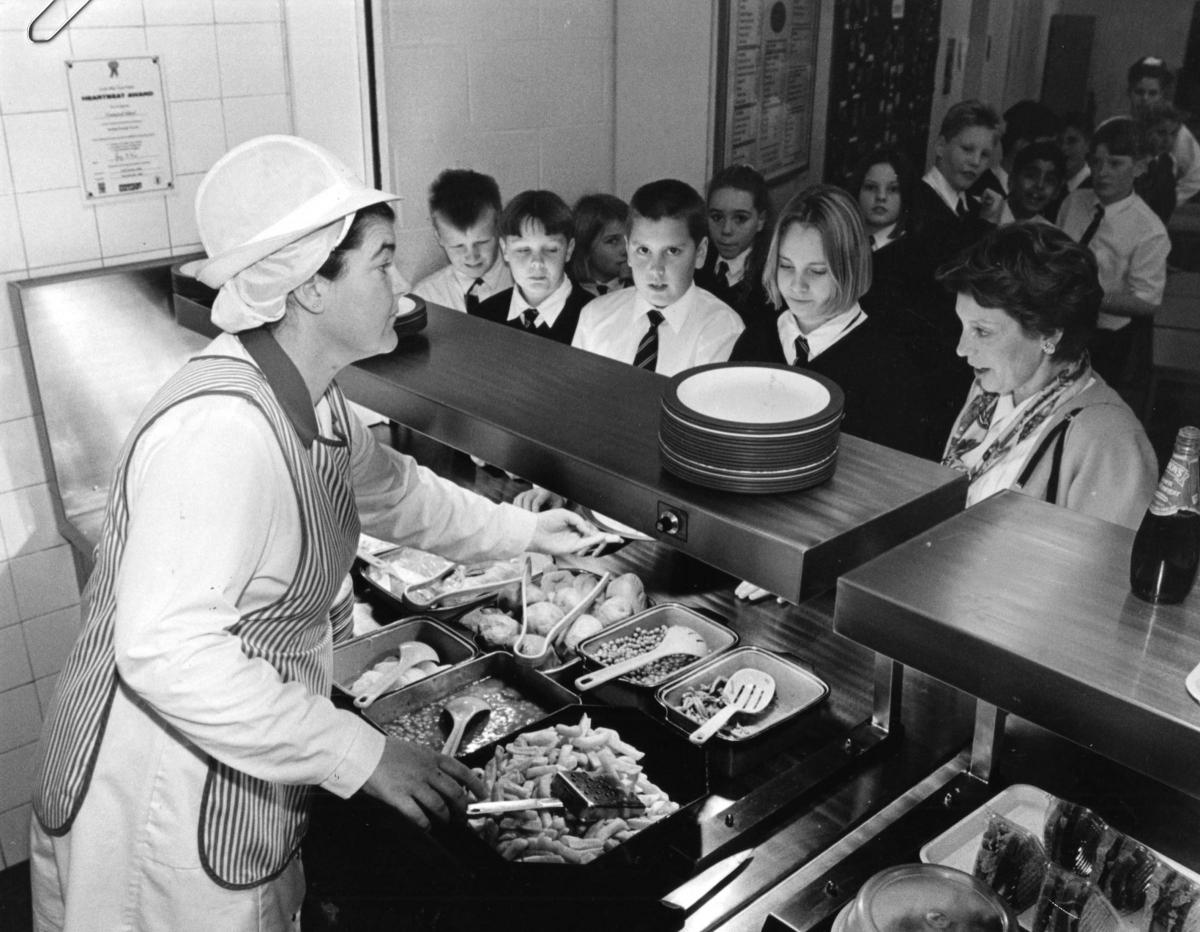
@SamaHoole Your photo shows chips peas jacket potatoes beans none of the other stuff you described. Also do some research on the school meat supply sandals in 70s and 80s. Substandard slop.
A British school dinner in 1975 was cooked on-site, from whole ingredients, by a dinner lady who knew, without consulting a nutritional database, what a growing child needed to eat.
The dinner was: roast beef, gravy from the drippings, boiled potatoes, cabbage, and sponge pudding with custard made from eggs and milk. Or shepherd's pie from real mince. Or liver and onions. Or fish on Friday, battered and fried in beef dripping.
In a single sitting: haem iron from the meat, calcium from the custard, B12 from the liver, vitamin A from the gravy fat, vitamin D from the eggs, zinc from the beef, omega-3 from the fish, collagen from the gravy, complete protein from every component, and roughly 800 calories dense enough to carry a child through an afternoon of running around a playground in January.
Then the system changed.
In the 1980s and 1990s, local authority catering was outsourced. On-site kitchens closed. Dinner ladies were made redundant. Central production kitchens began manufacturing meals reheated in convection ovens.
The roast beef became a turkey twizzler. The shepherd's pie became a pre-formed disc of processed potato and reconstituted meat product. The liver disappeared entirely. The fish was coated in breadcrumbs and fried in vegetable oil. The custard was made from powder, water, and yellow colouring. The sponge pudding was replaced by a yoghurt tube.
Jamie Oliver's 2005 campaign filmed children who could not identify a tomato. Kitchens where the only equipment was a deep fryer and a microwave. Menus that contained less nutritional value in a full week than the 1975 dinner contained in a single sitting.
The government pledged reform. But the on-site kitchen did not come back. The dinner lady did not come back. The roast beef and the liver and the custard made from eggs did not come back.
The 1975 dinner lady, who had no nutritional qualification and had never heard of a DIAAS score, was producing, at approximately 30p per serving, a meal that contained more bioavailable nutrition than anything the modern system produces at three times the cost.
She has been replaced by a supply chain.
The supply chain is more expensive.
The children are less well fed.
The dinner lady knew what she was doing.
Nobody asked her.
🚨 𝗡𝗘𝗪: For the first time in history, The World Cup Final will have a halftime show.
It will be organized by Chris Martin & Coldplay and could take up to 25 minutes.
Has anyone polled the public on how hated the stupid attached bottle cap thing is?
Or on useless paper straws?
Interested to see public attitudes here.
@MatthewConnolly@Aku_700 Clown! Speaking up against canceling an age celebration isn't intolerance but protecting what you have against unscrupulous individuals trying to take it away. Why Easter and not Ramadan for the refugee week? Hypocrites!
@msloobylou@Footinit If you didn't laugh at Ruth the seagull regurgitating a hotdog then what's the point? They have a terrible host in smarmy Jimmy the reincarnated Monkhouse and the rest are room warmers but Bob is the saving grace.
@Footinit I am FASCINATED by it cause everyone loves it and I find it totally unfunny. I swear the laughter in the other room is fake. OK, I laughed at Diane's farting poetry but nothing else is in the least amusing. Why do people love it so?
@PeteLiggins@tes The reason is that school first aiders can't diagnose concussion or brain injury and so err on safety and tell parents so they can say actually I would like to get my kid checked out by an actual doctor. It has happened that the oh they will be ok approach has not been right!
@MatthewConnolly@tes It never used to be a phone call. They’d just have a bump note for a minor knocks, grazes or bumps. And there was no offered choice of action. I got told she bumped her head, got told she was fine & got told to pick her up as normal. So was there any reason for the call not note?
Schools should not be ‘call centres’, warns teaching union as research reveals that nearly half of SLT staff spend more than 30 minutes a week calling parents
tes.com/magazine/news/…
Some of the comments about how hard it is to parent under 5s without unlimited access to screens is frightening. What did parents do before screens were invented for thousands of years of human history…..
@tes Got a call from my kids school this week as she had bumped her head running round the playground. Panicking I legged it out the door as I presumed they wanted me to rush to a hospital or collect her straight away. Er No, they said she was fine. So why call me? Policy apparently.
@Doug_Lemov Scrap paper and pencil. Bring back hotter? Mwb terrible for writing. Plastic waste from pens not great. There are multiple ways to get feedback 30 mwb held up is not really easy to check. Zero record is an issue. Don't wipe off your wb is as dangerous as next clean page!
Mini-white boards are great. I genuinely love them. But as with any means of participation, they have benefits and limitations and teachers should be aware of both and use accordingly.
On the upside, they offer maximum observational efficiency. When everyone writes i can see the full data set—everyone’s answer—and when they hold them up I can scan and review with maximum speed. That’s a big win.
Plus they feel low stakes to students and therefore low-risk… if it’s wrong I just erase it. Ideal for settings like retrieval practice.
And when the routine is installed well they are fast and engaging.
Some limitations to consider though.
There’s a downslide to disposable writing that disappears. It’s harder to go back to it: to study and revise it later or to improve it. The answers are not in your notes!
By the way we have a video of a chemistry teacher, Abi Mincer of Totteridge Academy in London who writes the answer on her smart board after students erase so there’s a list of the answers permanently visible. Love that.
MWBs can also socialize hasty or even sloppy writing- with the sloppy referring to the production or to the thinking. The goal can easily become speed of response. The marker slips easily across the board and this just maybe makes it so that students don’t write as slowly and thoughtfully as they might on paper. Slow, deliberate thinking leads to careful word choice, the inclusion of new ideas and assists with encoding.
MWBs can be a crutch. It’s an easy way to engage students. A bit easier than other also important ways to engage them such as cold call and stop and jot. That means there’s a risk of over relying on it. It’s a great tool for some situations. But a craftsperson needs lots of tools.
I’m sure you can think of other benefits and limitations. Just wanted to share a few so that teachers are more likely to use a great tool for maximum gain.
When assessing the quality of teaching, it is important to identify whether any problems are pedagogical or structural. Are the issues due to teaching, or what is being taught? Are the problems in delivery, or the curriculum? Or are they as a result of previous SLT requirements?