Cheersupsir@Cheersup2God
Thank you for interacting with my post. I can’t respond to everything since I’m short on time and didn’t intend to get into an in-depth discussion.
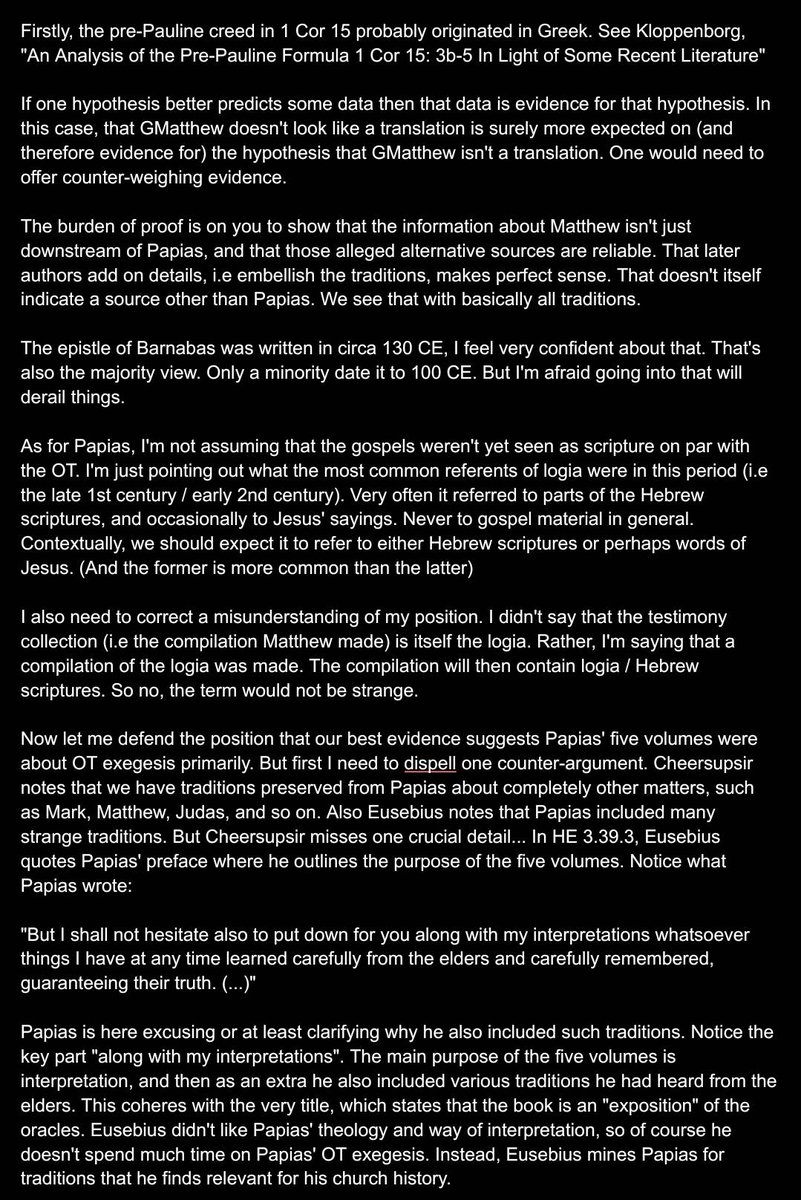
Preamble: My brief post values the voice of the Fathers, and I think that their testimony is strong evidence for my hypothesis.
I think Alfred may under-appreciate how complicated the development of the four gospels probably was, and how there are many “valid” views on the development of the four gospels, including Matthew.
The framing in my mind is this, “does the lack of solid evidence *from the gospel of Matthew itself* that it is in some sense an ancient “translation” of an earlier Semitic source outweigh the testimony of the Fathers?”
I argue no, because the ancient concept of translation allowed for practices that make it very hard to impossible for us to verify from the document alone (something Alfred grants to some degree it seems). As I pointed out with the Josephus example, his Jewish War is widely recognized to be based on a Semitic original primarily because that is what he himself reports in his introduction. And yet as Steve Mason notes, the Greek isn’t translation Greek, and contains “several forms that are native to Greek literature” (Flavius Josephus on the Pharisees, p. 61).
I view the relationship between Hebrew Matthew and Greek akin to how Mason views the relationship between the Aramaic version of JW and the Greek version, namely that “although it cannot be denied ... that Josephus’ Greek War was preceded by an Aramaic account of the revolt, the relationship between the two works is a matter of conjuncture.”
Alfred points to alliteration, but that doesn’t move the needle for me. Consider 1 Corinthians 15:3-7. Many scholars think parts of 1 Cor 15:3–7 preserves an early pre-Pauline creed that ultimately derived from Aramaic-speakers and testimony, and yet the Greek formulation contains carefully shaped alliterative features in Greek. Josephus exhibits similar stylistic features in JW too. Keep in mind too that I'm not committed to the view that everything in Greek Matthew stems from Hebrew Matthew. As I noted, there is a lot of room for expansion and reliance on other sources in the ancient concept of translation.
I stand by my claim that there is no way to show from a document alone that a document in ancient Greek is not translated from a semitic original. Moreover, there are numerous places in gMatthew that indicate material stemming from a semitic original.
Alfred thinks that the Church Fathers after Papias are evidentially useless because they relied on Papias. But I think that’s bad reasoning. Sure, Irenaeus, Eusebius, Origen etc., knew of and used Papias. But that doesn’t mean they are purely dependent on him. Irenaeus for example contains details about Matthew and Mark that are not reported by Papias in his extant quote, such as a solid when and where with respect to gMatthew and gMark. Papias lacks these details in our extant evidence. Irenaeus, Origen, Eusebius, etc., also had access to a wider range of early church and oral sources than we do. Irenaeus in particular also commonly cites “the elders” for his information on things. He does not commonly cite Papias.
But let’s grant that these later writers are only relying on Papias for their comments on Matthew. That is still weighty because then the universal interpretation of Papias’ comment would be that Papias is referring to Matthew writing a gospel. Why should we value 21st century interpretations of Papias over people who were much closer to the person and writing of Papias?
I now address Alfred’s and Carlson’s claims about Papias. Alfred says that we wouldn’t expect Papias to use logia in reference to a gospel. Except, as implicitly revealed in his response, this assumes that the gospels weren’t viewed as scripture during Papias’ time, something which isn’t a given. I also note that he dates Barnabas to 130 AD, even though an earlier date (~around 100AD) is often preferred. More importantly, no ancient Christian testimonia of OT passages is itself called “logia.” So the term would be strange on his hypothesis as well.
I disagree that the evidence suggests that Papias’ works were “mainly about” messianic exegesis of the OT when in our preserved extracts, the OT is only cited or alluded to once (Isaiah 11). Instead, the quotations we have preserved are comments about Mark, Matthew, Judas, a messianic teaching that floated around in first century Judaism (the grapes).
Most striking is how Eusebius summarizes some of Papias’ work in Church History. He says that Papias wrote about “miraculous deeds, stating that he acquired the knowledge of them from tradition. The residence of the Apostle Philip with his daughters in Hierapolis has been mentioned above. We must now point out how Papias, who lived at the same time, relates that he had received a wonderful narrative from the daughters of Philip. For he relates that a dead man was raised to life in his day. He also mentions another miracle relating to Justus, surnamed Barsabas, how he swallowed a deadly poison, and received no harm, on account of the grace of the Lord. The same person, moreover, has set down other things as coming to him from unwritten tradition, among these some strange parables and instructions of the Saviour, and some other things of a more fabulous nature. Amongst these he says that there will be a millennium after the resurrection from the dead, when the personal reign of Christ will be established on this earth. He moreover hands down, in his own writing, other narratives given by the previously mentioned Aristion of the Lord's sayings, and the traditions of the presbyter John.”
Much of what Eusebius summarizes of Papias involve narrations that don’t seem to have any direct relation to OT messianic passages. I’m sure Papias’ work included such elements (like in Matthew), but if anything, if logia in Papias’ title refers to the content of his work, then the content of his work including narration and deeds leads me to expect that nuance to the term logia when he uses it in reference to Matthew’s account.
Alfred, in response to the use of logia in Papias’ testimony on Mark, argues that logia more likely refer to a complication of OT passages. However, as I think even Carlson would grant, this is not the most common way that scholars read “logia” in Papias' testimony on Mark. I think it makes mincemeat of the Papian testimony. The whole concern Papias is addressing and is why the sayings and deeds are out of order. The logic is that Mark wrote what Jesus said and did, but out of order, and the reason given is that he was not an eyewitness but followed Peter, who addressed the need of his hearers (or presented anecdotal material on another reading) and did not attempt to give a complete narrative or compilation of the "oracles" of the Lord; hence, Mark did not fault by writing only some of "them" as he remembered.
On Alfred’s reading, Papias’ response to the concern of Mark’s lack of order of Jesus’s sayings and deeds includes Peter not making a complication of OT passages. But how would that help explain why Jesus’ sayings and deeds are out of order for Papias? I don’t see how.
Moreover, the parallelism in and around the phrase “sayings and deeds” and “oracles of the Lord is striking. (A) Just as Mark "wrote" what was said and done by the Lord, so too had Mark "written" the oracles of the Lord. (B) Just as Mark "remembered" what was said and done by the Lord via Peter, so too does Mark "recall" the oracles of the Lord via Peter. (C) Just as the saying and deeds in Mark were written out of order, so too were the oracles of the Lord presented in an incomplete way (the latter justified the former for Papias; “order” heavily revolved around completeness in ancient Greco-Roman rhetoric).
Carlson says: “this parallel is ultimately misleading due to an overreading of σύνταξιν as 'ordered arrangement' rather than its more usual meaning as 'composition.'” But as we saw, the case does not reply on σύνταξιν. I agree that the term doesn’t necessarily mean “ordered arrangement”.
Carlson says: “the gravamen of Papias's concern is not so much arrangement but lack of the content, excusing Mark for writing only 'some [oracles]' (neuter plural ἔνια in agreement with λόγια) as he remembered."
But in a common ancient Greco-Roman rhetorical nuance of taxis, to lack certain content is to lack taxis. Dionysius (On Thucydides 10) explains that a suitable beginning is supposed to start with nothing preceding it, and an ending that lacks nothing. Theon of Alexandria (Progymnasmata, 8) also tells us that the proper ordering of a historical work begins with ancestry and birth. Lucian of Samosata even tells us that a prologue and epilogue are important for an account's order. This understanding of (a lack of) taxis would be applicable to Mark’s gospel, which opens by introducing the narrative at the baptism of John, with only vague references to who, what, and where. Plenty of events preceded the beginning of Mark 1 (e.g., ancestry, the birth of Jesus), and there are plenty of things lacking at the end (e.g., what happened to the women, the appearances, the ascension, etc.). Mark 16:8 also ends with a giant cliffhanger. There is also no prologue or epilogue. Mark’s account would be out of order in the sense meant by these rhetoricians *because* it contains only “some” oracles!