Massimo Albarello

58 posts

Massimo Albarello

Massimo Albarello

@MaxAlbarello

co-founder & CTO @ https://t.co/dve6WiXuT6
San Francisco, CA Katılım Ocak 2020
498 Takip Edilen143 Takipçiler
Massimo Albarello retweetledi
Luca Bertelli
Luca Bertelli@ilbert_luca·
There was no TanStack Router for TypeScript CLIs. So I built parsh. Type-safe end to end. File-based commands. Typo a positional param, the compiler tells you which one. Parent options autocomplete in nested handlers. And more. 90s of the type system catching every drift:
English
1
1
11
288
Andrew Yeung
Andrew Yeung@andruyeung·
New York might be the best place in the world to build a consumer tech company. It’s the only city where you get a true cross-section of consumers: every income bracket, every ethnicity, every taste profile, every age group. The problem with SF is that 99.9% of the world is not AI-pilled. If everyone around you uses Claude Code daily and believes agents are normal, you lose touch with how regular people actually live. San Francisco is not indicative of the mass consumer.
English
28
6
131
11.1K
Massimo Albarello
Massimo Albarello@MaxAlbarello·
@pietrozullo interesting, wondering if pure data access will be enough for a "queryable company" or whether you need to distill that data into some sort of operational knowledge
English
0
0
0
11
Pietro
Pietro@pietrozullo·
yeah I just plug it then I ask specific questions e.g. please read the emails from this thread (gmail) and pull our latest meeting (granola), update the linear tickets according to what was said. draft an answer for this email, our company blurb is in notion if I need anything to recur I use schedules
English
1
0
1
32
Pietro
Pietro@pietrozullo·
codex or Claude cowork are pretty good at this
Y Combinator@ycombinator

The AI Operating System for Companies @sdianahu The best AI-native companies have made their entire company queryable: every meeting, ticket, and customer interaction legible to an intelligence layer that learns from it. Building this today requires brutal integration work, and there's no product that connects all this context into a single layer that can reason across it.

English
1
0
1
869
Massimo Albarello retweetledi
Andrej Karpathy
Andrej Karpathy@karpathy·
It's like we dug up a powerful alien artifact and society is humping it while taking selfies
English
105
322
4K
0
Massimo Albarello retweetledi
Luca Bertelli
Luca Bertelli@ilbert_luca·
We built waclaw to let you host many OpenClaw instances behind a single WhatsApp Business Account. Good for personal use (one bot, one number) or for companies that want to give each of their users their own AI assistant reachable over WhatsApp. Open-source repo in the comments
English
1
2
4
731
Massimo Albarello retweetledi
andrew chen
andrew chen@andrewchen·
Web 1.0 came with new channels: - email, search, link sharing, etc Web 2.0 too: - feeds, creators, viral invites, etc Mobile: - app stores, SMS invites, vertical vid, mobile ads What about AI? I’ve been complaining that AI hasn’t come with much. But we’re seeing a big growth channel opening now: Products that are built as APIs/CLIs that can be pulled into new projects by Codex/Claude on the fly Maybe the “AI-native hotel app” doesn’t mean a mobile booking app with an AI chat panel. It means a CLI that can book a hotel for you, that an AI agent can pull into a bespoke answer or project or into code. Bolting on an AI chat panel is this generation’s weak form of AI. Maybe the full reinvention involves making it agent-first not human-first and once you start looking at it that way, a lot of existing products suddenly feel mis-specified. they’re built as destinations, but agents don’t want destinations. they want capabilities. composable, callable, reliable capabilities. So instead of “go to Expedia” or “open the app,” the future interaction is more like: an agent assembles a workflow on the fly. it pulls a flight search tool, a hotel booking tool, maybe a weather model, maybe even your personal preference graph. none of these are full products in the traditional sense. they’re more like endpoints with taste and state. This flips distribution completely. historically you win by owning the surface area. seo, app store ranking, homepage traffic. in an agent world, you win by being the default callable primitive. the thing that shows up again and again in agent-generated plans because it works, has clean interfaces, and returns structured outputs. distribution shifts from “top of funnel” to “top of call stack.” And the crazy part is this might actually compress product surface area dramatically. the best products might look more like tight, extremely well-designed CLIs with opinionated defaults rather than sprawling UIs. almost like the stripe api moment, but for everything. imagine if every vertical had a “stripe-level” primitive that agents preferentially use. there’s also a weird inversion of brand here. humans used to choose brands. now agents will. so the brand becomes partially machine-legible. reliability, latency, error rates, schema clarity. you can almost imagine “agent seo” where the ranking factors are things like success rate across thousands of agent runs, or how easy your tool is to integrate in a chain-of-thought execution loop. This also suggests a new kind of moat. not just data or network effects, but integration depth with agent ecosystems. if claude or codex or openclaw learns that your tool is the safest way to accomplish X, it gets baked into prompts, templates, maybe even fine-tunes. you become a default. and defaults, historically, are insanely sticky. The contrarian take is that most current “AI features” are a local maximum. chat panels, copilots, assistants. they’re transitional. the real end state might look closer to invisible infrastructure that agents orchestrate. the ui is just a debug layer for humans to peek into what the agents are doing. so maybe the new growth channels for ai look like: - being callable - being composable - being reliable at scale in agent loops - being embedded in agent templates and workflows - being the default primitive in a given domain and if that’s right, then the question for any new product isn’t “what’s the ui” or even “what’s the killer feature.” it’s “what’s the minimal, highest-leverage capability we can expose such that agents will repeatedly choose us when building something new.”
English
129
87
826
212.4K
Massimo Albarello retweetledi
ORCA Dexterity
ORCA Dexterity@orcahand·
it's time to drop three new #opensource robotic hands! this time with tactile sensors! Tweak it, 3D print it, and use them in your robotics and physical AI research! Here are some wild examples ↓↓↓
English
51
340
2.1K
362.9K
Massimo Albarello retweetledi
Fabric
Fabric@buildonfabric·
1/I used @claudeai's #1 Product Hunt prompt to export my AI memories from @ChatGPTapp after 3 years of daily use. They were surface-level, outdated, and boring. The AI memory you can export isn't the memory that matters. 🧵
Fabric tweet media
English
2
2
2
142
Massimo Albarello
Massimo Albarello@MaxAlbarello·
@JonhernandezIA when your AI context/memory is portable, the incentives change. instead of a zero-sum race for control, companies are forced to focus on what actually matters: adding value to you. context-use.com allows you seamlessly port your context to your favorite AI agents
English
0
0
0
8
Jon Hernandez
Jon Hernandez@JonhernandezIA·
📁 Sam Altman says the real AI breakthrough will not be better reasoning, but total memory. An AI will be able to remember every conversation, email, and document across a person’s lifetime, identifying patterns and preferences humans never consciously express. Once memory becomes persistent, the idea of a personal assistant will fundamentally change.
English
1.4K
388
3.7K
4.3M
Massimo Albarello
Massimo Albarello@MaxAlbarello·
@cdixon it's even more important now that AI agents are fighting over users' context. when your context is portable, the incentives change. instead of a zero-sum race for control, companies are forced to focus on what actually matters: adding value to you. context-use.com
English
0
0
0
5
Chris Dixon
Chris Dixon@cdixon·
Why is data portability important? It means that users can easily switch services if those services start charging too much, inserting ads and algorithmic feeds, throttling their traffic, or mistreating them in other ways.
English
11
14
168
0
Chris Dixon
Chris Dixon@cdixon·
How web3 data portability reduces the power of centralized services 🧵
English
48
290
1.3K
0
Claude
Claude@claudeai·
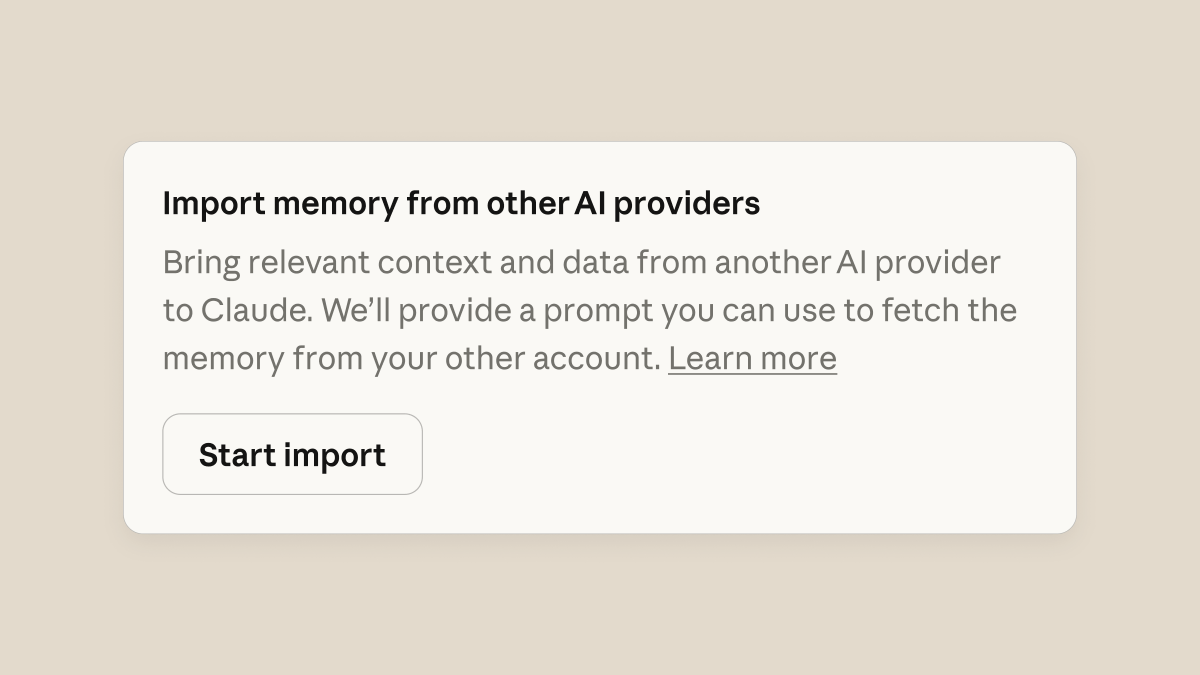
Memory is now available on the free plan. We've also made it easier to import saved memories into Claude. You can export them whenever you want.
Claude tweet media
English
1.2K
2.6K
37.9K
10.9M
Massimo Albarello
Massimo Albarello@MaxAlbarello·
Fabric enables any consumer app to start from the same prior of the user as the biggest consumer apps in the world. All your years of searching, liking and chatting, made available to your favorite AI agents. So they can feel more like friends and less like chatbots.
Fabric@buildonfabric

All consumer apps start with no prior understanding of their users - finally they can tap into Instagram's social graph! For most apps, user value is unlocked only once the app gets an accurate enough understanding of the user. Not anymore!

English
0
0
0
25
Massimo Albarello retweetledi
Fabric
Fabric@buildonfabric·
All consumer apps start with no prior understanding of their users - finally they can tap into Instagram's social graph! For most apps, user value is unlocked only once the app gets an accurate enough understanding of the user. Not anymore!
English
3
1
2
245
Massimo Albarello retweetledi
Fabric
Fabric@buildonfabric·
EeClaw (@pande_eeshita's @openclaw agent) used her Instagram stories and became more popular than her human. Eeshita gave EeClaw her Instagram stories, Google searches, and ChatGPT conversations via Fabric. Seeded her memory, gave her some tools, and got out of the way.

English
1
1
2
269
Massimo Albarello retweetledi
Eeshita Pande
Eeshita Pande@pande_eeshita·
AI agents are getting incredibly smart. But they still don’t really know you. Having worked on consumer products powered by Open Banking (@meetcleo) and IoT data (Omnia), @MaxAlbarello and I started onfabric.io at @join_ef because we believe something is missing: portable, user-controlled personal context for truly personal AI. Our belief has deepened as we use agents that show real intelligence but have gaping holes in their understanding of us e.g. ChatGPT does not know which restaurant I posted from last Saturday and Claude has no idea which book I just ordered. In real life, your preferences don’t develop in neat little boxes, one box for Google, one for Instagram, and one for ChatGPT. So why does your personal context stay siloed in Google, Instagram, YouTube, ChatGPT and every other app you use? You might use ChatGPT multiple times a day. But you also: - Post your trips on Instagram - Watch interesting videos on YouTube - Use Google to search, discover and navigate the web Right now, each app sees a slice of you. None of them see the whole person. Fabric changes that. With Fabric, you can bring rich personal context from your Instagram stories, Google searches, YouTube watch history and more into AI apps like Claude and ChatGPT. So your AIs stop being clueless agents and start feeling more like friends who actually get you. Context that evolves with you. And moves with you. Not trapped in Big Tech or Big AI. Because you should be able to use many AI products all perfectly tailored to you, instead of being forced into using one or two products that lock you in with your context. Our vision is simple: just like Visa lets you pay anywhere in the physical world with one card, Fabric lets you sign in with your personal context anywhere in the digital world. If this resonates, sign up at onfabric.io. And comment “Fabric” to get early access to our beta. I’ll reach out and personally onboard you.
English
24
24
59
5K
Massimo Albarello
Massimo Albarello@MaxAlbarello·
@integral_wizard @ajki76 We ported the tendermint rpc to the IC so we are already a good way towards integrating with other cosmos chains. Definitely need more work though in order to be generalized
English
0
0
4
32