Chris Dixon

943 posts

Chris Dixon banner
Chris Dixon

Chris Dixon

@cdixon

Programming, philosophy, history, internet, startups, crypto. Managing Partner @a16zcrypto. See disclosures: https://t.co/Ov6kKJAUpq


Katılım Mart 2007
4.7K Takip Edilen933.6K Takipçiler
Chris Dixon retweetledi
Robbie Petersen
Robbie Petersen@robbiepetersen_·
Excited to announce that I'm joining @a16zcrypto as an Investment Partner My thesis on crypto has always been the same: if you believe the arc of technological adoption bends toward efficiency, market forces will inevitably reveal that blockchains are the most efficient technology for global coordination This is already evident across stablecoins, perps, prediction markets and tokenized assets. The only bottleneck to blockchains eating the rest of global markets – and creating net new markets – is time The delta between sentiment and fundamentals has never been wider in crypto, and therefore I've never been more bullish Couldn't be more fired up to work alongside @cdixon, @alive_, @guywuolletjr, @eddylazzarin and the entire @a16zcrypto team, backing the most ambitious founders pulling this future forward!
English
241
62
977
112.8K
Chris Dixon
Chris Dixon@cdixon·
The CLARITY Act has now passed out of the Senate Banking Committee with bipartisan backing and moves to a full Senate vote - a historic moment for crypto entrepreneurs and American consumers. Crypto is not a red or blue issue. It is about whether the next generation of financial and internet infrastructure gets built in the United States. Thank you to @SenatorTimScott and @SenLummis for your leadership on the committee, to @BankingGOP, @Sen_Alsobrooks, and @RubenGallego for their support, and to all of the staff who have worked tirelessly to get to this point. It’s time to pass CLARITY.
a16z crypto@a16zcrypto

BREAKING: The Senate Banking Committee has voted to advance the CLARITY Act. Next stop: the Senate floor.

English
81
135
997
142.6K
Chris Dixon
Chris Dixon@cdixon·
The Senate Banking Committee released the latest draft of the CLARITY Act last night. The draft has significantly improved since January and reflects years of bipartisan negotiations. It’s time to get this passed. This bill safeguards consumers, includes important developer protections, and gives crypto entrepreneurs the regulatory clarity they need to build here in the U.S. We’re thankful for the hard work of the Senate Banking Committee and their staff. We urge Senators on both sides to move quickly to advance it out of Committee, to the Senate floor, and ultimately be signed into law by the President.
U.S. Senate Banking Committee GOP@BankingGOP

Chairman @SenatorTimScott, @SenLummis, and @SenThomTillis released market structure text ahead of this week’s markup.   The Senate’s CLARITY Act delivers clear rules of the road, protects investors, combats illicit finance, and keeps innovation in America. banking.senate.gov/newsroom/major…

English
68
110
813
292.6K
Chris Dixon
Chris Dixon@cdixon·
Congress has worked tirelessly to give builders the rules they need. It’s time for members of the Senate on both sides to hammer out the final details of the Clarity Act. When rules are defined, both consumers and entrepreneurs win.  The GENIUS Act unlocked stablecoin innovation. The Clarity Act can do the same across crypto.
Treasury Secretary Scott Bessent@SecScottBessent

Congress has spent the better part of half a decade trying to pass a framework to onshore the future of finance. It is time for @BankingGOP to hold a markup and send the CLARITY Act to President Trump’s desk. Senate time is precious, and now is the time to act.

English
46
84
589
214.7K
Chris Dixon retweetledi
a16z crypto
a16z crypto@a16zcrypto·
Sam Broner says that stablecoins are just the first step. "If stablecoins win, everybody succeeds. Once I'm paying every day, there's a lot of services that want to move onchain due to that gravity." "Identity is the most obvious. Then social networks begin to form on top of that. Then so do customer to merchant relationships." "As you begin to move payments onchain a lot of additional things begin to quickly follow, and those opportunities are potentially even bigger and more creative than just the simple payments, just the simple exchange." @SamBroner
English
50
42
285
39.5K
Chris Dixon
Chris Dixon@cdixon·
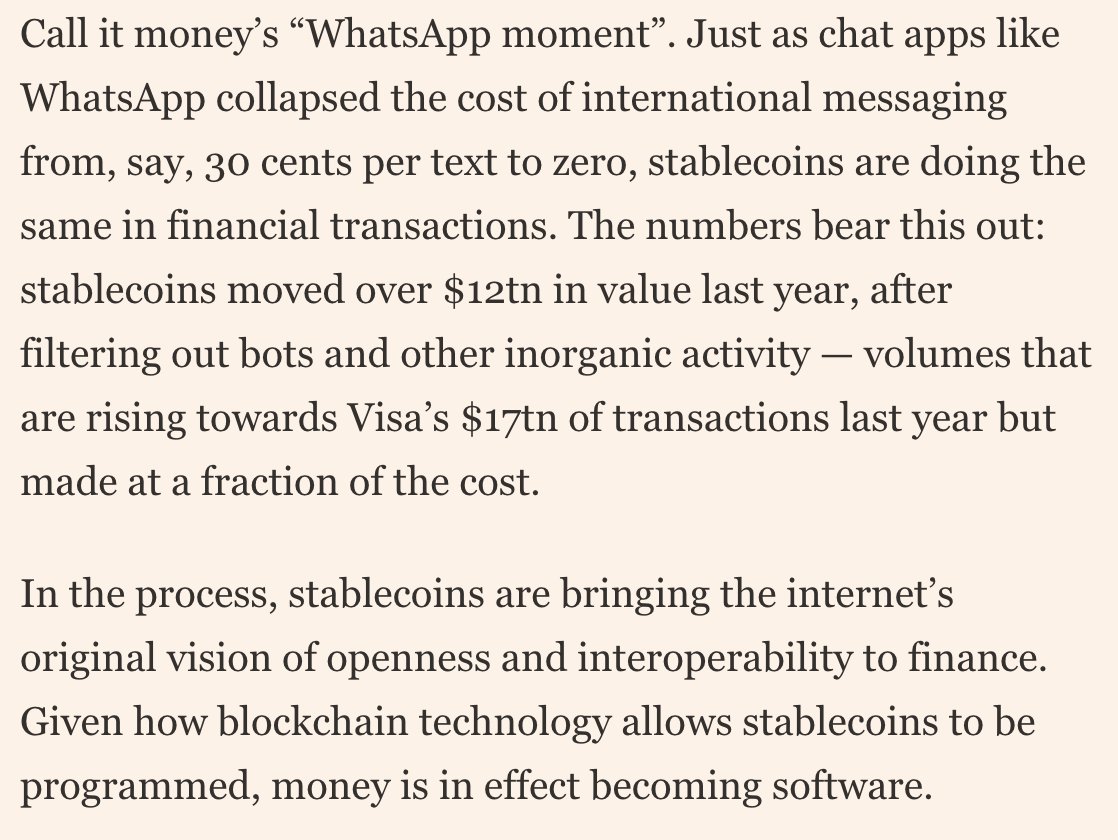
The internet made information global. Crypto is doing the same for money. I discuss how stablecoins bring the internet's original vision to finance, and this important “WhatsApp moment” in the @FT. ft.com/content/7b604d…
Chris Dixon tweet media
English
114
108
641
67.9K
Chris Dixon retweetledi
Noah Levine
Noah Levine@nlevine19·
Excited to share that I’m joining @a16zcrypto as an Investment Partner, focused crypto x fintech, payments, and onchain finance. This comes after two incredible years at @Visa helping shape our stablecoin strategy and leading onchain data efforts. Deeply grateful to @cuysheffield for his mentorship and leadership. Huge thanks to @cdixon , @AliYahya, @guywuolletjr, @eddylazzarin , and the entire a16z crypto team for the opportunity. If you’re building in the space, I’d love to connect.
Noah Levine tweet media
English
101
13
281
47.3K
Chris Dixon retweetledi
miles jennings
miles jennings@milesjennings·
People wildly underestimate how damaging bad regulation is to innovation. The lack of clear rules in crypto didn't just slow progress—it fundamentally distorted what got built, who benefited, and how markets functioned. Specifically: 1⃣Anti-Transparency—The weaponization of US securities laws meant that transparency became a liability. Builders were told to avoid speaking openly and plainly about their systems, economics, or roadmaps. They were told to avoid marketing altogether. How can startups succeed when they can’t talk about what they’re building? The forced opacity in crypto undermined trust, slowed adoption, complicated partnerships, and prevented the ecosystem from maturing as other tech sectors do. Innovation doesn’t thrive in the dark. 2⃣Adverse Selection—In an enforcement-by-ambiguity regime, trust in the rule of law diminishes. The result is the creation of powerful short term incentives for value extraction. Careful, good-faith builders moved slowly and deliberately, trying not to cross any lines, but would still get targeted by regulators. Meanwhile, profiteers moved quickly to capture attention, capital, and users, and then would disappear before the regulators knew what happened. Naturally, products were optimized for greed and product market fit became an afterthought. That's unsustainable for any industry, not just crypto. When regulations incentivize bad outcomes over good, that’s exactly what happens. 3⃣Structural Contortions—When no one is playing by the same rules, the lowest common denominator becomes the default. Shortcuts to decentralization, dubious Cayman Island foundation structures, token distributions optimized for legal superstition, and governance systems excluding the people actually building all became the norm. These contortions eroded all of crypto’s strengths—openness, decentralization, and shared ownership—and made the alignment of incentives impossible. Innovation doesn’t happen without incentive alignment. 4⃣Inefficient Markets—Capital efficiency and rational pricing don't emerge organically in distorted markets. Crypto might be the largest experiment ever to demonstrate that without a baseline regulatory framework, markets drift towards vibes over fundamentals. They become less rational, not more. The disastrous U.S. regulatory approach is what drove cycles of memecoins and nihilism instead of innovation. Markets need rules. ———— Given the above, what’s striking, is not that crypto hasn’t yet delivered on expectations. What’s striking is that it made it to this point, where it sits on the precipice of overcoming all of these distortions. The GENIUS Act has already legitimized dollars onchain. Project Crypto at the SEC and CFTC are legitimizing securities, derivatives, and other assets onchain. And the CLARITY Act will legitimize the building of the blockchain networks that underpin all of these and other use cases. With CLARITY, builders can speak plainly. Economic models can be pursued. Roadmaps can be published. Governance can include builders. And guardrails against profiteers, rugpulling, and self-dealing become the norm. Innovation can happen without distortion. CLARITY doesn’t guarantee success. But it does create the world’s first regulatory framework for building open networks rather than companies—It creates a legal architecture that finally matches crypto’s technical architecture. Once that happens, crypto can finally use its strengths at scale. In that world, crypto's opportunity looks a lot more obvious.
English
42
45
272
59.3K
Chris Dixon retweetledi
Ali Yahya
Ali Yahya@alive_·
Making the uses of money 1,000x cheaper, faster, and more programmable unlocks a massive new design space. This leap is similar to the one from the postal service to the internet, which unlocked multi-trillion dollar companies like Google and Amazon. It’s a failure of imagination to think that all that crypto has to offer is “finance, but faster.” Quantity has a quality all of its own.
Jesse Walden@jessewldn

If you assume all finance and markets are becoming programmable onchain, you should probably also entertain an expansionary view of what “finance” will look like in the end state. I think that is the nuanced through line that is being missed in the debate.

English
34
16
181
46.5K