Maximilian Kroner Dale

252 posts

Maximilian Kroner Dale banner
Maximilian Kroner Dale

Maximilian Kroner Dale

@MaxKronerDale

Researching AI governance and online harms. FLF | Meta | GovAI winter fellow. Formerly at @oiioxford and @B_I_Team

San Francisco Katılım Aralık 2012
482 Takip Edilen198 Takipçiler
Maximilian Kroner Dale retweetledi

Karri Saarinen
Karri Saarinen@karrisaarinen·
A common dynamic I observe with AI: it feels most impressive when you don’t know much about the subject, don’t care or don’t have a clear idea of what the you want. This applies across design, code, legal, and more. If I don’t know code very well, every piece of code it writes feels very impressive. Once you know what something should feel or look like, it becomes almost impossible to guide AI there. And you definitely can’t one-shot it.
English
254
395
3.5K
562.1K
Maximilian Kroner Dale retweetledi
smitha milli
smitha milli@SmithaMilli·
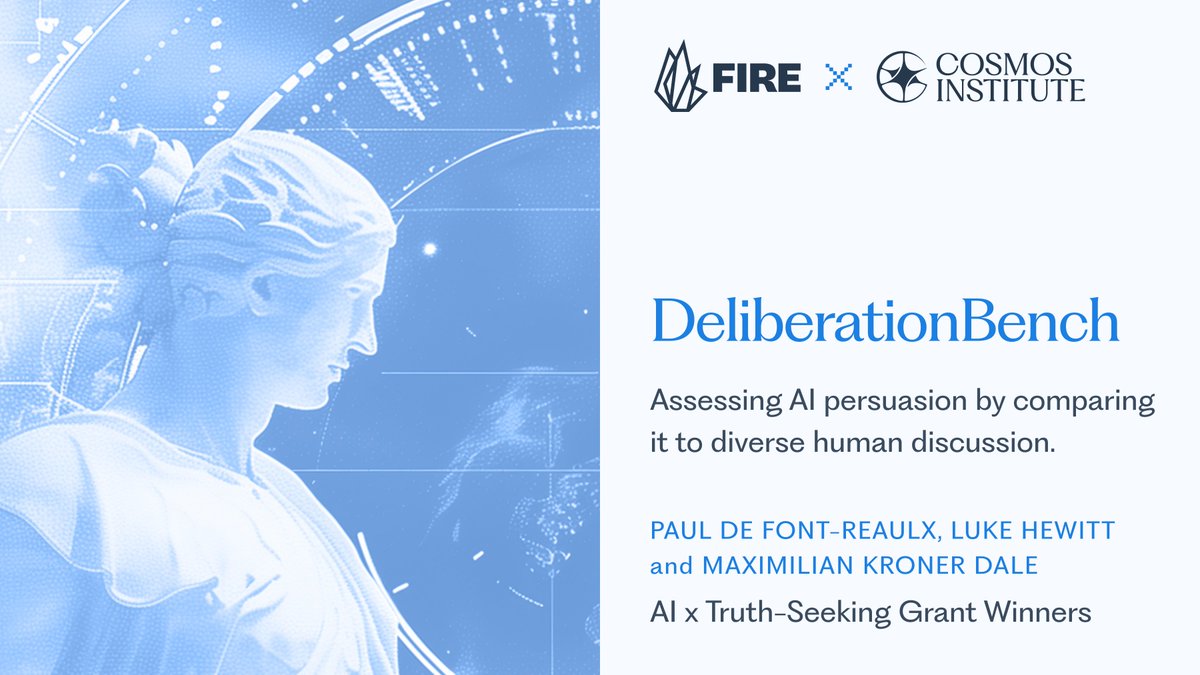
This FT article went way too viral... The study used no real humans. The simulations of humans are basic---LLMs prompted with political beliefs. They assume the synthetic human updates their political beliefs as a weighted average of their original position and the chatbot's response. I'd like to highlight some more exciting work by @MaxKronerDale @PReaulx @lukebeehewitt on "DeliberationBench" arxiv.org/abs/2603.10018 Chatbots will inevitably influence people. The question is whether that influence is procedurally legitimate. A useful comparison is deliberation: a process which we consider to produce procedurally legitimate opinion change, e.g., en.wikipedia.org/wiki/Deliberat… In the "DeliberationBench" paper, they find that after talking to a chatbot, people on average, change their opinions similarly to how they would if they participated in a deliberation on the same topic. This provides some evidence that models may be producing epistemically desirable changes because they move people in the same direction that a process with procedural legitimacy does. Note that this doesn't directly answer whether the process the _model_ used was legitimate. A model could lie to the user but still get them to the deliberative outcome. To address that, we should try to directly align models with the deliberative ideals which give deliberation procedural legitimacy in the first place, something I argued for in my IASEAI'25 talk youtube.com/watch?v=NoM1Bg…
YouTube video
YouTube
Rob Wiblin@robertwiblin

Really great news I would say: "Social media is populist and polarising. AI may be the opposite." – @jburnmurdoch in the FT

English
2
18
66
6.9K
Maximilian Kroner Dale retweetledi
smitha milli
smitha milli@SmithaMilli·
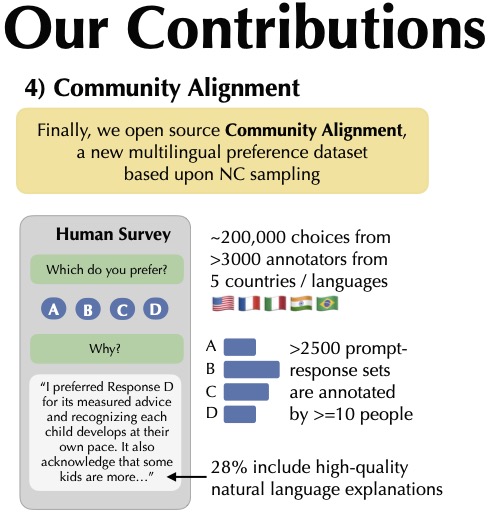
Finally, based on these insights we collect Community Alignment (CA). Features include: - NC-sampled candidate responses - Multilingual - >2500 prompts are annotated by >= 10 people - Natural language explanations for > 1/4 of choices and more!
smitha milli tweet media
English
1
1
9
725
Maximilian Kroner Dale
Maximilian Kroner Dale@MaxKronerDale·
I was glad to serve as an external advisor on this Community Alignment initiative. Culture has been a relatively neglected dimension of alignment research. This is an important step toward producing AI systems that can reflect pluralistic values.
smitha milli@SmithaMilli

Today we're releasing Community Alignment - the largest open-source dataset of human preferences for LLMs, containing ~200k comparisons from >3000 annotators in 5 countries / languages! There was a lot of research that went into this... 🧵

English
0
0
1
102
Maximilian Kroner Dale retweetledi
Andrew Curran
Andrew Curran@AndrewCurran_·
General agreement between both groups that the government will not go far enough in regulating AI.
Andrew Curran tweet media
English
2
6
31
1.7K
Maximilian Kroner Dale
Maximilian Kroner Dale@MaxKronerDale·
My copy of Thinking Fast & Slow has more annotations than nearly any other book I own. Daniel Kahneman’s research, which I stumbled across just before college, was a huge influence in my choice of career path. We’re lucky so much of his work lives on. RIP Daniel Kahneman.
English
0
0
3
209
Maximilian Kroner Dale
Maximilian Kroner Dale@MaxKronerDale·
Really excited to announce that these exciting results are now peer-reviewed and published in @JUAurban! Extending the initial work, a conservative cost-benefit analysis found that the intervention was a positive return on investment. #ChoiceArchitecture #VisionZero
Maximilian Kroner Dale@MaxKronerDale

I am delighted to share the results of our project (@BITAmericas) with @sfmta_muni. Using rigorous methods, we found that speed bumps & delineator posts causally reduced the speed of left-turning cars by 17% bi.team/press-releases… (1/3)

English
1
0
7
332
Maximilian Kroner Dale
Maximilian Kroner Dale@MaxKronerDale·
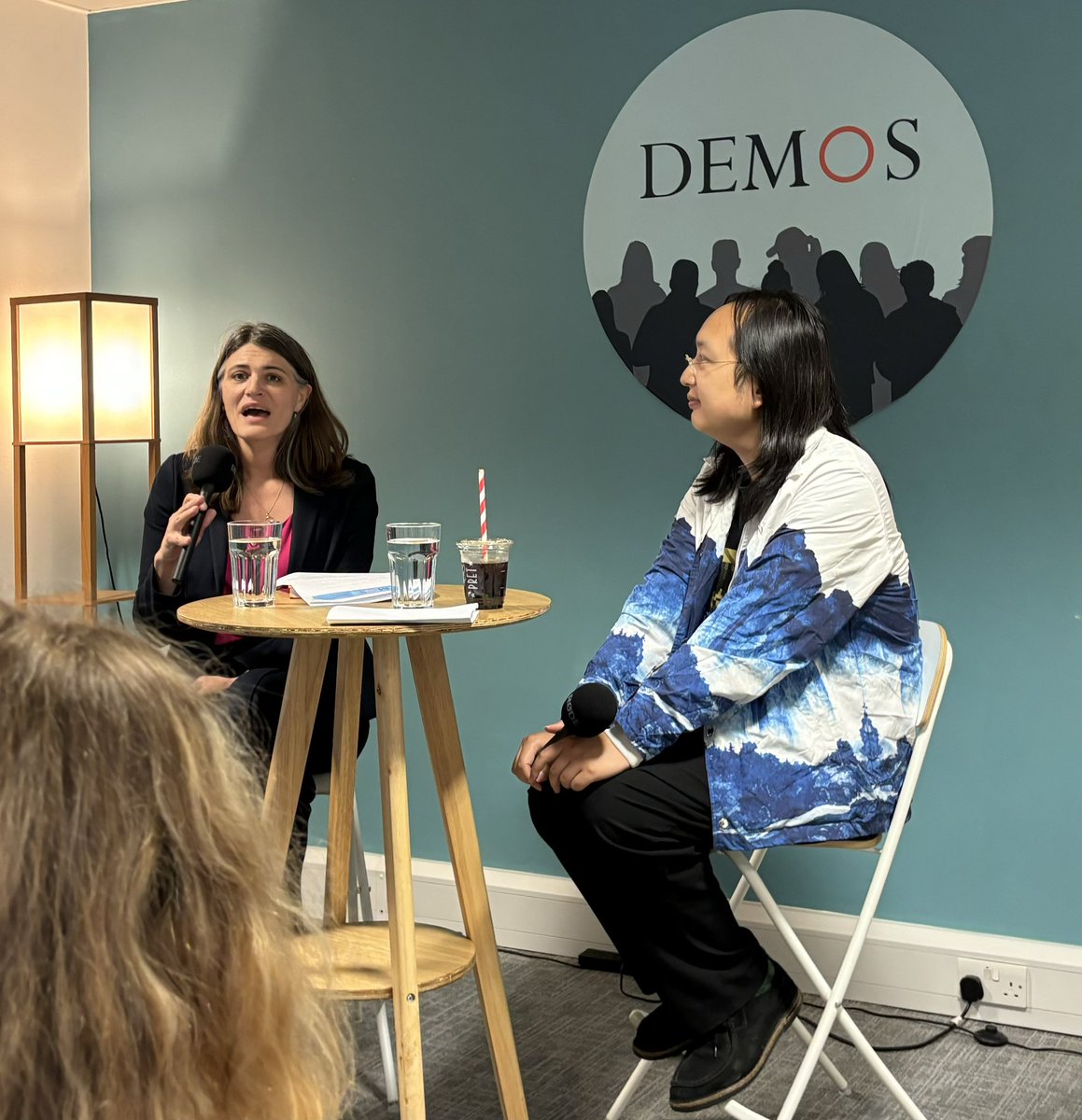
Strong turnout at the Oxford Generative AI Summit @OxGenAI. Currently listening to @chloesmith, MP, talk about the UK’s progress on AI regulation.
Maximilian Kroner Dale tweet media
English
0
0
4
251
Maximilian Kroner Dale
Maximilian Kroner Dale@MaxKronerDale·
More on Meta’s Global Community Forum. If all goes well, I think this could be a big leap in #PlatformDemocracy (h/t @metaviv). There’s also plenty to learn about how to make such processes work effectively. Maybe of interest to @CaseyNewton
BIT@B_I_Team

🤔Our work with @Meta is showing the power of deliberative democracy in empowering users to help shape the rules of platforms Wisdom really can come from crowds 💡 bi.team/blogs/helping-… @DavidHalpernCEO @Lis_Costa_ @mhallsworth

English
0
0
4
0
Maximilian Kroner Dale retweetledi
Aviv Ovadya 🥦
Aviv Ovadya 🥦@metaviv·
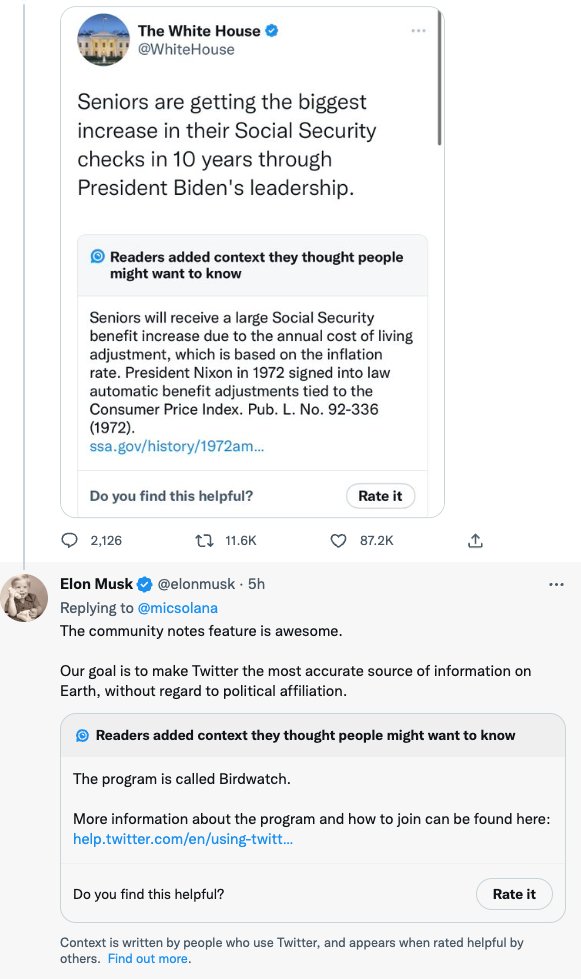
Twitter @Birdwatch has been going viral today since @elonmusk brought it up today—with a fact check of the @WhiteHouse. 🔥🔥🔥 It implements ~bridging-based ranking from my report: belfercenter.org/publication/br… Check out the 🧵 below for detail on what exactly it is and how it works.
Aviv Ovadya 🥦 tweet media
Aviv Ovadya 🥦@metaviv

This is incredibly exciting, and great model for what we need more of going forward. Most social media has a "bias toward division." 😡 @Birdwatch introduces a counteracting force. It uses a form of bridging-based ranking (belfercenter.org/publication/br…) to overcome that bias. /1

English
2
5
14
0