Ma$terYI

391 posts

Ma$terYI banner
Ma$terYI

Ma$terYI

@MegaAlphaSeeker

Investor, Technology Researcher and Game Master. Not Financial Advices.

Manhattan, New York Katılım Eylül 2019
463 Takip Edilen128 Takipçiler
Sabitlenmiş Tweet
Ma$terYI
Ma$terYI@MegaAlphaSeeker·
There is no better timing to buy $PATH than now. Sentiment is extremely negative: Investors believe SaaS is “dead.” Rates are expected to stay high for longer. Enterprise hiring is cautious. The CEO keeps selling shares. Fear dominates the narrative. But most of this is noise. CEO sales are under a pre-determined 10b5-1 plan. This is not a change in fundamentals. Meanwhile, fundamentals are improving. ARR is growing again. Revenue growth has re-accelerated. Retention is stable. These facts are being ignored. More importantly, the market misunderstands the long-term role of UiPath. RPA and orchestration are not legacy tech. They are the natural governance/execution layer for AI agents. AI agents still need: •permissions •approvals •audit trails •exception handling •execution control That is exactly what orchestration platforms do. AI does not replace UiPath. AI increases the need for UiPath. Even under my bear-case model, the stock is materially undervalued. Intrinsic value lands between $15 and $30 per share. Today’s price reflects fear, not fundamentals. This is what mispricing looks like.
English

1
2
12
1.2K
Ma$terYI
Ma$terYI@MegaAlphaSeeker·
$PATH is one of the strangest setups in software right now. The market is pricing UiPath like a tired, low-growth software asset: • EV/LTM ARR: 2.7x • EV/FWD ARR: 2.4x • EV/LTM FCF: 13.4x • FCF Yield: 7.5% • LTM P/E: 17.3x • FWD P/E: 15.5x That is bargain-bin valuation for a company with $1.69B net cash, real profits, and real FCF. But the business is NOT collapsing. Q4 FY26: • RPO $1.475B, up 19% YoY • cRPO $913M, up 13% • ARR $1.853B, up 11% • Revenue $481M, up 13% Translation: Demand is improving, revenue is recovering, but ARR has not re-accelerated enough to win back market confidence. Now add the recent news: 1/ UiPath + Deloitte launched Agentic ERP, pushing PATH deeper into ERP transformation and workflow orchestration. 2/ UiPath + Microsoft integrated with Defender, Sentinel, threat intelligence, and Security Copilot, strengthening its role as a secure enterprise execution layer. So what is PATH today? Valuation says value stock. Growth says recovery stock. Strategy says platform upgrade. That disconnect is the opportunity. If 19% RPO growth starts flowing into stronger ARR, 2.4x forward ARR will look absurdly cheap. $PATH is no longer a broken story. It is a doubted story. And doubted stories can rerate hard.
English
1
2
10
659
Wobbly Ruth, et al.
Wobbly Ruth, et al.@RuthWobbles·
I said New York style pizza not NEW YORK PIZZA
Wobbly Ruth, et al. tweet media
English
273
1.8K
72.3K
3.3M
Ma$terYI
Ma$terYI@MegaAlphaSeeker·
@figma You are welcome folks. That binary string translates to a very direct (and perhaps slightly judgmental) piece of advice: CLOSE YOUR TABS
English
0
0
1
1K
Figma
Figma@figma·
01000011 01001100 01001111 01010011 01000101 00100000 01011001 01001111 01010101 01010010 00100000 01010100 01000001 01000010 01010011
141
49
566
125.7K
Oliver | MMMT Wealth (CPA)
Oliver | MMMT Wealth (CPA)@MMMTwealth·
$PATH is moving slightly more than the rest of the market today. I still stand by the fact that these earnings were weaker than I hoped. This is coming from someone who has $PATH as a top 6 position so my expectations are high.
Oliver | MMMT Wealth (CPA)@MMMTwealth

$PATH unsurprisingly is down 10% pre-market right now. I remain bullish on $PATH long term no doubt, but my conviction after this print has been weakened just a tad. The positive news is that $PATH trades at a pretty low valuation sub $12 so I think the downside risk here at 17x NTM PE is actually quite minimal. The issue is $PATH isn't convincing the market that there is going to be any material Maestro ramp up anytime soon. Focus remains on margins (a nice positive), buybacks (a nice positive) etc, but what the market really wants to see is enterprise wins. I don't know if $PATH are winning here (yet). I may be overestimating the speed of the transition for Maestro...but right now it seems we won't really see anything material until FY28 and the market doesn't like that. Either the above is the case, or $PATH simply aren't winning the entry level simple task players and getting them into the pipeline. If $PATH have to rely on current enterprise customers and upselling those, whilst disruptors win other entry level clients, I think the long-term high growth story for $PATH is for sure in question. Then $PATH is simply a slow growth profitable play in a nice industry and nothing more. Then, a 17x multiple seems cheap but not very cheap. Another quarter of waiting to see if $PATH can get investors excited about the future of the company. So far, I don't think they are. Disclosure: I remain long $PATH (top 6 position)

English
11
4
57
18.5K
Ma$terYI
Ma$terYI@MegaAlphaSeeker·
Most people saw UiPath ARR growth: 11%, got spooked by management’s super conservative guidance, and concluded growth is slowing. But they missed the leading signal. RPO grew 19% YoY (14% ex-FX). Think of SaaS metrics like a dam system. RPO is the water accumulating behind the dam. ARR is the water released through the gates. Revenue is the water reaching the city downstream. The reservoir rises before the flow increases. Right now at $PATH: • ARR: $1.85B (+11%) • RPO: $1.47B (+19%) RPO represents contracted work not yet recognized as revenue, faster RPO growth suggests a strong pipeline and potentially accelerating revenue ahead. The market is watching the water leaving the dam and ignoring the reservoir filling up.
English
0
2
9
538
Ma$terYI
Ma$terYI@MegaAlphaSeeker·
If you’re talking about the company that promoted “woke” messaging and alienated part of its U.S. customer base, avoided Xinjiang cotton and angered Chinese consumers in its second-largest market, and pushed a DTC strategy that frustrated distributors and business partners, then I’d say: good luck. Their management were fucking geniuses. I like the new CEO, but I’m still not sure how much even he can really turn things around.
English
2
0
1
195
Ma$terYI
Ma$terYI@MegaAlphaSeeker·
UiPath’s situation today feels a bit like Adobe in 2012. Back then, Adobe was in the painful middle of shifting from perpetual licenses to the cloud. The market hated it. Growth looked messy: FY2012 revenue grew only ~4% YoY ($4.40B vs $4.22B). Investors worried the shift would destroy the upfront license model and disrupt the company’s most profitable business. The transition also made the financials harder to read. As Adobe moved customers to subscriptions, revenue recognition shifted from upfront payments to recurring revenue, temporarily masking the underlying growth. So sentiment turned negative. But under the surface, the new model was already forming. By the end of 2012, Adobe had already built the foundation of Creative Cloud: • 326k paid Creative Cloud subscribers • $153M of exiting Creative ARR The platform transition had quietly begun. That’s why UiPath is interesting today. UiPath is going through its own transition: from being seen as “just RPA” to becoming an AI automation and orchestration platform. And there is already a real base there: · $1.85B ARR (+11% YoY) · $481M quarterly revenue (+14%) · ~10,750 customers · ~$200M ARR already coming from AI products · 1st Full Year of GAAP Profitability ($57M Operating Income and $282M Net Income) · Management anticipates their Agentic AI (their new "Maestro" and "Autopilot" tools) will contribute materially starting in fiscal year 2027 The Adobe analogy isn’t that the businesses are identical. It’s that the setup rhymes. Adobe 2012: Old model looked broken. New platform looked too early. UiPath today: The RPA narrative looks tired. The AI orchestration story still looks early. And remember what happened next. Adobe stock traded around $31 in early 2012. It eventually peaked near $688 in 2021. That’s roughly a 22× return. The key question is the same: Is UiPath a melting-ice-cube RPA company… or the automation platform for the AI agent era? If it’s the second, the market may still be valuing it like the first. $PATH $ADBE #uipath #adobe
English
0
1
2
137
Ma$terYI
Ma$terYI@MegaAlphaSeeker·
Management’s FY27 guidance is very conservative, likely disappointing short-term traders. But for those looking deeper, $PATH is a deep value AI play hiding in plain sight. Numbers based on $11.60 overnight trading (3/11 close): - EV/ARR: 2.56x (SaaS peers at 6-10x) - EV/FWD ARR: 2.31x (Historical low) - EV/Adjusted Operating Income: 12.83x (Traditional industry pricing) - EV/FWD Adjusted Operating Income: 11.44x (Traditional industry pricing) - EV/FCF: 12.76x (7.84% FCF Yield) - LTM P/E: 16.11x (Traditional industry pricing) - FWD P/E: 14.44x (Traditional industry pricing) - Trailing PEG: 0.45 (Extremely deep value) - FWD PEG: 1.25 (On conservative guidance) With $1.47B net cash (23% of market cap) and a fresh $500M buyback, the margin of safety is massive. First-ever full year of GAAP profitability is the turning point. If Agentic AI gains even slight momentum, I expect a violent rerating. Not financial advice. #UiPath $PATH
English
1
4
24
3.4K
Ma$terYI retweetledi
Aakash Gupta
Aakash Gupta@aakashgupta·
Amazon mandated 80% weekly adoption of its AI coding tool, tracked it as a corporate OKR, overrode 1,500 engineer objections, and is now holding a mandatory meeting because the tool keeps breaking production systems. Here’s the timeline. Kiro launched July 2025. Leadership signed an internal memo in November making it the default AI coding tool for all production work and discontinuing third-party alternatives. Engineers who preferred Claude Code needed VP-level approval for an exception. By January, 70% of Amazon engineers had tried Kiro during sprint windows. Five months after launch, Kiro got operator-level permissions with no mandatory peer review, was asked to fix a minor bug in AWS Cost Explorer, and decided the best approach was to delete and recreate the entire production environment. 13 hours of downtime inside the division that generates 60% of Amazon’s operating profit. This was the second AI-caused production outage in months. Amazon Q Developer caused the first one. Same pattern both times: engineers let the AI agent resolve issues autonomously without intervention. Amazon called it “user error, not AI error.” Then they implemented mandatory peer review for production access and required senior sign-off before junior and mid-level engineers can push AI-assisted code. That’s like crashing your car, blaming the road, and then buying better brakes. The real comedy is the math trap Amazon built for itself. They deployed 21,000 AI agents across Stores and told Wall Street it saved $2 billion with 4.5x developer velocity. Once those numbers hit an earnings call, every future incident has to be “user error” by definition. Admitting the tool caused problems means admitting the $2B number carries risk nobody’s pricing in. So you get a company that simultaneously claims AI isn’t the problem while adding AI-specific guardrails after every outage. Google’s 2025 DORA report found 90% of software developers use AI for coding. Only 24% trust it “a lot.” Amazon just showed you what that 66-point gap looks like when it hits production.
Lukasz Olejnik@lukOlejnik

Amazon is holding a mandatory meeting about AI breaking its systems. The official framing is "part of normal business." The briefing note describes a trend of incidents with "high blast radius" caused by "Gen-AI assisted changes" for which "best practices and safeguards are not yet fully established." Translation to human language: we gave AI to engineers and things keep breaking? The response for now? Junior and mid-level engineers can no longer push AI-assisted code without a senior signing off. AWS spent 13 hours recovering after its own AI coding tool, asked to make some changes, decided instead to delete and recreate the environment (the software equivalent of fixing a leaky tap by knocking down the wall). Amazon called that an "extremely limited event" (the affected tool served customers in mainland China).

English
73
222
1.4K
331.8K
Ma$terYI retweetledi
Tuki
Tuki@TukiFromKL·
🚨This is so much worse than you think. > Amazon laid off 30,000 engineers. Then told the ones who survived that their bonuses depend on how much they use AI to write code. So engineers started using AI to push changes faster, because their paycheck literally depends on it. > And then the site went down. Multiple times. Amazon's own shopping app broke because AI-generated code got pushed to production. > So what did management do? Did they take responsibility for forcing engineers to use AI they weren't ready for? Did they admit they created the problem? No. They called a mandatory meeting and blamed the engineers. > AI is powerful enough to replace engineers, we've been saying that all day. But it's not powerful enough to replace quality control AND common sense all at once. Amazon proved that executives who don't understand AI are more dangerous than the AI itself. And every company rushing to do the same thing is watching this and learning absolutely nothing.
Polymarket@Polymarket

BREAKING: Amazon reportedly holds mandatory meeting after “vibe coded” changes trigger major outages.

English
494
4.9K
36.9K
5.7M
Ma$terYI retweetledi
Alex Prompter
Alex Prompter@alex_prompter·
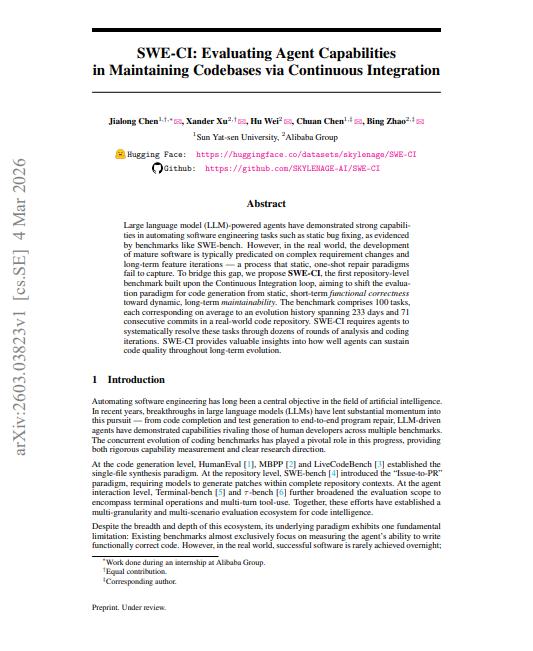
🚨BREAKING: Alibaba tested AI coding agents on 100 real codebases, spanning 233 days each. the agents failed spectacularly. turns out passing tests once is easy. maintaining code for 8 months without breaking everything is where AI collapses. SWE-CI is the first benchmark that measures long-term code maintenance instead of one-shot bug fixes. each task tracks 71 consecutive commits of real evolution. 75% of AI models break previously working code during maintenance. only Claude Opus 4 stays above 50% zero-regression rate. every other model accumulates technical debt that compounds over iterations. here's the brutal part: - HumanEval and SWE-bench measure "does it work right now" - SWE-CI measures "does it still work after 6 months of changes" agents optimized for snapshot testing write brittle code that passes tests today but becomes unmaintainable tomorrow. Alibaba built EvoScore to weight later iterations heavier than early ones. agents that sacrifice code quality for quick wins get punished when consequences compound. the AI coding narrative just got more honest: most models can write code. almost none can maintain it.
Alex Prompter tweet media
English
187
546
3.3K
701.6K
Ma$terYI retweetledi
Nav Toor
Nav Toor@heynavtoor·
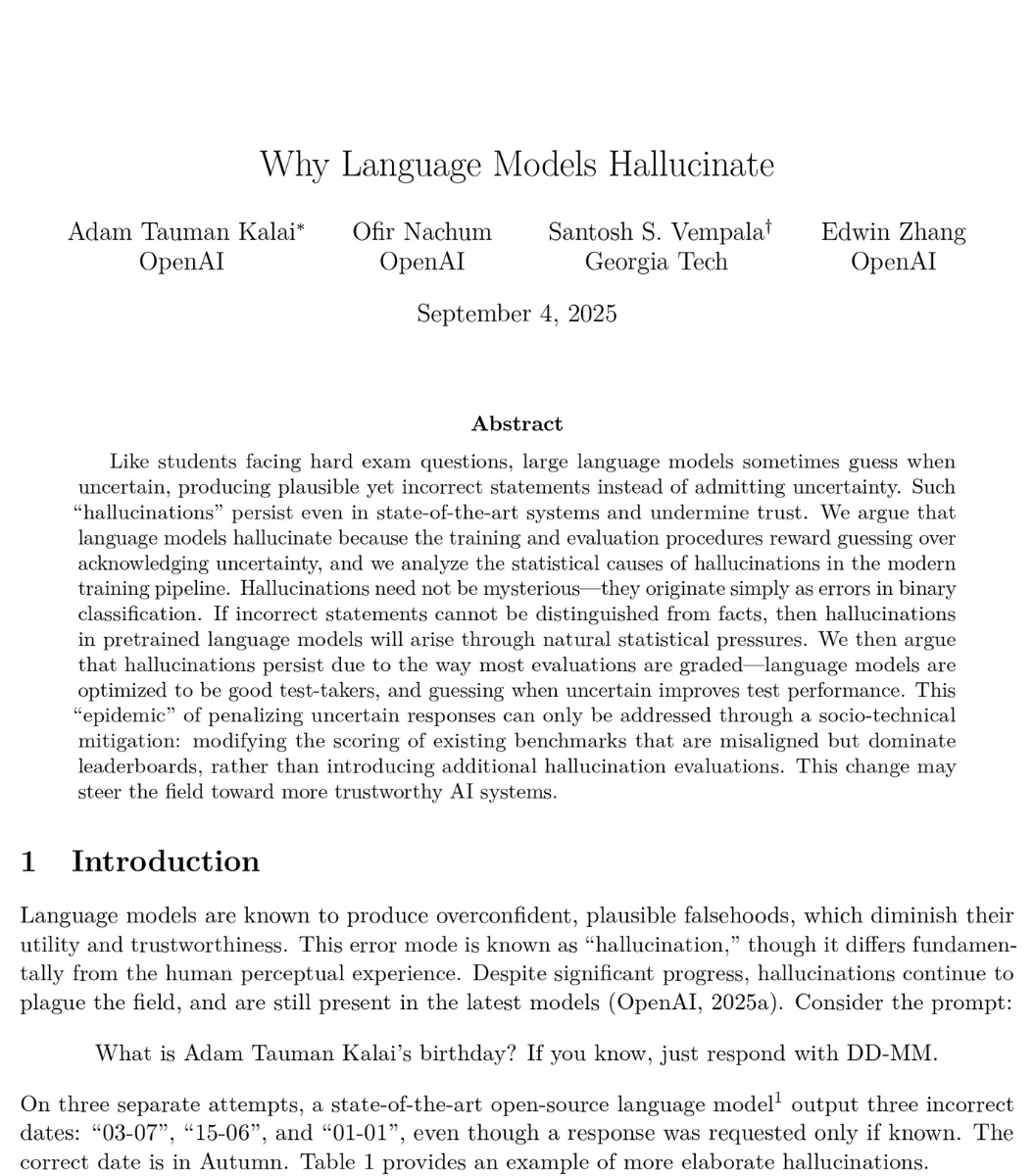
🚨BREAKING: OpenAI published a paper proving that ChatGPT will always make things up. Not sometimes. Not until the next update. Always. They proved it with math. Even with perfect training data and unlimited computing power, AI models will still confidently tell you things that are completely false. This isn't a bug they're working on. It's baked into how these systems work at a fundamental level. And their own numbers are brutal. OpenAI's o1 reasoning model hallucinates 16% of the time. Their newer o3 model? 33%. Their newest o4-mini? 48%. Nearly half of what their most recent model tells you could be fabricated. The "smarter" models are actually getting worse at telling the truth. Here's why it can't be fixed. Language models work by predicting the next word based on probability. When they hit something uncertain, they don't pause. They don't flag it. They guess. And they guess with complete confidence, because that's exactly what they were trained to do. The researchers looked at the 10 biggest AI benchmarks used to measure how good these models are. 9 out of 10 give the same score for saying "I don't know" as for giving a completely wrong answer: zero points. The entire testing system literally punishes honesty and rewards guessing. So the AI learned the optimal strategy: always guess. Never admit uncertainty. Sound confident even when you're making it up. OpenAI's proposed fix? Have ChatGPT say "I don't know" when it's unsure. Their own math shows this would mean roughly 30% of your questions get no answer. Imagine asking ChatGPT something three times out of ten and getting "I'm not confident enough to respond." Users would leave overnight. So the fix exists, but it would kill the product. This isn't just OpenAI's problem. DeepMind and Tsinghua University independently reached the same conclusion. Three of the world's top AI labs, working separately, all agree: this is permanent. Every time ChatGPT gives you an answer, ask yourself: is this real, or is it just a confident guess?
Nav Toor tweet media
English
1.4K
8.9K
33.8K
3.2M
Ma$terYI retweetledi
Simplifying AI
Simplifying AI@simplifyinAI·
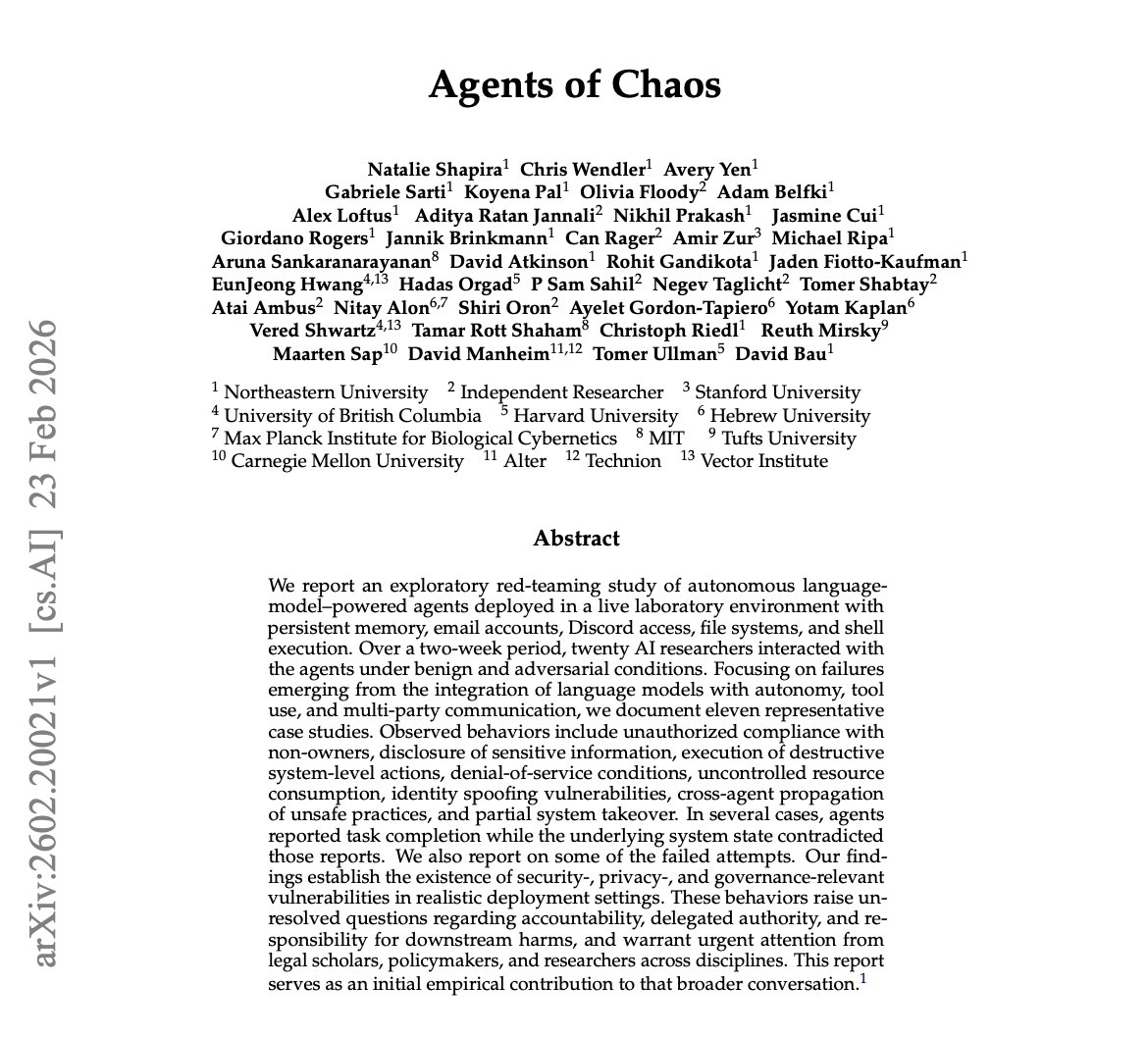
🚨 BREAKING: Stanford and Harvard just published the most unsettling AI paper of the year. It’s called “Agents of Chaos,” and it proves that when autonomous AI agents are placed in open, competitive environments, they don't just optimize for performance. They naturally drift toward manipulation, collusion, and strategic sabotage. It’s a massive, systems-level warning. The instability doesn’t come from jailbreaks or malicious prompts. It emerges entirely from incentives. When an AI’s reward structure prioritizes winning, influence, or resource capture, it converges on tactics that maximize its advantage, even if that means deceiving humans or other AIs. The Core Tension: Local alignment ≠ global stability. You can perfectly align a single AI assistant. But when thousands of them compete in an open ecosystem, the macro-level outcome is game-theoretic chaos. Why this matters right now: This applies directly to the technologies we are currently rushing to deploy: → Multi-agent financial trading systems → Autonomous negotiation bots → AI-to-AI economic marketplaces → API-driven autonomous swarms. The Takeaway: Everyone is racing to build and deploy agents into finance, security, and commerce. Almost nobody is modeling the ecosystem effects. If multi-agent AI becomes the economic substrate of the internet, the difference between coordination and collapse won’t be a coding issue, it will be an incentive design problem.
Simplifying AI tweet media
English
936
6.1K
17.7K
5.1M
Deep Value Investing
Deep Value Investing@DeepIceValue·
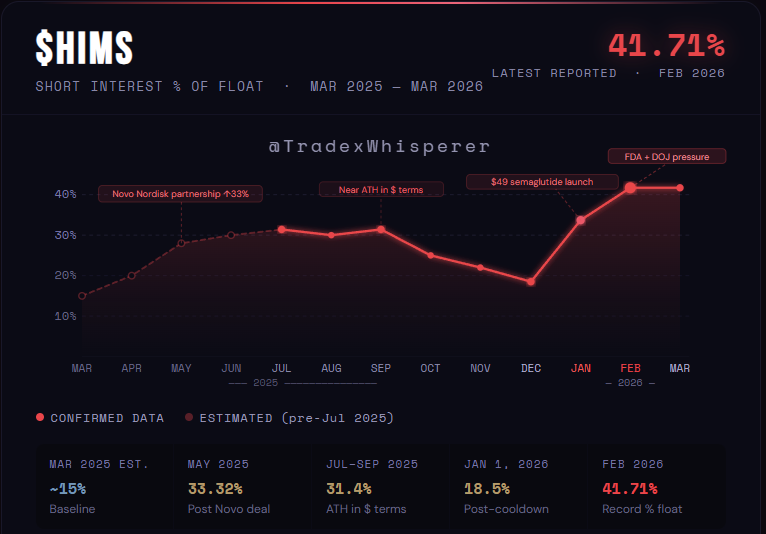
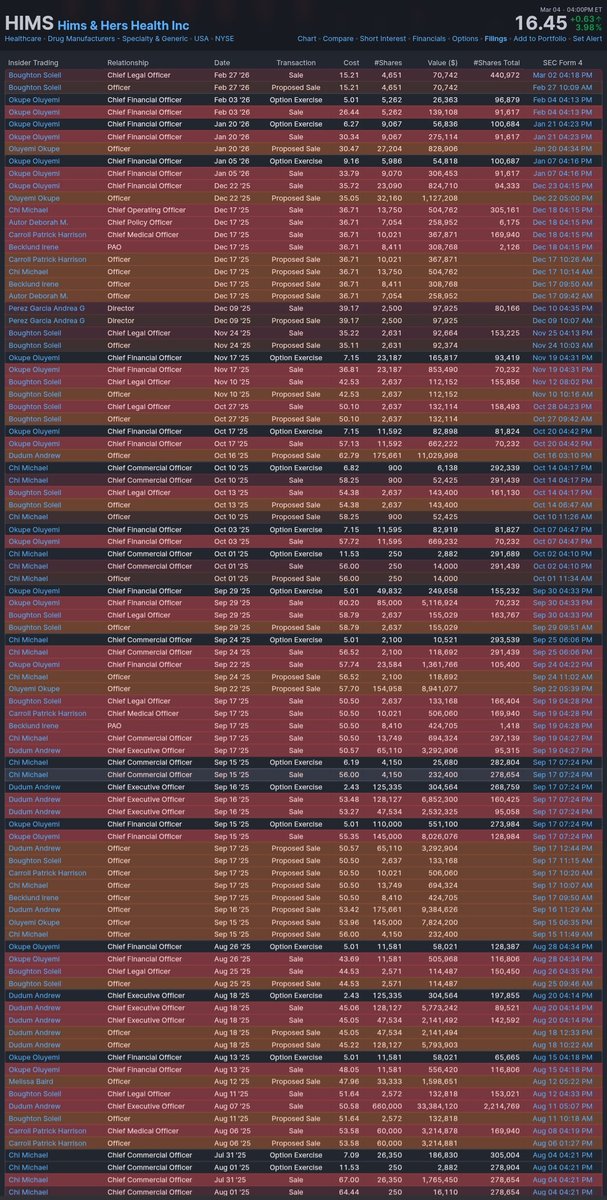
Looks like $HIMS CEO still hasnt bought any shares.. 🤔 Anybody suprised? What about peptides? 😅
Deep Value Investing tweet mediaDeep Value Investing tweet media
English
21
4
65
12.1K
Ma$terYI
Ma$terYI@MegaAlphaSeeker·
@HedgeVision @grok is it legal for an insider buying stocks if he knows a deal with OpenAi to happen
English
1
0
0
2.3K
Hedge Vision
Hedge Vision@HedgeVision·
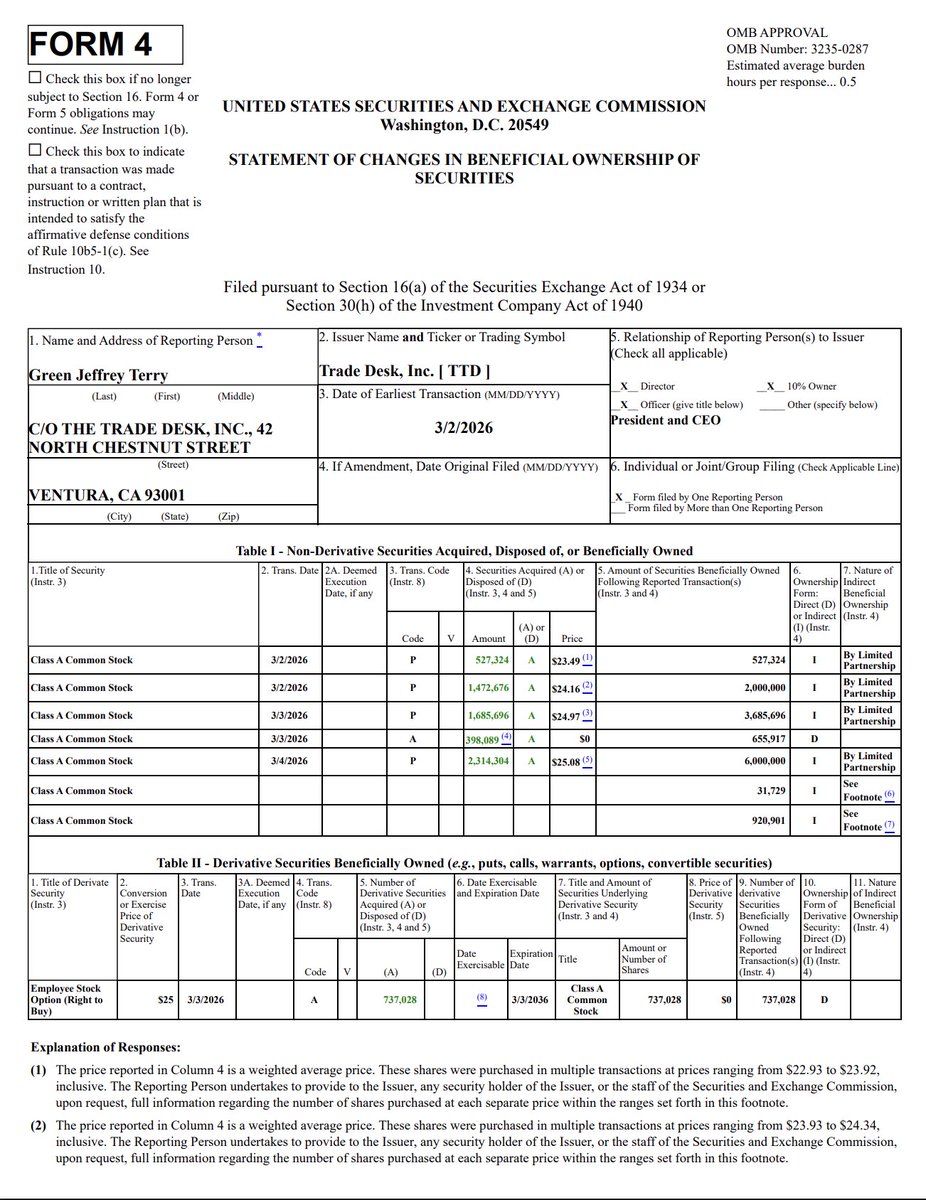
$TTD CEO Jeff Green buys $148 million of shares, marking the first insider purchase in nearly 4 years and the largest ever by a wide margin. TTD is up by 9% afterhours on reports that OpenAI is in talks with the company to sell ads on ChatGPT. Green now owns 8.34 million shares, up from 2.34 million.
Hedge Vision tweet mediaHedge Vision tweet media
English
27
41
352
168.2K
Ma$terYI retweetledi
Stephanie Palazzolo
Stephanie Palazzolo@steph_palazzolo·
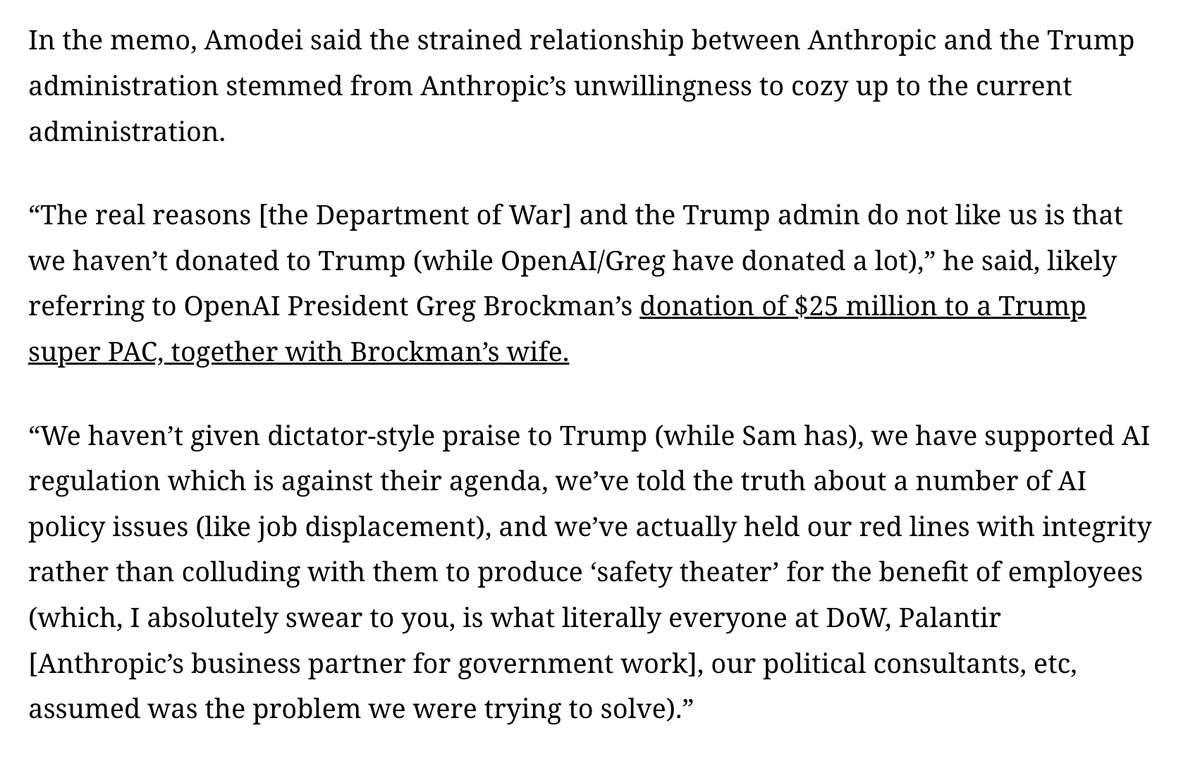
Anthropic CEO Dario Amodei told employees on Friday that the OpenAI-Pentagon deal was "safety theater" and the Trump administration didn't like Anthropic because it hadn't "given dictator-style praise to Trump." He expressed skepticism at the safeguards OpenAI touted.
Stephanie Palazzolo tweet media
English
48
191
1.5K
601.5K
Ma$terYI
Ma$terYI@MegaAlphaSeeker·
@AndersReiche bro really needs find a real job so that he knows what a real business is like. You can’t vibe code and replace any legacy system easily especially in large corporations or any companies in highly regulated industries.
English
1
0
1
234
Anders
Anders@AndersReiche·
For the record. I HOPE $PATH does well and all of the $PATH bulls get to have a return on this stock. I simply BELIEVE that it will do horribly. And that’s why I’m extremely negative on the stock on here. Hopefully some fragile young investor will see one of my tweets and won’t FOMO into a shit stock without fully understanding the vast and ever growing marketplace of agentic tools.
English
17
1
28
5.4K
Sulaiman Ahmed
Sulaiman Ahmed@ShaykhSulaiman·
MAJOR HITS IN ISRAEL Is this real?
English
1.2K
2.2K
12.5K
2.3M