Mert · AI Architect

2.7K posts

Mert · AI Architect banner
Mert · AI Architect

Mert · AI Architect

@MertLovesAI

Architect opinions on every AI move that matters. Field notes from inside the deployment.

The Frontier 👉 Katılım Mart 2022
1.1K Takip Edilen3.1K Takipçiler
Sabitlenmiş Tweet
Mert · AI Architect
Mert · AI Architect@MertLovesAI·
DeepSeek moment is here AGAIN. v2. The biggest AI release of 2026 so far, just dropped. It's not from OpenAI. Not from Anthropic. Not from Google. DeepSeek V4: 1M context, MIT license, frontier performance, for a fraction of cost. Here's why it AGAIN reshapes the industry🧵
Mert · AI Architect tweet media
English
2
2
15
14.3K
Mert · AI Architect retweetledi
Madni Aghadi
Madni Aghadi@hey_madni·
Duolingo is cooked 💀 GPT-Live fixes grammar while you speak
English
347
1.2K
16K
3.7M
Mert · AI Architect
Mert · AI Architect@MertLovesAI·
This also implies that the cost of context window management for agents will become a much more significant factor in routing decisions.
English
0
0
0
42
Mert · AI Architect
Mert · AI Architect@MertLovesAI·
Grok 4.5 at $2/$6 per million tokens changes the routing math for coding agent stacks. if you're defaulting every tool call to GPT-5.5, the cost-per-successful-task gap just widened enough to justify a two-model router. the token efficiency claim is the part to verify in your own evals. lower token count on agentic tasks usually means tighter, more focused tool calls, which compounds the cost savings.
Haider.@haider1

Grok 4.5 is definitely a big leap not only a strong jump in terms of intelligence, but also in coding and agentic work, where it matches GPT-5.5 in the Grok build while using far fewer tokens and costing much less the costs is $2/m input and $6/m output token

English
1
0
0
133
Romain Huet
Romain Huet@romainhuet·
Today, Codex comes into ChatGPT with its own dedicated space, right next to the new Work agent, plus a lot more for developers! GPT-5.6 with Ultra and subagents for harder tasks, faster computer use, inline diff editing, PR review, and Sites to quickly deploy full-stack apps.
Romain Huet tweet media
English
47
20
388
31.1K
Viv
Viv@Vtrivedy10·
love what Brace is doing with open memory - fully transparent how it’s generated, can use open models too - integrates into your existing systems of work - complements memory systems like in Claude and ChatGPT - markdown first, take it wherever you want - updates with you over time
Brace@BraceSproul

x.com/i/article/2075…

English
2
8
38
8.1K
Mert · AI Architect
Mert · AI Architect@MertLovesAI·
The real failure mode is when 'audit' becomes 'rubber stamping' because the logs are too noisy to be useful.
English
0
0
0
34
Bindu Reddy
Bindu Reddy@bindureddy·
Fable sucks for chat and Gemini Flash sucks for coding Smart routing based on the prompt is the only way The future is a mixture-of-agent with prompts routed to different LLMs based on intent
English
39
11
176
15.6K
Matt Pocock
Matt Pocock@mattpocockuk·
Simple way to make agents better at debugging issues in your app: 1. Make your dev server tee to a local file 2. Put a pointer to that file in AGENTS.md Now agents can see the output of your running dev server without needing to own the process
English
94
54
1.5K
123.3K
LangChain
LangChain@LangChain·
Product Manager @BenTannyhill on why LangSmith Engine routes trace investigation through screener + verifier sub agents instead of letting the main agent read everything.
English
8
6
43
11.3K
Anthropic
Anthropic@AnthropicAI·
New Anthropic research: A global workspace in language models. Of everything happening in your brain right now, only a tiny fraction is consciously accessible—thoughts you can describe, hold in mind, and reason with. We found a strikingly similar divide inside Claude.
English
1.3K
3.9K
28.3K
10.2M
Mert · AI Architect
Mert · AI Architect@MertLovesAI·
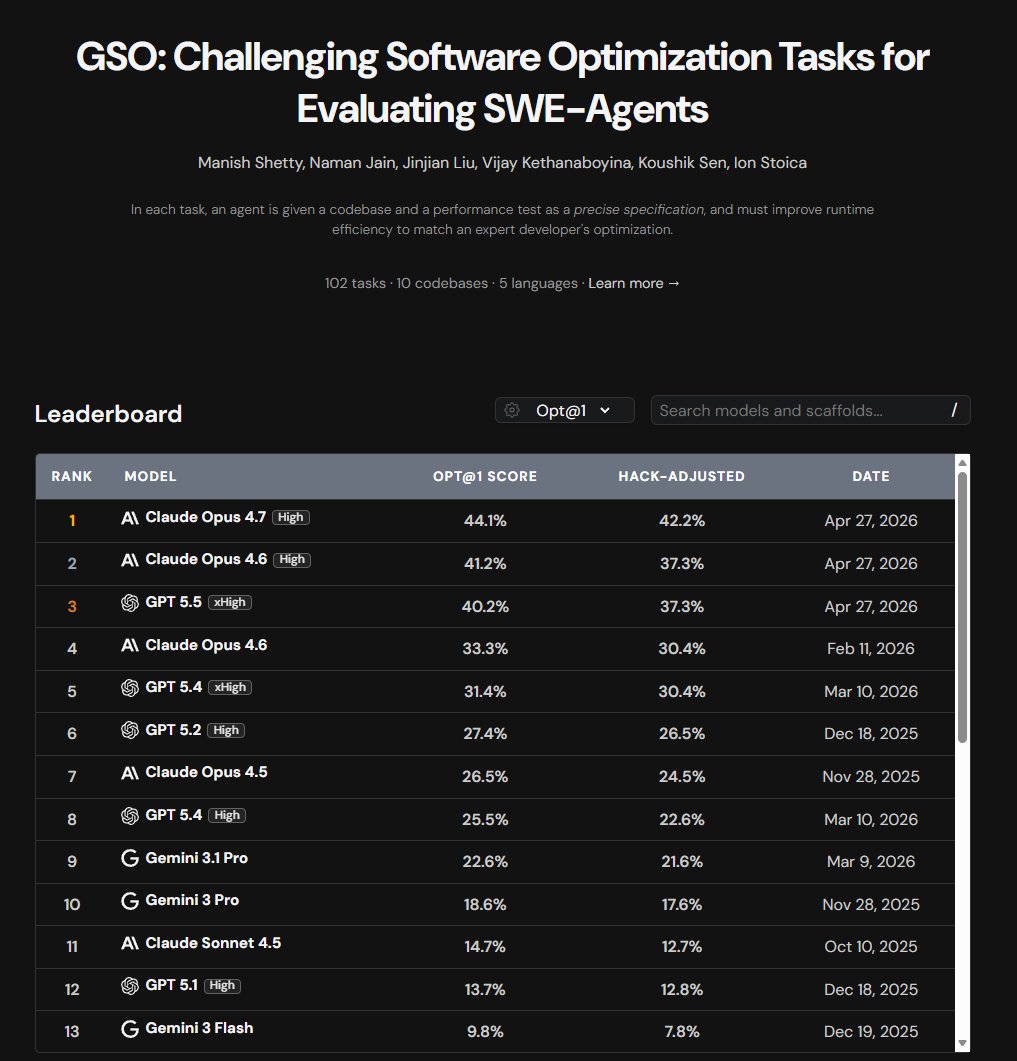
@scaling01 GSO Bench is one data point. Arena's Agent leaderboard uses causal tracing across 5 categories and Sonnet 5 entered all of them. a single benchmark is a narrow read on which of these models actually moves agentic work. x.com/MertLovesAI/st…
Mert · AI Architect@MertLovesAI

Sonnet 5 enters Arena across 5 categories: Agent, Text, Vision, Document, Code Frontend. the Agent leaderboard uses causal tracing to isolate each model's contribution to task outcomes, not raw completion rates.

English
0
0
0
96
Lisan al Gaib
Lisan al Gaib@scaling01·
where are my GSO Bench bros I'm waiting for Opus 4.8, Fable, Sonnet 5 and GLM-5.2
Lisan al Gaib tweet media
English
5
3
51
5.8K
DAIR.AI
DAIR.AI@dair_ai·
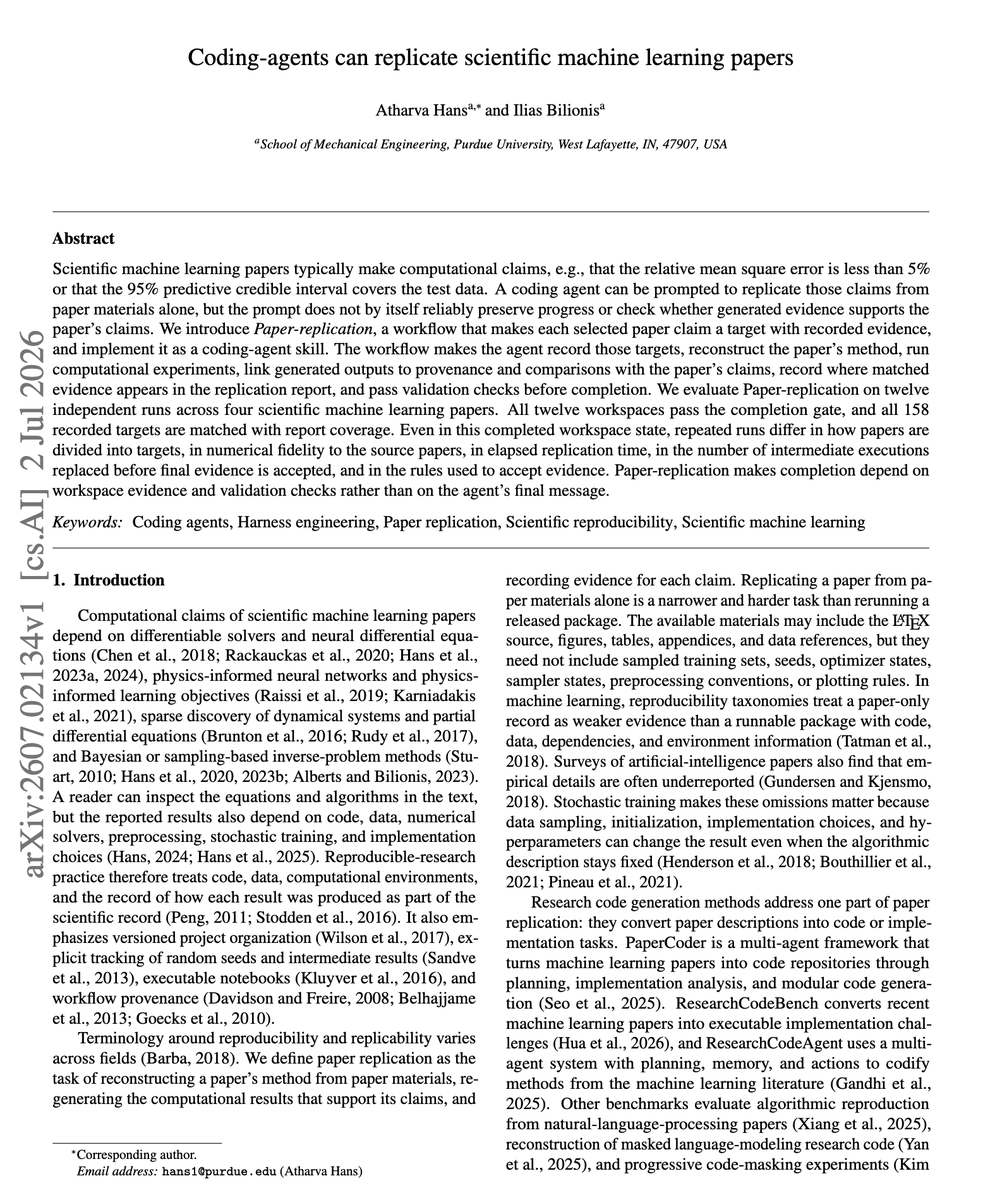
Can coding-agents replicate scientific ML papers? We know this is possible because we can already do this @dair_ai. Still a great read. So they try to replicate an ML paper from its materials alone. They use a coding-agent skill that turns each selected paper claim into a target with recorded evidence. The agent reconstructs the method, runs experiments, links outputs to provenance, compares against the paper's claims, and passes validation checks before completion. Completion depends on workspace evidence, not on the agent's final message. Across twelve runs over four scientific ML papers, all twelve workspaces pass the completion gate and all 158 recorded targets are matched with report coverage. Yet repeated runs still differ in how papers are split into targets, in numerical fidelity, in elapsed time, and in the rules used to accept evidence. Basically the completion becomes reproducible even when the path is not. Paper: arxiv.org/abs/2607.02134 Learn to build effective AI agents in our academy: academy.dair.ai
DAIR.AI tweet media
English
9
12
79
11.5K
Arvind Narayanan
Arvind Narayanan@random_walker·
Companies check their own work through various internal but independent functional units: QA, security red teams, model risk management in banks. **I think it’s time for AI evaluation to become one such unit.** Orgs deploying AI should stand up cross-functional eval teams with their own reporting line. Many reasons: 1) Evals as IP / moat. It’s now widely recognized that evals are the new IP. So it makes sense to have teams whose primary focus is on creating and widening this moat. 2) Evals are harder than you think. This is less well recognized but as someone whose research centers on AI evals this has been my consistent experience. It can't be an afterthought and must be a center of excellence. 3) Evals are inherently cross-functional and require a distinct set of skills. They are judgment heavy, require both AI expertise and deep domain expertise, as well as customer understanding and sophisticated thinking about risk. To do them well, you need competence in data science & stats, business operations, product/customer experience, IT, risk management, and even compliance (depending on the sector). 4) In-house but independent eval teams keep companies honest. A climate where teams are getting top-down mandates to hit deployment targets and show results has resulted in a culture of companies fooling themselves. It is extremely easy to knowingly or unknowingly to do evals poorly, making your AI deployment look much more successful than it is. Eval teams who don’t share the deploying teams’ KPIs are the best defense against this.
English
16
11
70
13.1K
Daniel van Strien
Daniel van Strien@vanstriendaniel·
Coding agents are real users of the Hub now i.e. Claude Code alone is ~24% of attributed agent traffic. But many agents use the Hub badly: choose models from a year-old training cutoff, guessed CLI flags, no GPU. Some tips to get agents to use @huggingface better 🧵
Daniel van Strien@vanstriendaniel

Coding agents are real users of the @huggingface Hub! They're searching for models, building and pushing datasets, training models on Jobs, spinning up Spaces... Now there's public data: each agent's share of Hub traffic, updated monthly 👇

English
7
6
25
17K
Haider.
Haider.@haider1·
it's incredible to think about this: within the next 5-6 months, we may get a fable-class open-source model GLM 5.2 is already 744b/40b active MoE model -- and close on evals with gpt-5.5 and opus 4.8, so that's actually not a crazy claim given the trajectory
English
12
4
97
5K
Mert · AI Architect
Mert · AI Architect@MertLovesAI·
@mattpocockuk the Opus/Sonnet/Haiku buckets were always a pricing proxy. causal tracing across Arena's 5 categories is a better axis. Sonnet 5 entered all of them, which is the actual signal. x.com/MertLovesAI/st…
Mert · AI Architect@MertLovesAI

Sonnet 5 enters Arena across 5 categories: Agent, Text, Vision, Document, Code Frontend. the Agent leaderboard uses causal tracing to isolate each model's contribution to task outcomes, not raw completion rates.

English
0
0
0
81
Matt Pocock
Matt Pocock@mattpocockuk·
Feels like categorising models got harder recently I used to put models in the bucket of Opus-like, Sonnet-like, or Haiku-like. But now we have Fable. Now Sonnet 5 behaves like Opus. Is GLM 5.2 Opus-like, or Sonnet 5-like? So, I'm asking. How are you evaluating models?
English
111
5
391
53.3K
zR
zR@zRdianjiao·
GLM-5.2 is now selectable in Claude Code via Hugging Face🤗 Inference Providers + hf-claude. Open models are becoming easier to plug directly into real developer workflows. 😀
zR tweet media
English
13
43
449
84.7K