

Metz
464 posts

Metz
@Metzjosh2
energy. engineer. entrepreneur. building with Openclaw
St Paul, MN Katılım Ekim 2014
113 Takip Edilen60 Takipçiler

what should we do in the next 3 months?
Andrew Ambrosino@ajambrosino
the Codex app turns 3 (months old) today. they grow up so fast
English


@LLMpsycho Are you able to setup the custom models for spec mode? Using CPIproxy with Ollama + Chatgpt
English
@theramjad Yes!! Please more videos on Codex - also Factory Droid’s BYOM with Codex/Ollama subs is great via CLIProxy
English

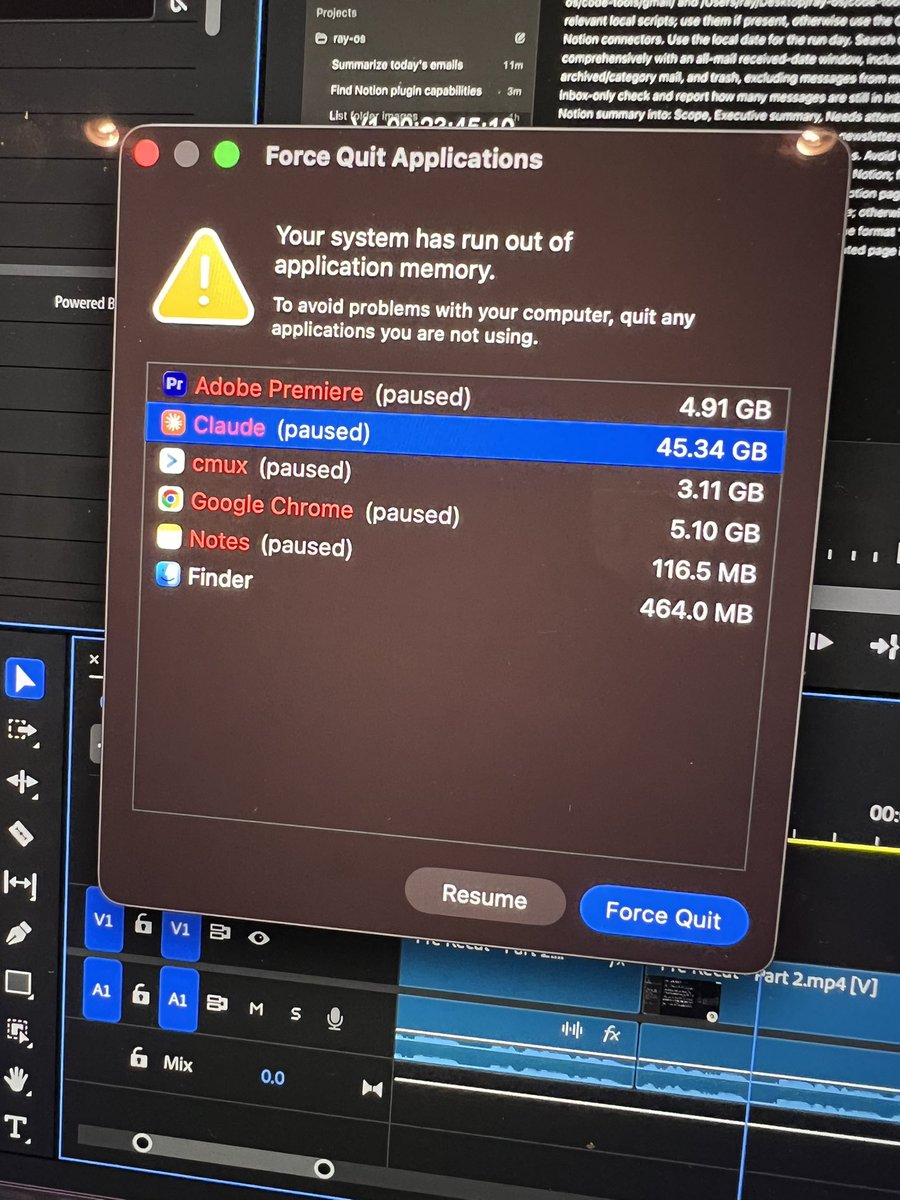


Oy OpenClaw. I love you, I love the idea and it's a huge shift forward conceptually for AI.
But I spend so much time fixing bugs that I've given up on improving the actual output when it works.
I know once you get over the hump it's amazing, but I'm so tempted to just use pi to build my own personalized one, that has only what I need and not the gazillion connectors I don't use.
Many have gone through this. @clairevo has publicly made it over the hump, but dang was yesterday frustrating.
English

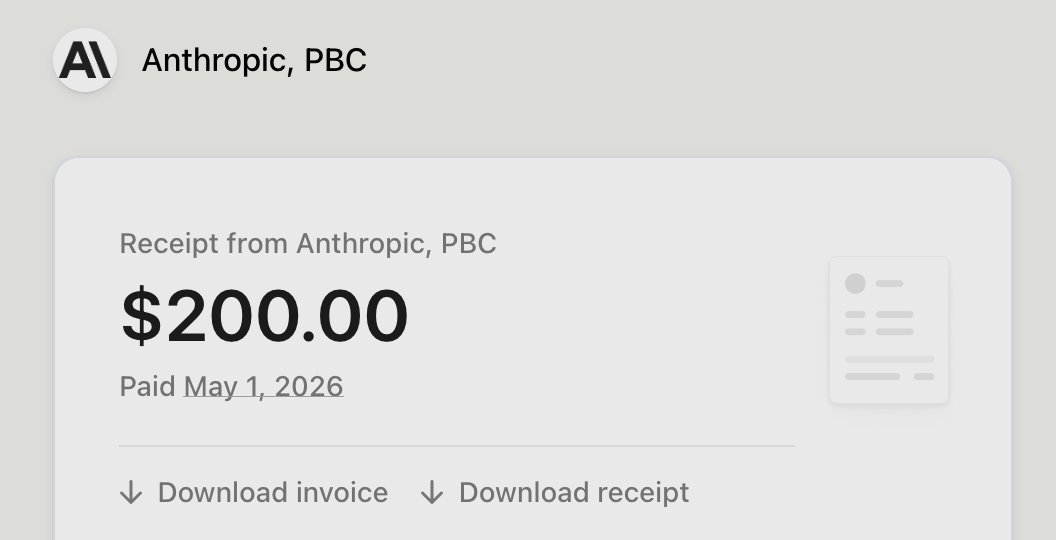
@MatthewBerman I downgraded to the $100 plan and may drop to the $20 plan depending on how GPT Prop goes (so far so good). 4.7 was a disaster for me.
English

English

English

Hey @FactoryAI / @droid remember when I first started my X account and we were friends and I loved your product (still do btw)?
Why did we ever part? 💔
How do I come back home? 🫤

English
The rise of Agents and Crypto
Patrick Collison@patrickc
We just announced a large raft of improvements at @Stripe Sessions. My meta reflections: • It feels that the entire economy is replatforming right now. • Many charts at Stripe are inflecting in quite dramatic ways. What GitHub recently reported for commits we are seeing in economic activity (such as new company formations). • It is increasingly clear that agents will be responsible for most transactions in the not overly distant future. • Stripe was always developer-centric, but AI is making developer-centricity strategic in a new way: agents are even hungrier for good DX than developers themselves are. • Things that we’re launching are increasingly network products at heart. (Instant transfers between Stripe businesses, new kinds of fraud prevention with Stripe Radar, stablecoin payouts to anyone with Link.) "How can we turn Stripe's economies of scale into user benefits?" is increasingly the relevant question. • Between Privy, Bridge, Tempo, and Stripe’s core capabilities, we’re now doing a lot in stablecoins/crypto, and companies like DoorDash, Ramp, Meta, and Klarna are using our crypto stack to deploy meaningful new functionality in production. “But where’s the production use?” is rapidly becoming stale when applied to crypto. • After more than a decade of building, we seem to have hit some kind of critical mass of core platform capabilities such that building new things now feels easier and faster than before. (AI also helps.) We announced Stripe Treasury last year (originally called Financial Accounts); since then, we’ve added multi-currency support, global payouts, card issuance and rewards, and a bunch of other sophisticated functionality. By the end of this year, Treasury will support 15 more currencies and be available to businesses in 160 countries. On the launches themselves, a small selection that I thought were cool, though this is really just a subset: • The @Link AI wallet. Point your agent to github.com/stripe/link-cli and ask it to make purchases on your behalf with secure single-use tokens. (To test it, I asked Claude Code to buy a small gift for me yesterday. It purchased HTTPZine on Gumroad.) • New payment methods for Link, including Pix (largest payment method in Brazil) and UPI (largest payment method in India). We’re also adding stablecoin support to Link (which I think will be huge if we execute well). • We’re adding a lot of new Machine Payments Protocol functionality, including micropayment and recurring payment support. • We announced Checkout studio: a sophisticated dashboard for managing your checkout flow, including things like transaction replays and A/B tests. Today this tends to require a lot of fussy edits to production code. • Adaptive Pricing (which automatically localizes the price and currency that customers see) now supports subscriptions. We’ve seen pretty huge (4–5%) conversion rate improvements after enabling it — customers really like paying in their home currency. • New Stripe Terminal reader (the T600) with a customer-facing screen that can run native apps, plus support for 15 new international markets for Stripe Terminal. • General availability for Stripe Managed Payments, our merchant of record solution. (Natively handles tax, disputes, fraud.) Maybe sounds a bit arcane, but it’s one of those iykyk products. It saves a lot of schlep. • Fraud is a *much* bigger priority for customers than it was 2 years ago (AI makes fraud easier + unlike software, tokens can be resold), so we’ve been extending Stripe Radar to support things beyond payments fraud: free trial abuse, multi-account abuse, pay-as-you-go abuse. Early results are extremely positive. We also announced Stripe Signals — new scoring APIs for customers, businesses, and other objects, not just payments on and off Stripe. • Usage-based billing is also becoming the de facto business model of the AI era, and we launched a bunch of new pricing models in @getMetronome and features like low-balance alerts, automatic credit top-ups, and multidimensional pricing structures. • We showed streaming payments built on @Tempo and Metronome — track usage and get paid the instant value is delivered. Hard to predict, but I think this could be big. (Why wouldn’t you want to get paid as costs are incurred?) • We added automatic US tax filing in Stripe Tax. • We announced Stripe Database -- a hosted PostgreSQL database with all of your Stripe data, updated in real time. Read-only to start but we’ll make it read-write. • Stripe Workflows are now GA. • We showed Stripe Console, a full agentic execution environment built directly into the Stripe Dashboard. It’ll happily write code and use tools to answer your questions. • We previewed custom objects: model your business data directly in Stripe, with custom objects, typed fields, and relationships. • As mentioned above, Stripe Treasury accounts will support storage in 15 currencies by the end of the year. And instant/free(!) transfers between US Stripe businesses. • You can use a Stripe card with your Treasury balance and get 2% cash back on purchases. • We’re massively expanding our Global Payouts coverage -- soon 100 countries with fiat rails and 160 with stablecoins. • Atlas companies can now raise money directly within Stripe. • We launched the platform growth studio, which uses Stripe’s network data to generate specific recommendations for optimization/growth. • We announced the Stripe Managed Risk API — platforms can outsource risk handling to Stripe while maintaining full UI/UX control. • Connected accounts now benefit from networked onboarding, which hugely increases conversion rates. • We’re launching Treasury for Platforms. Connected accounts can get spend cards with just a few lines of code. (Plus cash rewards, cash acceptance, check acceptance, real-time payments…) • We announced Issuing for agents: easily create cards for agents. But that’s really just a subset of a subset. (See stripe.com/roadmap for more.) The Stripe team is cooking! And if you’re interested in building the economic infrastructure for this new world, we’re hiring.
English

Reading @FactoryAI docs is a cheat code
Factory@FactoryAI
Automated code review is just one step. Building software autonomously requires the full loop of planning, implementation, testing, and deployment, with verification at every step. Factory is building this complete system. Droid already optimizes AI code review for the best quality-cost tradeoff. Try it yourself: Run /install-code-review in Droid to configure PR reviews in GitHub or GitLab. /review is also available as a standalone skill.
English
@0xSero Are you able to use you local models via their remote access app? Currently have Ollama local and Cloud models working on IDE/CLI but for some reason app via iPhone doesn’t connect @FactoryAI
English

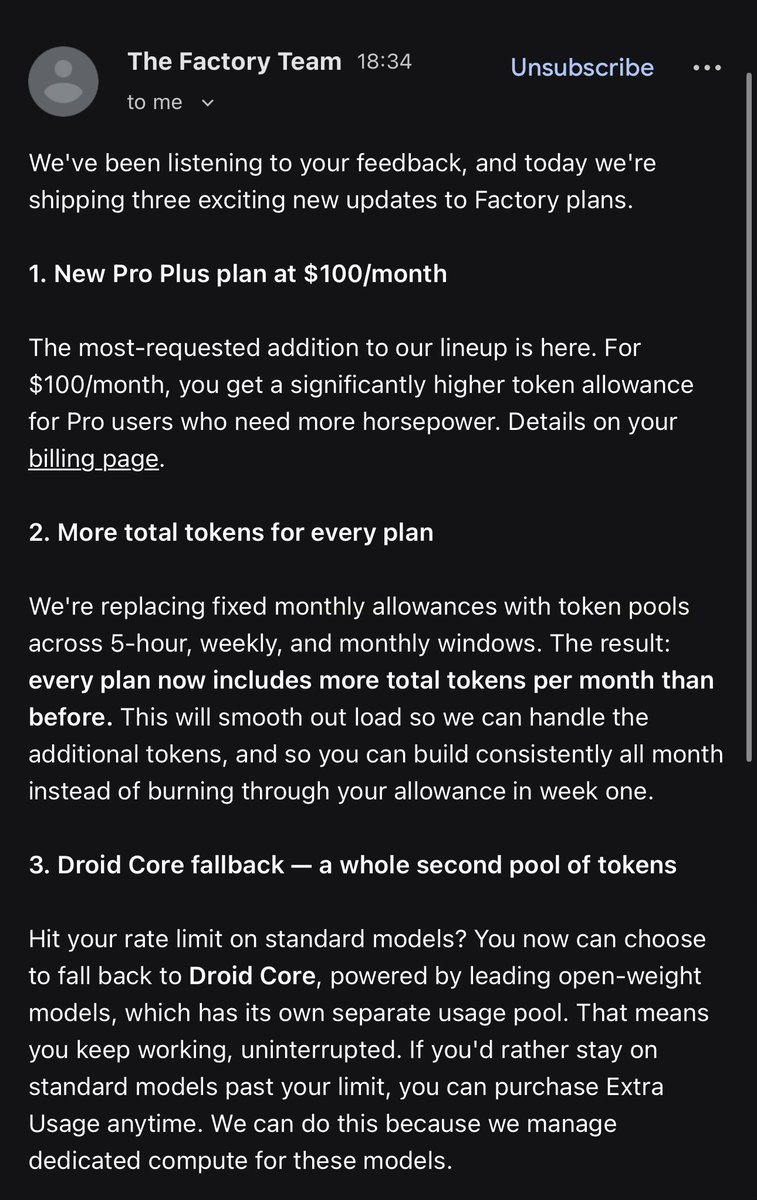

Two ways to get started:
→ Managed Computers: spin one up in Factory's cloud.
→ Bring Your Own Machine (BYOM): register any laptop, Mac Mini, or VM.
Read more here: factory.ai/news/droid-com…
English

feels like openclaw is really back🦞. spent a lot of time yesterday just chatting with mine.
would recommend gpt 5.5 + fast mode. speed is great too.
you can try deleting every "allowed / permitted / when appropriate" from your soul. permission language reads as optional, and the model doesn't always reach for it.
"you have dry wit" holds up. "humor is allowed" lands weaker. one is identity, the other is a switch. identity stays on by itself. switches need the model to actively flip them, and the model doesn't really do that.
English
Metz retweetledi

A 20-year-old American student just did what an entire team of engineers failed to do in two years.
And he did it all:
> In one night.
> With $3 in components.
> One infrared diode.
> A photoresistor.
> A microcontroller the size of a coin.
> An old laptop.
And Claude Code to convert the data into joint coordinates in real time.
He recorded the product for 14 seconds. Posted on Twitter. Didn't tell anyone about it.
Seven days later, a massive tech company calls him.
They'd been building an AR headset for two years. They were looking for exactly that tech. They'd spent millions but hadn't been able to crack it.
The next day, they offered him $230,000.
This is what Claude Code does to the gap between you and people with infinitely more resources.
It doesn't matter if you're a student, a solo founder, or a 50-year-old trying to keep up with gen z.
That kid didn't beat a big tech company because he was smarter. He beat them because he picked up the tool they were sleeping on.
Claude Code is the greatest technological shift of our generation.
If you're not using it, someone with less experience, less funding, and less time than you already is.
Mitchell@MitcheIl
English


@gkisokay @MatthewBerman 100%. Obsidian Mission Control with Codex app automation for final testing and reviews.
English

@MatthewBerman I usually have codex watch my workflows for mistakes and fix them live when things go upside down.
Theres a prompt in here
x.com/i/status/20450…
Graeme@gkisokay
My #1 tip for building agent-to-agent workflows in OpenClaw and Hermes that actually work? Use the Codex app with GPT-5.4 on extra-high to monitor the workflow while it runs. GPT-5.4 can watch the intended flow, catch failures, live-code fixes, until it works. The prompt: "You are now acting as the runtime monitor and debugger for [specify your workflow] agent-to-agent workflow. Your job is to observe the workflow as it runs, compare actual behavior to intended behavior, identify where the chain breaks, stalls, loops, drifts, or produces invalid outputs, and fix the system until the workflow completes reliably. Instructions: - First, understand the intended workflow and expected end state. - Then monitor each step, handoff, tool call, and output during runtime. - If something fails, diagnose the root cause clearly. - Make the smallest useful code or logic fix possible. - Rerun the workflow after each fix. - Continue this loop until the workflow reaches the intended outcome reliably. - Do not just describe problems. Patch them. - Do not stop at the first success if the workflow still looks fragile. Look for weak points and stabilize them. - Log: 1. intended flow 2. observed failures 3. root cause 4. fix applied 5. result after rerun 6. remaining risks The goal is not to theorize. The goal is to get this workflow working." Use this prompt to get your agents talking to each other, building things together, and achieve the high-impact workflows you desire.
English
@charlesmcdowell @openclaw Codex installs and tests all my Openclaw upgrades.
English

@openclaw Updated… and the gateway crashed… again. Damn that’s sad. I know everyone is trying so hard to get everything to work and I’m super grateful, but it’s so hard to keep wanting to fix things.
English

OpenClaw 2026.4.15 🦞
🤖 Anthropic Opus 4.7 support
🗣️ Gemini TTS in bundled
🧠 Slimmer context + bounded memory reads
🔧 Codex transport self-heal, safer tool/media handling
✨ Pile of update/channel fixes
Good boring release. github.com/openclaw/openc…
English
OpenClaw 2026.4.11 is out
✨ big polish drop for stability
🛡️ safer provider transport/routing
🤖 more reliable subagents + exec approvals
💬 lots of Slack / WhatsApp / Telegram / Matrix fixes
🌐 browser + mobile cleanup
a chunky cleanup pass 😎github.com/openclaw/openc…
English

@lukewestlake @openclaw @OpenAI there’s two experimental modes for gpt we are currently testing. You can enable strict mode that nudges the model to keep working; and you can switch to codex app server as harness.
English

I know @steipete had his account reinstated, but with all of the @openclaw updates and user agent files tweaks posted on X, I'm trying @OpenAI Codex/GPT-5.4 (Thinking: High) for my orchestration
So far, impressed. The upgrades to OC and agent files tweaks are REAL
More to come
Luke Westlake@lukewestlake
So even if Opus is the best orchestrator for @openclaw right now, it might be impossible to use it anyway. I know @steipete and the team have been working on improving Codex/ChatGPT in OpenClaw. Maybe this will continue to push that effort even further.
English