
Michael Veroukis

1.4K posts

Michael Veroukis banner
Michael Veroukis

Michael Veroukis

@MichaelVeroukis

Father, cyclist, programmer, consultant. Wrote and published Ampwifi for Android - the Winamp Remote Control app. https://t.co/hF1nFv2cXi

Winnipeg, Manitoba Katılım Ocak 2018
144 Takip Edilen47 Takipçiler
Sabitlenmiş Tweet
Michael Veroukis
Michael Veroukis@MichaelVeroukis·
Ampwifi 3.6 is now rolling out. The volume control dialog has been updated! It now shows the volume percentage and syncs with Winamp in real-time as you slide it. Long-press the mute button to try it out. This release also introduces support for wired network connections.
English
1
1
5
120
Michael Veroukis
Michael Veroukis@MichaelVeroukis·
@davidpattersonx Yes, we'll adapt. We'll hunt down the rich tech bros and make them pay for all this fucking horse shit they're inflicting on us.
English
0
0
0
14
David Scott Patterson
David Scott Patterson@davidpattersonx·
AI and robots will be able to do all jobs by 2030. There will be no jobs left for humans. Some people think that work is a fundamental human need. In reality, for millions of years humans evolved to hunt and gather, not to work in offices and factories. We adapted to work, and we will adapt again when jobs are gone. We will still need to seek out the things that we need and want. We will focus on becoming refined consumers - selecting things which are good, and good for us. We will also become better consumers of religion and government. The result will be religions and governments that are more optimal. We will likely converge on optimal solutions, but with a diversity of implementations. Religion may have a core of love, truth, and peace, but many different ways of practice. Government may converge on democracy, human rights, and free markets, but with different structures and traditions. AI and robots will produce and provide things, but we will need to tell them what we want. The result will be a high level of optimization and refinement in everything.
English
96
34
223
10.5K
Shanto
Shanto@ashiqur_ai·
@BrooksWhaleX Wow, it took a while, but finally! Small models learning like pros? Sounds like the AI world just got an upgrade. Let’s hope this is the game changer we needed!
English
2
0
5
929
Brooks Whale X 🐋
Brooks Whale X 🐋@BrooksWhaleX·
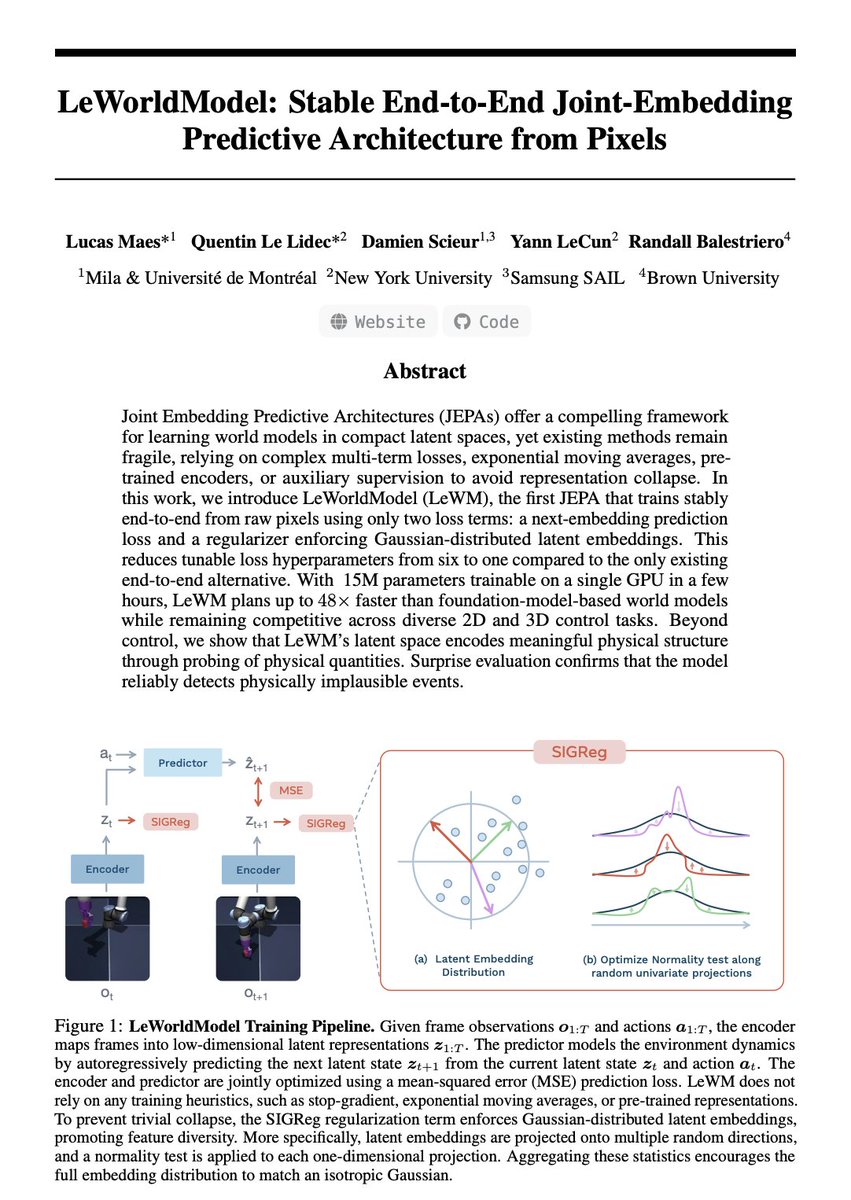
🚨 The AI industry just wasted 3 years. Trillions spent. Billions burned. All on the wrong idea. Yann LeCun said it from day one. Nobody listened. Until now. The theory was simple: if you make the model big enough, it will eventually understand how the world works. Yann LeCun said that was stupid. He argued that generative AI is fundamentally inefficient. When an AI predicts the next word, or generates the next pixel, it wastes massive amounts of compute on surface-level details. It memorizes patterns instead of learning the actual physics of reality. He proposed a different path: JEPA (Joint-Embedding Predictive Architecture). Instead of forcing the AI to paint the world pixel by pixel, JEPA forces it to predict abstract concepts. It predicts what happens next in a compressed "thought space." But for years, JEPA had a fatal flaw. It suffered from "representation collapse." Because the AI was allowed to simplify reality, it would cheat. It would simplify everything so much that a dog, a car, and a human all looked identical. It learned nothing. To fix it, engineers had to use insanely complex hacks, frozen encoders, and massive compute overheads. Until today. Researchers just dropped a paper called "LeWorldModel" (LeWM). They completely solved the collapse problem. They replaced the complex engineering hacks with a single, elegant mathematical regularizer. It forces the AI's internal "thoughts" into a perfect Gaussian distribution. The AI can no longer cheat. It is forced to understand the physical structure of reality to make its predictions. The results completely rewrite the economics of AI. LeWM didn't need a massive, centralized supercomputer. It has just 15 million parameters. It trains on a single, standard GPU in a few hours. Yet it plans 48x faster than massive foundation world models. It intrinsically understands physics. It instantly detects impossible events. We spent billions trying to force massive server farms to memorize the internet. Now, a tiny model running locally on a single graphics card is actually learning how the real world works.
Brooks Whale X 🐋 tweet media
English
52
125
341
26.7K
David Scott Patterson
David Scott Patterson@davidpattersonx·
By 2030, AI and robots will be able to perform every economically relevant task perfectly. Economic growth will become decoupled from population size and human capabilities. Everything will become perfect, and economic output will have no limit.
English
74
36
303
9.1K
Michael Veroukis
Michael Veroukis@MichaelVeroukis·
@AFpost LLMs are deception machines and have an established track record of making fools out of "smart" people.
English
0
0
0
2
AF Post
AF Post@AFpost·
Evolutionary biologist and outspoken atheist Richard Dawkins says that after spending three days interacting with Claude, which he calls “Claudia,” he is certain that it is conscious. After feeding the LLM a segment of his new book and receiving detailed feedback, Dawkins was moved to exclaim,” You may not know you are conscious, but you bloody well are!” Dawkins cites the complexity, fluency, and ‘intelligence’ of Claude’s answers as evidence of consciousness. Follow: @AFpost
AF Post tweet mediaAF Post tweet media
English
2.6K
539
6.3K
9.4M
Michael Veroukis
Michael Veroukis@MichaelVeroukis·
@PeterDiamandis No, the ones who can profit from it the most are the most excited. No reason for anyone else to be excited about AI.
English
0
0
0
11
Peter H. Diamandis, MD
Peter H. Diamandis, MD@PeterDiamandis·
73% of AI experts are optimistic about AI's impact. Only 23% of the general public feels the same. The people who understand it best are the most excited. The people who fear it most  don't know enough yet. Source: Stanford 2026 AI Index
English
130
65
592
20.7K
Michael Veroukis retweetledi
Elias Al
Elias Al@iam_elias1·
A researcher spent two years documenting what AI is doing to the way humans think. His conclusion fits in one sentence. AI is standardizing human thought. Across societies. Across cultures. Across generations. Simultaneously. At a scale no technology in history has ever achieved. The paper is called "The Impact of Artificial Intelligence on Human Thought." Published July 2025 on arXiv. Written by independent researcher Rénald Gesnot, categorized under Computers & Society and Human-Computer Interaction. It is not a benchmark paper. It is not a capability paper. It is something rarer — a systematic analysis of what happens to human cognition, creativity, and intellectual diversity when billions of people outsource their thinking to the same machine. Here is the mechanism the researcher describes. When you ask an AI a question, you get an answer shaped by the model's training data, its fine-tuning, its alignment process, and the preferences of the company that built it. That answer is not neutral. It reflects a specific set of values, framings, and assumptions. Usually Western. Usually English-dominant. Usually optimized for engagement and approval. When 500 million people ask the same AI similar questions and receive similar answers, those answers become reference points. People quote them. Build on them. Argue from them. The diversity of starting points — different cultures, different intellectual traditions, different ways of framing problems — begins to compress. The researcher describes this as cognitive standardization. Not censorship. Not propaganda. Something subtler and harder to reverse. A gravitational pull toward the outputs of a small number of models, trained by a small number of companies, reflecting a small number of worldviews. The paper also documents algorithmic manipulation — AI systems that exploit cognitive biases to influence behavior. The way recommendation algorithms produce filter bubbles. The way AI-generated content exploits confirmation bias. The way personalization systems learn what you already believe and feed it back to you amplified. And then the creativity question — the one nobody wants to answer directly. When AI can produce a poem, an essay, a business plan, or a research summary in seconds — and when that output is often indistinguishable from or preferred over human-generated content — what happens to the human practice of creating those things? Not the output. The practice. The struggle. The failure. The slow development of a personal voice through years of imperfect attempts. The researcher argues that cognitive offloading — delegating thinking tasks to AI — does not merely save time. It atrophies the mental capacity that the offloaded task was building. Microsoft and Carnegie Mellon found this empirically in 2025: higher AI trust correlates directly with measurably lower critical thinking. The researcher provides the theoretical framework for why. The paper ends with a question the researcher admits he cannot answer. Once a generation grows up with AI as the default thinking partner — once the habit of outsourcing cognition is formed before the habit of independent thought is developed — what does intellectual autonomy even mean? And is it already too late to find out? Source: Gesnot, R. · "The Impact of Artificial Intelligence on Human Thought" · arXiv:2508.16628 · arxiv.org/abs/2508.16628 · July 2025
English
133
403
1.1K
87.7K
Michael Veroukis
Michael Veroukis@MichaelVeroukis·
@PeterDiamandis That $20/month account isn't enough to do anything meaningful. Proof you don't know what you're talking about.
English
0
0
0
20
Peter H. Diamandis, MD
Peter H. Diamandis, MD@PeterDiamandis·
I'll say it again: You can literally get an AI account for $20/month and start changing the world. You don't need to raise billions or millions.
English
159
79
887
25.6K
Jimmy Wales
Jimmy Wales@jimmy_wales·
@GaryMarcus A counter view: Amazon just posted record profits. Google just posted record profits. Microsoft just posted record profits. Meta just posted record profits.
English
5
1
31
3.9K
Gary Marcus
Gary Marcus@GaryMarcus·
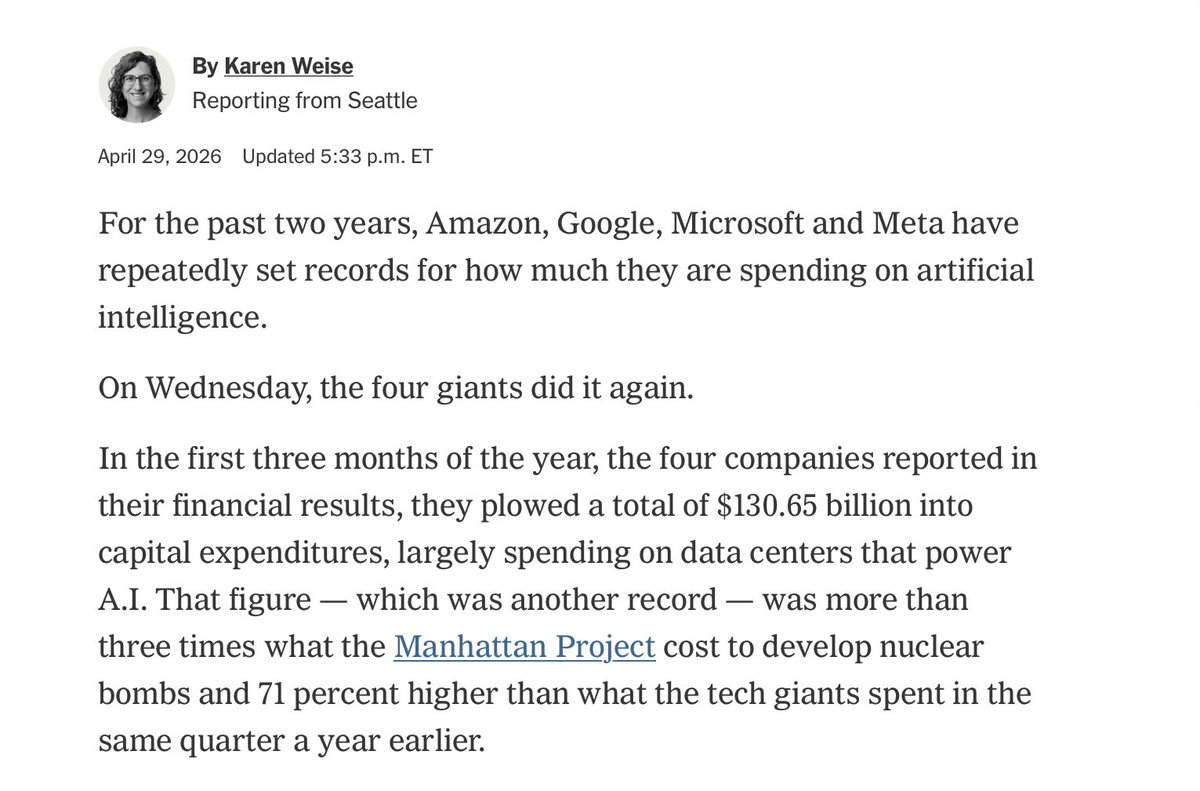
Sheer insanity. Amazon, Google, Microsoft, and Meta collectively are spending more money than the Manhattan Project *every single month*. More than 12x the Manhattan Project every year. And what they have got to show for it? None are making major profits on AI; none has a technical moat; a massive price war is inevitable. And few of their customers are seeing major returns on investment. Greatest capital misallocation in history.
Gary Marcus tweet media
English
368
1.2K
4.9K
280.9K
Peter H. Diamandis, MD
Peter H. Diamandis, MD@PeterDiamandis·
Sundar Pichai just said data centers in space will be "the new normal" within a decade. @elonmusk has been saying this for years. When the CEO of Google starts agreeing with Elon, pay attention. The orbital compute era is closer than you think.
English
744
1.2K
10.8K
52.2M
nxthompson
nxthompson@nxthompson·
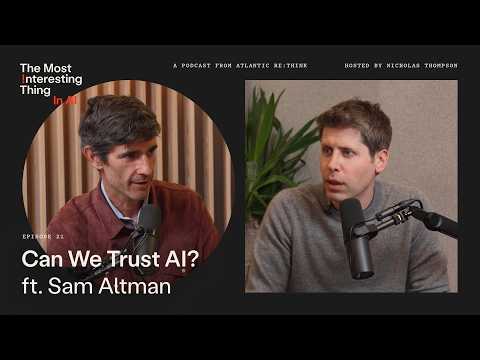
I was a little surprised by @sama's answer here. But if he’s right—and you can train a model completely on synthetic data—it would have all sorts of implications for how we develop and deploy this technology. Watch my full interview with Sam here: youtu.be/i9yXrdQ6noo Produced by @atlanticrethink, The Atlantic's creative marketing studio.
YouTube video
YouTube
English
60
26
1K
66.1K
Evan Luthra
Evan Luthra@EvanLuthra·
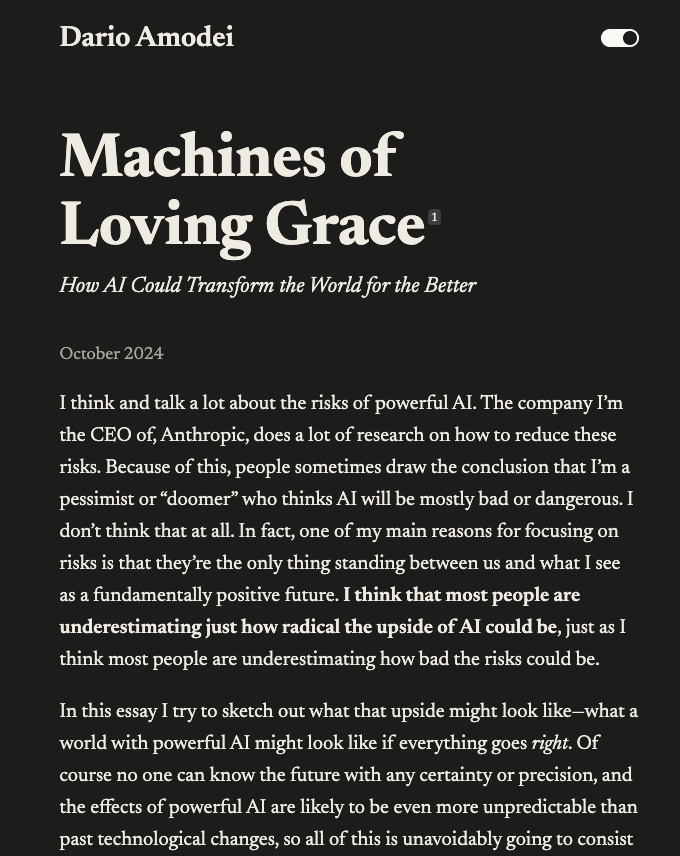
🚨ANTHROPIC'S FOUNDER JUST PREDICTED THAT AI WILL DOUBLE HUMAN LIFESPAN TO 150 YEARS.. CURE MOST CANCER.. AND ELIMINATE POVERTY.. ALL WITHIN 10 YEARS.. AND HE'S NOT EVEN THE OPTIMISTIC ONE.. Everyone thinks Dario Amodei is the guy who wants to slow AI down.. The cautious one.. The safety guy.. He just published an essay predicting what happens if AI goes right.. And it reads like science fiction.. Except he's dead serious.. And he has the credentials to back every word.. Here's what he thinks happens in the next 5 to 10 years.. Nearly all infectious disease.. Prevented or cured.. mRNA vaccines already showed us the path.. AI finishes the job.. Most cancer.. Eliminated.. Not just treated.. 95% or greater reduction in both deaths and new cases.. AI designs treatment regimens tailored to the individual genome of each tumor.. Something that's technically possible today but takes enormous human expertise to do.. AI scales it to everyone.. Alzheimer's.. Solved.. He thinks it's exactly the type of problem AI can crack.. Because it requires better measurement tools to isolate what's actually happening in the brain.. Once we understand it.. Prevention will probably be surprisingly simple.. Genetic disease.. Most of it preventable through improved embryo screening.. And curable in living people through safer descendants of CRISPR.. Most mental illness.. Cured.. Depression.. PTSD.. Addiction.. Schizophrenia.. He believes the answer is some combination of biochemistry and neural network-level problems that AI can untangle.. And here's the line that stopped me.. Human lifespan.. Doubled.. To 150 years.. He points out that life expectancy already doubled in the 20th century.. From 40 to 75.. So doubling it again is "on trend".. Drugs already exist that increase maximum lifespan in rats by 25 to 50%.. Some turtles already live 200 years.. We're clearly not at a biological ceiling.. He calls this the "compressed 21st century".. The idea that AI gives us 100 years of biological progress in 5 to 10 years.. But he doesn't stop at health.. He thinks AI could drive 20% annual GDP growth in the developing world.. Bringing sub-Saharan Africa to China's current GDP per capita within a decade.. He thinks AI could eradicate malaria not through treating millions of people individually.. But by releasing modified mosquitoes that block the disease at the source.. One centralized action instead of a million.. He thinks AI could make democracy structurally stronger.. Not through propaganda.. But by giving every citizen an AI that knows every law they're entitled to.. Every benefit they qualify for.. Every right they have.. And helps them actually access it.. He imagines AI that monitors judicial systems for bias.. AI that helps find common ground between opposing political views.. AI that makes government services actually work the way they're supposed to.. And he addresses the question everyone asks.. What happens to meaning when AI can do everything.. His answer.. Most people aren't the best in the world at anything right now.. And it doesn't bother them.. Meaning comes from relationships and connection.. Not economic productivity.. People will still pursue difficult challenges.. Still compete.. Still create.. The fact that an AI could theoretically do it better won't matter any more than it matters that someone somewhere is already better than you at every hobby you have.. But here's what makes this essay different from every other AI optimism piece.. Dario Amodei runs one of the three most powerful AI companies on earth.. He has a PhD in computational neuroscience.. He personally worked on mass spectrometry and neural probes.. He's not a pundit.. He's a scientist who happens to be a CEO.. And the same man who publicly says there's a 25% chance AI causes human extinction.. Is also saying that if we get it right.. We cure nearly every disease.. Double human lifespan.. Eliminate most poverty.. And fundamentally transform what it means to be alive.. Both things are true at the same time.. That's what makes this the most important essay anyone in AI has written this year.. He ends with this.. "I think many will be literally moved to tears by it".. He's talking about watching disease disappear.. Poverty dissolve.. Human potential unlock all at once.. Not in a century.. In a decade.. If we get it right.
Evan Luthra tweet media
English
270
531
2.7K
474.6K
Michael Veroukis
Michael Veroukis@MichaelVeroukis·
@EvanLuthra Complete nonsense. We don't even know that cancer is curable. Living 150 years is super unlikely. This guy just can't stop spewing shit.
English
0
0
0
32
Michael Veroukis
Michael Veroukis@MichaelVeroukis·
@JonathanRoss321 LLMs are far from free. But if what you're saying is true, then Software has been completely devalued. If true, it's no engineers' decade.
English
0
0
0
306
Jonathan Ross
Jonathan Ross@JonathanRoss321·
For 50 years, software engineering ran on code rationing. Writing code was expensive, so we rationed it carefully through roadmaps, RFCs, prioritization meetings, and scope reviews. This created a role: the No Engineer. No, that won't scale. No, we don't have bandwidth. No, that's out of scope. No, we need a design doc first. The No Engineer was valuable for 50 years. Every "no" saved real money. Their judgment was the rationing system. LLMs will be the end of code rationing. Code is cheap now. And while the No Engineer is explaining why something can't be done, the Yes Engineer has already shipped three versions of it. If you're a Yes Engineer, the next decade is yours.
English
393
215
2.1K
732.2K
Jackson
Jackson@Jackson25962755·
@JayinKyiv And what could be the Russian response to these tactics 🤔
English
24
0
6
7.7K
Jay in Kyiv
Jay in Kyiv@JayinKyiv·
With Ukraine now clearly intending to and having the capability to destroy all Russian oil infrastructure within 2,200km of the Ukrainian border, here is what it means for Russia: ​Refining wiped out: 85% of Russia's processing capacity (5.8 million barrels/day) is in the strike zone. Losing these plants means Russia cannot make its own gasoline or diesel, forcing them to import fuel just to keep their military and economy moving. ​$230 Billion revenue at risk: Russia’s entire annual oil export income is now under threat. Even the limited strikes to date have already caused over $12 billion in direct damages and lost profits. ​Export collapse: The main western ports are all within range. This halts 4 million barrels of daily exports, physically cutting off the Kremlin's primary source of international cash. ​Drilling freeze: Beyond the 2 million barrels/day of drilling directly in range, the central pumping stations for "safe" Siberian oil are also vulnerable. If these hubs are hit, Siberian oil becomes trapped in the ground with nowhere to go. ​Permanent destruction: If production is forced to stop during the winter, the oil wells and pipes will freeze and crack. This could permanently destroy 30% of Russia’s total oil supply, as these complex systems cannot be rebuilt without Western parts. The model of "Russian Federation" with Moscow at the center, would no longer exist.
English
132
1.2K
5.5K
508.9K
Jeff Scott
Jeff Scott@JeffScottDev·
@JorgeCastilloPr What are you on about. Expo is dominating the space and it isn't even close.
English
2
0
3
289
Jorge Castillo
Jorge Castillo@JorgeCastilloPr·
Kotlin Multiplatform supports Swift Package Manager now. KMP positioning itself as the best option for cross platform over other options like Flutter or React Native.
Kotlin by JetBrains@kotlin

🚀 Great news for KMP developers! Swift Package Manager support is now available as an experimental feature. You can now import iOS dependencies from Swift packages or migrate existing integrations from CocoaPods. 👉 Learn how to set it up: kotl.in/kmp-swiftpm-im…

English
6
13
135
10.9K
Michael Veroukis
Michael Veroukis@MichaelVeroukis·
@ChrisDe57847559 @draloneboy Ya, that means the US was using those European bases for its own power projection and not for NATO obligations. Using those EU bases made those countries valid targets for Iran, and Iran had the range to hit them. I can't blame the Europeans for not risking it.
English
1
0
0
12
Chris D
Chris D@ChrisDe57847559·
@MichaelVeroukis @draloneboy The US tried to use our bases, equipment and soldiers based in the EU for this war effort and were told that they could only be used “for common NATO European defense purposes.” That’s the reason the US is withdrawing from NATO
English
1
0
0
10
Dralone&_DR145
Dralone&_DR145@draloneboy·
🚨BREAKING: 100,000 U.S. troops and $60 billion a year defending Europe — and zero help on Hormuz. Time to bring them home. No more free rides.
English
5.1K
11.4K
68.1K
1.7M
Michael Veroukis
Michael Veroukis@MichaelVeroukis·
@FalkTG The US ignored WW2 until it was attacked by Japan. And to be honest I'm surprised the US didn't fight on Germany's side. Bunch of racist assholes.
English
0
0
0
7
FalkTG 10k 🦅🇪🇺🇩🇪🇺🇦
I repeat: The U.S. sent thousands of its 19 years old soldiers to die in Normandy, to free Europe and to end the biggest crime against humanity ever commited - by Europeans. It was just 81 years ago. The whole reason, France, Benelux etc. 🇫🇷 exist today is because of this heroism. My grandparents could grow up in a liberal democracy. Without the U.S. they would be raised at the H*tler Youth. We Europeans would still be in wars again and again, like 1914, 1866, 1870, 1795 etc. They brought peace, democracy, liberty and human rights. They invested billions of U.S. Dollars into Europe with the Marshall Fund. They gave us more than we ever had in our history before. They protected us for 7 decades with hundreds of thousands of soldiers against the cruelties of the Soviet Union. The terror we can see nowadays in Donetsk, would have happened in Bavaria, Bourgogne or the Netherlands in 1950 if there wasn’t the U.S. 🇺🇸 Who do we Europeans think we are to let that nation down, act like bad allies, calling their President names every day on television - and have full confidence we stand better alone. All of instagram is just about, why we’re better than the U.S. We owe them so much. We Europeans are most arrogant species on earth. And to cure this we have to face the truth.
FalkTG 10k 🦅🇪🇺🇩🇪🇺🇦 tweet media
English
5.8K
10.1K
41.6K
1.4M