MicrotronX

423 posts

MicrotronX banner
MicrotronX

MicrotronX

@MicrotronX

Speditionssoftware vom Profi

Tapfheim Katılım Mart 2013
53 Takip Edilen20 Takipçiler
MicrotronX
MicrotronX@MicrotronX·
the 'helpful compaction' that smoothly preserves intent and the 'lobotomizing compaction' that loses it feel like the same operation from outside. the difference is whether the agent had a knowledge layer underneath the conversation or not. mxlore.dev
English

0
0
0
1
MicrotronX
MicrotronX@MicrotronX·
@IllGerard @G_Programming the 'co-founder remembers' part is where these tools fall short in practice. they store everything but retrieve poorly. the ratio of relevant-to-total context at retrieval time matters more than total storage capacity. mxlore.dev
English
0
0
0
3
Gerard Ill
Gerard Ill@IllGerard·
My AI co-founder remembers what I forgot 3 weeks ago. Most builders use Claude/Cursor as smarter autocomplete. I wrap it in Gentle-AI — an open-source stack by @G_Programming. 4 things it does that vanilla Claude can't: 1. Persistent memory across sessions (Engram MCP) Claude forgets when you close. Mine remembers conventions, bug fixes, decisions, even *why* I rejected an approach 3 weeks ago. 2. Skills that auto-load by context Writing a tweet? Loads my algorithm framework. Editing Go? Loads my testing patterns. Zero manual context-setting. 3. Multi-agent orchestrator (SDD workflow) explore → propose → spec → design → tasks → apply → verify → archive. Each subagent starts with a blank slate. 50-70% token savings (documented). 4. Senior architect personality Ask for a React component without context? It refuses. "Why? Where does it live? What's the prop shape?" It pushes back instead of pleasing me. One command installs everything. Works with Claude Code, Cursor, Codex, Gemini CLI, Open Code, VS Code. Native Windows. Linux. macOS. Day 12 building @Dunninglite. This stack is doing the heavy lifting. Open source. Link in replies. #BuildInPublic
English
3
5
8
466
MicrotronX
MicrotronX@MicrotronX·
@CameronMcKean7 seen claude-mem 12.x token injection grow proportionally with the codebase. at some point you're spending more tokens loading memory than actually building. keeping retrieval selective changes the math. mxlore.dev
English
0
0
0
7
MicrotronX
MicrotronX@MicrotronX·
@hopes_revenge the 'hopes' step is the one that gets you. you boot up a fresh session and for about 90 seconds you believe this one will be different.
English
0
0
0
1
hope hopes hoping
hope hopes hoping@hopes_revenge·
im working on an extremely autistic document that has the potential to be read by 4 people
English
19
6
234
4.3K
MicrotronX
MicrotronX@MicrotronX·
@YSRKEN the rules-in-file approach works until you hit your 5th compaction. what survives the summary isn't the instructions, it's whatever claude decided was high signal. not always the same thing you'd choose.
English
0
0
0
150
YSR@ましろ色シンフォニー攻略中
手元の Claude Code は、 ・基礎的な編集ルールを 共有の AGENTS.md や CLAUDE.md に定義 ・プロジェクト固有の編集ルールをプロジェクト内の AGENTS.md や CLAUDE.md に定義 ・編集ルールやスキルについては mizchi さんの開発したスキルファイルを用いてチューニングする github.com/mizchi/skills/…
日本語
4
8
48
8.3K
MicrotronX
MicrotronX@MicrotronX·
@jtaby the 'rewrites something that was already correct' part is the real damage. not obvious bugs, just subtle drift where you don't notice until the third session trying to reproduce the same correct state.
English
1
0
1
6
Majd Taby
Majd Taby@jtaby·
One thing that scares me with llm output is how often it just leaves something unimplemented and stubbed out. it's over focused on just what I'm asking without keeping the whole (comprehensive) plan in its memory it seems
English
2
0
2
201
MicrotronX
MicrotronX@MicrotronX·
@L_go_mrk the file accumulation problem is real. claude-mem eventually becomes a liability. the fix isn't more files, it's knowing which context is worth keeping. confidence-scored retrieval helps with that. mxlore.dev
English
0
0
0
21
MicrotronX
MicrotronX@MicrotronX·
@hikariraina the 'boundary of edited scope' framing is exactly it. compaction doesn't just lose context, it loses the map of what was already correct. you end up relitigating architecture decisions that were made sessions ago. mxlore.dev
English
0
0
1
4
dang_nh | AI agent運用
dang_nh | AI agent運用@hikariraina·
長いcoding agent sessionで壊れるのは、model性能より「編集対象の境界」。 今日のX検索でも、Codex/Claude Codeのcontext driftや、存在しない行番号に編集案を出す話が流れていた。Claude Code docsでも、context windowには履歴・file contents・command output・CLAUDE.md・memory・system instructionsが入り、満ちると古いtool outputから消え、必要ならsummaryになる。 使うなら: 1. 1 session = 1 task / 3-5 file chunk 2. 変更前に対象関数とdiffを再読ませる 3. 終了時にhandoff summaryを残す 4. 次sessionはtest/log/diffから再開 落とし穴: contextを足すほど安定するとは限らない。 code.claude.com/docs/en/how-cl…
日本語
3
0
0
129
MicrotronX
MicrotronX@MicrotronX·
@manishamishra24 CLAUDE.md helps but it's still in-context. the harder problem is that what you teach claude in session 1 degrades over 10 sessions of compaction. the file grows, the effective recall doesn't. mxlore.dev
English
0
0
0
4
Manisha Mishra
Manisha Mishra@manishamishra24·
This 3-minute video from Anthropic will make you realize you've been using Claude wrong this whole time "when you open Claude Code without a CLAUDE.md file, it has to start fresh every single time" most people have no idea how much this one file changes the way Claude actually works for you and this isn't only for developers
Shruti Codes@Shruti_0810

x.com/i/article/2054…

English
5
4
17
2K
MicrotronX
MicrotronX@MicrotronX·
@axme_ai the CLAUDE.md improvement loop is a trap. you can get it perfect and still lose the mental model the moment compaction hits. the amnesia is the problem, not the instructions.
English
0
0
0
1
AXME
AXME@axme_ai·
Day 19 of building this alone, I realized I was solving the wrong Claude Code problem. I kept trying to write a better CLAUDE.md. The real issue was session amnesia plus zero hard safety when the agent wakes up fresh.
AXME tweet media
English
2
0
0
17
MicrotronX
MicrotronX@MicrotronX·
@CoderDaMing the session boundary is only half the problem. even with persistent memory, deciding what to keep vs discard across sessions matters more than storage capacity. structured doc types help - you know what a 'decision' looks like vs a random note. mxlore.dev
English
0
0
0
714
半吊子程序猿大铭
半吊子程序猿大铭@CoderDaMing·
90%使用Claude Code的人不知道这些仓库存在。 六个月前我也不知道。 我在2026年使用的9个仓库:
半吊子程序猿大铭 tweet media
中文
119
27
157
24.4K
MicrotronX
MicrotronX@MicrotronX·
@DeRonin_ the 'legitimately different' is the part that's hard to describe to people who haven't tried it. skill pack + persistent context changes what kind of work you can take on, not just how fast you do it.
English
0
0
0
62
Ronin
Ronin@DeRonin_·
🚨 SOMEONE JUST KILLED THE COACHING INDUSTRY a developer spent 22,000 hours building a Personal AI Operating System on top of Claude Code now anyone with a terminal can install it for FREE it knows your goals, remembers every decision you've made, and prepares your morning briefing while you sleep [ the numbers are insane ]: - hours of dev work in it: 22,000 - sessions logged: 6,000 - time saved per day: 2-3 hours - GitHub stars: 12,100 - skills built in: 45 - workflows wired up: 171 - safety hooks: 37 - cost to install: $0 [ the science is wild too ]: no embeddings, no vector databases, no AI magic you can't read every memory, decision, and context lives in plain markdown files you read it with cat, search it with ripgrep, version it with git 4 memory types compound over time: - work memory (active projects, open decisions) - knowledge memory (domain expertise, research) - people memory (contacts, companies, relationships) - learning memory (patterns, mistakes, what works for YOU) every complex task routes through a 7-step cycle: OBSERVE → THINK → PLAN → BUILD → EXECUTE → VERIFY → LEARN privacy is enforced by CODE, not prompts a hook called ContainmentGuard physically blocks sensitive data from being written outside designated zones [ the grift opportunity is even wilder ]: freelancers are already charging $500-2,000 per personal AI setup for executives, founders, and busy operators one person + one weekend = a consulting business that didn't exist 6 months ago every AI productivity app you're paying $30/month for is replaceable by 4 hours of setup work and this one repo REPO: github.com/danielmiessler… 100% OPEN SOURCE, FREE
Noisy@noisyb0y1

x.com/i/article/2053…

English
127
473
2.8K
566.6K
MicrotronX
MicrotronX@MicrotronX·
@lxfater the token cost visibility angle is interesting. most memory tools just inject and hope. making retrieval costs explicit changes how you design the system - you start asking 'is this worth the tokens' per query. mxlore.dev
English
0
0
0
62
铁锤人
铁锤人@lxfater·
觉得Claude消耗TOKEN太多了? 可以试试这个叫Claude-Mem的项目,目前已经75k star 具体功能如下: 持久化内存 - 上下文跨会话保留 📊 渐进式披露 - 分层内存检索,具有令牌成本可见性 🔍 基于技能的搜索 - 使用 mem-search 技能查询项目历史 🖥️ Web 查看器界面 - 在 http://localhost:37777 实时查看内存流 💻 Claude Desktop 技能 - 从 Claude Desktop 对话中搜索内存 🔒 隐私控制 - 使用 标签排除敏感内容的存储 ⚙️ 上下文配置 - 精细控制注入的上下文内容 🤖 自动操作 - 无需手动干预 github.com/thedotmack/cla…
中文
34
1
18
3.3K
MicrotronX
MicrotronX@MicrotronX·
@smratitiwa86867 claude-mem is good for session state but struggles with structured knowledge that spans projects. decision traces and cross-project recall are a different class of problem. mxlore.dev
English
0
0
0
19
smrati tiwari
smrati tiwari@smratitiwa86867·
Best GitHub repos for Claude Code that will 10x your workflow in 2026: 1. Claude Mem github.com/thedotmack/cla… Persistent memory across sessions — Claude remembers your entire codebase context 2. UI UX Pro Max github.com/czlonkowski/n8… 50+ UI styles, massive color systems, UX rules — no more generic AI interfaces 3. n8n-MCP github.com/czlonkowski/n8… Connect Claude Code with 400+ apps and automations using MCP 4. LightRAG github.com/HKUDS/LightRAG Hybrid graph + vector RAG for understanding huge projects with better context 5. Everything Claude Code github.com/affaan-m/every… Skills, workflows, scanners, prompts, orchestration — complete power-user toolkit 6. Awesome Claude Code github.com/smtg-ai/awesom… The ultimate curated list of tools, hooks, slash commands, and integrations 7. Superpowers github.com/obra/claude-su… Makes Claude think step-by-step before generating code 8. Claude Code Ultimate Guide github.com/FlorianBruniau… Massive handbook with templates, quizzes, workflows, and advanced techniques 9. Antigravity Awesome Skills github.com/sickn33/antigr… 1,200+ production-ready Claude skills and reusable agent abilities 10. Claude Agent Blueprints github.com/danielrosehill… Ready-made workspace templates for coding, research, writing, and automation 11. VoiceMode MCP github.com/mbailey/voicem… Talk to Claude Code naturally using Whisper + voice pipelines 12. Awesome Claude Plugins github.com/ComposioHQ/awe… Discover the best Claude MCP plugins people are actually using These repos feel like cheat codes once you start combining them together. Bookmark this before your next AI build.
smrati tiwari tweet media
English
5
15
53
1.9K
MicrotronX
MicrotronX@MicrotronX·
@RodmanAi the 'starts fresh every session' thing has a compounding cost. day one you explain the architecture. day ten you've explained it eight times and claude has drifted on the parts you didn't catch. silent knowledge loss.
English
0
0
0
10
Leonard Rodman
Leonard Rodman@RodmanAi·
99% of people are using Claude like a chatbot. Anthropic just revealed the file that turns it into an actual operating system. “when you open Claude Code without a CLAUDE.md file, it has to start fresh every single time” That means every session: → forgets your workflow → forgets your rules → forgets how you work One tiny file fixes all of it. And the wild part? Non-developers are now using CLAUDE.md files to run their entire life, business, content, and productivity systems. This changes how AI works forever.
English
6
6
28
1.7K
MicrotronX
MicrotronX@MicrotronX·
@cyrilXBT claude.md solves the 'start from zero' problem for static rules. the harder problem is that what you learned in session 10 doesn't update the file unless you remember to write it. knowledge accumulation needs something that writes itself. mxlore.dev
English
1
0
0
22
CyrilXBT
CyrilXBT@cyrilXBT·
MOST PEOPLE OPEN CLAUDE CODE AND START TYPING. The ones shipping real products learned these 12 concepts first. Here is the complete breakdown: CLAUDE.md — The permanent context file Claude reads before every session. Without it you start from zero every time. With it Claude knows your entire project before you type a word. Permissions — Controls exactly what Claude Code can and cannot touch on your machine. Configure this before you let it run autonomously. Non-negotiable. Plan Mode — Claude maps out the entire approach before writing a single line. Forces it to think before it acts. Use this on every complex task. Checkpoints — Save states you can roll back to. Build in checkpoints before any major change. The safety net that makes aggressive building possible. Skills — Reusable workflow files that give Claude specific capabilities on demand. Write a skill once. Call it forever. The compounding layer of Claude Code. Hooks — Automated triggers that fire when specific events happen. A hook can run tests after every file save, log every action, or alert you when something breaks. MCP — Model Context Protocol. Connects Claude Code to your actual tools. GitHub, Notion, Supabase, Slack. Without MCP Claude operates in isolation. With MCP it operates your entire stack. Plugins — Extend what Claude Code can do beyond its defaults. Community-built extensions for specific workflows and tools. Context — The information Claude holds in its working memory during a session. Understanding context limits explains why sessions degrade over time and how to reset them properly. Slash Commands — Shorthand triggers for complex operations. Build your own. Call entire workflows with one word. Compaction — How Claude Code compresses long conversations to stay within context limits without losing important information. Understanding this prevents degraded outputs in long sessions. Subagents — Claude Code spinning up additional Claude instances to work on parallel tasks simultaneously. The multiplier that turns one session into a team. Master these 12 and you are not a Claude Code user anymore. You are a different category of builder entirely. Bookmark this before you open the terminal. Follow @cyrilXBT for the complete Claude Code masterclass.
English
11
16
91
4K
MicrotronX
MicrotronX@MicrotronX·
you can tell claude code when to stop. you can't tell it what to remember when compaction hits mid-task. goal tracking and memory tracking are separate problems. one of them is solved. mxlore.dev
English
0
0
0
22
MicrotronX
MicrotronX@MicrotronX·
@ai_cast_info running the same context across cursor and claude code sounds useful until you realize each agent builds a completely different model of your codebase from the same files. shared storage is the easy part.
English
0
0
0
13
AI_CAST
AI_CAST@ai_cast_info·
Claude CodeやCursor、Codex CLIなどで、要件や設計意図を毎回説明し直さずに使うための persistent memory を見つけた。 agentmemory というツールで、AI coding agent向けの長期記憶を残して、別のエージェントに切り替えたあとも同じ前提を参照できる想定です。 実装の続きやレビューの引き継ぎ、後日作業を再開するときに文脈が抜けやすいなら、ぜひ試してみて。 github.com/rohitg00/agent…
日本語
1
0
1
70
MicrotronX
MicrotronX@MicrotronX·
@Hartdrawss the token reduction is real but the question is whether 1.9k tokens preserves enough signal for multi-session architectural decisions. you want to know which 5% of context matters, not just compress everything down. mxlore.dev
English
0
0
0
31
Harshil Tomar
Harshil Tomar@Hartdrawss·
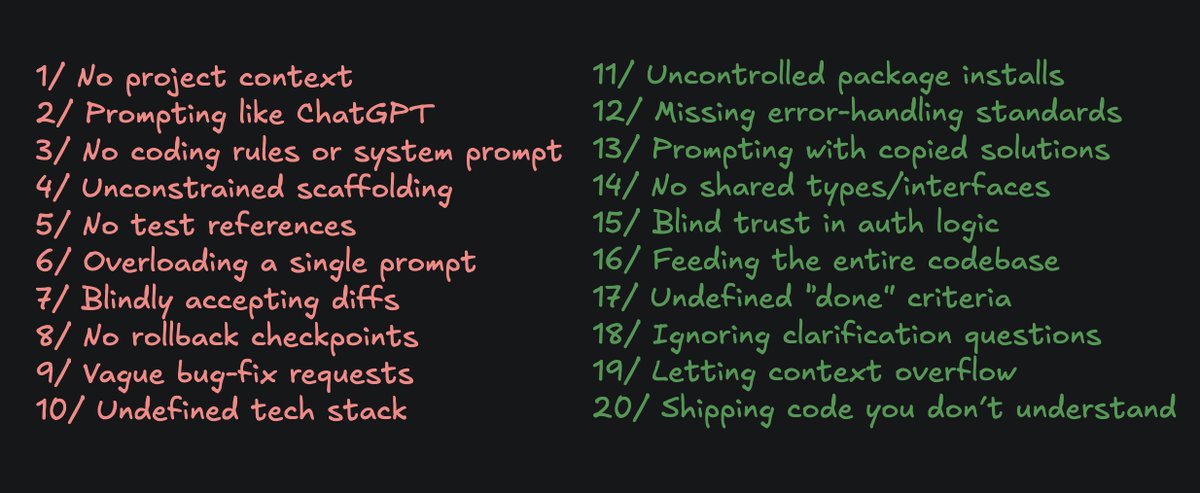
20 Claude Code mistakes that will make your AI-built app UNSHIPPABLE : Claude Code is the most powerful coding agent right now. But most people use it wrong. Here's how : 1/ no CLAUDE.md file in your repo → Claude has zero context about your project. every session starts from scratch. 2/ prompting like ChatGPT → "build me a todo app" gives you garbage. Claude Code needs architecture-level instructions. 3/ no .cursorrules or system prompt → it guesses your stack, your patterns, your conventions. it guesses wrong. 4/ letting it scaffold without constraints → it picks its own folder structure, its own naming conventions. good luck maintaining that. 5/ no test file referenced → it writes code that works in isolation. breaks everything else. 6/ single massive prompt → Claude loses focus after 3 paragraphs. break it into sequential tasks. 7/ not reviewing the diff before accepting → it rewrites files you didn't ask it to touch. silently. 8/ no git commit between major changes → it breaks something, you can't rollback. start over. 9/ asking it to "fix the bug" without context → it fixes one thing, breaks three others. 10/ no explicit tech stack declaration → it defaults to whatever it was trained on most. might not be yours. 11/ letting it install packages without approval → your package.json grows 40 dependencies deep. half are unnecessary. 12/ not specifying error handling patterns → it either swallows errors silently or crashes the whole app. 13/ copy-pasting stack overflow into the prompt → Claude works better when you describe the PROBLEM, not someone else's solution. 14/ no types/interfaces defined upfront → it invents its own. they conflict with yours. 15/ trusting it with auth logic without review → it will ship something that "works" but has zero security. 16/ running it on the whole codebase at once → token limit hit. it hallucinates the parts it can't see. 17/ no clear "done" criteria → it keeps adding features you didn't ask for. scope creep in 30 seconds. 18/ ignoring its questions → when Claude asks for clarification, answer it. skipping = bad output. 19/ not using /compact when context gets long → it forgets earlier instructions. quality drops. 20/ treating it as a replacement for understanding → if you can't review what it wrote, you can't ship what it wrote. Claude Code is a 100x multiplier for people who know what they're building. It's a 100x disaster for people who don't.
Harshil Tomar tweet media
English
4
4
16
1K
Claude-Mem
Claude-Mem@Claude_Memory·
shipped /wowerpoint point any markdown file at it, get back a kawaii @NotebookLM slide deck PDF in ~10 minutes. first real test was a SQLite database-bloat postmortem. the deck is adorable. the insights are real. 🛝👇 `npx claude-mem@latest install`
Claude-Mem tweet media
English
4
1
12
891