
Sabitlenmiş Tweet
CathSchTeacher
619 posts


CathSchTeacher
@MiddleGradeELA
Catholic School ELA teacher. Convert from PCUSA. St. Anne, pray for us.
Katılım Aralık 2025
344 Takip Edilen119 Takipçiler
@CatholicSat @BackwardsFeet I'm fortunate I can't recall a time where I saw any issues.
English

Pope Leo XIV urges priests to respect the text and rubrics of the Holy Mass: "I therefore urge all those called to prepare the celebration of the divine mysteries, in particular priests who exercise the ministry of liturgical presidency, to always uphold that respect for the texts and regulations of the liturgy which springs from an inner attitude of openness and trust in God, manifesting humility before His greatness and sincere fidelity to ecclesial communion."

English
@Gamma_Pyramind God Bless. You are on the right path. Hang in there!!
English

It was one year ago today on May 26th, 2025, that I officially became a Trinitarian and stated I believed the Jehovah’s Witnesses to be wrong.
It was a rough day, but I’m glad it happened cause now I am going to Mass, and I intend on starting OCIA this summer 😊
English
@BuckeyeRico @BishStrick It doesn't defame anyone. That is too dramatic. It is just accurate. Maybe he just writes like that. But it would be flagged. That is just true.
English

@MiddleGradeELA @BishStrick It’s sad that a Catholic school teacher doesn’t understand that human dignity is not the foundation of our faith, and resorts to nonsense insinuations to defame the person pointing it out.
English
I feel it is important to address concerns regarding the recently released Encyclical Letter, “Magnifica Humanitas,” of the Holy Father Leo XIV. pillarsoffaith.net/a-catholic-dis…
English
@Nwa_alexander @McDivad In the areas it is booming, like where I live, it is REALLY booming. There are also tons and tons of young families. So it will be substantially reduced and increased depending upon the location.
English

@McDivad I was arguing with one omenala Twitter merchant the other day. He said "he's glad catholic church is dying, especially in the SE". I told him in the 2000 years of existence, the church has wedged wars from multiple fronts, stormed castles, ruled the world, became global cabals.
English

The Catholic Church has existed for 2000 years and some people still think it’ll disappear because of Twitter arguments.
English

@gonefishin1948 Bauer Holz is not a Catholic priest. Please use discernment with his content.
English

Be honest.
Are you being honest?
How do I know if you're being honest?
How do I know if you're not being honest?
English
@ilhasx God will reward your faithfulness. Many people's Faith have been destroyed because of this.
English

@SemanticSteward @matthew_sede Honestly, I have only ever seen one effeminate priest. Not judging. He was. But he was very trad. Experiences will vary obviously
English

@matthew_sede @RomanCathMedia Nothing gaslights me into fiery zeal like forcing myself to cuck to a NO Mass and watching the effeminate cunt clergy lead the faithful astray.
I just completed my 5th or 6th return to "The Church" and waltz out mid sacrifice today.
I've had enough.
English

His Excellency Bishop Sanborn: We’re not doing this because the pope is a heretic. We’re doing this because these men are imposing a false religion on the Church, which is why you cannot find the Faith at your local parish.
English
@skrwdrvr @BreeSolstad You made me look it up lol. It says this: "Neither may deacons or non-ordained members of the faithful use gestures or actions which are proper to the same priest celebrant."
English

@bdhoward8741610 @BreeSolstad CCC 1669
Ecclesia de Mysterio (Article 6).
Italiano
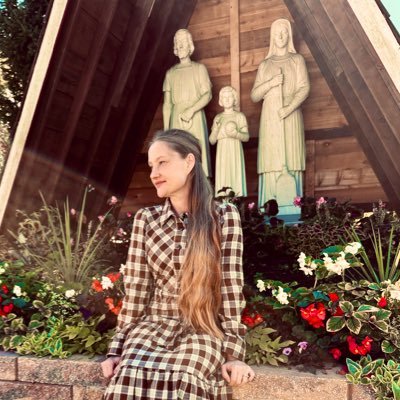
Cute but nuns should not lay hands on someone’s head during prayer.
Nuns are consecrated religious women but not ordained clergy. The laying of hands on the head is a priestly/sacramental sign reserved for ordained ministers.
Timothy Gordon (Rules for Retrogrades Show)@timotheeology
Dope that the nuns showed up for the Spurs game tonight and that Luke Kornet prayed with them
English
Novus Ordo bishops are singing on Twitter and dancing on TikTok while the world burns.
Bishop Robert Barron@BishopBarron
As many of you well know, Bob Dylan means a lot to me. His birthday is this Sunday, and I recorded his song “You're Gonna Make Me Lonesome When You Go” in tribute to him. Happy 85th birthday, @bobdylan!
English
"Doctors" in Bible Studies, Theology, etc. denying dogmas in every class like it's nothing, shitting on the pre-V2 Church, implying Scripture contradicts, etc. All of this with approval and backing of the local bishop. Nothing I've experienced or read has blackpilled me as much
English
@ZhardcorecC My answers. Catholics are the OG Christians. I don't know what you have been taught. I sorta doubt it but I don't know what your church teaches.
English

@bdhoward8741610 @BreeSolstad False.
Lay faithful are allowed in a Private, Informal Setting so long as permission is given.
English
@Xtopher_Uzo So true. All of the mainline Protestants changed their doctrines. Evangelicals changed their beliefs about birth control, women's ordination, and will just continue to do so. However, the worst thing is to shred historical worship and replace it with long songs and a TED talk.
English

All my life as a Catholic, I will keep thanking God and praying for the Church.
One thing you learn as a Catholic is this: the Church cannot change doctrine because of your feelings, opinions, or modern trends. The Church is bigger than that because the truth is bigger than us.
If something does not sound clear to you, the Church will explain why it teaches it. If you are still not satisfied, the Church will go even deeper and give you more reasons grounded in Scripture, Tradition, history, and theology. And if you still choose to walk away, the Church will pray for you and leave you to God and your conscience.
That is why many people leave the Church confidently, only to return later after discovering the truth outside.
For 2,000 years, the Catholic Church has never changed doctrine, edited doctrine, or "corrected" revealed truth to fit the times. That consistency is not human achievement. It is the work of the Holy Spirit guiding the Church in matters of faith and doctrine.
That is why Catholics believe in the indefectibility of the Church and the infallibility of the Pope when defining dogma ex cathedra.
Christ did not leave us confusion. He left us a Church.
Be Catholic and be proud of it.
God bless us and God bless the Catholic Church.
English
@poperespecter1 True! I fought this truth for 35 years. However, even as a young Protestant, I never bought a Protestant explanation of Matthew 16. There is no break from Peter and Paul to the modern Catholic Church. People assert there is, but never prove it.
English
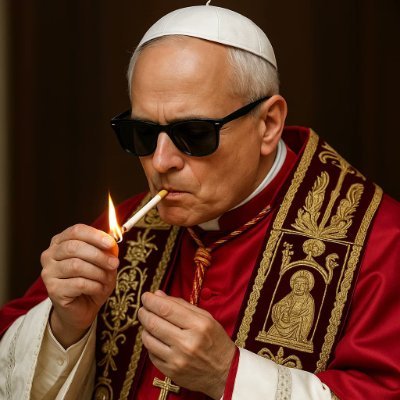
If your church was not built on the bones of St. Peter and St. Paul, you don't have the original church.
Stop with the larp trad prots and orthos. Only the Catholic Church is the original church.

English

@bdhoward8741610 @Rblv73 @BibleInContext1 I have no respect for Liberty, tbh. Anything I see come from their theology program is so poor, I don't even believe they get a legitimate education.
English
Oh, a bunch of ignorant heretics who have never studied scripture or Church history are having an open mic.
I have a better idea, no one show up and ignore them. They are idiots unworthy of attention.
Elizabeth Marie supports them. That should say a lot.
English
@Brosephos @Rblv73 @BibleInContext1 Just to clarify, the classes are often 8 wks. The degree itself( 75 to 90 graduate hours). It is RA and ATS accredited.
English
@Rblv73 @BibleInContext1 I'm sure 2k years of Church history will be overturned by a clown with a 8 week MDiv.
GIF
English
@HwsEleutheroi @WesleyLHuff I do not see any difference in how Catholic and Protestant apologists are treated. X is not real life. As we sat in church this weekend, I would wager not more than two people have anything to do with X. Obviously, if the church is pastored by an X celebrity. it would differ.
English

Much to consider here. It is interesting to watch @WesleyLHuff getting ravaged for making the very same comments I have made about Rome for 35+ years. It is not a thoughtful response, it is, Rick said, visceral. Non-rational. Driven by emotion.
Pastor Rick Brennan@rickbrennanjr
The Roman Catholic backlash to @gavinortlund and @WesleyLHuff has been instructive. Both men are irenic, careful, and respectful in how they address what they believe are errors in Roman Catholic doctrine. Yet both have drawn deeply personal attacks for their apologetic work. This raises an important question many Protestants are asking: why do thoughtful, respectful critiques of Roman Catholicism often provoke such a visceral response? The visceral reaction many Catholics have when Rome is challenged makes sense once we understand the Roman Catholic system. Rome is not merely one church among others in their theology. It is the visible institution possessing the fullness of the means of salvation, the sacramental economy, the authentic interpretation of Scripture and Tradition, and the Petrine office of universal authority. Therefore, to challenge Rome is not received as a mere doctrinal disagreement. Rather, it is received as an attack on the what they believe is the very structure by which Christ supposedly teaches, governs, absolves, and saves. In contrast, Protestants are less threatened by challenges to a particular church tradition because Protestantism, at its best, does not locate salvation in institutional submission. The Baptist does not need the Baptist church to be indefectible. The Presbyterian does not need every presbytery to be incapable of grave error. The Lutheran does not need Wittenberg to be the necessary center of visible unity. Protestants argue fiercely, but their assurance rests finally in Christ’s finished work received by faith, not in the claim that one visible hierarchy or institution uniquely dispenses the fullness of saving grace. That is the real issue: Rome’s authority claims make historical criticism an existential threat. Protestantism can admit that church history is messy because the visible Church is always in need of reform. Protestants can also recognize ambiguity in the historical record and draw reasoned conclusions that differ from others without collapsing the faith. Rome cannot do this so easily. If too much historical complexity is admitted, Rome’s claim to be the indefectible guardian and interpreter of the apostolic deposit begins to weaken. History must produce clear answers because Rome must show that she has always taught what she now requires believers to confess—whether baptismal regeneration, Eucharistic transubstantiation, or papal supremacy. If the historical record shows change, ambiguity, contradiction, or later accretion rather than apostolic continuity, the entire sacerdotal system is threatened. So when a Roman Catholic lashes out at a protestant theologian or historian who is making an argument that runs counter to the approved narrative, the issue is often deeper than the topic being debated. The Protestant is arguing about history or doctrine. The Catholic may feel that their whole edifice of certainty, grace, authority, and salvation is being pulled down. And in a sense, the Catholic is right to feel critical importance of the stakes. If Rome is wrong about herself, then she is not merely wrong about secondary matters. She is wrong about the very place she has assigned herself between Christ and the believer.
English
@davidwbalch @rickbrennanjr @naveen4god Calvin Robinson is actually the most famous denomination jumper there is in modern times. Like...four denominations in 5 years maybe? I, of course, like him though lol. He is an interesting speaker.
English

@rickbrennanjr @naveen4god How did you write such a lengthy post without realizing that this guy is not a Catholic priest? Do you do any due diligence before you write?
English

Here is another Roman Catholic priest denigrating the office of Protestant pastor by claiming we have no scriptural warrant to serve in the role of presbyteros (pastor or priest), episkopos (bishop), as described in the New Testament; but are merely shepherds without authority. Implied, but not stated, is that Pprotestants don't have churches, but are only local assemblies according to Roman Catholic doctrine.
Respectfully, on these subjects, the Roman Catholic Church does not accurately reflect the teaching of the New Testament or the practice of the first and early second century church.
The New Testament does not teach a medieval sacramental system of “Holy Orders” in which bishops, priests, and deacons form a sacerdotal hierarchy possessing a unique power to mediate grace through the sacraments. That is not apostolic Christianity. It is later ecclesiastical development that is being read back into the New Testament—a textbook anachronism.
In the New Testament, presbyteros and episkopos are used in overlapping ways. Elders are overseers. Overseers shepherd the flock. Paul can summon the Ephesian elders and then tell them that the Holy Spirit has made them overseers to shepherd the church of God. That is not the later Roman structure of bishop, priest, and deacon as distinct grades of sacramental holy orders.
Nor does the New Testament teach a ministerial priesthood that stands between Christ and his people. Christ alone is the one mediator between God and man (1 Tim. 2:5). Christ alone is the great high priest who offered himself once for all and now intercedes for his people at the right hand of the Father (Heb. 4:14–16; 7:23–28; 10:11–14). The church as a whole is a royal priesthood, called to offer spiritual sacrifices acceptable to God through Jesus Christ (1 Pet. 2:5, 9; Rev. 1:5–6).
Ministers do have real authority, but it is ministerial, not sacerdotal. They preach the Word, administer baptism and the Lord’s Supper, shepherd souls, and exercise discipline under the authority of Christ and Scripture (Matt. 28:18–20; Acts 20:28; Eph. 4:11–12; 1 Tim. 3:1–7; 2 Tim. 4:1–2; Titus 1:5–9; Heb. 13:17). They do not stand as sacrificing priests who mediate saving grace by virtue of an ontological change conferred through holy orders. Christ is the priest. Christ is the sacrifice. Christ is the mediator. Christian ministers are servants and stewards of the mysteries of God (1 Cor. 4:1)..
Protestant pastors have spiritual authority because Christ gives pastors and teachers to his church. Their authority does not depend on an allegedly unbroken chain of episcopal hands. It depends on fidelity to the apostolic gospel, something Roman Catholicism has too often buried beneath layers of tradition, sacramentalism, priestly mediation, and ecclesiastical claims that obscure the simplicity and sufficiency of Christ.
A minister who faithfully preaches the Word, administers the ordinances Christ instituted, shepherds the flock, and guards the apostolic doctrine has real authority under Christ.
Apostolic succession, rightly understood, is succession in apostolic doctrine. A man may have hands laid on him by a hundred bishops, but if he corrupts the gospel, his succession is only institutional, not apostolic.
So no, when you call a Protestant pastor “pastor,” you are not merely being polite. You are acknowledging, however unwillingly, that Christ continues to shepherd his church through men called to preach his Word and care for his flock.
And for Protestants, the same principle applies when we refer to a Roman Catholic priest as “Father.” We may use the title as a courtesy, but that does not mean we accept Rome’s doctrine of a sacerdotal priesthood or submit to that priest’s spiritual authority.
Personally, I reject the titles “priest” and “Father” as formal ministerial titles because they reflect later ecclesiastical development and can obscure the New Testament pattern. Christ alone is our great high priest. Ministers are pastors, elders, overseers, teachers, servants, and stewards of the mysteries of God.
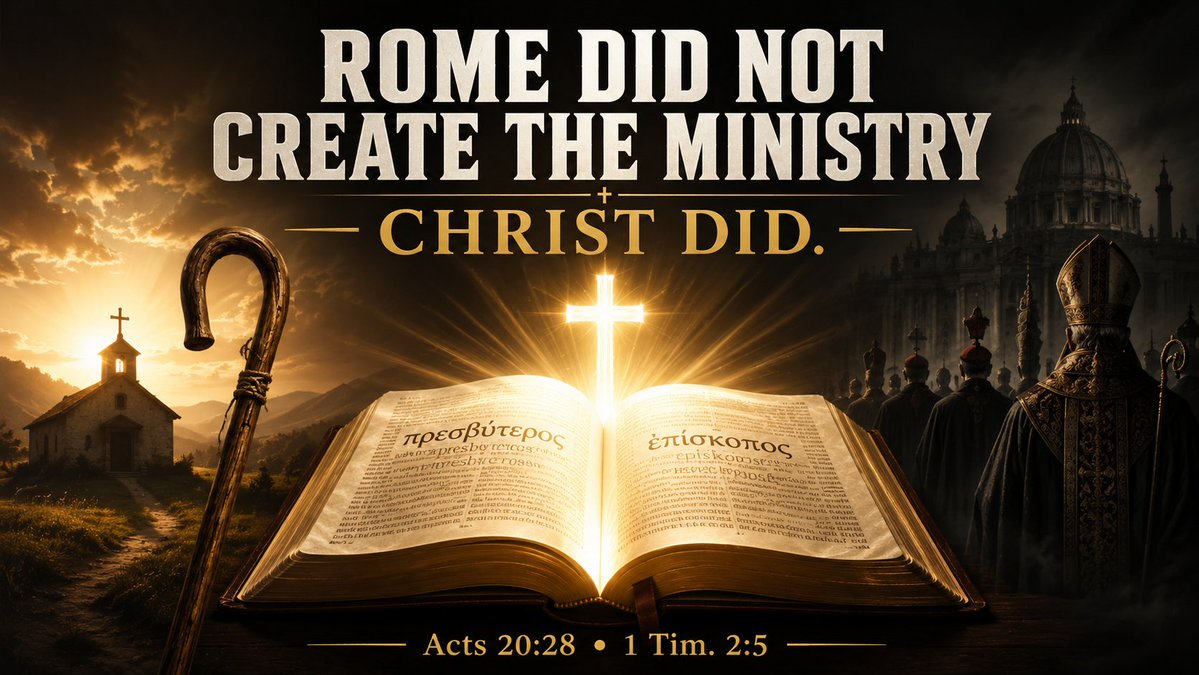
It's important to always remember that Rome did not create the ministry.
Christ did.
Fr Calvin Robinson ©️®️@calvinrobinson
In the Bible we see diakonos (Deacons) as servant ministers, presbyteros (Presbyters/Priests) as ordained teachers who preside over the Sacraments, episkopos (Bishops) who excercise oversight (overseers) and the fullness of Holy Orders. Protestant “pastors” are somewhere between presbyteros and episkopos coopting the title of shepherd, but they are not ordained into Holy Orders. They have no Apostolic Succession. The deposit of faith is missing in its fullness. Therefore, when a Catholic or Orthodox Christian refers to a Protestant as “pastor” he is being polite, he is not recognising or submitting to any spiritual authority, as the Church teaches there is none there outside of that which all Christians have in the royal priesthood of all believes (i.e. all fathers are the spiritual leaders of their household.) but not the ministerial/sacerdotal priesthood.
English