In 2006, Germany killed a bear called Bruno the Problem Bear.
In 2026, Germany killed a whale called Timmy the Exploding Whale.
In 2046, we must kill something even bigger or face the wrath of the gods.
A Bridge of Weir resident involved in a dispute with Rangers legend Ally McCoist over the height of two trees has taken the issue to the Scottish Government #Echobox=1779726457-2" target="_blank" rel="nofollow noopener">thenational.scot/news/26137085.…
@RomeInTheEast That's why Phocas decided to break with imperial shaving tradition when he seized power two years later: he know full well the power of the Longbeards.
By 600AD Pope Gregory lamented the Lombard destruction of Italy:
“Cities have been depopulated, fortresses razed, churches burned down, monasteries and nunneries destroyed, the fields abandoned by mankind, and, destitute of any cultivator, the land lies empty and solitary.”🧵
Imagine being a medieval Irish monk who has to defend this round tower from a hoard of Vikings all alone.
What would you do if you had 10 hours to prepare?
I’m spending Thanksgiving, Christmas, and New Year’s in the US, and I’m so damn excited to see snow for the first time.
Oh, and also my fiancé, I guess… but SNOW!!!
Byzantine Emperor Justinian II having his nose mutilated, earning him the crude nickname "the slit nosed", as he was forced off the imperial throne. Despite this, Justinian would return and gain his revenge.
@histories_arch Aside Ireland, he wasn't much better for the people of England, he essentially imposed a puritan Taliban. Never understood why they still have a statue of him outside the Houses of Parliament.
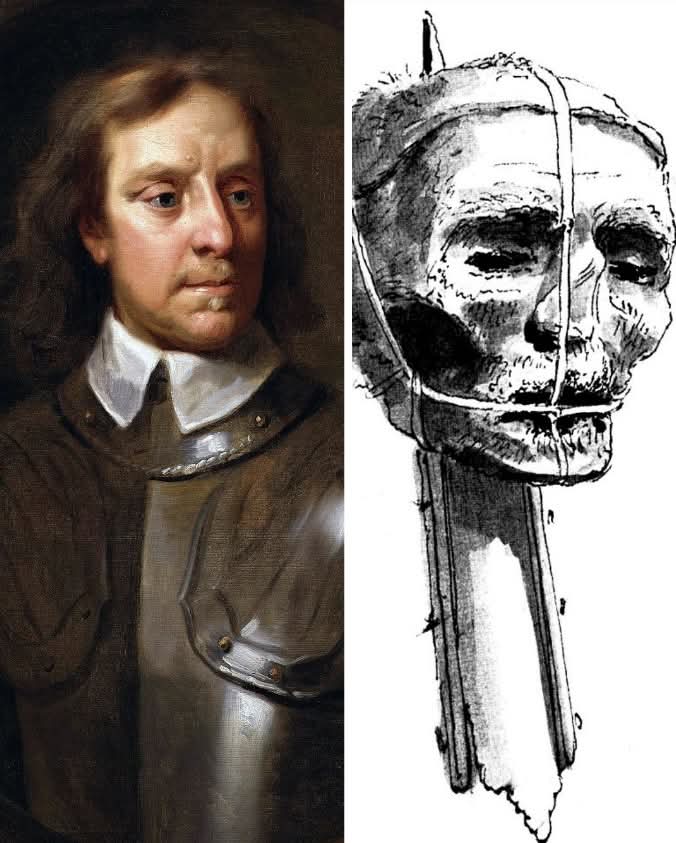
Oliver Cromwell remains one of the most divisive figures in British history. When he died of natural causes in 1658, he was buried with full state honors in Westminster Abbey, remembered by supporters as a powerful leader of the English Commonwealth. Yet his legacy would be violently reshaped just three years later. In 1661, following the Restoration of the monarchy under King Charles II, Cromwell was posthumously condemned for his role in the execution of Charles I. His body was exhumed, dragged to Tyburn, publicly hanged in chains, and then beheaded in an act of symbolic royal vengeance.
Cromwell’s severed head was placed on a spike above Westminster Hall, where it remained on display for roughly 25 years. Exposed to the elements and public scorn, it served as a stark warning to any who might challenge the restored crown. Eventually, a storm dislodged the head, ending its time as a state symbol—but beginning a far stranger chapter. Rather than being laid to rest, the head entered private hands, passing between collectors, appearing in sideshows, and even being examined by phrenologists fascinated by its supposed insights into character.
For more than three centuries, the head of Oliver Cromwell existed as both historical artifact and macabre legend, reflecting the deep political divisions and shifting attitudes of Britain itself. What began as an act of posthumous punishment evolved into a haunting reminder of a turbulent era. Finally, in 1960, the long and unsettling journey ended when Cromwell’s head was quietly buried at Sidney Sussex College, Cambridge—bringing closure to one of the strangest afterlives in British history.
#archaeohistories