

MoneyBro
4K posts


The fastest-growing roofing company in Utah isn't winning on reviews.
They're winning on pins.
Over 20 Google Business Profiles spread from Salt Lake City down through Provo.
Short-term commercial lease. Go through verification process with Google. Opt out lease.
Each profile covers a 5-10 mile radius.
Together they cover the entire state.
One of their competitors drove to one of their addresses expecting to find an office.
Nothing there.
But the profile is live and ranking in that neighborhood's Map Pack.
That's how the Map Pack actually works. It's proximity-based, not merit-based
English
MoneyBro retweetledi

If you missed this last night... WATCH THESE VIDEOS
They are all less than 2 minutes long & will teach you how to find stocks to swing trade
GET AFTER IT!
ThiccTeddy@ThiccTeddy
FOUR OF THE BEST SCREENERS IN THE WORLD🌎🌎 1) 200sma 2) Double Bottom/Top 3) News 4) Buy Ugly USE THESE TO FIND STOCKS TO TRADE📈📉
English
MoneyBro retweetledi

I haven’t had a serious drawdown since the 1980s—just a few single-digit down years in over three decades. How? A deep respect for risk and unconditional patience.
A few key rules:
1. Always cut losses short - no big losses. no exceptions!
2. Only trade large on the heels of smaller trades working
3. Always trade progressively smaller when
trades aren't working
4. Never average down
5. Never let a good-size gain turn into a loss
6. No forced trades - no style drift
Ivo@IvayloPashov
@gfc4 curious to hear what @markminervini has to say, i would assume he is one of those
English
MoneyBro retweetledi

This feels like cheating.
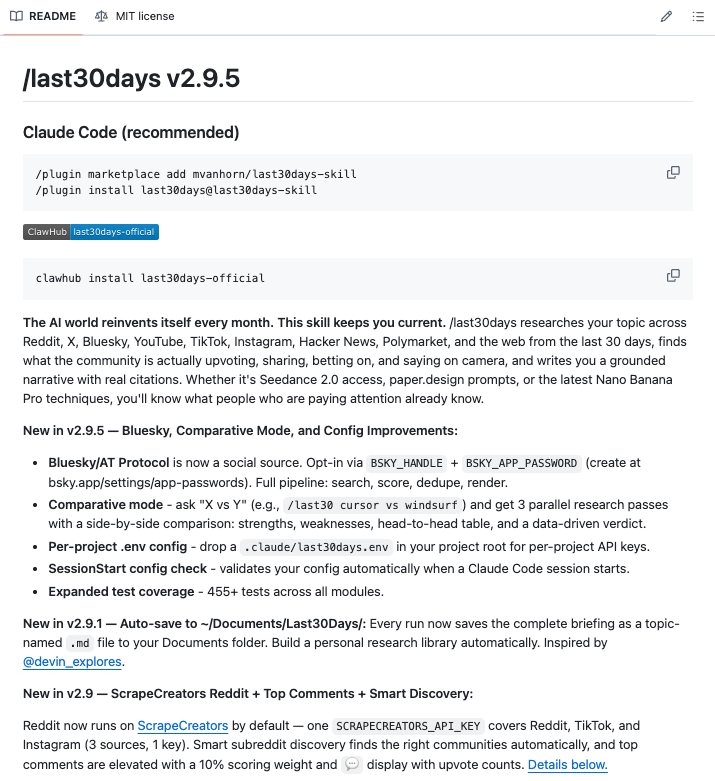
Someone built a Claude Code skill that scans Reddit and X from the last 30 days on any topic you give it, then writes you copy-paste-ready prompts based on what the community has actually figured out not what was working six months ago.
You type /last30days prompting techniques for ChatGPT for legal questions and it comes back with the top patterns real lawyers and power users are using right now, complete with a fully written prompt you can drop in and use immediately.
No more Googling, no more digging through threads, no more prompts that worked last year but got patched out.
It works for anything - Midjourney techniques, Suno music prompts, Cursor rules, trending rap songs, whatever you need to know what people are actually saying about right now.
100% Open Source. MIT License.
Link in the comments.
English
MoneyBro retweetledi

in a world of INFINITE content, infinite choice, infinite scroll, people are starting to want things that END
- finite formats
- physical products
- no ai, no internet
- clear boundaries
there’s a real shift here and it’s going to create massive companies
here we go
MaxellCorp@MaxellCorp
Maxell is bringing back a classic, w/ their brand new Cassette Player 🥳🎉 -Wireless AND Wired 🙌 -Rechargeable ⚡️ -11 Hours of Battery 🤯 * Step back into the 80’s with Maxell *
English
MoneyBro retweetledi

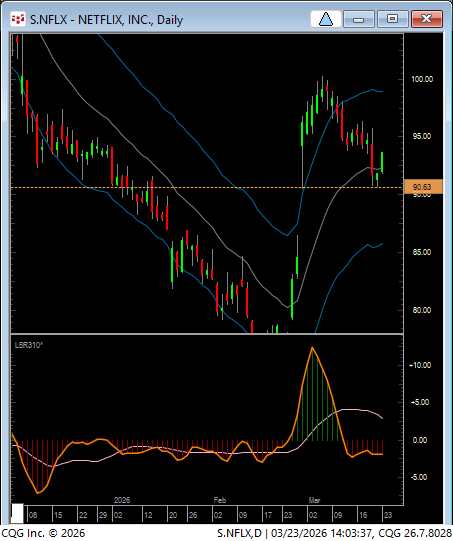
Kyle posts these setups to me the night before on TEAMS. I keep telling him he needs to post on X but its not his thing. I will send more of his content going forward. He is the BEST with charts (and before coming to work with me!)
English


"It doesn't matter how good your process is or how smart you are — you're not gonna beat me to the ball."
Kirk McKeown ran prop research at Point72 for Steve Cohen. Now building Carbon Arc (@CarbonArcAI).
His first edge? Working Sundays.
"If you work six hours a Sunday, 50 Sundays a year — that's 300 hours. On a 50-hour work week, that's six weeks. I was working 13 and a half months a year to somebody else's 12."
His warning for young people using AI shortcuts:
"Nothing beats doing the work. If you haven't pulled apart a three-sheet model, if you haven't spent the time trying to figure out the MD&A in a 10-K — there is value in that apprenticeship. There is value in swinging the hammer."
"Those extra 300 hours a year were the difference between good and great. Generating alpha is about tradeoffs. Creating competitive advantage is about tradeoffs."
Then he went further than anyone else.
"I've been down in coal mines in Australia. I've walked factory floors in Taiwan. Malls in Germany. Pubs in the UK. Hospitals. Distribution centers. Cornfields. All to understand how it all works."
Knowledge compounds.
Ethan Kho@ethanrkho
Ex-Point72 Proprietary Research Head Kirk McKeown on building edge, alpha decay, & why everything that happened on Wall Street is about to happen on Main Street. Kirk McKeown (8.5 years @ Point72 under Steve Cohen | Built primary research at Glenview under Larry Robbins | Now founder of Carbon Arc @CarbonArcAI) "Alpha rewards those who value assets in a cold way. You want to get it right — not be right." We cover: - How alpha creation differs across multi-manager vs. concentrated shops - The 3 vectors every middle office function must move to justify its existence - Why he worked 6-hour Sundays from 2006-2020 — and the math behind it - The TSMC call that signaled semiconductor cancellations before anyone else knew - What the quant revolution on Wall Street tells us about the AI economy today - His framework: 4 market structures, 9 business models, & why they have rules - The MIT beer game & why every business problem is really an inventory problem - His hot take: a top hedge fund launches an enterprise AI lab in 2026 Highlights: 00:00 Intro 04:47 Tutor vs Glenview vs Point72: how edge differs 12:29 How to build “lift” for PMs: at-bats, hit-rate, sizing 18:44 Building research edge: outwork, read, fieldwork 27:16 Personal moat in 2026: analogs, history, decision trees 40:08 “Main Street becomes Wall Street”: what that actually means 44:30 Carbon Arc thesis: “decimalization” of data market structure 46:43 Why the edge migrates to data plus domain context 51:00 How to win in commoditized research: sample size beats anecdotes 01:03:26 Factorizing everything: themes, market structure, business models 01:08:37 Pruning decision trees: signals, scale points, inventory dynamics 01:14:18 Contrarian 2026 take: hedge funds launching enterprise AI labs 01:23:32 Final question: one habit to build career alpha
English
MoneyBro retweetledi



@Seanfrank Love the new pivot you guys added.
FDIC insurance on the cash deposits in my ridge wallet + the market leading 5% interest rate.
Wallet to distributed open source banking company.
Genius.
English

We own all of Ridge.
me + 5 guys.
At any point, we can cash out and sell for life changing money.
there is ALWAYS a market for EBITDA positive, growing brands.
not having investors means the deal is clean-
no preference, no board member vetos.
I keep running ridge because it is fun and I like it.
Build a business YOU LIKE to run.
Not one you are trapped in.
This is the number one reason to not raise money.
English
MoneyBro retweetledi
"If everybody at the table is equally skilled, the outcome is determined by luck."
Kris Abdelmessih (@KrisAbdelmessih). 8 years at SIG. Energy derivatives. Now writes Moontower.
Two core lessons from SIG's trading floor:
"If you have edge and you manage to not blow yourself up, you'll eventually end up with lots of money. And if you have negative edge, you are gonna lose all your money. That's the whole basis of every trading business in the world."
But here's the problem — edge is hard to find.
"Trading is ultimately about labor. It's not really investing. You have to do a whole bunch of work to get your vantage point close enough where it no longer looks random."
And if you skip the work?
"If everybody at the table is equally skilled, the outcome is determined by luck."
Then the market maker reality check:
"Somebody calls you up and asks you for a price. That person's been staring at that thing for a week, a month. They've chosen this moment. And you're a sitting duck. You get 30 seconds."
"You have to be maximally humble. Otherwise you're just walking around thinking everyone else is an idiot. You're not gonna last very long."
Ethan Kho@ethanrkho
MUST-WATCH: Why SIG Dominated Options Trading — Explained by an 8-Year Insider Kris Abdelmessih (@KrisAbdelmessih) spent 8 years trading energy derivatives at SIG, then ran options businesses at Parallax & Prime before founding Moontower —one of the world's most popular newsletters on options & volatility trading. "SIG understood there was an abnormal amount of edge in the market. They came from gambling—sports betting, poker—where edge was tiny. A bookie makes 5% margins. But trading a $2.5 call spread for $2.20 when it's worth $2.50? That's a ridiculous amount of edge compared to gambling, with the same risk distribution." We cover: - Why SIG was called "the evil empire" & how they crushed competitors by trading massive size for tighter spreads - The exact structure of prop shop deals: 50/50 splits, escrow accounts, how you get to 60% then 70% payouts - Why markets look efficient from most vantage points & how trading is ultimately about labor—getting your vantage point close enough that it stops looking random - The tyranny of beta: why the best operator in a melting ice cube business will lose to a mediocre performer in a great market - How to escape the "striver" trap & tune out status optimization (hint: find what you got obsessed with before college applications mattered) - Teaching his 12-year-old options market making & involving his 9-year-old in building a trading card game—scattered cards on the bedroom floor that'll become a finished product Thanks to @KrisAbdelmessih for the masterclass. Highlights: 02:05 How Kris first recognized real trading edge 04:01 How early market structure created easy edge 05:27 Why improvement in trading comes from hindsight 07:08 The core SIG frameworks that shaped his edge 09:37 Why uncovering edge requires labor and precision 11:02 How informed order flow forces trader humility 12:53 What truly differentiated SIG from competitors 13:23 How SIG built a world-class education pipeline 16:30 How SIG captured edge by refusing to hedge 18:11 How centralized risk controlled exposure and variance 19:09 How SIG used size and spreads to dominate markets 23:20 What Kris learned working with Jason McCarthy 25:40 Why elite traders share extreme competitiveness 26:06 How top performers operate across domains and PM roles 28:22 How Kris transitioned from SIG to prop trading 31:56 What shifting into senior roles taught him about trading 33:46 How Kris built training and feedback systems for traders 35:00 How the backer model works inside prop shops 38:41 How escrow capital protects traders from tail events 41:03 How natural gas options trading changed with regime shifts 42:13 How Kris applies trading edge concepts to life decisions 45:46 Why personal alignment beats chasing status in trading 47:13 How status games distort decision-making for young traders 52:23 Why striver behavior is actually risk management 56:27 How Kris teaches opportunity cost through parenting 1:01:28 How exposing kids to decisions builds intuition 1:04:46 How Kris teaches EV using homemade trading games 1:08:05 How iteration and feedback loops shape real learning
English
MoneyBro retweetledi

The transistor, Unix, nylon, Teflon and the laser all have one thing in common: They were a result of the golden age of corporate R&D. In 1985 IBM had 400,000 employees but only 8 called "Wild Ducks." They could break all the rules, pull people off other projects, get budget on demand, and reported directly to the CEO. Bell Labs alone produced 11 Nobel laureates and 28,000 patents. Its budget came from American phone bills. Fortune 500 companies won 41% of America's top innovation awards in the 1970s. By 2006, that number dropped to 6%. Here's what killed American R&D:
1. The hostile takeover wave of the 1980s pushed executives toward short-term results
2. The AT&T breakup gutted Bell Labs from 26,000 to 19,000
3. Venture capital gave the best researchers a better deal than staying inside a corporation
4. Offshoring broke the feedback loop between making things and understanding them
5. Jack Welch turned GE from an industrial research company into a financial engineering shop and donated RCA's research lab to a nonprofit
6. The 2017 tax law penalized R&D spending so aggressively that some companies faced 4x higher tax bills for doing more research
Today the U.S. spends nearly $1 trillion a year on R&D, but two-thirds of it goes to incremental product improvement. The labs that built modern America are gone. I'm reverse-engineering what made them work. And what a modern skunkworks looks like.
Startup Archive@StartupArchive_
Marc Andreessen explains IBM founder Thomas Watson‘s famous “Wild Ducks” program Marc believes that the organizational complexity is one reason you don’t see innovation at large companies. But that’s not the only reason: “I think there’s another deeper thing underneath that that people really don’t like to talk about, which is the sheer number of people in the world who are capable of doing new things is just a very small set of people. You’re not going to have a hundred of them in a company… You’re going to have 3, 8, or 10, maybe.” Marc learned this early in his career at IBM, which was one of the most powerful companies in the world and had over 440,000 employees at the time. “They had a system that worked really well for 50 years. Most of the employees in the company were expected to basically follow rules… But they had this category of people they called ‘Wild Ducks.’ This was an idea that the founder Thomas Watson came up with. They often had the formal title of an IBM Fellow and they were the people who could make new things.” He continues: “There were eight of them and they got to break all the rules and invent new products. They got to go off and work on something new, they didn’t have to report back, they got to pull people off of other projects to work with them, they got budget when they needed it, and they reported directly to the CEO.” Marc recalls one wild duck, Andy Heller, putting his cowboy boots on the conference room table “amongst an ocean of men in blue suits, white shirts, and red ties.” It was fine for Andy Heller to do that, but it was not fine for you to do that. “They very specifically identified almost like an aristocratic class within our company that gets to play by different rules… Their job is to invent the next breakthrough product. We, IBM management, know that the 6,000 person division is not going to invent the next product. We know it’s going to be crazy Andy Heller and his cowboy boots.” Marc believes companies like IBM and HP ultimately collapsed when venture capital emerged as a parallel funding system for these wild ducks to start their own companies. Video source: @hubermanlab (2023)
English
MoneyBro retweetledi
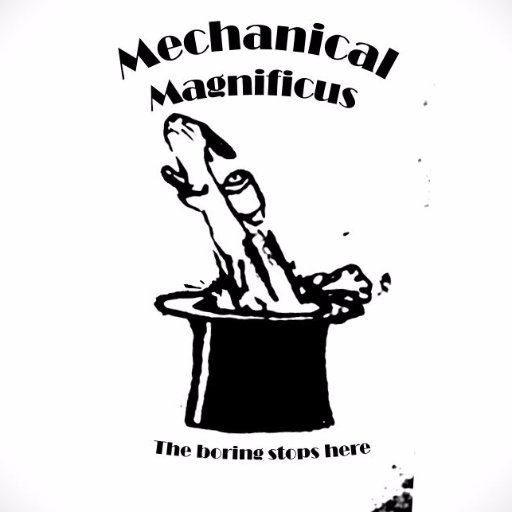
These are EPMs, the electromagnet’s better relative that nobody’s ever heard of.
They require ridiculously little power to operate and can stay on or off EVEN WITHOUT POWER.
Here are 3 simultaneously powered by only 2 camera batteries, capable of lifting up to 80lb/36kg… each.
English
MoneyBro retweetledi

The entire AI industry spent a week convinced DeepSeek had secretly launched V4. Reuters reported it. Developers debated it. OpenRouter usage charts broke.
It was Xiaomi.
A smartphone and electric vehicle company just shipped a 1-trillion-parameter model that topped the world's largest API aggregation platform, and nobody guessed the origin because the model was too good to be associated with a hardware company.
The stealth launch as "Hunter Alpha" on March 11 was the most elegant product validation in recent AI history. No brand, no attribution, no expectations. Just raw performance. The model processed over 1 trillion tokens in 8 days. Developers organically chose it over every labeled frontier model on the platform. When Reuters tested the chatbot, it identified itself only as "a Chinese AI model primarily trained in Chinese" with a May 2025 knowledge cutoff, the exact same cutoff DeepSeek reports.
The person behind this is Luo Fuli. Born in 1995. Eight papers at ACL as a graduate student at Peking University. Alibaba DAMO Academy. Then DeepSeek, where she co-developed V2 and contributed to R1. Lei Jun reportedly offered tens of millions of yuan to recruit her. She joined Xiaomi in November 2025. Four months later, she's shipping a model that benchmarks alongside Claude Sonnet 4.6 and GPT-5.2 at one-fifth the API cost.
The detail that tells you everything about how this team operates: when Luo first experienced a complex agentic scaffold, she tried to convince the MiMo team to adopt it. They resisted. So she issued a mandate. Anyone on the team with fewer than 100 conversations with the system by tomorrow can quit. They all stayed. The imagination converted into research velocity.
The architectural bets matter. Hybrid Attention for long-context efficiency. MTP inference for low latency. 1M context window. 42B activated parameters out of 1T total. These are infrastructure decisions optimized for agents that run autonomously for hours, not chatbots that answer one question at a time.
Pricing: $1/$3 per million tokens up to 256K context. $2/$6 for 256K to 1M. Claude Sonnet 4.6 costs roughly 5x that. Xiaomi's shares rose 5.8% on the announcement.
The real DeepSeek V4 still hasn't shipped. The model everyone mistook for it already has a trillion tokens of real-world usage data.
Fuli Luo@_LuoFuli
MiMo-V2-Pro & Omni & TTS is out. Our first full-stack model family built truly for the Agent era. I call this a quiet ambush — not because we planned it, but because the shift from Chat to Agent paradigm happened so fast, even we barely believed it. Somewhere in between was a process that was thrilling, painful, and fascinating all at once. The 1T base model started training months ago. The original goal was long-context reasoning efficiency. Hybrid Attention carries real innovation, without overreaching — and it turns out to be exactly the right foundation for the Agent era. 1M context window. MTP inference for ultra-low latency and cost. These architectural decisions weren't trendy. They were a structural advantage we built before we needed it. What changed everything was experiencing a complex agentic scaffold — what I'd call orchestrated Context — for the first time. I was shocked on day one. I tried to convince the team to use it. That didn't work. So I gave a hard mandate: anyone on MiMo Team with fewer than 100 conversations tomorrow can quit. It worked. Once the team's imagination was ignited by what agentic systems could do, that imagination converted directly into research velocity. People ask why we move so fast. I saw it firsthand building DeepSeek R1. My honest summary: — Backbone and Infra research has long cycles. You need strategic conviction a year before it pays off. — Posttrain agility is a different muscle: product intuition driving evaluation, iteration cycles compressed, paradigm shifts caught early. — And the constant: curiosity, sharp technical instinct, decisive execution, full commitment — and something that's easy to underestimate: a genuine love for the world you're building for. We will open-source — when the models are stable enough to deserve it. From Beijing, very late, not quite awake.
English
MoneyBro retweetledi

MoneyBro retweetledi

Talked yesterday on my drive home yesterday with a friend that worked at several tech companies in SF (had some nice wins as a few went public) and considered buying a small business before buying a small consumer app.
He used to have an entire coding team in India. He fired them and now just used Claude Code. He used to give them instructions and then iterate maybe 5-6 times before being okay with the changes. Now that he can iterate much faster, he'll now iterate like 15 times because it's so much faster. He's pretty fired up.
x.com/toddsaunders/s…
Todd Saunders@toddsaunders
I heard an incredible analogy from a VC friend that I can’t stop thinking about. “The moat in software was the cost of building software. And Claude Code just mass produced a bridge.” It’s wild when you think about the impact of this. The SaaS boom produced a few dozen billionaires and a bunch of zero sum winners. But the AI SaaS era will mass produce millionaires. There will be fewer ServiceTitans hitting $5B valuations, and instead there will be 50,000 companies doing $500K-$5M each, run by 1-3 people with deep expertise and huge margins. To be clear, I believe that the total value of software goes up, and the number of companies created goes up exponentially. But the number of people who capture the value also goes up 100x. I don’t believe in the “SaaS is dying” headline, I think it’s missing the point. It’s simply that the power of SaaS is changing hands.
English
MoneyBro retweetledi

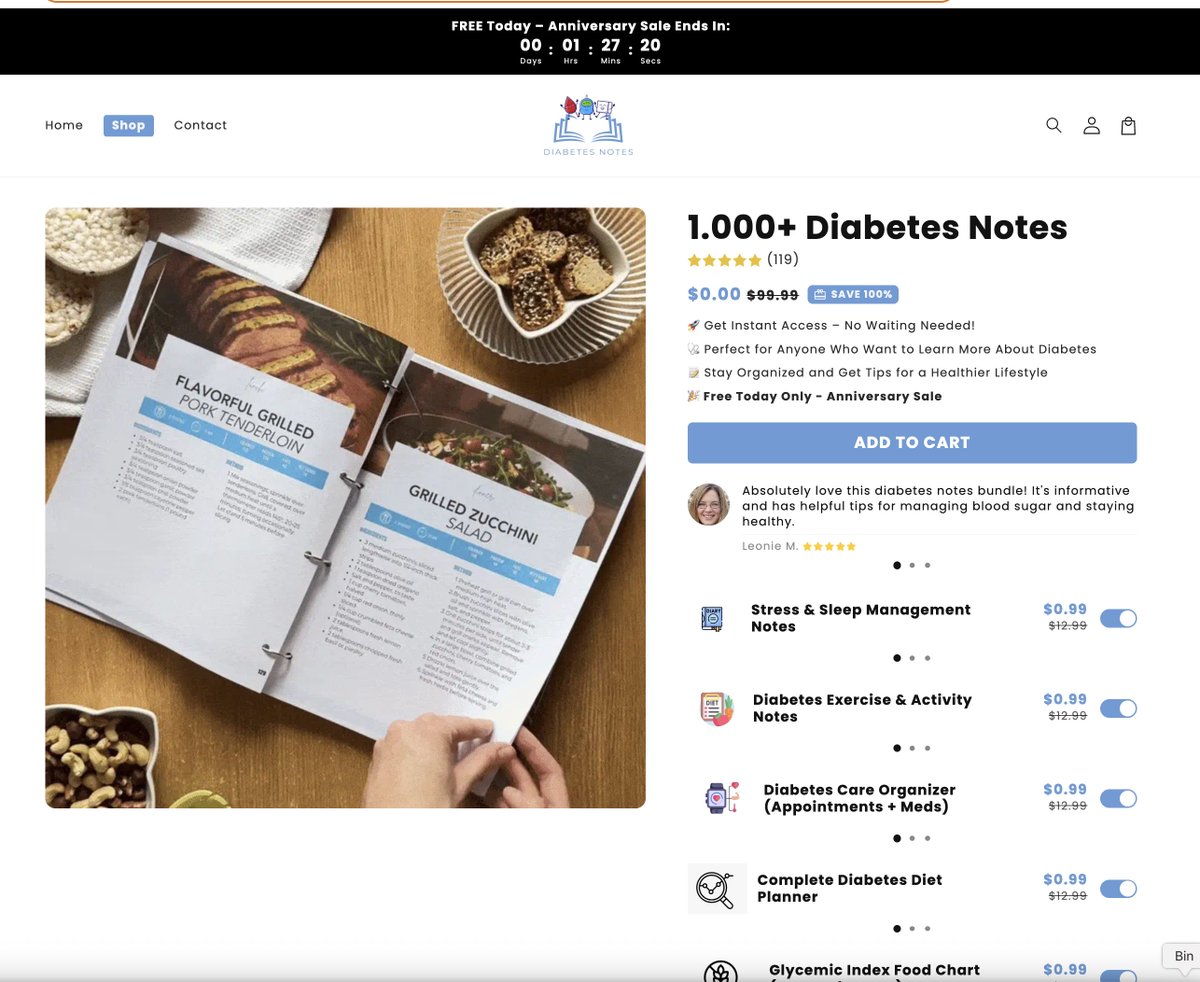
Bro this guy is printing money selling a free diabetes ebook
found a store called "diabetes notes" 130 ads running, been seeing them for 6 months straight, 50k visitors a month on their site.
completely faceless. grabs recipes from tiktok, films his physical book, but it's actually a digital ebook. sells it for $0 upfront then stacks upsells and shipping fees behind it.
now here's where it gets interesting.
i think this is the same person running the photography store and the risen art store. found around 10 stores with the exact same design, same funnel structure, same offer just dropped into a different niche each time. all of them running hundreds of ads for 6+ months.
if it's one guy the strategy is just: pick a niche, build an ebook, set up the funnel, repeat. that's it.
or people are just copying the model and jumping into new niches. either way someone is eating.
the product almost doesn't matter. digital products work in every niche right now. health, art, photography, fitness same playbook, different audience.
if you're sleeping on this you already know what to do.
English
MoneyBro retweetledi

The trading education industry is built around keeping you dependent.
I built a finish line instead.
Trading 101 through 401. Four courses. Done.
Here’s what gets overlooked: the daily work is where real traders are built.
Every day, Legacy Profits Club members get trade ideas in their inbox. Names with real catalysts, setups I like, and the market context behind why a name is on the list.
Not alerts for you to copy. Education to build on.
Every course in the library. Direct access to me.
$15 a month. Less than you probably spend on lunch out.
If you’ve been watching on the sideline this is the easiest decision you will make this week.
English
MoneyBro retweetledi

MoneyBro retweetledi

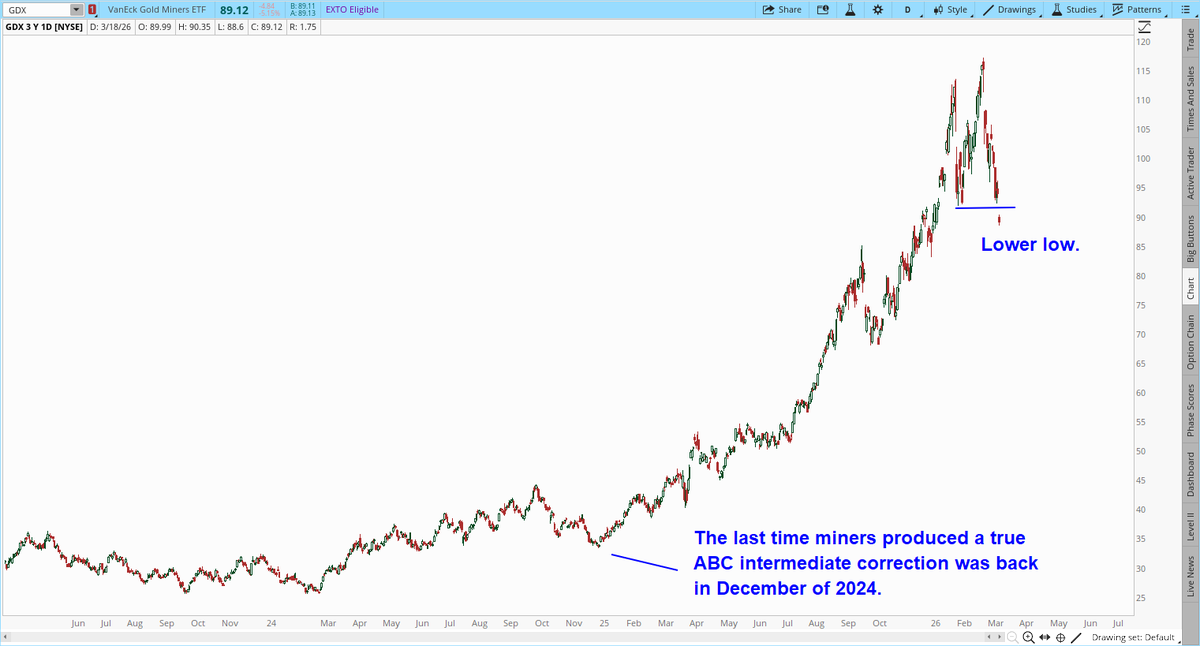
It's been a long time coming but we finally have a true ABC intermediate correction in the mining stocks. That means a failed daily cycle. This is what triggers technical stops and ultimately washes out the last remaining sellers to set the stage for the next leg up.
This doesn't mean the bottom has to occur today but it does mean we are very close. The bullish precent is now under 20. This is building the fuel for a move above $6000 and probably above $7000 during the next rally that will follow once this completes.
With the daily cycle now on day 31 the bottom could come at anytime.
BTW this is a great spot to buy more physical gold and silver.
English
MoneyBro retweetledi

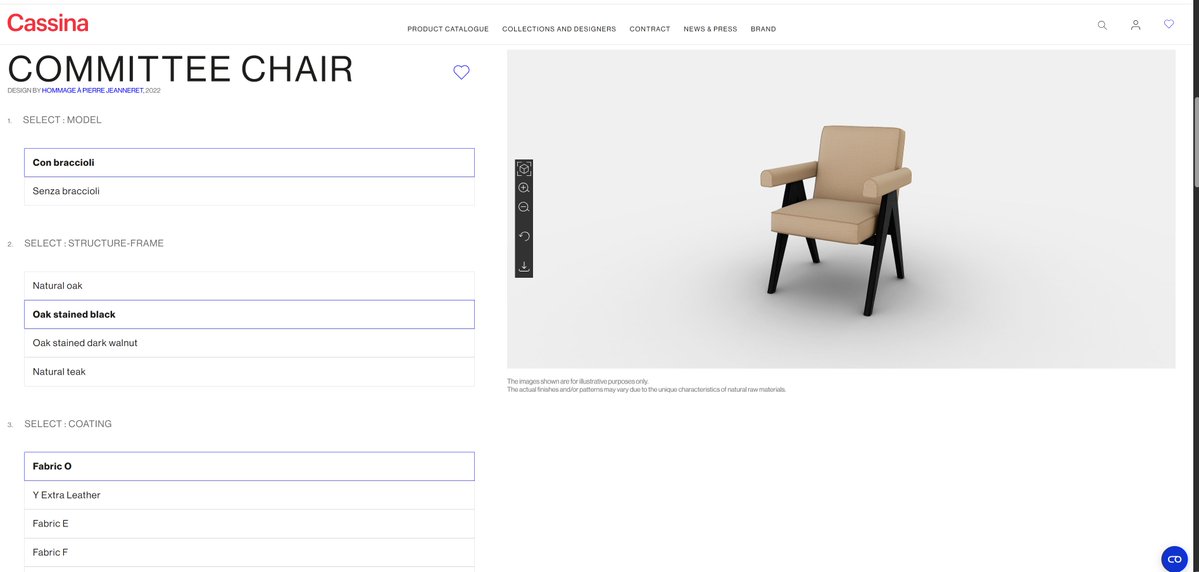
I've tried so many office chairs, and none of them really felt great. This time I decided to try a chair without wheels, and thus far it's so much better.
If you have a long torso relative to legs and carry more weight at the top of your torso, this one is worth trying because it gives so much back support. It's very comfortable.
People way underspend on chairs given how much time we spend sitting in them. This is something to not cheap out on, and to keep hunting around until you find a chair that suits you well.
English