
Mauricio Vargas
2.2K posts

Mauricio Vargas
@MoritzVargas
Economist and Finance Expert with @greenpeace_de • Views are my own


📦 Can industrial policy work? Yes—the East Asian experience shows it can (at least partially). But its success rests on a key condition: labor control. 🇯🇵🇰🇷🇹🇼 Japan, South Korea, and Taiwan industrialized rapidly under authoritarian or semi-authoritarian regimes. Wages and labor rights were systematically repressed to favor capital accumulation and export competitiveness. This was especially stark in South Korea during the 1980s–1990s, when unions clashed with the state and business. (If you’ve watched Squid Game, it’s in the backstory of Seong Gi-hun.) ⚠️ Authoritarianism wasn’t incidental—it was functional. Not all authoritarian regimes succeed with industrial policy, but successful cases relied on the ability to suppress real wages and labor rights. 🇦🇷 This is why Latin America’s Big Push programs failed: their political base—urban working-class voters (e.g., Peronistas)—couldn’t sustain the wage repression required. The strategy collapsed under its own contradiction. 💥 You can’t push industrialization with cheap labor and depend politically on those who demand higher wages. The internal logic breaks. Latin America’s populism was a road to nowhere. As far as I can tell, there are no examples of country-wide industrial policy success where real wages (and consumption) were not kept relatively low. 🇨🇳 China is not so different today. 🧾 Consumption as a share of GDP remains exceptionally low—even compared to countries at similar stages of development. That wouldn’t be the case if China were a democracy. High savings and low consumption are features, not bugs, of its growth model. 🤔 That’s why I’m puzzled when advocates defend industrial policy from a progressive position that favors high wages and democratic institutions. You can’t have your cake and eat it too. 📚 This point isn’t new: @pseudoerasmus has made it for years. And long before him, it was central to Marx, Gerschenkron, and Dobb—and deeply embedded in the logic of socialist Big Push programs, from Stalin to Mao.


Deutschlands Abstieg ein absolutes Desaster

Good point. Also today, large segments of the left are driven not by empathy for the poor, but by resentment toward “the rich.”


3/7 Was nicht gut funktioniert ist der Link zum Vermögen: Im Alter wird das Vermögen kaum angetastet, oft wird sogar weiter gespart. Einfaches Lebenszyklusmodell (Sparen im Erwerbsleben, Entsparen im Ruhestand) funktioniert empirisch nicht.


Zur Kaiserzeit und zur Zeit des Wirtschaftswunders lag die Staatsquote übrigens bei knapp über 10 %. Mit einem funktionierenden Staat. Und die Infrastruktur nutzen wir teils heute noch.


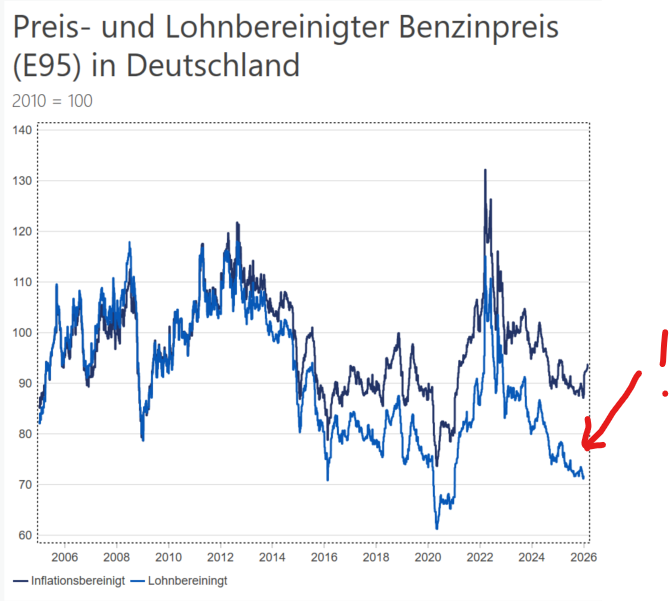
„Seit Beginn des Irankriegs sind es 21 Millionen Euro pro Tag mehr Gewinne bei den Mineralölkonzernen. Davon könnte man 27.700 Menschen ein kostenloses ÖPNV-Jahresticket schenken pro Tag.“ Maja Göpel bei #hartaberfair


Der einst wichtigste Autoboss des Landes fordert Gespräche zwischen demokratischen Parteien und der rechtsextremen AfD. Es ist nicht die einzige radikale Position, die Ex-VW-Chef Matthias Müller in einem Interview äußert. #ref=rss" target="_blank" rel="nofollow noopener">spiegel.de/wirtschaft/soz…