
Mister Kavanagh
467 posts
Mister Kavanagh
@Mr_Kavanagh
LMS ready self-grading primary source quizzes. At least one new each week.
Katılım Nisan 2012
135 Takip Edilen20 Takipçiler


My best one, I think. Portugal. Algarve.

The Random Recruiter@randomrecruiter
@MSUKyleBrown @vrexec Epic
English

Mister Kavanagh retweetledi


@uncledoomer There is a plant in the caribbean named Chadon Beni. Its like cilantro except better. Most people love it but very rarely u find someone who hates it and now we know why.

English


@fishstark @kevbonicus @BenSasse Wild that the response to “are we trading real life for dopamine hits” is a demographic chart and a Cameroon joke. Sasse asked a philosophical question and got a stats debate
English

@kevbonicus @BenSasse That's a great point. I've always wanted to live in Cameroon
English
All right @BenSasse, let's make a bet.
Let's divide the US in half. I'll let you pick which half.
In your half, you ban Candy Crush. In my half we institute 16 weeks of paid parental leave, universal childcare, & a restored child tax credit.
Let's see which has more babies.
60 Minutes@60Minutes
“We've stopped making babies. We've decided that being distracted by a dopamine hit around Candy Crush might be a good way to spend your time. Not if you're a full human," former Sen. Ben Sasse says in an extended interview. cbsn.ws/4cA1Jrp
English
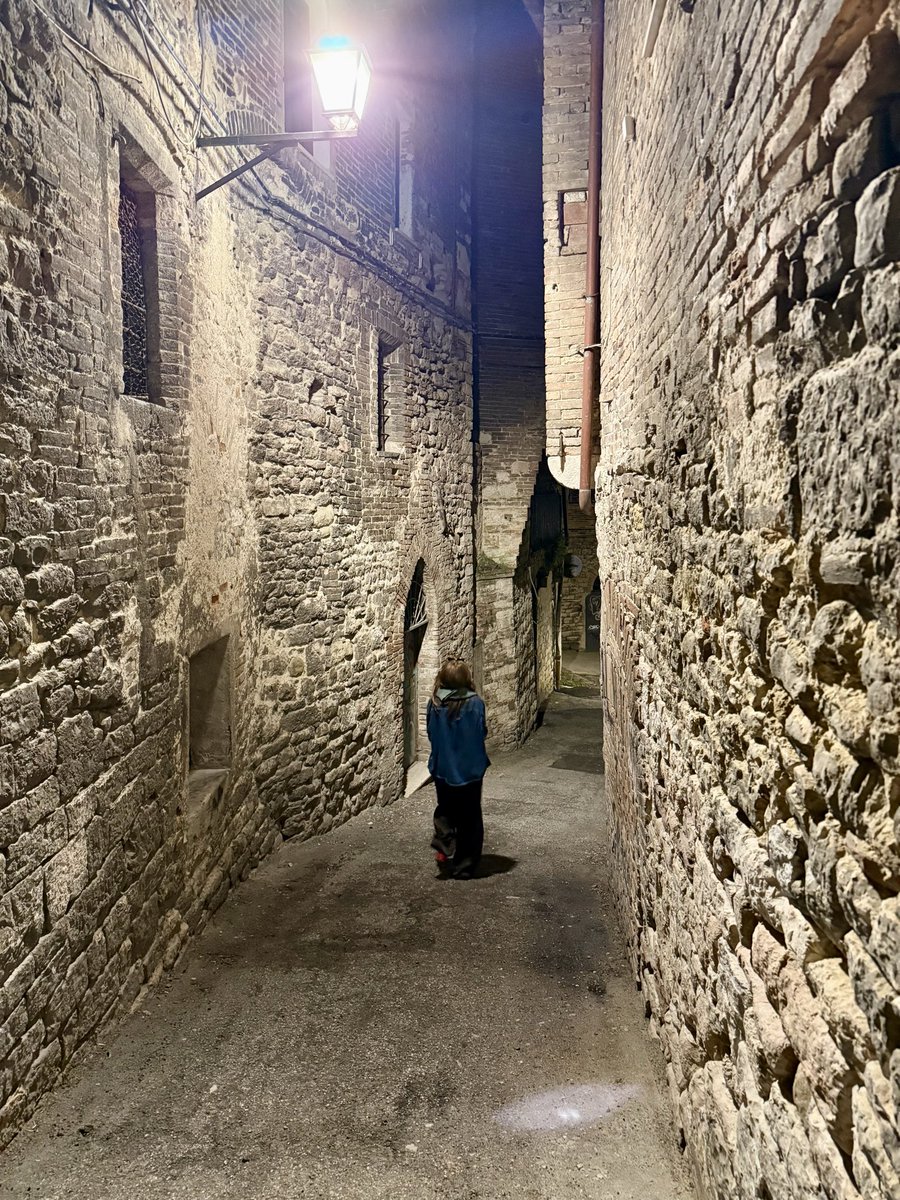
I love spending a few days and nights in the ancient cities in Europe… and just sitting around drinking wine or eating with the family.. meandering the alleyways.. because both physically and mentally there is no difference between your current experience and the experience of people in that same place thousands of years prior…



English
@IterIntellectus Welcome to the club! My own take on optimization tends towards “good enough” from a relaxed and supporting parents over perfect stacks administered with performance pressure. But parents should absolutely give thought and approach it all open minded.
English

@vrexec Gattaca style - don’t save anything for the swim back.
English
It’s that time of night when I’d say you should quit your job tomorrow with your spouse and even your small children and move to Brazil or Greece or Portugal or Japan or South Africa.
People will then lose their minds… Impossible! Visas! Residency! What about the kids?!
Figure it out. Make it a challenge to yourself.
The 16th and 17th century explorers didn't have Google, remote jobs, or cheap flights…they had 1/1000th of your resources and still sailed into the unknown. They figured shit out or died trying. The modern mind is so uncreative… modern soul so uninspired.
What is your actual excuse?
English
@ProfBZZZ @Tyler_A_Harper To me, a nation that cannot produce enough engineers, critical thinkers, or civically literate citizens to compete with authoritarian rivals hasn’t chosen kindness, it’s chosen a comfortable story about kindness.
English

@Mr_Kavanagh @Tyler_A_Harper People just don't get how close to the metal we are messing with things flippantly when we mess around like this.
x.com/i/status/20426…
Brandon Zicha@ProfBZZZ
Since so many like to be glib about how 'we will all be replaced by machines', let's put it in machine terms. Reading thousands of pages, inhabiting others through literature in a sustained manner, understanding math and form and proportion, having an understanding of history and how society and people move and change, just.. taking in via highly relational methods of text, analysis, experience, experiment, and cultivated viewing... This is how human beings populate their semantic networks and train their models. Embodied. Over years. Through genuine encounter with the material. That's what makes human, understanding as we've known it for centuries (millenia?), human. That's what makes us different. You can't shortcut it without getting a shallower and even truly alien mind at the end. /8
English
The drop in standards is a complex story, but the group that is almost never to blame is the students themselves. They had this done *to them*.
I am not dunking, but I am concerned, because this cohort also doesn't seem very happy.
English
@KeruboSk Genuine question - if urgency and novelty are the triggers, aren’t we basically describing a brain optimized for high-stakes environments? Makes you wonder if ADHD is less a disorder and more a mismatch with abundance.
English

People with ADHD have what’s called an “interest-based nervous system.” They literally can’t force themselves to care about things that bore them.
It’s not a choice. It’s not willpower. Their brains physically won’t produce the neurochemicals needed to engage unless something triggers interest, urgency, novelty, or challenge.
English
@katrosenfield @Tyler_A_Harper Rousseau had some great lines about Caribbean peoples seeing European court life as hell, and the inverse.
English

The replies of this post are very worth reading— some really smart people debating in there — but what I’m thinking is that whether or not you think the apocalypticism has panned out is mostly a question of what you imagined the apocalypse might look like
Henry Shevlin@dioscuri
When I was a kid, people said television was eroding society and corrupting the youth. Since then we’ve had the same story for videogames, smartphones, social media, and now AI. Not to deny these technologies have all *changed* society, but the apocalypticism never quite pans out
English
@Tyler_A_Harper Back in the classroom after 7 years, and I’m 100% in agreement that the digital can and should be decoupled from much learning, at least into high school. If people don’t build the mental scaffolds that necessary friction once imposed, we’ll lose them by design.
English

A lot of smart people seem to think "well we had oral culture and then print culture next and now we're transitioning to some new culture. That's just progress." But the problem is that modernity was built on print culture! Who knows if you can just sub it out for the next thing!
English
Mister Kavanagh retweetledi
What we think of as modern civilization is essentially coextensive with mass literacy. People greeting the end of mass literacy with a yawn are assuming that we can keep this machine work going in the absence of the foundations it was built on. Huge civilizational-scale gamble.
Jaikaran@drakmog
"passively accepting the end of mass literacy" is the line more people need to hear. the framing around AI in education has somehow made "kids should learn to read and write well" the radical position. if the default path leads to a generation that can prompt but can't compose, we've made a terrible trade. the typewriter idea is interesting because it forces the actual thinking back into the process.
English

Parents have had it. Kindergartners should not be watching YouTube at school. In a few years, we're going to look back at school tablets and laptops and wonder what the heck we were thinking, especially for elementary school students. washingtonpost.com/opinions/2026/…
English
@fede_intern @GiraffeMcGraff @Azariel91 Discovering the centrality of the friction we’ve been compelled to smooth.
English

indeed:
The core argument is simple: many features of human life that appear stable and natural are historically produced. As society accelerates, a number of these features begin to lose their function and their permanence. I believe consciousness as we know it is one of them.
#Individuality as technology
Life is organized around information that replicates under constraint. Computation generalizes this biological logic. It allows selection and optimization to occur faster and at larger scales by externalizing memory, comparison, and feedback. Problems that once required internal deliberation can be solved through external processes that test, filter, and iterate possibilities.
Capital pushes this logic further. It reorganizes social life around continuous feedback, price signals, and competitive selection. As these forces compound, individuality starts to look less like a foundation and more like an interface that emerged to solve earlier coordination problems.
Capital behaves as an impersonal intelligence oriented toward speed, abstraction, and self-optimization. As cognition, decision-making, and coordination migrate into automated systems, the inner self loses its structural role. Over time, many assumptions we take for granted are worn down by this acceleration. Individuality and consciousness appear increasingly exposed to this process.
#The construction we cannot see
Fish do not realize they live in water. The medium that sustains them is so constant that it disappears from perception. Some of the most important structures are overlooked for the same reason. Individuality and consciousness belong to that category.
We tend to treat individuality and consciousness as self-evident facts, as if humans have always experienced themselves as bounded selves with an inner voice, a private mental space, and a continuous narrative identity. Because this experience feels natural, it is assumed to be timeless. However, for most of human history people did not describe themselves as individuals in the modern sense. Decisions were not understood as outcomes of inner deliberation, and agency was not located inside a private interior self. Action was organized through rituals, traditions, kinship, and prescribed roles. Meaning arrived from outside the person rather than from introspection. In many societies outside the Western trajectory, this structure remains largely intact.
The idea of a you inside your head observing your own thoughts is therefore a learned construction. It depends on language, habits, metaphors, and social practices that had to be developed and stabilized over time. Inner speech, narrative memory, moral self-examination, and the sense of authorship over action emerged as cultural achievements layered on top of older biological processes.
Modern societies actively reproduce this configuration. From early childhood, people are trained to understand themselves as autonomous units with opinions, preferences, goals, and an inner life that belongs only to them. The training is so pervasive that it becomes invisible. Other ways of being human recede from view, even though many have existed and some still persist.
#The weakening of the conditions
The conditions that once made individuality functional are weakening. Earlier systems relied on human subjects to think, decide, judge, and take responsibility. Cognition and coordination were constrained by human minds. Individuality emerged as a solution: a stable self enabled long-term planning, moral accounting, and institutional continuity.
Earlier societies coordinated without modern consciousness. Contemporary systems increasingly coordinate without modern selves. Decision-making proceeds without inner deliberation. Meaning is delivered through incentives, metrics, and feedback loops.
At the cultural level, individuality remains constantly invoked. People are urged to be themselves, express themselves, optimize themselves. Yet the channels for expression arrive pre-shaped, quantified, and monetized. What appears as selfhood increasingly takes the form of managed performance within narrow bounds.
#Replacement by degrees
The modern self does not collapse in a single moment. It is replaced function by function, each substitution small enough to go unnoticed.
Taste was once formed through a slow, private process: encountering things by accident, sitting with discomfort, learning to love what initially resisted you. Algorithmic recommendation compresses this into a profile that updates in real time. The system knows what you will like before you do. The inner process of forming a preference, the hesitation, the revision, the gradual shaping of sensibility, loses its purpose when an external system performs it faster and with better accuracy. What remains looks like taste but functions as consumption.
Judgment follows a similar path. In organizations that once depended on accumulated experience, performance metrics now determine what counts as competent work. The slow formation of professional intuition, the kind that takes years to develop and resists easy articulation, gets flattened against quarterly targets. When the metric becomes the institution’s memory of what the work is for, the judgment it was meant to approximate quietly disappears. People still show up. They optimize what is measured. The rest erodes.
Inner deliberation faces the same pressure from a different direction. When an AI assistant can draft your emails, plan your week, summarize your reading, and suggest your next decision, the internal process of thinking through a problem starts to feel unnecessary. Not wrong, just slow. The assistant is not forcing you to stop thinking. It is making thinking feel like friction in a system that rewards speed. Over time, the habit of sustained internal reflection weakens for the same reason any unused capacity weakens: through disuse.
Each of these substitutions is individually reasonable. Each solves a real problem. Taken together, they describe a pattern where the functions that once required a self are gradually absorbed by systems that do not.
#What is at stake
The modern self once felt inevitable because it solved concrete problems. It enabled abstraction, continuity, and responsibility at scale. Its future usefulness is far less certain.
The self depends on performing certain functions, and when those functions migrate outward, the self weakens not through suppression but through redundancy.
The question is not whether individuality was real. It was. It produced philosophy, law, science, art, and institutions that reshaped the world. The question is whether it will remain functional as the systems around it absorb more of what it used to do. A coordination technology that no longer coordinates does not persist on sentimentality alone.
None of this means the self will vanish. It means the conditions under which it developed are changing, and what comes next may look different enough that the word “individuality” stops pointing at anything recognizable. Whether that transition is a loss, a transformation, or simply the next phase of the same process that produced the self in the first place is not something that can be settled in advance. But it should be named clearly, because what cannot be seen clearly cannot be preserved deliberately.
federicocarrone.com/series/les-cir…
English

@vrexec $12 direct to Venice, $24 to Innsbruck. Trains that are, dare I say, pleasant.
I’ve told a lot of people in the U.S. that I feel like Encino Man coming back after almost a decade. The changes are stark. Less obvious if you’ve been steeped in it the whole time.
English
Something my wife and I lament this time every single year…
Going back to the US each summer and trying to figure out how we’ll get around…
Do we rent a car? Take a train? Just use Ubers.
Our families are spread across the Philly and NYC suburbs.. the trains to and from are an absolute horror show, especially if you have little kids and luggage to carry around.
Hard for Europeans to fathom. The poor quality of the Philly to NYC train corridor is difficult to express with words.. the aesthetic, the delays, the speed, the communication — all terrible. Plus it’s expensive.
Not to mention the fact that trains don’t even take you to where you need to actually go. The US is not connected this way.
We always end up renting a car and it’s just the worst. Highways.. insane drivers.. no care whatsoever for the aesthetic of the roadways. Ridiculous and embarrassing billboards everywhere with personal injury attorney or gambling ads. Cars broken down on the side of the road. Garbage all over the place.
Ugh.
English
@tomowenmorgan Knowing what we know now, it’s like coating the environment in lead paint for young people.
English

@DKThomp Recently returned to the U.S. after several years abroad. Rust belt city. Definitely notice recent immigrant children playing outside, looking around on the bus, and generally behaving in a more pre-phone way than locals.
English
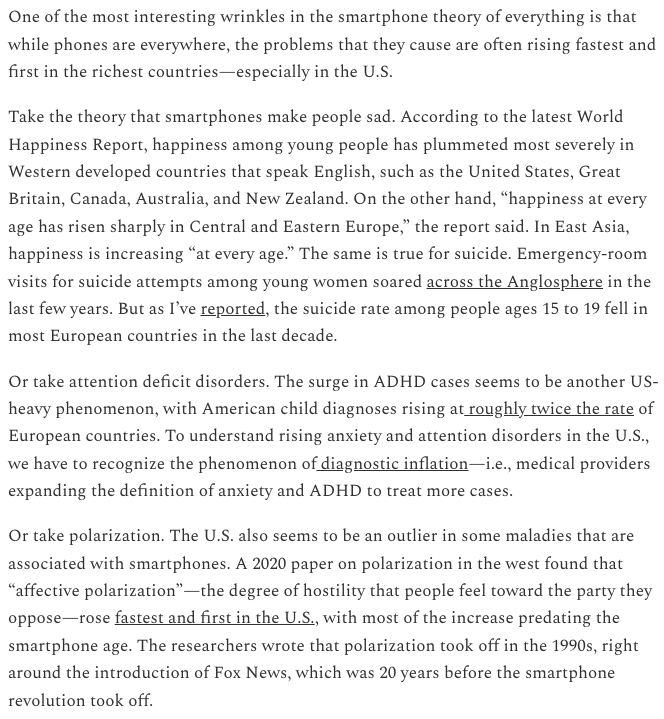
New newsletter: THERE'S SOMETHING VERY WEIRD ABOUT PHONES AND AMERICA
The most interesting thing about the Smartphone Theory of Everything is that it's really a Smartphone Theory of Everything in America and the English-Speaking World.
While phones are everywhere, the problems that they cause are often rising fastest and first in the richest countries, especially in the U.S.
Youth sadness? Surging in the Anglosphere, but almost nowhere else.
Attention disorders? Skyrocketing in the U.S., but not Europe.
Populism, distrust, polarization? Much larger effects in the U.S. than other countries.
The version of the SToE that is most defensible given the best data we have is something like this:
Compulsive phone use along with under-regulated social media produce widespread youth anxiety, attention issues, polarization, populism, and institutional distrust in:
1. highly individualistic societies, with
2. a culture of diagnostic inflation [i.e., expanded diagnostic guidelines for anxiety and ADHD], plus
3. negative-affect prevalence [i.e., people online constantly talking about their anxiety and ADHD], and finally
4. high levels of negativity in their news ecosystem
... and post-2010 America was simply the first and most dramatic example of all these ingredients coming together.
English
@normonics Looks really cool. I’m working in the U.S. until June while my 4 and 5 year old daughters are in Italy. Would love to see them try it.
English

We have been expanding beta. We are certainly on to something. The data could not be more clear. Kids are engaged. No explicit "rewards". No "streaks" or crazy slot machine bells and whistles. Just good, solid, holistic engagement of their minds, hands, and speech.
We are opening up more seats progressively. There are some open now if you're interested. DM me for a 50% off code. sageteacher.ai
Feedback is extremely valuable. We are going to continue improving on this continuously, only getting better from here.
Currently tuned in for 4-8 range. (4 can be iffy if they don't yet enunciate well). Will be rapidly expanding to other ages if this is not your zone.
English