Sabitlenmiş Tweet

Slides of the #AOM2025 #PatentPDW (and of previous Patent PDWs) are available at: patentpdw.wordpress.com/workshops/.
Thank you all for participating.@ThomasSchaper

English
Mingtao Xu
2.2K posts

@MtX9
A professor @Tsinghua_Uni @SEM_Tsinghua. #Strategy, #Innovation, #PropertyRights, #IPR #AI. All views are my own. [email protected]

From 2015 to 2024, the number of early-stage drug development programs worldwide increased by more than 80%, with pronounced growth in China and a relative decline in the US and other high-income countries. 🧵 ja.ma/4rULaL2



A new paper on correlates of zero-sum thinking just came out and it has everything: race, sex, politics, class, mobility, and even deep roots! Here are my favorite graphs from the paper. But first: how was zero-sum thinking measured? The answer is as a set of four questions on whether things are zero-sum with respect to ethnicity ("If one ethnic group becomes richer, this generally comes at the expense of other groups in the country"), citizenship ("If those without American citizenship do better economically, this will generally come at the expense of American citizens"), trade ("In international trade, if one country makes more money, then it is generally the case that the other country makes less money"), and income ("If one group becomes wealthier, it is usually the case that this comes at the expense of other groups"). Endorsement of these ideas is considered zero-sum thinking. Because these can feel political, you might think that would compromise the results. And true! Measurement invariance wasn't tested, but removing mechanically-related questions didn't seem to change this paper's findings much. Onto the graphs! The first one I liked was on the demographics of zero-sum thinking. It's a young and middle-aged person's game, but it's also a game for Hispanics and Blacks, but not Asians, for Democrats and not Republicans, for urbanites, somewhat for ruralites, and not as much for suburbanites, and there are U-shaped relationships with income and education. There are lots of findings in the break-downs of these categories, like that Democrats who voted for Trump were often highly zero-sum thinkers, or that zero-sum thinking is simultaneously related to - The belief that luck trounces effort - The perception that mobility is high - Universalist values - A belief in the importance of tradition - Generalized trust A second finding I found extremely interesting was that people who experienced more growth in the first twenty years of their lives had less zero-sum values. Because of the correlation between growth and zero-sum thinking over time and compositional changes that covary with those changes, it's important to do some post-stratification to see if this result really holds up. If it does, it has fascinating implications. The paper is really chock-full of fun facts, like that, globally, right-wingedness is related to less zero-sum thinking, but in some countries, the relationship is nullified or reversed. Another finding was that being anti-immigrant and pro-redistribution was related to zero-sum thinking among Democrats, and even more strongly, among Republicans. Yet another finding was that parental, grandparental, and great-grandparental mobility was negatively related to zero-sum thinking. A more immigrant-focused finding was that later-generation immigrants are closer to non-immigrant levels of zero-sum thinking. That is, they become more zero-sum! More likely there's selection at play, but regardless, immigrants are less zero-sum and this held up in the 2nd and 3rd generations, too. It was also found that county foreigner shares were unrelated to zero-sum thinking in respondent's generation or their parent's generation, but they were negatively related in their grandparent's generation. Another intergenerational transmission of values question had to do respondents' self-identification of having ancestors who experienced different bouts of slavery. The descendants of African slaves, Holocaust survivors, indentured servants, interned Japanese Americans, and enslaved Amerindians were more likely to be zero-sum thinkers. The same was not true for the descendants of prisoners of war. Unlike with immigration, the zero-sum correlates of enslavement seem more robust. For example, a person's county enslaved share in 1860, their parent's county enslaved share in 1860, and their grandparent's county enslaved share in 1860 all correlated with zero-sum sentiment. This remained true for people, their parents, and their grandparents if they moved out of the American South! Additionally, these findings also held true for each level when it came to county Confederate culture. In other words, the transmission of values, even with controls for demographics, state, and race was robust! This study paints a vivid picture of the correlates of zero-sum thinking in the present day, internationally, and with respect to their roots in the deep past. I definitely recommend reading it! Go check it out: nber.org/papers/w31688


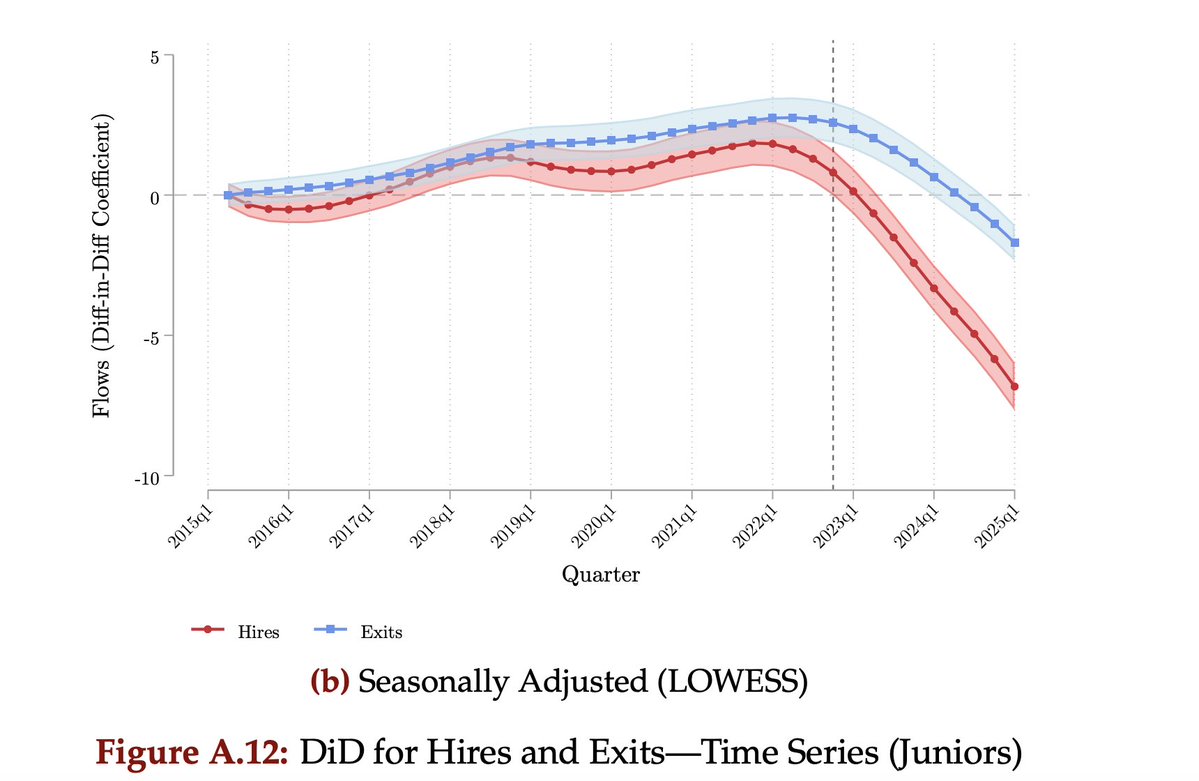
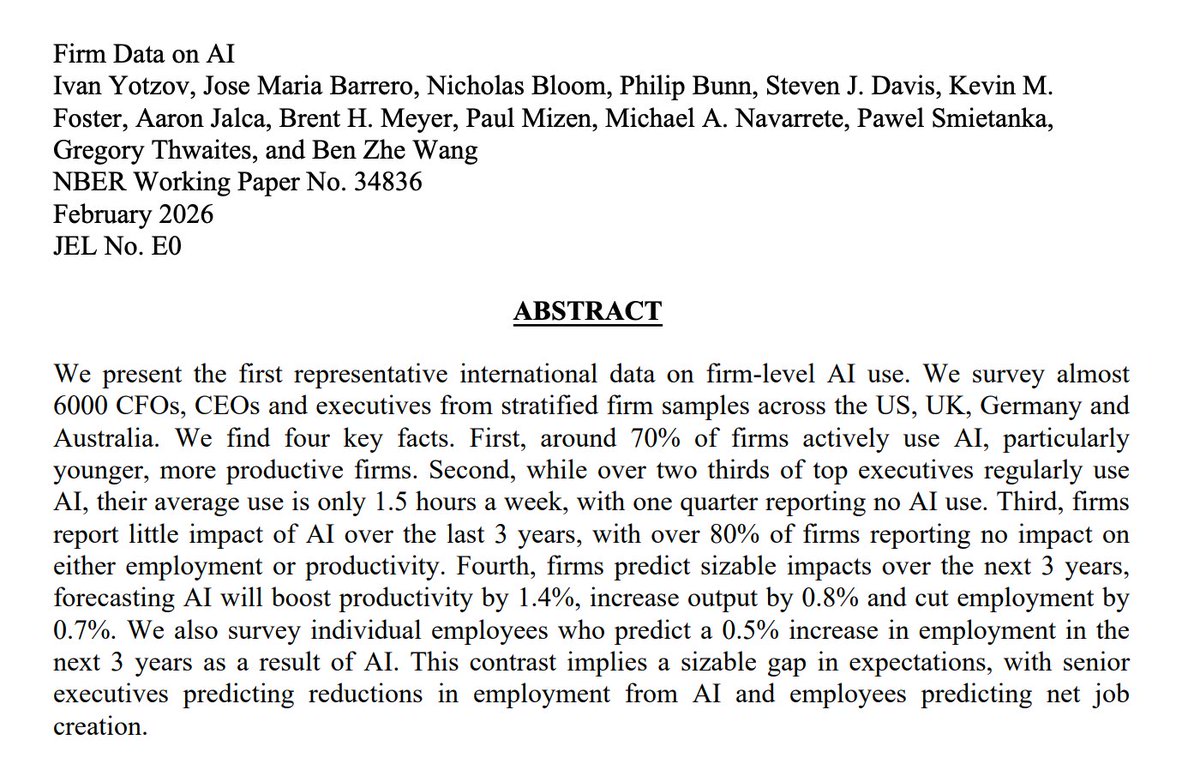
My hypothesis is that AI will lead to less dramatic layoffs (e.g., the Block memo) and more a slower drip: companies will continue to fire at similar rates, but will hire at much slower rates. Those who are left will be expected to use AI tools--to figure it out--in order to pick up the slack from those who were let go. This will naturally lead to AI models being adopted effectively throughout organizations. But the labor market implications for the economy are in some ways more dire than the dramatic scenario: exactly the type of slow drip of increasing unemployment and lower labor force participation that policy has the hardest time dealing with (policy is much better when there is a clear demarcated disaster).

1/ Some Simple Economics of AGI—🔥🧵 Right now, there is a low-grade panic running through the economy. Everyone is asking the same anxious question: what exactly is AI going to automate, and what will be left for us?