
Safa
445 posts



@martinfisip Halo Kak, mksih banyak udh ngadain ini, aku pejuang gap year yg belum lolos SNBT kmren & tahun ini. Semoga tahun ini menjadi kesempatan terakhir aku lewat jlur simak,
Aku gk ingin nyerah dgn keadaan, tpi aku juga gk ingin membebani ortu, wish me luck, semoga kakany berkah slalu.
Indonesia

Safa retweetledi

To understand docker you just need to know these 8 concepts
✅ Bookmark you will need this :

English
@olinpsych Halo Kak! Aku pejuang gap year yg gagal di SNBT tahun kemarin & tahun ini. Semoga lewat jalur mandiri ini jd kesempatan terakhirku. Aku butuh bgt perpus Nakamatika ini sebagai bahan evaluasi, karena slama ini aku cuma blajr dri YT/X. Makasih banyak y Kak udah ngadain GA ini! 🙏✨
Indonesia

guys aku mau GA perpus nakamatika buat 1 orang, komen saja di bawah yh kenapa kamu butuh
Nakamatika@nakamatika
Beda satu kata, tapi rasanya beda dunia. "TETAP SEMANGAT" vs "SELAMAT". Buat yg belum dapet ucapan "Selamat" di layar birunya, lepasin aja kecewanya. Gak apa-apa, tapi jangan lama lama🫶 biar gak kelamaan down, Nakamatika resmi buka JALUR BANGKIT!
Indonesia
Safa retweetledi

Docker commands you use every single day 👇
docker ps
docker ps -a
docker images
docker build -t name .
docker run -p 8080:8080 name
docker stop containerid
docker rm containerid
docker rmi imageid
docker logs containerid
docker exec -it container bash
docker pull imagename
docker push imagename
docker system prune
docker volume ls
docker network ls
Save this. 📌
Which command do you use most? 👇
English
Safa retweetledi

The most popular GenAl architecture, RAG, has evolved so much💯👇
All within 2 years and the difference? Night and day.
Here's what actually changed:
Basic RAG (what most people use to build):
(Simplified)
L↳ Chunk documents into pieces
L↳ Store them in a vector database
↳ Retrieve similar chunks via embedding search
L↳ Feed retrieved data to the LLM for a response
Simple. But limited.
The problem with basic RAG:
1. It misses connections between information
2. Can't reason across multiple data sources
3. Retrieves irrelevant context (garbage in = garbage out)
4. No iterative refinement when the first answer is wrong
Agentic RAG (the upgrade):
(Simplified)
Instead of one-shot retrieval, you get:
L, A retrieval agent that reasons iteratively
L↳ Multiple enterprise tools (vector search, web search, SQL)
The agent decides which tool to use when
L↳ Refines its approach until it finds the right answer
This is 2x better for complex queries.
But the problem started once we saw the limitations of single-agent systems.
With a multi-agent system, you have better control as well as the ability to chain multiple tools and reason on each agent's output.
Now, for graph DB, we all know that enterprise documents are related to each other.
Hence, just finding a similarity search was not enough for these documents.
We needed a much more concrete structure in which document relationships are mapped so that they can be retrieved according to those relationships.
That's when we started using
Multi-agent graph RAG (the final evolution):
(Simplified)
Now you have specialized agents:
L, Graph agent: Understands entity relationships
L, SQL agent: Queries structured databases
L↳ Web agent: Pulls real-time information
L↳ Retrieval agent: Orchestrates everything
Each agent is an expert. The retrieval agent coordinates them.
But you cannot afford to build graph RAG when you are just starting.
So, here's the correct sequence:
- Start with basic RAG. Get it working.
- Add agentic capabilities once you hit limitations.

English

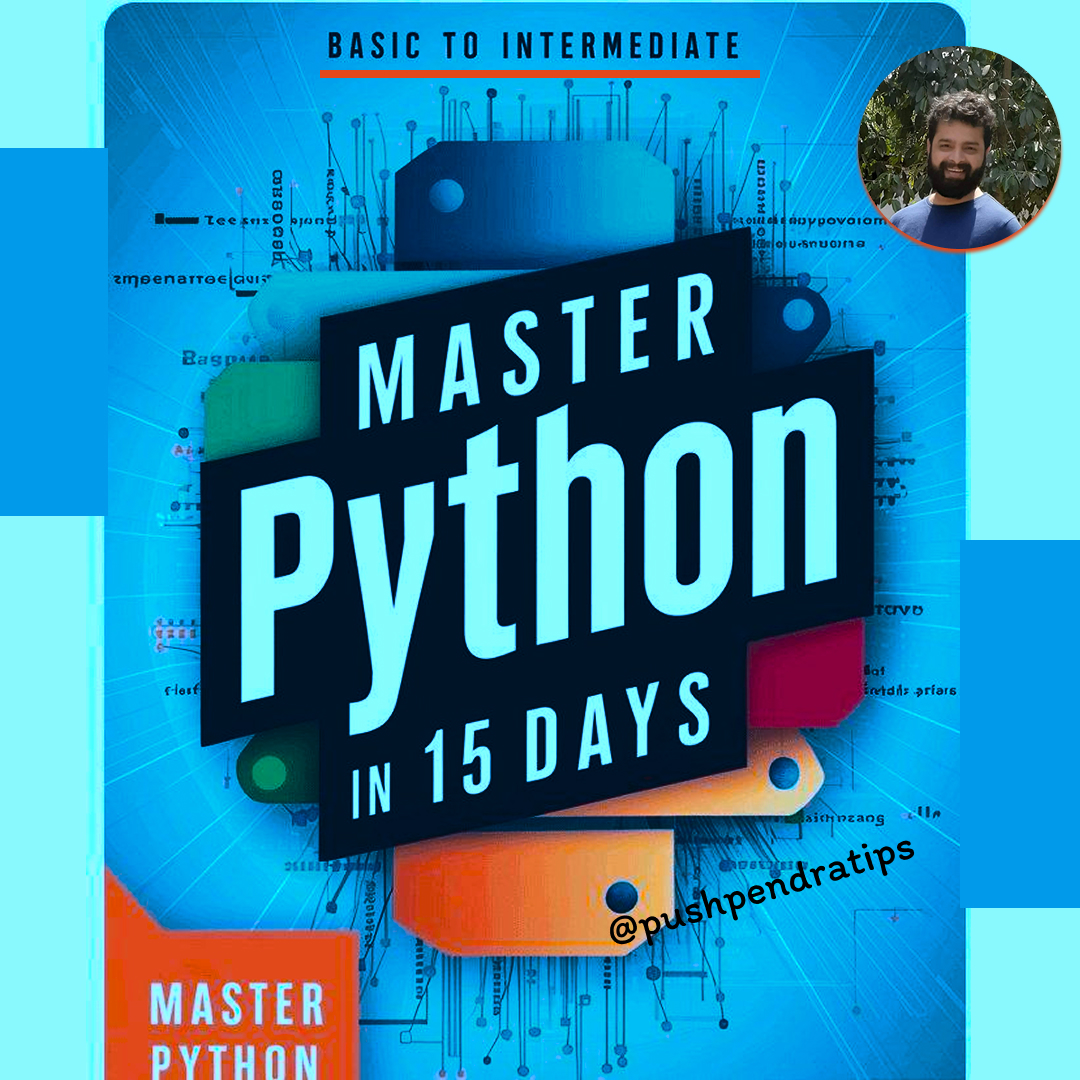
Python is difficult to learn, but not anymore!
Introducing Complete Python Training Course, All formulas, Tips & Tricks , shortcuts Absolutely Free
It helps you to save 80% time and money
To get it, just:
👉 Like and Repost
👉Comment "Python"
👉Follow me
@pushpendratips
English
@RidwanRWG @keharyapatihan @MikaelDewabrata @riantisilvi @karimakayyim @bepituLaz Selamat sore
Pak, saya berminat untuk join kelasnya
Indonesia

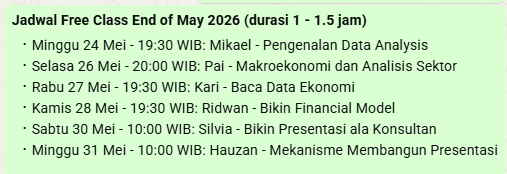
Mumpung market lg gak enak, saya mau ngajak belajar bareng buat nambah2 pengetahuan dan skill tipis2
yang mau ikut bisa tulis komen atau QRT/RT post ini
Pemateri
@keharyapatihan @MikaelDewabrata @riantisilvi @karimakayyim
Masih mau ngajakin yg lain (TBC)
@bepituLaz pemateri founder stage in Code with Claude at London
@Rudiyanto_zh @cettabox @donnyjustinvest
Buat yg berminat ngisi kelas ini bisa DM saya ya buat diatur jadwalnya
Indonesia
Safa retweetledi

Docker Learning Roadmap
|-- Foundations of Containers
| |-- What is Docker?
| |-- Virtual Machines vs Containers
| |-- Containerization Concepts
| |-- Docker Architecture (Client, Daemon, Registry)
| |-- Installing Docker on Different Platforms
|-- Docker Basics
| |-- Docker Images & Containers
| |-- Pulling & Running Images
| |-- Docker CLI Commands
| |-- Managing Containers (start, stop, restart, remove)
| |-- Working with Docker Hub
|-- Creating Docker Images
| |-- Understanding Dockerfiles
| |-- Writing Efficient Dockerfiles
| |-- Layer Caching & Optimization
| |-- Multi-Stage Builds
| |-- Building & Tagging Custom Images
|-- Managing Data in Docker
| |-- Volumes & Bind Mounts
| |-- Persistent Storage Concepts
| |-- Sharing Data Between Containers
| |-- Backing Up & Restoring Volumes
| |-- Managing Container Data Safely
|-- Networking in Docker
| |-- Docker Networking Basics
| |-- Bridge, Host & Overlay Networks
| |-- Container Communication
| |-- Exposing Ports & Port Mapping
| |-- DNS & Service Discovery
|-- Docker Compose
| |-- Multi-Container Applications
| |-- Writing docker-compose.yml Files
| |-- Managing Services & Dependencies
| |-- Environment Variables in Compose
| |-- Scaling Services with Docker Compose
|-- Docker Security Best Practices
| |-- Running Containers Securely
| |-- Managing Secrets & Environment Variables
| |-- Image Vulnerability Scanning
| |-- Least Privilege Containers
| |-- Securing Docker Daemon & APIs
|-- Advanced Docker Concepts
| |-- Container Orchestration Basics
| |-- Introduction to Kubernetes
| |-- Docker Swarm Fundamentals
| |-- Resource Limits & Monitoring
| |-- Logging & Debugging Containers
|-- CI/CD with Docker
| |-- Integrating Docker into Pipelines
| |-- Automated Builds & Deployments
| |-- Docker with GitHub Actions / GitLab CI
| |-- Versioning & Image Registries
| |-- Deployment Strategies with Containers
|-- Docker in Cloud & Production
| |-- Deploying Docker Apps to AWS / Azure / GCP
| |-- Container Registries (ECR, Docker Hub, GCR)
| |-- Load Balancing & Scaling
| |-- Monitoring & Observability
| |-- High Availability & Resilience
|-- Real-World Docker Projects
| |-- Containerize a Node.js Application
| |-- Build a Full-Stack Dockerized App
| |-- Deploy Microservices with Docker Compose
| |-- Create CI/CD Pipelines with Docker
| |-- Run Databases & APIs in Containers
|-- Continuous Learning & Growth
| |-- Read Official Docker Documentation
| |-- Explore Open Source Docker Projects
| |-- Learn Kubernetes & Orchestration
| |-- Practice Container Debugging
| |-- Stay Updated with Cloud-Native Trends
Get the Docker Projects & Mastery Ebook
codewithdhanian.gumroad.com/l/svjkv
This ebook teaches you Docker step-by-step with practical projects, real deployment examples, and production-ready container workflows to help you master containerization and modern DevOps practices.

English
Safa retweetledi
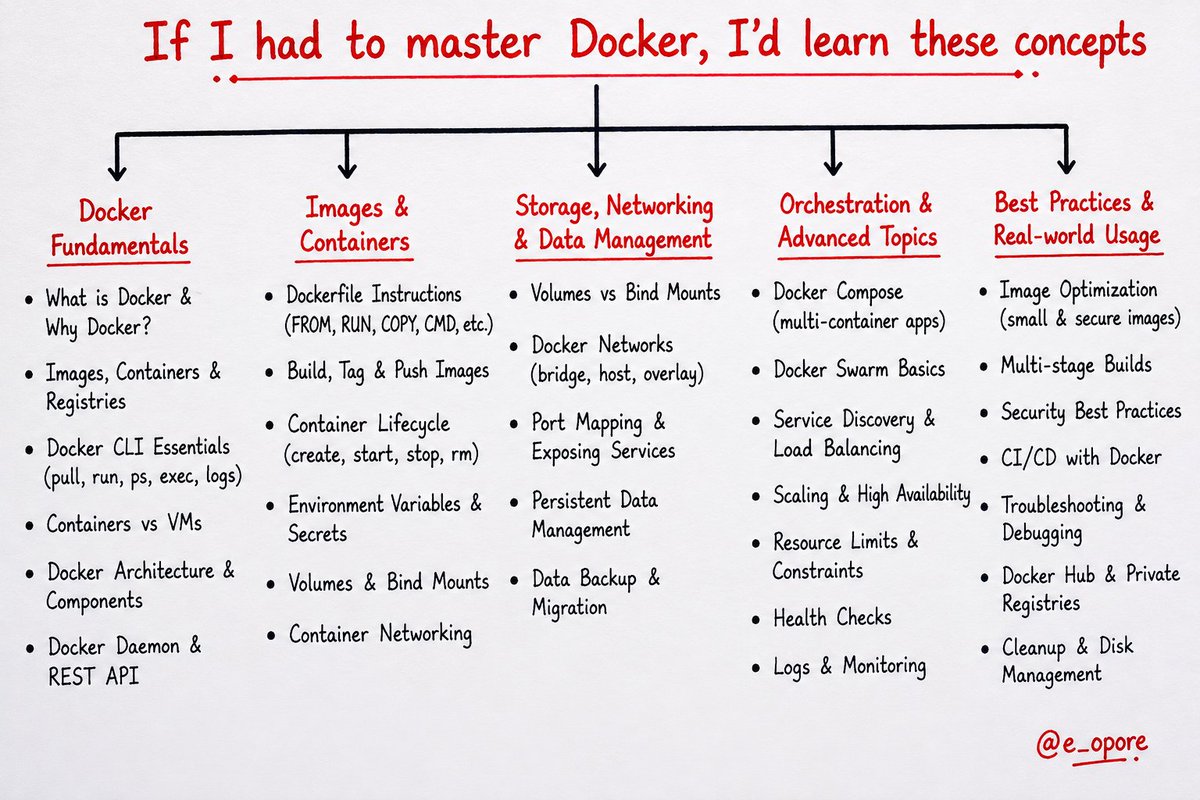
If I had to master Docker, I’d learn these concepts:
1. What is Docker
2. Containers vs Virtual Machines
3. Docker Architecture
4. Docker Engine
5. Docker CLI
6. Docker Desktop
7. Docker Images
8. Docker Containers
9. Docker Hub
10. Container Lifecycle
11. Pulling Images
12. Building Images
13. Dockerfile Basics
14. Dockerfile Instructions
15. Layers & Caching
16. Multi-Stage Builds
17. Base Images
18. Alpine Images
19. Image Optimization
20. Container Networking
21. Bridge Network
22. Host Network
23. Overlay Network
24. Port Mapping
25. Volumes
26. Bind Mounts
27. Persistent Storage
28. Environment Variables
29. Secrets Management
30. Docker Compose
31. Multi-Container Applications
32. Service Dependencies
33. Health Checks
34. Restart Policies
35. Logging Drivers
36. Monitoring Containers
37. Docker Logs
38. Resource Limits
39. CPU & Memory Allocation
40. Container Security
41. Linux Namespaces
42. Control Groups (cgroups)
43. Docker Registry
44. Private Registries
45. Image Tagging
46. Versioning Strategies
47. CI/CD with Docker
48. Docker in GitHub Actions
49. Docker in Jenkins
50. Docker in GitLab CI
51. Container Orchestration
52. Docker Swarm
53. Kubernetes Basics
54. Running Docker on Cloud
55. Docker on AWS
56. Docker on Azure
57. Docker on GCP
58. Reverse Proxy with Nginx
59. Load Balancing
60. Service Discovery
61. Scaling Containers
62. Stateful vs Stateless Containers
63. Database Containers
64. Redis Containers
65. PostgreSQL Containers
66. MySQL Containers
67. MongoDB Containers
68. Debugging Containers
69. Inspecting Containers
70. Exec into Containers
71. Networking Troubleshooting
72. Image Scanning
73. Vulnerability Management
74. DevSecOps with Docker
75. Rootless Containers
76. Distroless Images
77. Docker Best Practices
78. Layer Minimization
79. Build Optimization
80. Caching Strategies
81. Backup & Restore
82. Multi-Architecture Images
83. ARM vs x86 Containers
84. Docker APIs
85. Container Runtime
86. OCI Standards
87. Podman vs Docker
88. BuildKit
89. Docker Extensions
90. AI Workloads in Docker
91. Microservices with Docker
92. Event-Driven Systems
93. Observability
94. Prometheus & Grafana
95. ELK Stack with Docker
96. High Availability
97. Fault Tolerance
98. Production Deployment
(...and more concepts)
===
👋 PS - Want a complete Docker roadmap from beginner to advanced?
Read right now:
→ Docker Ebook:
codewithdhanian.gumroad.com/l/svjkv
===
💾 Save this for later & RT to help others learn Docker.
👤 Follow @e_opore + turn on notifications.
English
Safa retweetledi

Github Webhook Plugin released!
Plugin ini membantu developer menghubungkan workflow Github x Evonic.
Contoh use case:
1. auto-docs, ketika ada rilis terbaru adit akan meng-update dokumentasi.
2. auto-review, ketika ada PR baru, linus akan mereview dan memberikan rekomendasi.


Indonesia

GUYS AKU PENGEN DEH BAGI2 FILE PDF GRATIS LAGEE!‼️
KALI INI AKU PUNYA INI⬇️
"ROADMAP BELAJAR BAHASA INGGRIS DARI NOL (FROM ZERO TO HERO)"!
Jadi bisa banget buat yang pengen lancarin Speaking Skill dari Nol!
Comment ajaaa yang mauu!😍😍

Indonesia


guys mau tanya adakah latsol buat ujian tulis penmaba unj atau ga materi²nya gitu atau gambaran soal² nya????
Indonesia


lapak tag disiniii! buat yang mau baca boleh drop @ buat aku tag yaaa sch!

Indonesia
Safa retweetledi
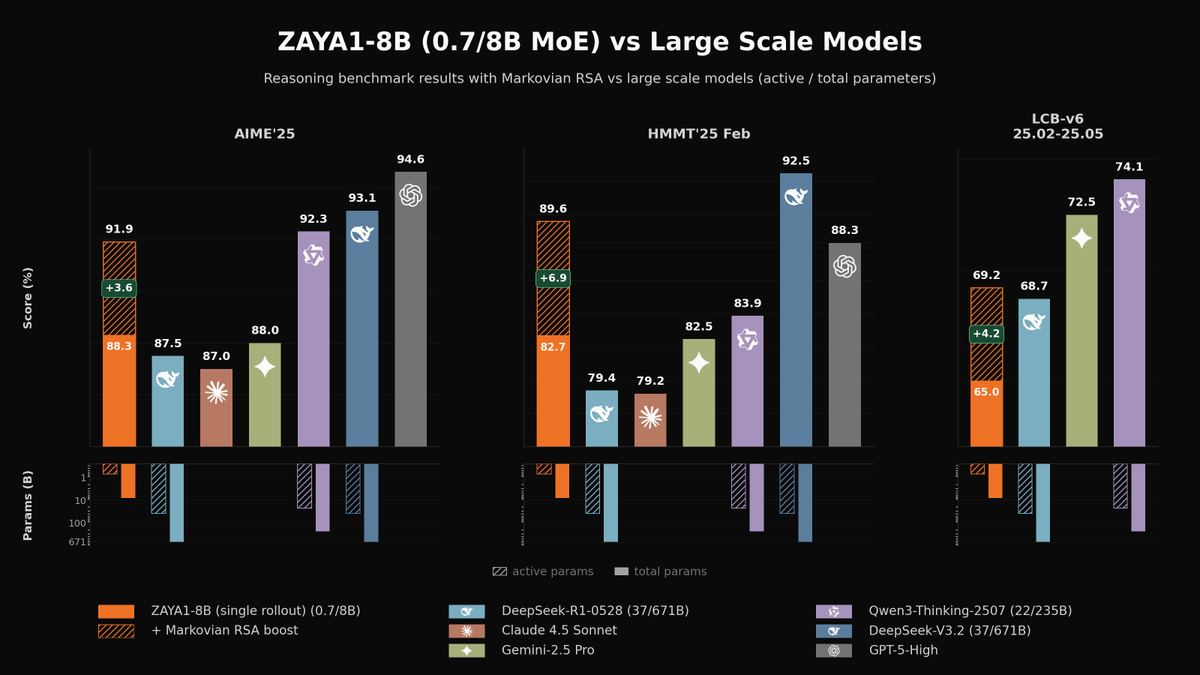
Today we're releasing ZAYA1-8B, a reasoning MoE trained on @AMD and optimized for intelligence density.
With <1B active params, it outperforms open-weight models many times its size on math and reasoning, closing in on DeepSeek-V3.2 and GPT-5-High with test-time compute. 🧵
English

hi ppl ppl, adakah yg bisa aku tanya2 ttg simak ui?? hit my dm yaa..!
Indonesia
@sainsinaja Ayo miin segera production fitur to ny terutama untuk simak sama utul
Indonesia

@nakamatika Makasih banyak miin sebelumnya. rencananya kalo dapet aku mau langganan analitica buat persiapan UM hhe
Indonesia

❗GIVEAWAY ALERT❗
2 orang pemenang total 40ribu rupiah.
Caranya :
RT tweet ini dan tweet di pinned tweet, reply mau buat apa hadiahnya.
Udah gitu aja :)
pemenang diumumkan besok malam yaa
semoga beruntung!
#Giveaway #zonauang️ #Zonajajan
GIF
Indonesia