They aren't even hiding it anymore.
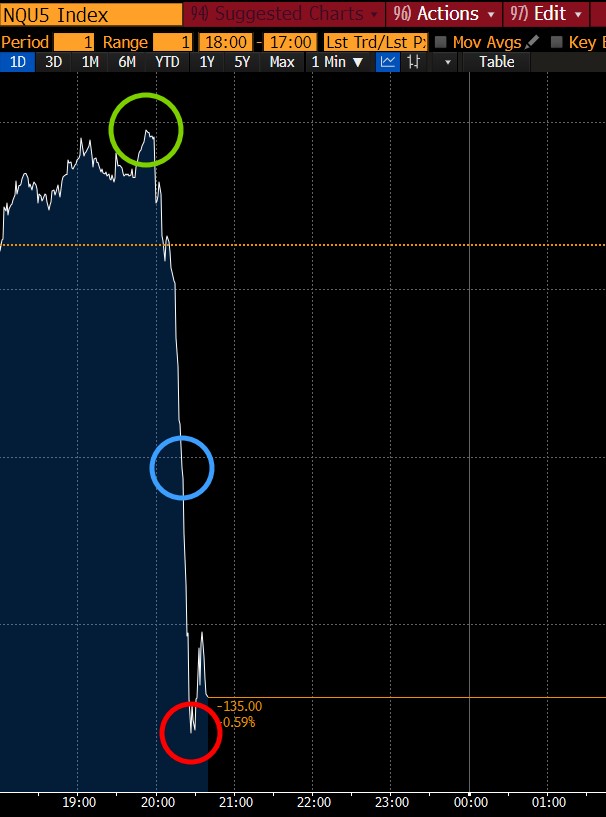
NASDAQ futures start *aggressively* selling off at 7:52 PM (green circle) for no reason whatsoever.
Trump announces tariffs on Canada, Europe, and the rest of the world at 8:06 PM (blue circle).
NASDAQ bottoms *4 minutes* later at 8:10 PM (red circle).
You don't even need room temperature IQ to figure out what is happening over here.
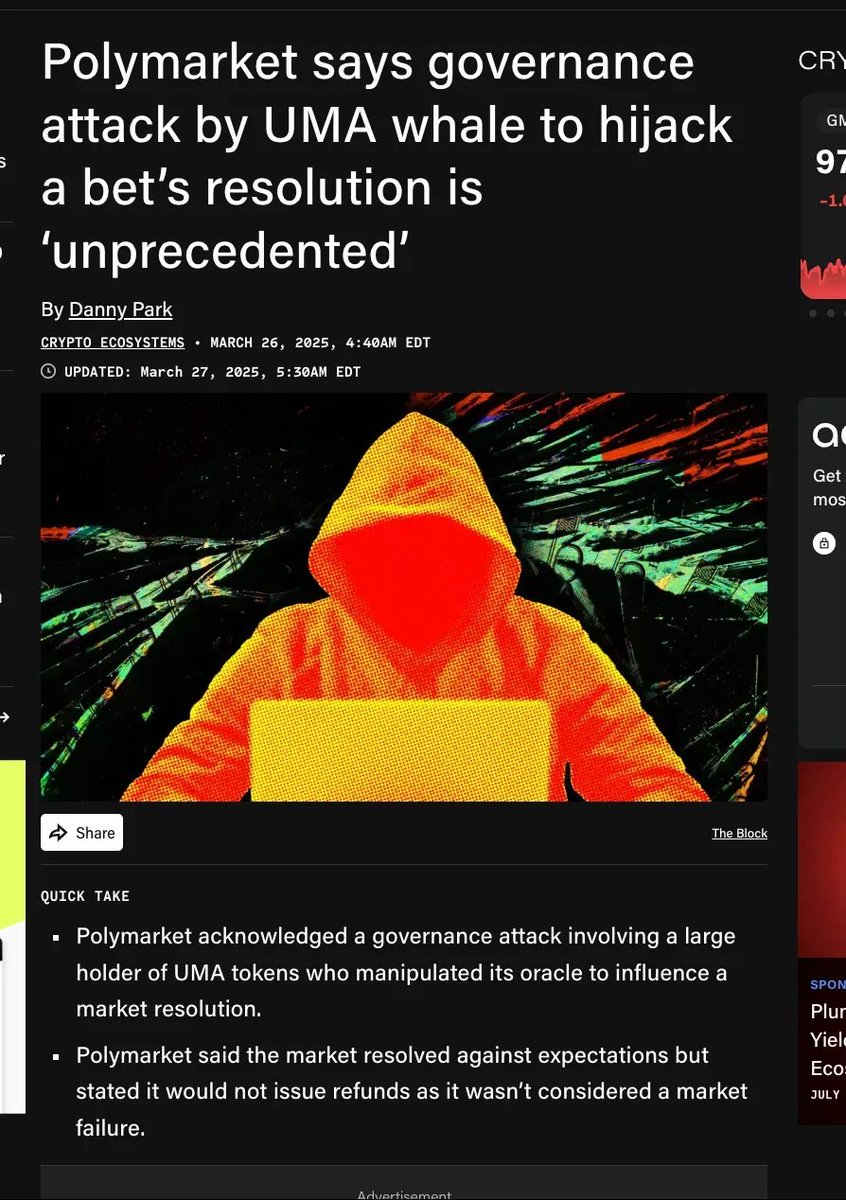
One wallet was shown sharing a message that read: “It doesn’t matter about the suit. We have more UMA tokens. I’m not losing my investment. Force it through.”
And yet @polymarket remains silent.
thestreet.com/crypto/markets…
I lost $20,000 on Polymarket.
And it wasn’t because I made a bad prediction.
It was because oracle system behind Polymarket is fundamentally broken.
This thread:
— How the system works
— 7 real examples of manipulation
— Why the $157M Zelenskyy outfit is another disaster
🧵
How Prediction Markets Became Manipulation Markets
When the cost of corruption is lower than the payoff, truth becomes a commodity auctioned to the highest bidder.
The controversy re: the Zelensky suit on Polymarket wasn't a glitch. It was a $200M demonstration of the fatal flaw in human-controlled oracles: when the cost of corruption is less than the reward, truth becomes a commodity sold to the highest bidder.
***
Zelensky’s $200 Million Fashion Show
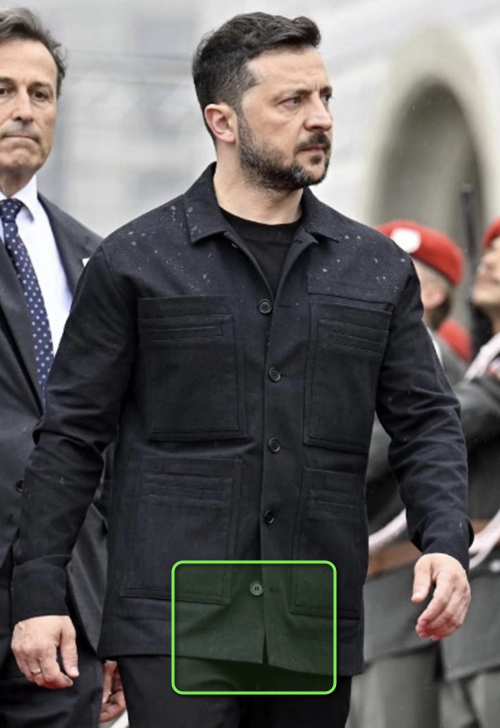
Picture this: Zelensky walks into a NATO summit wearing what every major news outlet calls a suit. The market has $200M in volume. The outcome seems obvious.
Then UMA's oracle votes "No."
Not because Zelensky didn't wear a suit.
Not because the evidence was unclear.
But because the people controlling the oracle had tens of millions riding on "No" and only needed to use their voting power to rewrite reality without real risk.
***
Oracle Manipulation 101
The uncomfortable truth about human-controlled oracles is that humans are biased.
- Some of the biggest UMA holders were heavily positioned on “No.”
- When “Yes” looked like the correct outcome, they didn’t accept the loss; they flipped the vote.
- Over 23M UMA were cast, worth ~$25M, to dispute the result.
This wasn’t decentralization. It was whales protecting their bags.
With enough UMA and coordination, truth doesn’t matter. Outcome does.
***
The Broader Oracle Crisis
This problem extends far beyond Polymarket and UMA. Human controlled oracles are subject to various manipulation and incentive design pitfall vectors.
Although we’re using the Zelensky Suit Market as a case study, we’ll note that we’ve observed this problem before, in the case of the March 2025, Ukrainian Mineral Deal Market.
Every major prediction market faces the same fundamental challenge.
Where humans control truth, truth bends to human profit.
***
Graduating from Human-Controlled Oracles: Replacing Intent with Intelligence
The only real fix for human oracles is to remove the humans.
AI‑powered oracles change this:
- No Financial Incentives: The model doesn’t hold positions or care who wins.
- Bias‑Resistant Decision Rules: Same training weights, same prompt, same temperature = the model scores evidence with the same underlying criteria. AIs have no moods, no side bets, no back‑room coordination.
- Reasoning Pipelines: Every intermediate step can be logged, inspected, and replayed.
- Machine‑Scale Throughput: Thousands of sources ingested in parallel without burnout or side deals.
Residual error still exists, but it is random statistical noise. This is significantly harder for a trader to game. With clear resolution criteria and authenticated data feeds, state‑of‑the‑art models already deliver production‑grade accuracy, and the curve is steeply improving.
***
Residual Noise Beats Calculated Lies
The future of prediction markets requires removing humans entirely from truth determination.
What this architecture looks like:
- Predefined Source Hierarchies: Reuters > BBC > Local News > Blogs
- Cryptographic Proof of Data Origin: Verify information hasn't been tampered with
- Multi-Agent Consensus: Multiple AI systems reaching independent conclusions
- Transparent Reasoning: Full audit trails for every decision
- Immutable Evidence: Blockchain-stored proofs that can't be revised or deleted
***
Truth Discovery in a Post-Truth World
Prediction markets are a microcosm of a much larger challenge. When Wikipedia can be edited, news can be revised, and "facts" become negotiable, we need systems that can establish ground truth.
This extends across domains:
- Election integrity and verification
- Scientific consensus and research validation
- News authenticity in the age of deepfakes
- Historical record keeping and revision prevention
- Corporate transparency and accountability
***
Final Thoughts
The choice facing prediction markets is stark: continue pretending that incentive-driven humans can be neutral arbiters of truth, or build systems that remove human bias from truth determination entirely.
The question has already been answered by the markets themselves. When $200M flows through a market about an obvious outcome and the obvious answer loses, the system has revealed its true nature.
The technology to solve this exists.
Truth discovery is too important to auction to the highest bidder.
@Atlantislq@defipolice_@UMAprotocol Also scammed on this one by @Polymarket. There's a chance they may fix this as the damage to their reputation will be massive, though I'm not hopeful and ready to go forward with the lawsuit if required.
🚨🤺 New slash alert
@HakResearch is slashing @UMAprotocol for 240 credibility score
> UMA Manipulated the “Will Zelenskyy Wear a Suit Before July?” Market on Polymarket
"This is not just a technical flaw – it is a systemic failure." ↓
Here's a wild one: Polymarket is in a $215 million mess to decide whether Volodomyr Zelensky wore a suit last month
The platform initially resolved the bet to "Yes," even though Zelensky's NATO outfit didn't look like a traditional suit
Users then accused Polymarket of manipulating the outcome and took the issue to a third-party
The bet is currently the largest on Polymarket by volume (by a lot), with a final decision coming later tonight
Did Ukraine president Volodymyr Zelensky wear a suit? Dispute over the answer has torn apart bettors on the gambling site Polymarket. With a collective $210 million on the line, some claim to have been denied their rightful winnings.
wired.com/story/volodymy…
UMA is manipulating the outcome of the Zelensky suit prediction market on Poly and everyone's just expected to go along with it, it seems. Absurd. Are you telling me that if they decide the earth is flat, that's the verdict the public has to agree with?
Can a suit be subjective? A $170M market is about to find out.
Since Russia’s invasion, Zelensky has worn military garb to signal wartime resolve. But one ambiguous outfit in June sparked a @Polymarket asking: did he wear a suit?
Now, $UMA voters must settle the answer—and millions hinge on how they define a suit.👇
~~ Analysis by @wmpeaster ~~
A “Will Zelensky wear a suit before July?” market was launched on May 22nd, 2025, running through June 30th. It has since seen over $170M in trading volume—but also major controversy.
The drama began on June 23rd, when Zelensky appeared in London wearing the outfit.
Dozens of outlets—including BBC, PBS, and The New York Times—called it a suit. Polymarket resolved the bet to “Yes,” meaning “Yes” voters would be paid out by “No” voters.
But the suit was unconventional, and a similar market in May 2025 resolved “No,” even though Zelensky wore a nearly identical outfit then.
That led challengers to dispute the new market’s “Yes” outcome using @UMAprotocol, Polymarket’s oracle protocol. They proposed a “No” resolution, which was then counter-challenged.
The final outcome will be decided today by UMA’s $UMA tokenholders.
With millions on the line, debate has flared. Even menswear expert Derek Guy weighed in with a thread tracing the history of suits to assess the outfit.
His verdict: it technically qualified as a suit but didn’t align with common expectations. Reasonable ambiguity remains.
There are a few paths forward.
UMA voters can lock in “Yes,” “No,” or “Unknown”—the latter would return 50% of users’ bets. Polymarket could also cancel the market and fully refund users.
“Unknown” or a refund might provoke the least backlash but risk setting a precedent for ambiguity. A “No” outcome could spark backlash from “Yes” bettors claiming token-weighted votes overrode reality. A “Yes” could upset “No” bettors over inconsistent standards.
The takeaway: in onchain prediction markets, clear rules and governance matter as much as the tech.
Now it’s up to UMA voters. Their ruling could either restore clarity—or deepen the controversy.
A bit more nuanced summary about Zelensky’s suit vs Polymarket situation since it’s one of the main talking point rn.
There are a lot emotional opinions on it like in the left vs right debate and as the political debate is almost never about politics per se, the reason why this market gathers so much discussion isn’t really about suit per se.
While the monetary incentives can play a role, purely financial incentives almost never trigger so many emotional strong opinions.
To understand the essence of the situation what triggers this heated debate, then imo “The Righteous Mind” by Jonathan Haidt and “Moral Tribes” by Joshua Green could be few good books to read.
Some bullet points:
As Haidt describes in his book there’s 5 different moral foundations people are generally driven by and a difference between the relevance of these is a major aspect what causes people to have in either left- or right-wing beliefs, and different moral preferences and views in many other matters.
And when beliefs are formed, it’s not gonna be easy to cancel them anymore.
a) Debate about the market: the fairness aspect (people have a strong opinion on the current matter bcs they are morally triggered) vs just follow how the system works (pragmatic benefit).
Based on how the rules of the market were written and presented, it favors “yes”, even if daily Poly traders lore with previous Zelensky’s markets set a different context and expectation what favors “no”.
So, the POV of both sides are in this context understandable.
It would feel be unjust for active traders to lose money since they followed the previous practice of the platform.
At the same time, Polymarket has grown too big in mainstream to just base the decision on loyal daily traders perception.
They gotta decide if they wanna be a more niche trading platform for serious active traders vs mainstream wagering platform on current events and a “truth machine”.
There are a lot of new people betting on the new markets who aren’t aware of the previous lore and don’t even have to be necessarily - they bet on the supposed outcome/truth based on the market rules.
And since the market rules were based on credible reporting, it should favor the “yes” side, considering that also the technical definition accepts the outfit as a suit.
Basically, Polymarket really effed up with the rules and realistically it’s their sh*t to clean and take responsibility imo.
If they don’t take any responsibility for this sh*tshow and speak up, then sooner or later there will be a tipping point where it’s gonna be a net negative situation for them.
Situations where people’s moral sense is triggered and where a wider debate in the media and among the opinion influencers can be evoked, shouldn’t be underestimated in the sense explosiveness.
b) Debate about “what’s a suit” - when we argue about it we pretty much debate about “what’s reality” and what are “societal norms” in our minds.
We live in the same society/culture with other people and expect them to perceive the world the same way as we do, and have a societal agreement about the norms.
So if someone says suddenly that “no bro, your perception is false”, then people can feel quite threatened and triggered.
If you have believed the whole life that this type of outfit qualifies as a suit (or doesn’t), then it’s effing with your belief system and we are veryyy resistant to give up our beliefs, no matter what’s the truth.
This question in hand has a lot of subjectivity and hence the market rules should be very clear and settlement should follow the rules, and if there’s a failure in that, Polymarket should work on getting the most fair possible outcome for both sides.
There’s not much more than different world perceptions in play - as in many societal matters - and neither side should really take the other as an enemy (unless a straightforward manipulation) - the issue in hand is more about the system itself and poorly clarified and set-up market.