Thanks to #GNSS data from the Central Weather Administration of Taiwan, we now have coseismic offsets for the M7.4 Hualing City #earthquake at geodesy.unr.edu
We are looking for a postdoc to work on the new Global Strain Rate Model @earth_jobs@EarthSci_Jobs
Position for 2.5+ years, starting at earliest convenience. GNSS time-series and ideally InSAR experience a plus, as well as good coding skills. Contact @GeodesyRules for more info.
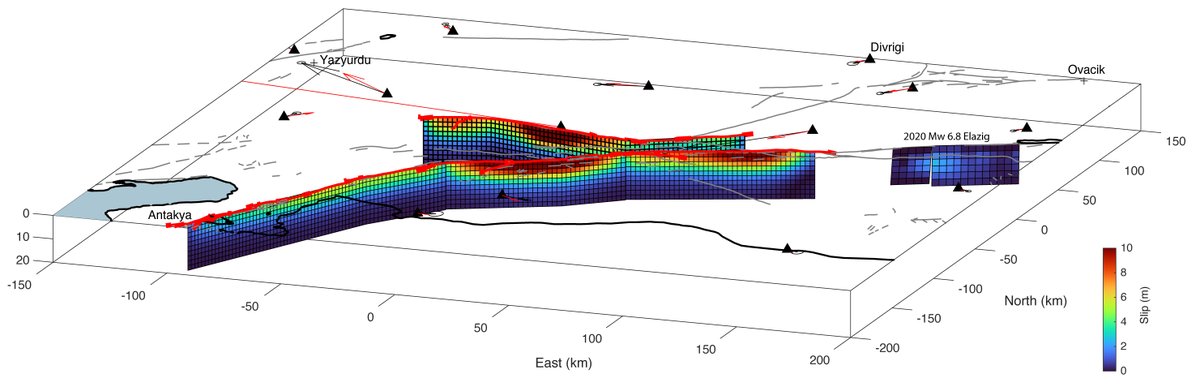
Smooth estimate of the slip distribution for the Turkey-Syria earthquake sequence from GPS data provided by @NVGeodeticLab. Fault slip confined above 10 km depth, tapering near segment boundaries. There is a wide gap between the 2020 Mw 6.8 Elâzığ and 2023 ruptures.
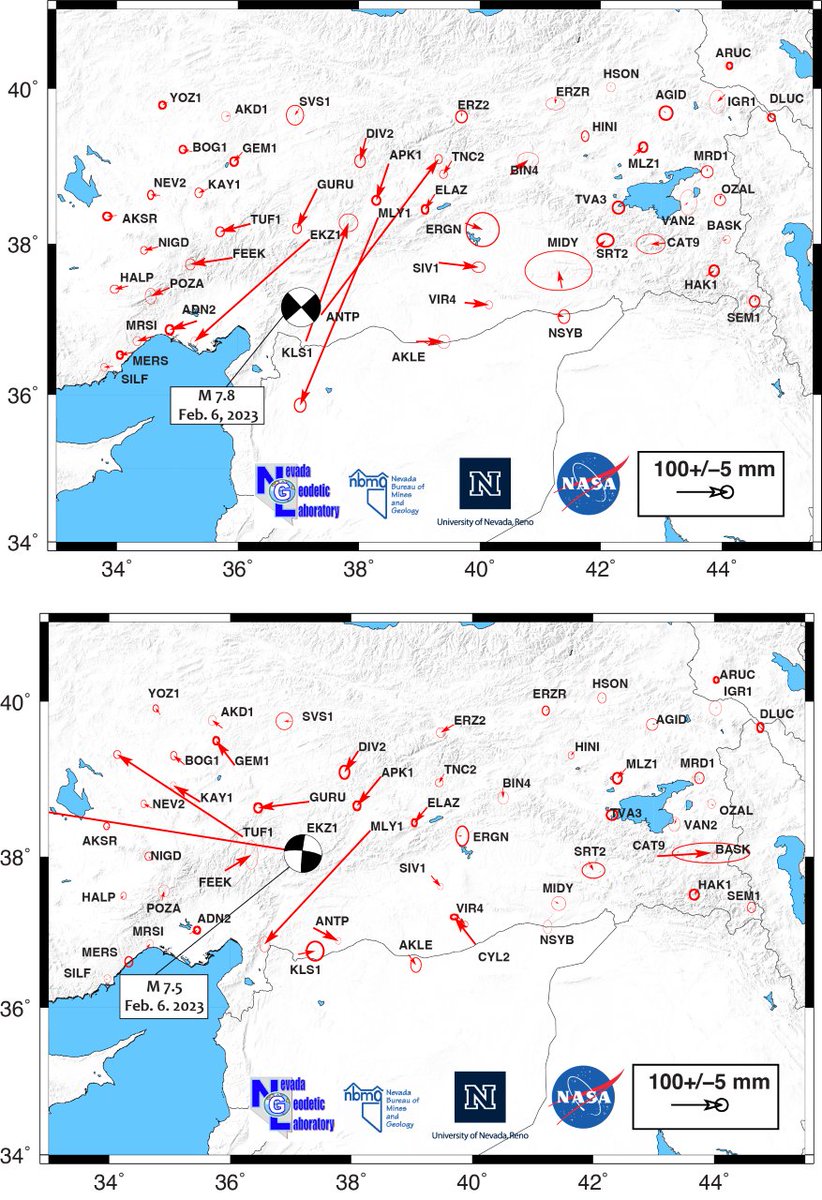
With help from Prof. Ugur Sanli, #gnss data has been obtained from some @tusaga_actif network stations near the epicenters of the recent #TurkeySyriaEarthquakes. Solutions are available at geodesy.unr.edu. Coseismic displacements from 5 minute samples shown below.
New paper alert: GPS measurements show 0.5-0.6 mm/yr of extension across Las Vegas Valley. Seismic hazard is larger than previously realized. Results sensitive to postseismic deformation from large plate boundary earthquakes. #lasvegas@SeismoSocietyAmpubs.geoscienceworld.org/ssa/bssa/artic…
@tetrimbath@UNAVCO@GeologyNick While there is a clear rotational aspect of rotation to the velocity field, it is not a “rigid body rotation” (there is deformation!), so you cannot really define a center of rotation.
@GobronKevin We like that the @NVGeodeticLab products were useful to you. Can you please specify what exactly you are plotting, or point to a paper where it is explained?