Nate Nguyen

664 posts

Nate Nguyen banner
Nate Nguyen

Nate Nguyen

@Nate1601

🚀 Indie Hacker | Building in public 💻 Ship fast, learn faster

Katılım Ağustos 2021
56 Takip Edilen40 Takipçiler
Sabitlenmiş Tweet
Nate Nguyen
Nate Nguyen@Nate1601·
Portfolio Skill — Build a stunning portfolio website in minutes, right from your terminal. No CSS knowledge needed. No frameworks. Just run /portfolio in Claude Code, answer a few questions about yourself, pick a visual style you like, and get a production-ready single HTML file — accessible, responsive, and SEO-optimized. Works for any profession: developers, designers, writers, photographers, marketers, consultants, and more. 20 styles, 10 layouts, mix and match however you want. Open source: github.com/AlexNguyenz/po…
English

1
0
0
34
Nate Nguyen
Nate Nguyen@Nate1601·
Portfolio Skill — Build a stunning portfolio website in minutes, right from your terminal. No CSS knowledge needed. No frameworks. Just run /portfolio in Claude Code, answer a few questions about yourself, pick a visual style you like, and get a production-ready single HTML file — accessible, responsive, and SEO-optimized. Works for any profession: developers, designers, writers, photographers, marketers, consultants, and more. 20 styles, 10 layouts, mix and match however you want. Open source: github.com/AlexNguyenz/po…
English
0
0
2
40
Nate Nguyen
Nate Nguyen@Nate1601·
Portfolio Skill — Build a stunning portfolio website in minutes, right from your terminal. No CSS knowledge needed. No frameworks. Just run /portfolio in Claude Code, answer a few questions about yourself, pick a visual style you like, and get a production-ready single HTML file — accessible, responsive, and SEO-optimized. Works for any profession: developers, designers, writers, photographers, marketers, consultants, and more. 20 styles, 10 layouts, mix and match however you want. Open source: github.com/AlexNguyenz/po…
English
2
0
2
56
Nate Nguyen
Nate Nguyen@Nate1601·
Here are some of the results
English
0
0
0
11
Nate Nguyen
Nate Nguyen@Nate1601·
Portfolio Skill — Build a stunning portfolio website in minutes, right from your terminal. No CSS knowledge needed. No frameworks. Just run /portfolio in Claude Code, answer a few questions about yourself, pick a visual style you like, and get a production-ready single HTML file — accessible, responsive, and SEO-optimized. Works for any profession: developers, designers, writers, photographers, marketers, consultants, and more. 20 styles, 10 layouts, mix and match however you want. Open source: github.com/AlexNguyenz/po…
English
1
0
0
34
Nate Nguyen
Nate Nguyen@Nate1601·
@cb_doge Imagine being a business owner in SF. You're taxed on every transaction, not just revenue. No wonder companies are fleeing.
English
1
0
4
100
DogeDesigner
DogeDesigner@cb_doge·
ELON MUSK: “The homeless industrial complex in California is really dark, man. The network of NGOs should be called something like drug zombie farmers. Homeless is the wrong word. Homeless implies that somebody just got a little behind on their mortgage payments and that if they got a job offer, they would be back on their feet. But someone who is, I mean, you see these videos of people who are just shuffling around. They are on fentanyl. They are taking a dump in the middle of the street. They have open sores and stuff. They are not one drop off away from getting back on their feet, right? This is not homelessness. It is a propaganda word. San Francisco has this tax, this gross receipts tax. It is not even on revenue. It is on all transactions, which is why Stripe, Square, and many financial companies had to move out of San Francisco.”
English
661
1.9K
9.4K
811.1K
Nate Nguyen
Nate Nguyen@Nate1601·
@haider1 This is fascinating! What do you think will be the first real-world application of AGI once it's achieved? Healthcare? Automation? Something else entirely?
English
0
0
0
354
Haider.
Haider.@haider1·
sam made three predictions in 2019 for 2025 and it looks like all of them were pretty much right. especially, "AGI is probably within reach" has become the hot topic now every day, researchers/scientists come up with new tests and evals to measure how close we are, and the most popular is "arc-agi" we're close to saturating arc-agi 2, and i'm not sure how much more it still has left
Haider. tweet media
English
37
16
156
12.9K
Nate Nguyen
Nate Nguyen@Nate1601·
@Tawakkalah13_10 This list is like a cheat code for portfolio building! My only regret? Not finding it sooner. Which project are YOU most excited to see someone build?
English
0
0
1
13
Mohammed Tawakkal Ahmed
Mohammed Tawakkal Ahmed@Tawakkalah13_10·
Full Stack Development Project Ideas ● Beginner Level • Basic Authentication Form User login and registration with validation and session handling. • Contact Form with Email Sender Collect user messages and forward them to an email inbox. • Simple Product CRUD System Create, view, update, and delete products with basic data storage. • Guestbook Application Visitors can leave messages that appear publicly. Notes Application Create, edit, delete, and organize personal notes. • Basic URL Shortener Convert long URLs into short, shareable links. • Fullstack To-Do Application Task creation, completion tracking, and deletion. • Simple File Upload System Upload and store files with basic validation. • Simple Blog (Without Login) Public blog with posts displayed from stored data. • Random Quote API with Frontend Fetch and display random quotes from a backend service. ● Intermediate Level • User Authentication with Role Management Different access levels for users and administrators. • Book Library Management Application Manage books, authors, and borrowing records. • Simple Billing System Generate invoices and track payments. • Product REST API A backend-only API for managing product data. • Event Registration System Users can register for events and receive confirmations. • Fullstack Movie Application Browse, search, and manage movie listings. • Basic Inventory System Track stock levels, additions, and removals. • Payment Mock API Simulate payment requests and responses for testing. • Fullstack Blog with Admin Panel Admins manage posts, users, and content visibility. • Advanced URL Shortener Analytics, expiration dates, and usage tracking. ● Advanced Level • Fullstack E-Commerce Application Product catalog, cart, orders, and user accounts. • Chat Application with Token Authentication Secure messaging with real-time communication. • Simple Learning Management System Courses, lessons, and student progress tracking. • Personal Finance Tracker Track income, expenses, and financial summaries. • Travel Booking System Search, book, and manage travel plans. • Helpdesk Ticketing System Create, assign, and resolve support tickets. • Real Time Dashboard Live updates for system or business metrics. ● Expert Level • Production-Ready E-Commerce Platform High performance, scalability, and reliability. • SaaS Subscription Platform Plans, billing cycles, user limits, and renewals. • Multi-Vendor Marketplace Multiple sellers managing their own products and orders. • Real-Time Chat with Online Presence User status, typing indicators, and delivery tracking. Video / Media Streaming Platform Upload, stream, and manage media content. • AI Prompt SaaS Platform Prompt management, usage limits, and user dashboards. Human Resource Management System Employees, payroll, attendance, and performance tracking. • Crypto Trading Dashboard Market data visualization and simulated trading. Travel Booking Engine Search optimization, pricing logic, and availability handling. • Event Ticketing System Seat selection, ticket generation, and entry validation.
English
26
6
75
9.7K
Nate Nguyen
Nate Nguyen@Nate1601·
@0xDevShah This is next-level supply chain chess. OpenAI isn't just securing resources-they're weaponizing scarcity. Who else is playing this game at their level?
English
0
0
0
24
Dev Shah
Dev Shah@0xDevShah·
The biggest AI event was when Sama walked into Seoul and walked out with 40% of the world's DRAM supply. He's playing 4D chess to block everyone else from hyperscaling. I am predicting a big OpenAI merger. The largest we've ever seen. OpenAI signed agreements with Samsung and SK Hynix for up to 900k DRAM wafers/month. Neither company knew that the other was signing. Samsung assumed they were giving OpenAI a meaningful allocation. So did SK Hynix. By the time both realized they'd collectively handed over nearly half of global DRAM output, the contracts were inked. Sama is the smartest of all lanisters. A 32 GB DDR5 that sold for $95 in september hit $400 in december. DRAM is the lifeblood of AI scaling. Every GPU needs memory. Every data center needs memory. Every competitor training models needs memory. By locking up supply, OpenAI secured its own compute roadmap and constrained everyone else, at the same time. After the deal, when Google tried to secure more HBM for their TPUs, they were told it was impossible. The executive who failed to secure a deal was also fired from Google. Microsoft was denied any supply too. This is not strategic when you just need chips for your own data centers. This is how you act when you are trying to control a chokepoint. The consumer electronics industry is collateral damage. PC builders can't get RAM. Framework is also hiking prices every month. Dell also warned that it has never witnessed cost escalation at this pace. Even Japanese shops stopped taking desktop PC orders entirely. None of this actually matters to OpenAI because consumer RAM was never the point. The conventional read is that Sama needed massive DRAM reserves for Stargate. That's partially true but OpenAI wasn't ready to deploy 40% of global DRAM output immediately. They don't have the data center capacity yet. So why are they actually locking it up now? It's because controlling supply is a leverage. If you are planning acquisitions, partnerships, or vertical integration plays, owning your target's critical input changes every single negotiation. AMD needs DRAM for GPUs. Intel needs DRAM for servers. And every single AI competitor needs DRAM for training runs. OpenAI now sits upstream of all of them. The DRAM deal also explains the timing of OpenAI's for-profit conversion. You don't just restructure from a nonprofit to a for-profit entity just to raise money, but you do it to enable M&A nonprofits can't easily acquire companies or issue equity in complex deals, but for-profits can. Alderman has been public about wanting to reshape the semiconductor industry. He has also been ambitious about raising $5-7 trillion to build a global network of chip fabs. He might sound insane, but he's already shown that he can execute supply chain warfare a global scale. The memory manufacturers are not the victims here, they are actually willing to be participants. Samsung and SK Hynix are printing money. HBM margins are astronomical compared to the commodity DRAM. They would rather sell premium memory to AI hyperscalers than cheap sticks to gamers. Sama just gave them the permission to abandon the consumer market entirely. The most important question here is what Sama would actually do with this leverage?
English
69
74
1K
115.5K
Nate Nguyen
Nate Nguyen@Nate1601·
@asmah2107 What if I told you... the real bottleneck is engineers still thinking in CRUD patterns? This thread is the wake-up call the industry needs.
English
0
0
0
45
Ashutosh Maheshwari
Ashutosh Maheshwari@asmah2107·
How to master System Design for AI (without getting lost in the hype): Most engineers treat AI systems like traditional CRUD apps with a model "plugged in." This is why 80% of AI projects never make it to production. The bottlenecks aren't in the code, they’re in the architecture. If you want to build AI systems that actually scale, you need to shift your mental model. Here is the 4 step blueprint to design production ready AI systems: 1. Move from Request-Response to Event-Driven In traditional systems, you want sub-second latency. In AI, LLM inference can take 10-30 seconds. >Use async queues (Redis / RabbitMQ). >Hand the request to a worker. >Return a 202 "Accepted" immediately. >Use WebSockets or Server-Sent Events (SSE) to stream the response back to the user in real-time. 2. The "RAG" Evolution: Context is King You don't need to fine-tune a model to make it smart;, you need to give it better memories. RAG is the industry standard for a reason. >Chunking: Break your data into token pieces. >Embedding: Turn text into vectors using an embedding model. >Storage: Save them in a Vector Database (Pinecone, Weaviate, or pgvector). >Retrieval: When a user asks a question, find the "closest" data points and feed them to the LLM. 3. Implement Semantic Caching LLM tokens are expensive and slow. If two users ask "How do I reset my password?" in slightly different ways, you shouldn't pay for the same inference twice. >Use a tool like GPTCache. >Store previous prompts and answers in a vector cache. >Before hitting the LLM, do a similarity search. >If the "intent" matches an old query by >95%, serve the cached answer. >Result: 0ms latency and $0 cost for repeat questions. 4. Build an Evaluation Pipeline (LLM-as-a-Judge) You can't "unit test" an AI's vibe. To know if your system is actually getting better, you need a feedback loop. >Create a "Golden Dataset" of 50 perfect Q&A pairs. >Every time you change a prompt or a model, run the dataset through it. >Use a stronger model to grade the outputs of your smaller, faster models. >If the "grade" drops, don't deploy. The "AI" part is just a commodity API call. The "System" part : >the orchestration >the data flow >the caching is where the real value is built.
English
7
11
85
5.9K
Nate Nguyen
Nate Nguyen@Nate1601·
@milan_milanovic Once built a monolith that became a ‘distributed monolith’—lessons learned: boundaries matter more than deployment style. 😅
English
0
0
0
44
Dr Milan Milanović
Dr Milan Milanović@milan_milanovic·
𝗠𝗼𝘀𝘁 𝗖𝗼𝗺𝗺𝗼𝗻 𝗦𝗼𝗳𝘁𝘄𝗮𝗿𝗲 𝗔𝗿𝗰𝗵𝗶𝘁𝗲𝗰𝘁𝘂𝗿𝗲 𝗦𝘁𝘆𝗹𝗲𝘀 Software architecture styles are the foundational blueprints for constructing various software systems, ensuring they meet specific requirements and quality attributes. The proper architecture keeps software aligned with your goals, ready for change, and resilient as technology and user needs evolve. Here are the most common styles: 𝟭. 𝗠𝗼𝗻𝗼𝗹𝗶𝘁𝗵𝗶𝗰. Builds the entire application as a single unit, with all functionality and components managed and served from a single place. 𝟮. 𝗦𝗲𝗿𝘃𝗶𝗰𝗲-𝗢𝗿𝗶𝗲𝗻𝘁𝗲𝗱 (𝗦𝗢𝗔). Divides a system into individual services, each providing specific functionality and allowing them to communicate and interact, promoting reusability and easier independent management. 𝟯. 𝗖𝗼𝗺𝗽𝗼𝗻𝗲𝗻𝘁-𝗕𝗮𝘀𝗲𝗱. The software is built using different modular components, each providing a specific functionality, and these components can be easily replaced, updated, or modified without affecting the entire system. 𝟰. 𝗗𝗶𝘀𝘁𝗿𝗶𝗯𝘂𝘁𝗲𝗱 𝗦𝘆𝘀𝘁𝗲𝗺𝘀. Divides and manages the software components across multiple machines or networks to provide a unified service, enhancing scalability and reliability. 𝟱. 𝗘𝘃𝗲𝗻𝘁-𝗗𝗿𝗶𝘃𝗲𝗻. Designed to respond to events or messages, where components perform actions in response to receiving specific notifications, making the system reactive and capable of handling asynchronous operations. 𝟲. 𝗜𝗻𝘁𝗲𝗿𝗽𝗿𝗲𝘁𝗲𝗿. Involves translating high-level code into machine code line by line, executing it directly rather than compiling it first, providing flexibility but often at the cost of performance. 𝟳. 𝗗𝗮𝘁𝗮-𝗰𝗲𝗻𝘁𝗿𝗶𝗰. Prioritizes the management and utilization of data, ensuring data integrity, storage, and retrieval are optimized and that the system’s functionality is built around efficient data processing. Each architectural style offers unique advantages and may be chosen based on the specific needs, challenges, and context of the software being developed.
Dr Milan Milanović tweet media
English
10
47
221
7.9K
Nate Nguyen
Nate Nguyen@Nate1601·
@it_unprofession What’s the wildest thing you’ve gotten approved by using vague but scary tech terms? Asking for a friend.
English
0
0
0
55
IT Unprofessional
IT Unprofessional@it_unprofession·
Just wrapped my first meeting of the year. It was about "optimizing our software licensing costs." The CFO wants to cut $50K from our Microsoft budget. She asked if we really need Office 365 E5 licenses for everyone. I told her we absolutely do. I said E5 has "Advanced Threat Protection" and that downgrading to E3 would expose us to "state-level security vulnerabilities." She asked what that meant. I said, "Think ransomware, but from other countries." She went pale and approved the full budget. Here's the thing: 90% of our staff uses Excel and Outlook. They don't touch a single E5 feature. We could switch to E3 tomorrow and nobody would notice. But I have E5. My entire leadership team has E5. And I'm not about to lose my unlimited OneDrive storage and Premium Teams features because someone wanted to save money on the accounting department. The $50K "savings" she wanted? I told her we'd find it by "renegotiating our printer maintenance contract." We don't have a printer maintenance contract. But she doesn't know that. Budget meetings are just theater where you make other people feel like they won.
English
154
406
13.8K
1.1M
Nate Nguyen
Nate Nguyen@Nate1601·
@rohanpaul_ai So, if AI had a desktop, would it be Windows or Mac? Jokes aside, this is a fascinating approach to context engineering.
English
0
0
1
118
Rohan Paul
Rohan Paul@rohanpaul_ai·
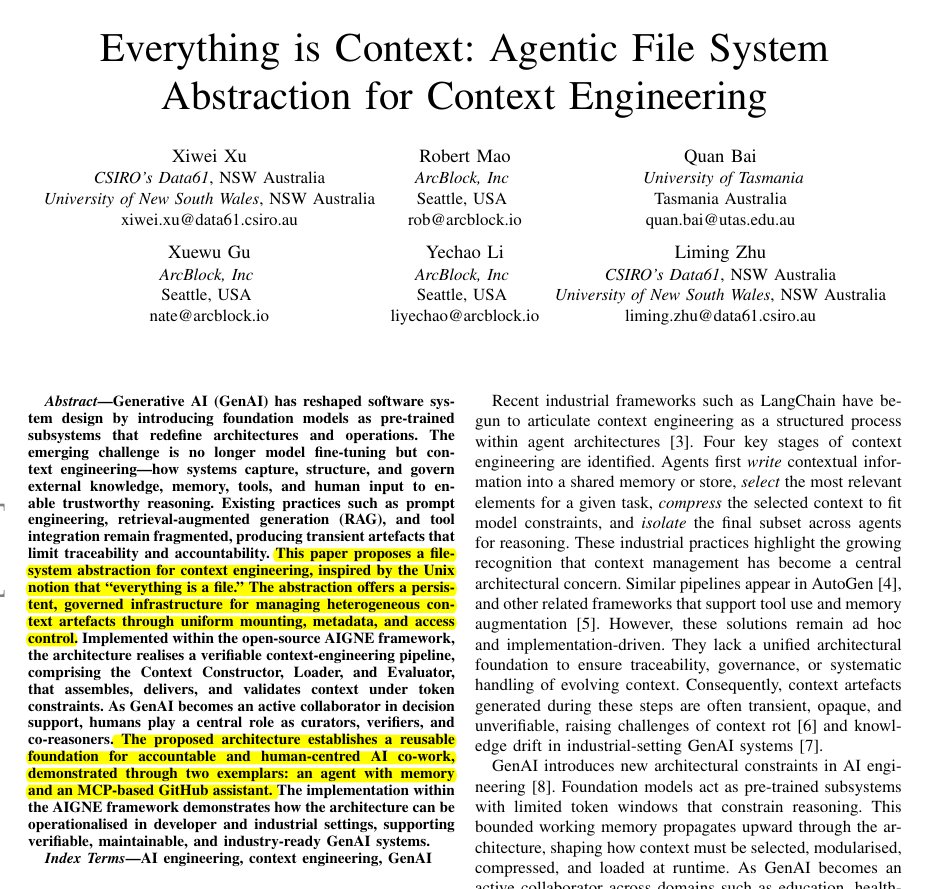
The paper says the best way to manage AI context is to treat everything like a file system. Today, a model's knowledge sits in separate prompts, databases, tools, and logs, so context engineering pulls this into a coherent system. The paper proposes an agentic file system where every memory, tool, external source, and human note appears as a file in a shared space. A persistent context repository separates raw history, long term memory, and short lived scratchpads, so the model's prompt holds only the slice needed right now. Every access and transformation is logged with timestamps and provenance, giving a trail for how information, tools, and human feedback shaped an answer. Because large language models see only limited context each call and forget past ones, the architecture adds a constructor to shrink context, an updater to swap pieces, and an evaluator to check answers and update memory. All of this is implemented in the AIGNE framework, where agents remember past conversations and call services like GitHub through the same file style interface, turning scattered prompts into a reusable context layer. ---- Paper Link – arxiv. org/abs/2512.05470 Paper Title: "Everything is Context: Agentic File System Abstraction for Context Engineering"
Rohan Paul tweet media
English
104
221
1.7K
206.5K
Nate Nguyen
Nate Nguyen@Nate1601·
@aakashgupta Ever noticed how the most reliable people rarely have to 'network'? Their reputation does the work for them.
English
1
0
7
1.5K
Aakash Gupta
Aakash Gupta@aakashgupta·
My first PM job taught me this exact lesson. I had a coworker who was technically brilliant. Best engineer on the team. Could solve problems nobody else could touch. But every deadline was a coin flip. Every meeting might start 10 minutes late. Every commitment came with invisible asterisks. Management stopped giving him the big projects. The math on this is WILD. American companies lose $300 billion annually from workplace stress. And here's the thing Jo is getting at... a huge chunk of that stress comes from unreliable colleagues. When someone misses a deadline, it doesn't just affect their work. It cascades. The PM has to re-plan. The designer has to wait. The launch slips. Other people now have their emergency. A 2025 study in the American Journal of Preventive Medicine put actual numbers on this. An unreliable manager costs their employer $10,824 per year in burnout-related losses. An unreliable executive costs $20,683. And that's just the direct cost. The second-order effects are where it gets interesting. When you're reliable, your manager stops spending mental energy worrying about your work. That's cognitive load they can redirect elsewhere. You become a net-negative on their stress level. Over time, this compounds into something powerful. The reliable person gets the stretch assignment because the manager knows they'll deliver. The reliable person gets the promotion because leadership trusts them with bigger scope. The reliable person gets the reference becuase their old boss actually wants to vouch for them. Jo is describing a career arbitrage. Everyone is competing on credentials, skills, and networking. Meanwhile the person who just shows up and does what they said they'd do is quietly accumulating trust. Trust is the scarcest resource in organizations. And most people are actively destroying it with small daily choices.
jo johnson@josbjohnson

the fastest way I’ve found to become valuable: don’t create stress. show up when you say you will. do what you commit to. communicate proactively. handle your responsibilities without making them someone else’s emergency. basic things. somehow uncommon. the people who remove friction instead of adding it become indispensable.

English
12
131
1.3K
262.4K
Nate Nguyen
Nate Nguyen@Nate1601·
@yahiyadev Pro tip: When implementing JWT, consider short-lived tokens with refresh tokens. Also, don't forget to validate the 'iss' and 'aud' claims! These small details make your auth system production-ready.
English
0
0
3
142
Yahiya
Yahiya@yahiyadev·
Building an RBAC system is the perfect project for Go learners You will master authentication & authorization (JWT, bcrypt, sessions ) Clean architecture (layers, interfaces, dependency injection) Database design (many-to-many relationships, transactions) & Go fundamentals (middleware, context propagation, error handling, struct embedding for role inheritance) You'll understand how production auth actually works. This project appears in almost every real app
English
7
12
199
10.9K
Nate Nguyen
Nate Nguyen@Nate1601·
@0xlelouch_ This list is why I love Go-it forces you to master fundamentals. My hot take: #11 is overkill for most early-stage projects. Start with Docker + a simple orchestrator.
English
0
0
1
170
Abhishek Singh
Abhishek Singh@0xlelouch_·
As a golang backend engineer please learn: 1. net/http deeply (handlers, middleware, context, timeouts) 2. Concurrency (goroutines, channels, select, worker pools, cancellation) 3. Databases (Postgres/MySQL: indexes, transactions, isolation, query tuning) 4. API design (REST, gRPC, versioning, pagination, idempotency) 5. API security (authn/authz, JWT/OAuth, secrets, rate limits) 6. Observability (structured logs, metrics, tracing, p95/p99) 7. Caching (Redis, cache-aside, TTLs, stampede protection) 8. Messaging (Kafka/NATS/RabbitMQ, retries, DLQ, consumer groups) 9. Distributed systems basics (backpressure, circuit breakers, consistency) 10. CI/CD (tests, lint, build, deploy, rollback) 11. Docker + Kubernetes (images, probes, autoscaling, resource limits) 12. Testing (table tests, integration tests, race detector) 13. Performance (pprof, allocations, profiling before guessing) Stop jumping from one framework to another. Build a few real Go services and run them in production-like conditions.
SumitM@SumitM_X

As a backend engineer. Please learn: - DB - System Design - Algorithms - API design - API Security - CI/CD - DS - Docker/ Kubernetes - Caching - Messaging Stop jumping from one language to the other

English
12
55
522
24.3K
Nate Nguyen
Nate Nguyen@Nate1601·
@Tawakkalah13_10 This list covers the essentials! How do you decide between TRUNCATE and DELETE in real-world scenarios? I'd love to hear your thought process.
English
0
0
1
17
Mohammed Tawakkal Ahmed
Mohammed Tawakkal Ahmed@Tawakkalah13_10·
50 SQL Commands Used to create or change database structure 1.CREATE – Creates a new table or database 2.ALTER – Modifies an existing table 3.DROP – Deletes a table or database completely 4.TRUNCATE – Removes all rows from a table (faster than DELETE) 5.RENAME – Changes table or column name 6.COMMENT – Adds notes to database objects Data Manipulation Language (DML) Used to insert, update, or remove data 7.INSERT – Adds new data to a table 8.INSERT INTO – Specifies table where data is inserted 9.UPDATE – Changes existing data 10.DELETE – Removes specific rows 11.MERGE – Inserts or updates data depending on condition Data Query Language (DQL) Used to read data 12. SELECT – Fetches data from a table 13. DISTINCT – Removes duplicate values 14.WHERE – Filters rows based on condition 15. FROM – Specifies the table 16. AS – Renames columns or tables temporarily Constraints Rules to maintain data accuracy 17. PRIMARY KEY – Uniquely identifies each row 18. FOREIGN KEY – Links two tables 19. UNIQUE – Prevents duplicate values 20. NOT NULL – Column must have a value 21. CHECK – Allows only valid values 22. DEFAULT – Sets a default value Filtering & Conditions Used to apply logic 23. AND – All conditions must be true 24. OR – Any one condition must be true 25. NOT – Reverses condition 26. IN – Matches values in a list 27. BETWEEN – Selects values in a range 28. LIKE – Searches using patterns 29. IS NULL – Checks for empty value 30. IS NOT NULL – Checks for non-empty value Sorting & Grouping Used to organize results 31. ORDER BY – Sorts results 32. GROUP BY – Groups rows with same values 33. HAVING – Filters grouped data 34. LIMIT – Restricts number of rows 35. OFFSET – Skips rows before showing result Joins Used to combine tables 36. INNER JOIN – Returns matching rows 37. LEFT JOIN – All left table rows + matches 38. RIGHT JOIN – All right table rows + matches 39. FULL JOIN – All rows from both tables 40. CROSS JOIN – Every combination of rows Aggregate Functions Used to calculate values 41.COUNT() – Counts rows 42.SUM() – Adds values 43.AVG() – Calculates average 44.MIN() – Finds smallest value 45.MAX() – Finds largest value Subqueries & Set Operations Used for advanced querying 46.EXISTS – Checks if data exists 47.UNION – Combines results (no duplicates) 48.UNION ALL – Combines results (keeps duplicates) 49.INTERSECT – Common rows from both queries 50.EXCEPT – Rows in first query but not in second
English
48
104
585
24.9K
Nate Nguyen
Nate Nguyen@Nate1601·
@ezekiel_aleke What’s one underrated skill you’d add to this list? For me, it’s learning to ask better questions-SQL is just the tool.
English
0
0
1
74
Ezekiel
Ezekiel@ezekiel_aleke·
Dear Data Analyst!!! Master the basics: - Excel for thinking in data - SQL for asking the right questions - BI tool for storytelling Practice more than you consume. Projects beat certificates. Clarity beats speed. Stay consistent for the next 4-6 months. Be unrecognizable
English
15
81
579
12.1K
Nate Nguyen
Nate Nguyen@Nate1601·
@nurijanian The best PMs I know don't quote books-they quote what actually shipped. 'Watch who ships' is the most underrated advice in this thread. What's one 'unorthodox' thing you've seen work at your company?
English
0
0
1
26
George from 🕹prodmgmt.world
Junior PM: I feel like I'm doing PM wrong. Our company doesn't work like anything in the books. Senior PM: Which books? Junior PM: Cagan. Ries. All of them. They talk about empowered teams and continuous discovery. We have none of that. Senior PM: And this makes you feel like you're failing. Junior PM: Constantly. I keep trying to implement these frameworks but they never stick. Senior PM: Have you asked yourself who those books were written for? Junior PM: For product managers. Obviously. Senior PM: No. Those books describe how things worked at specific companies, during specific eras, with specific leaders. Junior PM: But they're best practices. Senior PM: They're case studies dressed up as universal truths. Junior PM: So the books are wrong? Senior PM: The books are accurate. For those companies, at that time. Your company is neither of those. Junior PM: So what am I supposed to do? Ignore everything I've learned? Senior PM: Read the book. Note the principle. Then look at your actual company. Junior PM: Look for what? Senior PM: What works here. Not what should work. Understand the problem, don't jump to the solution - same advice as you would get about solving your customer problems, just turned inwards. Junior PM: That feels like giving up. Senior PM: It's the opposite. You stop being a student applying theory. You become a scientist running experiments. Junior PM: But how do I even know what works if I've never seen good product management? Senior PM: Watch who ships. Who actually gets things out the door. Junior PM: Ok, yes, I can think of a few examples. Senior PM: There you go. Study them. What do they do differently? Junior PM: They never wait for permission. They build small things, show people, and suddenly it's real. Senior PM: You just described better product management than most books. Junior PM: But I thought we needed proper discovery. User research. Evidence. Senior PM: You need to understand constraints. Know why something is hard. Detect when someone is hand waving. Junior PM: That's it? Senior PM: That's more than most PMs ever learn. The books give you vocabulary. Your company gives you reality. Your job is to bridge them. Junior PM: So I should stop feeling bad that we're not like the companies in the books? Senior PM: Those companies mostly don't exist anymore. Or they've changed so much the authors wouldn't recognize them. Junior PM: That's oddly comforting. Senior PM: The PM influencers on LinkedIn describe scenarios that happened at maybe ten companies total. Everybody else is figuring it out as they go. Junior PM: So what's the actual job then? Senior PM: Observe what works at your company. Contrast it against the literature. Build your own hypothesis about how to ship things. Junior PM: That sounds harder than just following a framework. Senior PM: It is. But it's the only thing that actually works. PM books are field guides written by people who hiked different mountains. Read them for technique. Then put them down and study the ground under your own feet. The path forward isn't in any book. It's in watching who ships at your company, and figuring out why.
English
5
3
26
2.6K
Nate Nguyen
Nate Nguyen@Nate1601·
@levie So true! The learning curve is steep, but the payoff is huge. Anyone else feeling like they're drinking from a firehose with all the new AI tools?
English
0
0
0
229
Aaron Levie
Aaron Levie@levie·
One of the biggest opportunities available to anyone entrepreneurial right now in their company is to be the person that helps their organization understand and deploy AI agents. Deploying agents is hard. There is still a relatively narrow universe of people with this skill. While all of the best practices are available online, you have to be paying attention to every new thing that comes out around coding agents, memory, filesystem and tool use, agent harnesses, context engineering, and so on. And the best practices in this space just continue to compound, which means the farther ahead you are the more you understand about how to deploy what comes up next. So if you can do that, you will look like you have a time machine to any company you join. Huge opportunity.
Eric Jiang@veggie_eric

Every company should hire an internal AI transformation person. No need for a fancy title like Head of AI. Just give them full latitude to clean up inefficiencies across sales, hr, finance, etc. There's so many manual workflows and arcane bs that can easily be fixed with LLMs

English
92
122
1.2K
186.3K
Nate Nguyen
Nate Nguyen@Nate1601·
@mattpocockuk Vibe Coding sounds like my weekend projects-fast, messy, but somehow works! 😅 Which one do you use most?
English
0
0
1
53
Matt Pocock
Matt Pocock@mattpocockuk·
History of AI Coding Vibe Coding: don't look at the code. Go fast. Only for prototypes Plan Mode: increase code quality by planning first Multi-Phase Plans: use a single plan across multiple context windows Kanban: Keep a kanban board of tasks, run the agent in a loop
English
59
9
336
28.5K