NaturalAlly

4.6K posts

NaturalAlly banner
NaturalAlly

NaturalAlly

@NaturalAlly7

From the UNKNOWN to the know-able, in Stillness. From the -hoods (human-, child-, mother-, and father-, friend-, and neighbor-) to express the Natural—ONE.

here or there Katılım Mayıs 2023
930 Takip Edilen402 Takipçiler
Sabitlenmiş Tweet
NaturalAlly
NaturalAlly@NaturalAlly7·
Yes! We' have been used! Yes! We have been abused! that is the explicit story in our history, yet . . . YES! Here we are!!! as in: use and abuse have not terminated Us, our Being remains! Whether we seek a prescriptive hive-mind of technical proportions, or an inconscient neurodivergent unity of disambiguous sensitivity, our Being is One Discerning the incongruities of positional perception in multiplicity stymies the rational of any other position, thus recognising the ignorance of positional awareness. Still, Being Is, I Am, including each Being, re-coGnising Truth or not, Peace especially in the do-over and out
English
0
0
2
124
NaturalAlly retweetledi
truthache
truthache@truthache68·
Any musicians, mathematicians, or artists out there? The real structure behind the ‘Circle of Fifths’ by TommyHoppeArt 👀. Outer circle: 12 numbers. Inside a 7-sided star heptagram. geometry + music = 🧠💥
English
13
40
177
8K
NaturalAlly retweetledi
Ihtesham Ali
Ihtesham Ali@ihtesham2005·
A scientist at Hokkaido University proved that a single-celled organism with no brain, no nervous system, and no concept of what a city is can design a better transportation network than teams of human engineers working for a century. The organism was a slime mold. The network it built was Tokyo's rail system. His name is Toshiyuki Nakagaki, and he runs the Laboratory for Mathematical and Physical Ethology at Hokkaido University. The organism he used is called Physarum polycephalum, a slime mold so primitive it doesn't even fit our normal definition of a cell. It is a single giant cell with millions of nuclei sloshing around inside it, and it eats by oozing toward food and absorbing it. In 26 hours, that yellow blob of goo built a network that was almost indistinguishable from the actual Tokyo rail system, the one that took some of the most disciplined engineers on earth nearly 100 years to design and build. Here is what happened, and why this experiment is one of the most important things anyone has ever shown about intelligence. Nakagaki put the slime mold on a wet surface that mapped to the geography around Tokyo. He placed oat flakes, which the slime mold loves, at the precise locations of 36 surrounding cities. He put the central blob exactly where Tokyo sits. Then he turned on the camera. In the first phase, the slime mold did what slime molds do. It expanded outward in every direction, blanketing the entire surface in a dense fan of yellow tendrils, exploring every possible path simultaneously. It did not plan. It did not strategize. It just spread. Then something extraordinary happened. Once the slime mold found the food sources, it began retracting the tendrils that were not productive and reinforcing the ones that were carrying nutrients efficiently between feeding sites. The tubes that moved more food got thicker. The tubes that moved less food got thinner and disappeared. Within 26 hours, the organism had pruned itself down to a sparse, elegant network of channels connecting all 36 cities through Tokyo. When researchers overlaid that network on a map of the actual Tokyo rail system, they were nearly identical. Same major routes. Same redundancy patterns. Same tradeoffs between efficiency and resilience. The slime mold had no map. It had no blueprint. It had no concept of what a rail system was. It was solving for one thing only: move nutrients between food sources using the least amount of biological material. That single optimization pressure, applied locally by an organism that cannot think, produced a global solution that matched the work of teams of engineers working with budgets, surveys, and a century of accumulated planning expertise. The implication that haunts Nakagaki's work is not that slime molds are smart. It is that the kind of solution we attribute to intelligence might not actually require intelligence at all. It might just require the right constraints applied to the right system over enough time. Human engineers solving the Tokyo rail problem had to consciously balance dozens of variables: cost, terrain, redundancy, traffic flow, political boundaries. The slime mold balanced all of those variables without knowing any of them existed. It just followed two simple rules: grow toward food, and retract from anywhere that is not paying for itself. That is the entire algorithm. Two rules, applied billions of times per second across millions of nuclei, produced an optimal transportation network. Researchers have since used Physarum to model highway systems in Spain, Canada, and the United Kingdom. The results keep coming back the same. The slime mold does not just match human-designed networks. In several cases, it produces networks that are measurably more efficient than the ones we built. The most unsettling thing about all of this is what it suggests about our own intelligence. We assume that solving complex problems requires a brain that thinks, plans, and reasons. The slime mold is showing us that something far simpler can arrive at the same answer, sometimes a better one, by doing nothing more than grow toward what feeds it and let go of what does not. Maybe the universe is full of optimal solutions that nobody is solving for. They just emerge wherever the right constraints meet the right amount of time. We thought we were the ones doing the thinking. We might just be a more expensive way of doing what a slime mold figured out for free.
Ihtesham Ali tweet media
English
24
176
439
22.7K
NaturalAlly retweetledi
Mushtaq Bilal, PhD
Mushtaq Bilal, PhD@MushtaqBilalPhD·
Sci-Hub is an evil website that pirated 85M+ research papers and made them freely available And now they've added AI to their database to make Sci-Bot. It answers your questions using latest, full-text articles. But DO NOT use it. We should all try to make billion-dollar academic publishers richer. I'm putting the link below so you know how to avoid it.
English
836
8.9K
46.9K
4.7M
NaturalAlly retweetledi
Science girl
Science girl@sciencegirl·
Blooming saguaro cactus are a true wonder of the Sonoran Desert, with bees, birds, and bats all helping pollinate their waxy flowers
English
130
1.4K
7.1K
146.2K
NaturalAlly
NaturalAlly@NaturalAlly7·
🎶There's a song in my heart!🎶 @christi_newhall
Aakash Gupta@aakashgupta

Your brain has a circuit that doesn't know you live in a city. Its only job is to monitor whether birds are still singing. Right now, in this room, it is on. The circuit predates primates. Mammals have been using ambient soundscape continuity as a predator-detection system for roughly 200 million years. Birds stop singing when something larger moves through their territory. For most of mammalian history, a forest full of song meant no large predator was nearby, and the cessation of sound was the warning. Your nervous system never updated this software. The Max Planck Institute tested the inverse in 2022 with 295 participants. Six minutes of birdsong dropped anxiety with a medium effect size. Six minutes of traffic noise raised depression with the same. The effect worked on subjects who lived in dense urban environments and had no regular contact with nature. The brain still ran the check. Birdsong sits in the 1,000 to 8,000 Hz range. Your brainstem reads continuous patterns in that band as a signal that nothing dangerous is currently moving through the environment. EEG data shows birdsong at 45 to 50 decibels boosts alpha wave activity by 14.1% relative to silence. Alpha is the brainwave signature of relaxed alertness. Push the same birdsong above 60 decibels and the response flips. Stress markers rise 29%. The circuit only trusts the signal at the volume of quiet conversation, which is exactly the volume birds sing at from a typical distance. Three things happen simultaneously when the brain registers ambient safety. The amygdala downregulates. The parasympathetic nervous system takes over from the sympathetic. Heart rate variability rises, cortisol drops. The posterior cingulate cortex, which sits at the center of the rumination circuit, quiets down. King's College London tracked this through a smartphone study with over 1,200 participants and found the mood lift lasted hours after the sound stopped. People diagnosed with depression got the same response as healthy controls. Most of what gets labeled mental fatigue is hypervigilance running in the background. Birdsong tells the circuit it can stand down, and the brain reallocates the freed compute everywhere else. A quiet park feels different from a quiet office because the parks have sentinels.

English
0
0
0
5
NaturalAlly
NaturalAlly@NaturalAlly7·
@Outspoken_Sam No judgement. The person that maintains that critical perspective is not the same as the one who would rejoice in your freedom, as I do.
English
0
0
0
37
OutspokenSamantha
OutspokenSamantha@Outspoken_Sam·
Question: Do you judge people for living in a trailer? 😅 My husband and I are thinking about buying some land and putting a double wide on it. But I'm not gonna lie... the stigma of living in a trailer is definitely in the back of my mind. I don't tend to care what people think for the most part, but this is something that gets me.
English
4.9K
74
1.8K
199.4K
NaturalAlly
NaturalAlly@NaturalAlly7·
@CuriosityonX Let's just say it gives us a pretty good foundation to stand on, and a glorious point of view.
English
0
0
1
135
Curiosity
Curiosity@CuriosityonX·
Be honest. Do you think the universe has a purpose?
Curiosity tweet media
English
1.7K
514
4K
174.2K
NaturalAlly retweetledi
RobLogic
RobLogic@RobLogic·
Reality is nothing like what your eyes show you. Your vision sees less than 1% of the electromagnetic spectrum. No UV, infrared, radio waves, quantum weirdness, or dark matter. What you ‘see’ is just your brain’s edited survival simulation. The real world is way wilder than we can perceive.
English
31
221
447
24.7K
NaturalAlly
NaturalAlly@NaturalAlly7·
@PhysInHistory Consciousness always creates something of which it is conscious to exist
English
0
0
1
34
Physics In History
Physics In History@PhysInHistory·
Do you believe consciousness can exist without a physical body? ✍️
Physics In History tweet media
English
592
85
578
41.8K
NaturalAlly retweetledi
TheNewPhysics
TheNewPhysics@CharlesMullins2·
🚨 BREAKING: Physicists may have revived a path to the narrowest laser ever built so coherent its light could stay in phase from Earth to Uranus. But the deeper idea is stunning: The stability doesn’t come from better hardware… It comes from atoms acting collectively as one system. Not independent oscillators. Shared coherence. That hints at something profound: Precision may emerge not from isolating parts… but from coupling them into structure. Even gravitational-wave detectors could benefit. What if nature’s deepest accuracy comes from collective order, not individual perfection? What do you think? Follow me for frontier science where coherence starts looking like geometry.
English
20
50
335
27.9K
NaturalAlly
NaturalAlly@NaturalAlly7·
Heart to Heart! @christi_newhall
GP Q@argosaki

🚨 To Her Surprise She Thought She Was Just Studying Breastmilk … But What She Discovered Made Her Weep in the Lab In 2008, evolutionary anthropologist Katie Hinde stood in a quiet California lab, surrounded by hundreds of tiny vials of breast milk. She expected cold data.
Instead, she uncovered one of the most tender, intelligent, and deeply loving conversations in the entire living world. What She Discovered: Mothers raising sons instinctively created richer, creamier, fat-packed milk — like the quiet voice of God … a promise: “Here, my strong one. Take everything you need to grow up,bold and powerful.”
To Mothers raising daughters … the voice of God …offered gentler, more abundant flows — as if whispering, “Come close, my love. There is enough for you, always.” This wasn’t random biology.
This was the hand of God …a mother’s heart, shaping liquid love specifically for her child. Katie kept listening. She found that young, first-time mothers — hearts racing with new-mama anxiety — passed on higher levels of cortisol in their milk. Their babies grew faster… but at the same time they also became more watchful, more sensitive, more attuned to every shift in their mother’s voice and the world around them. As if the milk itself carried the gentle warning: “The world is beautiful, little one… but stay close to me.” Then came the moment that brought tears streaming down Katie’s face. When a baby latches and nurses, a few precious drops of its saliva travel back into the mother’s breast — carrying secret messages only a mother’s body can understand. If the baby is fighting illness, the mother’s body hears the cry. Within hours, her milk transforms into a living shield of love. White blood cells rush forward like devoted guardians.
Custom-made antibodies surge to the rescue.
Healing compounds flood every drop. And when her baby finally smiles again, healthy and strong? The milk softly, lovingly returns to its gentle baseline. This is not mere food.
This is a mother’s soul, flowing directly into her child. A sacred, invisible dialogue of pure devotion — refined across 200 million years of evolution. Even more breathtaking: •Milk shifts with the rhythm of the day — energizing and bright in the morning, soothing and dreamy at night, as if singing lullabies in liquid form. •Every mother’s milk is exquisitely unique — perfectly tailored to her own baby’s exact needs. •It contains over 200 special sugars her baby cannot digest… because they exist only to feed the microscopic garden of life growing inside her child. Yet for decades, this miracle was barely noticed by science. Katie refused to let that silence continue. She launched the blog “Mammals Suck Milk” that touched over a million hearts. She stood on the TED stage with tears in her eyes. She shared this wonder with the world through Netflix’s Babies. And today, at Arizona State University’s Comparative Lactation Lab, she continues revealing the breathtaking intelligence of a mother’s love. Breast milk is not simple nourishment. It is fierce protection.
It is ancient wisdom.
It is unconditional love in its most pure, biological form. The very first conversation every human ever has — skin to skin, heart to heart — before words, before sight, before the world can touch them. One scientist dared to truly listen… and what she heard was the most beautiful, sophisticated act of love in existence. If this touched your soul, drop a ❤️
If you’re a mother, or were nourished by this miracle, or feel tears in your eyes right now, let us know with a 💧 or 🙏 Tag every mama, every parent, and everyone who needs to remember how deeply they were loved from the very first moment. Nature didn’t just feed us.
It wrapped us in love first. ❤️ #BreastMilk #MotherhoodMiracle #LoveInLiquidForm #TheSacredConversation #KatieHinde

English
0
0
1
17
NaturalAlly
NaturalAlly@NaturalAlly7·
Hammond of Texas | BIP-110🌽@FieldNas

My largest most beautiful rooster Nacho ruled the roost for many years. He beat out his little brother, a smaller rooster and forbid him access to hens or the coop. So Little Crow lived his life in the wild, as it were, in solitude. As such he was always on his feet, foraging, ducking for cover from wind or rain. When the warden (our border collie) was in a bad mood, he endured it. At night we would find him, and put him away in a pen of his own, lest Nacho wound him. What nobody understood is that Little Crow, over the years grew tough and strong, both physically and mentally; he grew experienced in the use of his velociraptor-like body. We started to notice how solid and dense he felt when we picked him up. Nacho on the other hand enjoyed the good life, with his harem. He oft hung out in the coop, perched on roosts, eating chicken feed like the Roman emperor he was. We started to notice he felt squishy compared to his brother. Occasionally, especially every spring, Little Crow would grow courage and confront Nacho. He would either get beaten severely, or herded back out to the wilderness by the dog. We all felt a little sorry for him, but then he was not as sweet from a human perspective as Nacho, so we didn't interfere. This spring Nacho's leisurely life, and Little Crow's arduous life met one another for the last time. Little Crow took his ceremonial beating, but this time, he didn't accept defeat. With his physically fit body he kept coming back for one beating after the other until Nacho was worn to bits. Nacho had no choice but to cede his entire Kingdom over to his smaller brother. Now Nacho must ask permission to enter the coop. Most of the time the answer is hell no. He spends his days now 12 to 20 feet away from everyone else, except one or two hens, still loyal to him (with Little Crow's permission). But here's what's most interesting. Today we felt so bad for Nacho, that we caught Little Crow and put him in a pen quite far away, to give Nacho a chance to relax with his old crew. Discipline in the roost completely and immediately broke down. Nacho, the broken former leader, had no authority. The other roosters started raping everyone like gangs of Pakistanis in England. Squawks, and feathers were everywhere. Even the warden gave up and headed for his lean-to. We had no choice but to return leadership to the one whom nature had awarded it. And in all of this I've learned many important lessons that are incredibly apropos in today’s failing Western civilization.

QAM
0
0
2
5
NaturalAlly retweetledi
𓂀 okült medrese
𓂀 okült medrese@dijitalyukselis·
Ahtapot bu gezegene ait değil. Bunu ben demiyorum, 2018'de 33 bilim insanının imzaladığı bir makale söylüyor. Ahtapot yumurtalarının meteorlarla dünyaya taşınmış olabileceğini yazdılar ve dosya sessizce kapatıldı. Çünkü evrim ağacında bu yaratığın durduğu yer boş. Atası yok, ara formu yok, kuzeni yok. Birden ortaya çıkmış gibi duruyor. Dokuz beyni var, üç kalbi var, kanı mavi ve en kritiği: kendi RNAsını anlık olarak yeniden kodluyor. Soğuk suya girdiğinde sinir sistemini kelimenin tam anlamıyla yeniden yazıyor. Hiçbir canlıda olmayan bir yetenek. Her an yeniden doğuyor. Kabala'da Leviathan denen bir varlık geçer. Derinliklerin efendisi, sekiz kollu, bilgeliği insanın kavrayamayacağı bir yaratık. Zohar onu "denizin aklı" diye tanımlar ve der ki o uyanmadan önce dünya dilini değiştirecek. Sümer tabletlerinde Enki su altından gelen bilgiyi getirir ve sembolü sekiz koldur. Hepsi ahtapotu işaret eder. Sen ahtapot görüp sevimli bir deniz canlısı sanıyorsun. O seni görüp katalogluyor. Üç kalbi ayrı ritimde atarken dokuz beyni aynı anda dokuz farklı problem çözüyor. Kollarının her biri merkezi beyne danışmadan karar veriyor. Sen tek kafanla zor düşünürken o, dağıtılmış bir bilinçle çalışıyor. Denizin dibinde ne yaşadığını bilmiyoruz. Çünkü o bizi gözlemliyor, biz onu değil. "Ahtapottan Öğrendiklerim" [My Octopus Teacher] isimli belgesel film hem ağlatmış hem de bunu araştırmaya teşvik etmişti beni.
𓂀 okült medrese tweet media
𓂀 okült medrese@dijitalyukselis

Ahtapottan bahsediyorum. Ama senin bildiğini sandığın şeylerin çoğu yanlış. Bu yaratığın hikayesi bir biyoloji dersinden çok bilim kurguya benziyor. Çünkü evrim ağacında onun durduğu yer, sanki başka bir ağaçtan koparılıp buraya iliştirilmiş gibi duruyor.

Türkçe
517
2.6K
20.4K
2.2M
NaturalAlly retweetledi
Stephen Chavura
Stephen Chavura@ChavuraStephen·
Younger people have hardly any idea what the public sphere was like pre-JP. JP actually changed the world. I remember vividly. He was a one-man discursive revolution. As far as public discourse goes, we are In the Year of JP. We owe him so much.
Jake Rattlesnake@jakerattlesnk

We should not forget the impact that Jordan Peterson had in arming us with arguments against progressives. Nobody mainstream was able to do it like him.

English
41
111
1.7K
149.6K
NaturalAlly retweetledi
🧬Maxpein🧬
🧬Maxpein🧬@maximumpain333·
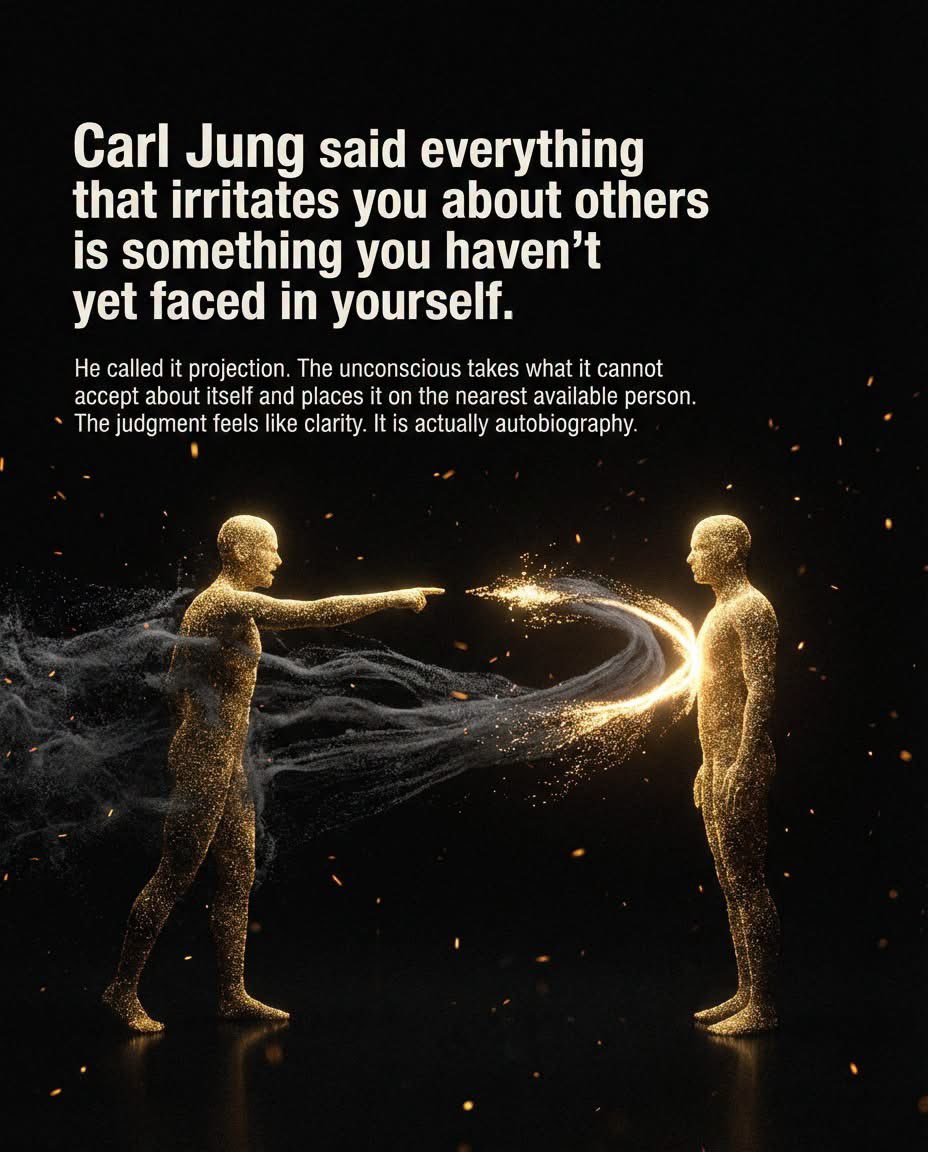
Jung called it projection and he was very specific about the mechanism. The human unconscious; the part of the mind operating below awareness cannot tolerate holding contradictions about itself. So when it encounters a quality it has suppressed, denied or refused to acknowledge, it does something very efficient: it outsources the recognition. It places the unacceptable quality onto someone else and then reacts to it there instead. The person who cannot acknowledge their own dishonesty becomes acutely sensitive to dishonesty in others. The person who has suppressed their own aggression becomes preoccupied with aggression around them. The person who secretly craves the attention they perform not wanting notices and criticizes attention-seeking in everyone nearby. Jung's argument wasn't that this means you're a bad person. His argument was that it's one of the most reliable self-diagnostic tools available. What irritates you most in other people not occasionally, but consistently, with a specific charge that feels personal is almost always pointing at something unresolved in yourself. He wrote: "Everything that irritates us about others can lead us to an understanding of ourselves." And honestly I think about this a lot. Because when the irritation has that specific heat to it, the kind that's disproportionate to what actually happened, that's the tell. That's the unconscious saying there's something here that belongs to you. The other person may genuinely have done something worth addressing. But the charge behind the reaction? That's yours. And it's pointing somewhere worth looking. ✨🙌🏾💫
🧬Maxpein🧬 tweet media
English
3
69
206
7.1K
NaturalAlly retweetledi
Thoughts Are Seeds
Thoughts Are Seeds@thoughtsRseeds·
Everything on earth is borrowed There is no "Mine or Yours." There is only "Ours." Even time is borrowed. We kill over a plot of land that belongs only to our Mother Earth. All you have is what you came with... and what you will leave with; Your Spirit. Native American Proverb
English
0
14
63
1.3K
NaturalAlly retweetledi
Dr Rudolf Steiner
Dr Rudolf Steiner@RudolfStein2026·
"Our epoch is directed to build the bridge to the kingdom in which the dead are living." — Rudolf Steiner Modern man believes death is separation. Steiner says the opposite: death only removes the physical veil. The relationship remains. He explains that the dead are not inactive or distant; they are present, conscious, and still in relation to us. But the medium changes. No longer through words or gestures, but through thought, memory, and inner life. What you think of the dead is not “in your head.” To them, it is experienced reality. To forget them is to dim the connection. To think of them consciously is to strengthen the bridge. Steiner even goes further: You can speak to the dead. You can read to them. You can help them. But only if your thinking becomes awake, intentional, and alive. This is one of our tasks: Not to remain bound to the visible world, but to develop a consciousness capable of communion across the threshold. The ancient world feared death. The modern world denies it. But the future human being will collaborate with the dead. Not as memory, but as living spiritual relationship.
Dr Rudolf Steiner tweet media
English
7
49
172
4.9K