Neeraj K. Agrawal
77.5K posts

Neeraj K. Agrawal
@NeerajKA
comms @coincenter—the cryptocurrency policy think tank | [email protected] | food account/retirement pasture: @neerajkafood


Should code ever lose First Amendment protections? This podcast covers free speech and software, including cryptography, cryptocurrency and AI. It should be the internet's most comprehensive. You'll hear from experts like @valkenburgh, @prestonjbyrne, @LazPieper, Sam Enzer, and Professors Eugene Volokh (@VolokhC) and @JaneYakowitz. We trace the history of Cold War export controls through to the recent restrictions on Anthropic's AI models, and explain why the Supreme Court has never definitively answered the question above. Timestamps: 0:00 Anthropic AI export controls 6:17 Intro 9:39 The First Amendment 10:38 @VolokhC on his free speech philosophy 13:42 Speech vs function 19:24 @valkenburgh interview 25:50 The Cold War, munitions list and Phil Zimmermann 29:57 The Bernstein case 34:53 Strict scrutiny 38:48 The Corley case 49:17 Sorrell, Stevens and where the Supreme Court is heading 53:25 @prestonjbyrne on the Supreme Court's AI case 57:23 Defense Distributed and 3D-printing 1:04:00 Where publication ends and conduct begins 1:15:20 Lowe v. SEC and the agency line 1:45:45 Compelled speech 2:04:17 @LazPieper on Sorrell and third-party liability 2:11:29 @prestonjbyrne on the GRANITE Act and foreign censorship Thank you to the presenting sponsor of this episode, @altitude. Nothing in this podcast is legal or investment advice.

2026 version of "blockchain not bitcoin": I like tokenization and stablecoins, but I still don't see how Ethereum, Solana, etc are useful.


The beer lobby knows beer is your friend


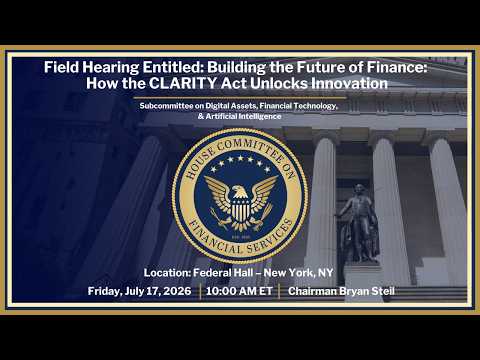
Coin Center's Director of Policy, Jason Somensatto, will testify today before the House Financial Services Committee, marking one year since the House passed the CLARITY Act (including the Blockchain Regulatory Certainty Act). Tune in—link to follow. Jason has worked on these regulatory questions from all angles since 2018: at the CFTC, in the private sector, and now at Coin Center. He understands better than almost anyone the importance—and the nuance—of clearly defining the line between trusted businesses and open innovation so that we protect investors without creating unnecessary barriers to speech, legitimate privacy interests, and innovation. This will be Jason's fourth congressional testimony since joining Coin Center last year. We're very fortunate to have his expertise and poise dedicated to our mission.

News in the PM edition: DOJ Criminal Division staff told Treasury this month that the latest version of DeFi liability protections could still make it more difficult to prosecute money laundering, imposing “a higher burden of proof” in proving specific intent

Coin Center has a new publication: Peer-to-Peer. We believe that open source, privacy protecting, and self sovereign tools are key to resisting tech authoritarianism. This is our vehicle for contextualizing our work in the larger tech policy world. p2p.coincenter.org/p/peer-to-peer…


Introducing Peer-to-Peer, a new publication from Coin Center. We will use this space to highlight reporting and commentary on tech authoritarianism, surveillance, censorship, and the people building ways out. We invite you to join us in this movement and to stay informed. p2p.coincenter.org/p/peer-to-peer…

Introducing Peer-to-Peer, a new publication from Coin Center. We will use this space to highlight reporting and commentary on tech authoritarianism, surveillance, censorship, and the people building ways out. We invite you to join us in this movement and to stay informed. p2p.coincenter.org/p/peer-to-peer…

Introducing Peer-to-Peer, a new publication from Coin Center. We will use this space to highlight reporting and commentary on tech authoritarianism, surveillance, censorship, and the people building ways out. We invite you to join us in this movement and to stay informed. p2p.coincenter.org/p/peer-to-peer…